Best WhatsApp Chatbots in 2026: 7 Platforms Compared
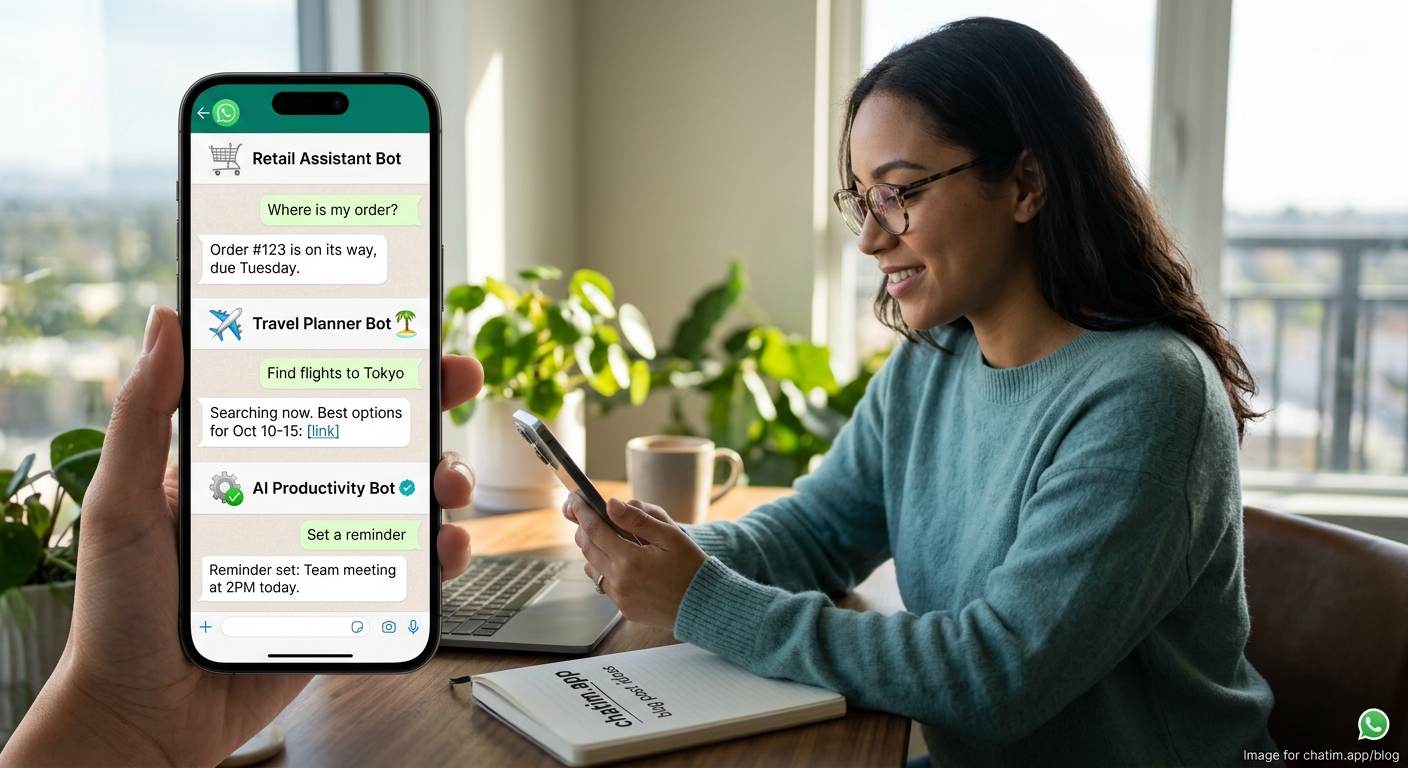
The best WhatsApp chatbots all sit on the same rails: Meta's WhatsApp Business Platform, the API that lets software send and receive messages on the world's busiest chat app. What you are actually choosing between platforms is everything around those rails: the flow builder, the broadcast tools, the inbox your team answers in, and a pricing model that behaves very differently for marketing than for support. This guide compares 7 platforms that genuinely run chatbots on WhatsApp, with pricing verified against vendor pages in July 2026, and closes with the question most guides skip: whether your business needs a WhatsApp bot at all, or just a way for customers to reach you there.
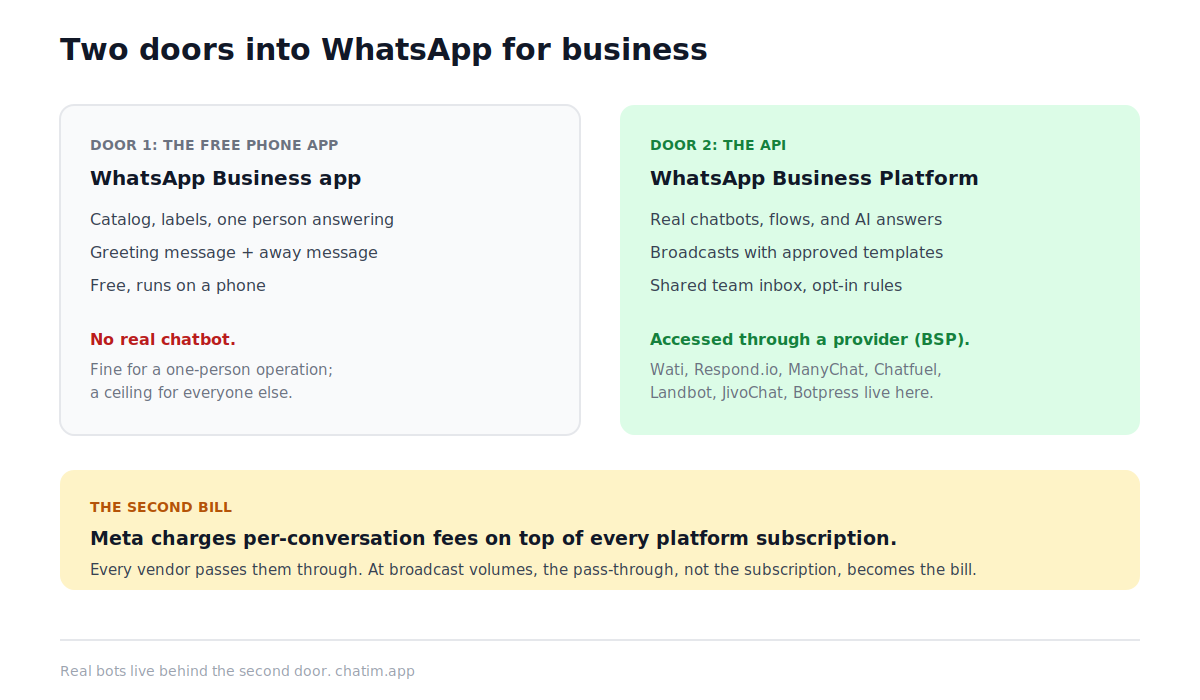
One cost fact upfront, because it surprises budgets: whichever platform you pick, Meta charges its own per-conversation fees on top of the subscription, passed through by every vendor. The platform fee is the visible cost; model both before committing.
How WhatsApp chatbots actually work
Meta offers businesses two very different doors into the channel. The free WhatsApp Business app is a phone app for small operations: a catalog, labels, and simple auto-replies (a greeting and an away message), but no real chatbot. Actual bots (flows, AI answers, broadcasts, team inboxes) require the WhatsApp Business Platform, the API, which businesses access through providers; several platforms below are official Business Solution Providers themselves, while others connect through one. Practical consequences follow: your number gets registered to the API (a dedicated or virtual number is the clean way to do it), customers must message you first or opt in before you can push messages to them, and template messages for outreach go through Meta approval. None of this is a reason to avoid the channel; it is the reason to pick a platform that handles the plumbing for you.
7 WhatsApp chatbot platforms compared
Annual-billing rates where vendors publish both; Meta's conversation fees apply on top of every row.
| Platform | Free plan | Paid entry | Channel depth | Best for |
|---|---|---|---|---|
| Wati | None (trial) | $59/mo (3 users) | Dedicated BSP | Broadcasts + bot + inbox |
| Respond.io | None (trial) | $79/mo | One lane of many channels | Multi-channel inboxes |
| ManyChat | 25 contacts, 2 channels | From $29/mo (Pro tier) | Add-on channel | Instagram-led marketing |
| Chatfuel | Included in free Light plan | AI PRO $49/mo | Core channel | Free entry into WhatsApp automation |
| Landbot | 100 web chats/mo | Dedicated plans from €160/mo | Dedicated WhatsApp plans | Visual WhatsApp flows |
| JivoChat | Up to 5 agents | $28/agent/mo + WhatsApp module $27/mo | Module on a chat suite | Adding the channel to website chat |
| Botpress | Capped free tier | See vendor pricing page | Channel on paid tiers | Developer-grade custom bots |
WhatsApp-first platforms
1. Wati: the dedicated WhatsApp operation in a box
Wati is what WhatsApp-first looks like: an official Business Solution Provider selling broadcasts, a no-code chatbot builder, and a shared team inbox as one package, starting at $59/month billed annually for 3 users, with higher tiers adding seats and features (and per-extra-user pricing published openly). Because WhatsApp is the whole product rather than a channel among many, the channel-specific details (template approvals, opt-in management, broadcast segmentation) are first-class features instead of afterthoughts. The fit: businesses whose customer conversations already live on the app (retail, services, education across much of Asia, Africa, and Latin America) and who want campaigns plus support in one tool. No free plan; a short trial instead.
2. Respond.io: WhatsApp as one lane of a wider highway
Respond.io treats WhatsApp as the anchor channel of a multi-channel inbox that also speaks Messenger, Instagram, Telegram, and more, priced from $79/month billed annually and scaling by monthly active contacts, with AI features included from the mid tier up. The contact-based meter suits teams whose customers return across channels, since one person counts once however many apps they message from. It costs more at entry than Wati, and earns the difference only if you genuinely run several channels; for the single channel, the dedicated players are leaner.
Marketing suites where WhatsApp is a channel
3. ManyChat: WhatsApp bolted onto the Instagram machine
ManyChat's center of gravity is Instagram and Messenger automation, and WhatsApp arrives on the Pro tier at $29/month, with Meta's per-conversation fees passed through transparently. The reason to pick it here is precisely that you are already using it for Instagram: one flow builder, one contact list, comment-to-DM funnels that continue into WhatsApp. The reason not to is symmetrical, since single-channel businesses are paying for social tooling they will not use, and the contact-based meter rewards subscriber marketing over drive-by support traffic. Our ManyChat alternative guide maps the neighbors.
4. Chatfuel: the free door into WhatsApp automation
Chatfuel's permanently free Light plan includes WhatsApp automations alongside Instagram and Facebook, which makes it the cheapest legitimate way to run a real WhatsApp bot today, with usage limits and a single paid tier (AI PRO, $49/month) above it. A Meta and WhatsApp partner, it suits small businesses that want to automate replies and simple flows on the channel without a subscription, and its ceiling (two plans, no gradual ladder) is the trade. The field around it is in our Chatfuel alternatives guide.
Flow builders and developer platforms
5. Landbot: visual flows for the channel, priced in euros
Landbot brings its pleasant drag-and-drop flow builder to the channel through dedicated WhatsApp plans, from €200/month billed monthly (€160 annual) with their own quotas, separate from its cheaper website-chat tiers, so read the WhatsApp plan page specifically rather than the headline grid. The fit is structured, guided conversations (qualification, booking, surveys) where the visual builder shines; the price positions it for teams treating WhatsApp as a serious funnel rather than an experiment. Neighbors in our Landbot alternatives guide.
6. JivoChat: adding WhatsApp to a website chat suite
JivoChat approaches from the opposite direction: it is website live chat first (free up to 5 agents, paid from $28/agent/month billed annually), and WhatsApp joins as a $27/month module feeding the same inbox. There is no deep bot builder for the channel here; the value is consolidation, with website chats, calls, and WhatsApp messages answered by one team in one pane. Fit: teams that already want a chat suite and need presence there more than automation. See our JivoChat alternatives guide for the field.
7. Botpress: developer-grade bots that happen to speak WhatsApp
Botpress earns the last slot for teams whose WhatsApp bot is really a product: custom logic, custom LLM integrations, and self-hosting of its open-source core for data-residency needs, with the channel available on its hosted paid tiers. Its cloud pricing moved to conversation-based plans in 2026 and has shifted since, so check the vendor's pricing page directly rather than trusting third-party roundups. The trade is the honest one: maximum control, meaningful engineering time.
Which WhatsApp chatbot fits
Take Wati when WhatsApp is your main street and you want broadcasts, bot, and inbox from one WhatsApp-first vendor. Take Respond.io when WhatsApp anchors a genuinely multi-channel operation. Take ManyChat when Instagram is the engine and WhatsApp extends it, and Chatfuel when you want a real WhatsApp bot for free. Take Landbot when guided visual flows are the product, JivoChat when you mainly need the channel folded into website chat, and Botpress when engineers are building something the others cannot express. Then re-check the math with Meta's conversation fees included, because at broadcast volumes the pass-through fees, not the subscription, become the bill.
Do you need a WhatsApp chatbot at all?
A large share of businesses shopping this category need something simpler: not a bot that converses there, but a frictionless way for website visitors to start a WhatsApp conversation a human answers. That path is free and takes minutes: our WhatsApp link generator creates a click-to-chat link with a pre-filled message, and a WhatsApp button on your website puts it in the corner of every page. Full disclosure on where we stand: Chatim, the product behind this blog, is not a WhatsApp chatbot platform and does not belong in the list above; what it does is connect your website to the channels your customers use, WhatsApp included, with a ready-made WhatsApp flow template for routing visitors there. If your volume grows to where automated answering inside the app pays for itself, the seven platforms above are the honest shortlist, and the bot-versus-human division of labor in our live chat vs chatbot guide applies on WhatsApp exactly as it does on your website.
More on this from our team: the AI chatbot guide, auto-reply message samples, and what a chatbot is.
Frequently Asked Questions
What is a WhatsApp chatbot?
Software that answers and sends WhatsApp messages automatically on a business number: greeting customers, answering repeat questions, running guided flows, and handing conversations to a human team. Real bots run on Meta's WhatsApp Business Platform (the API), not on the free WhatsApp Business phone app.
What is the best WhatsApp chatbot platform?
Depends on the job. Wati leads for WhatsApp-first businesses wanting broadcasts, a bot, and a team inbox in one tool. Respond.io fits multi-channel operations, ManyChat extends Instagram marketing into WhatsApp, Chatfuel is the strongest free entry, Landbot excels at visual guided flows, and Botpress serves developer teams building custom bots.
Is there a free WhatsApp chatbot?
Chatfuel's Light plan is the most complete genuinely free option, covering WhatsApp automations with usage limits. The WhatsApp Business phone app is also free but only offers simple auto-replies, not a real bot. Most other platforms start with trials rather than free tiers, and Meta's conversation fees apply to API traffic regardless of platform.
What is the difference between the WhatsApp Business app and the API?
The free phone app suits one person answering manually: it has a catalog, labels, and basic greeting and away messages. The Business Platform (API) is what chatbots, broadcasts, and shared team inboxes require, and it is accessed through provider platforms rather than an app. Growing past one phone in hand usually means moving to the API.
Do I need a Business Solution Provider to run a WhatsApp bot?
In practice yes: the API is accessed through providers, and several platforms in this guide are official BSPs themselves, which means they handle number registration, template approvals, and billing for you. Choosing a platform that is its own BSP removes a party from the chain.
How much does a WhatsApp chatbot cost?
Two bills, always. Platform subscriptions as of July 2026 range from Chatfuel's free tier through roughly $29 to $79 per month at entry for most platforms, with dedicated WhatsApp plans higher. On top, Meta charges its own per-conversation fees, passed through by every vendor, which at broadcast volumes can exceed the subscription. Verify both on the vendor's page and Meta's current rate card.
Can customers message my WhatsApp bot first, or can I message them?
Both, with different rules. Inbound is open: anyone can message your business number. Outbound requires opt-in, and messages sent outside the service window use pre-approved template messages that Meta reviews. Platforms in this guide manage the templates and approvals for you.
Do I need a separate phone number for a WhatsApp chatbot?
You need a number dedicated to the API: once registered, it cannot simultaneously run the consumer or Business app. Many businesses register a dedicated or virtual number for the bot and keep their existing line untouched, which also keeps personal and automated traffic cleanly separated.
Can a WhatsApp chatbot do marketing broadcasts?
Yes, and it is where WhatsApp-first platforms like Wati concentrate: segmented broadcast campaigns to opted-in contacts using approved templates. Respect the opt-in rule not just for policy reasons but for practical ones, since blocked and reported numbers lose sending quality ratings.
Can I use a WhatsApp chatbot for customer support?
That pairing works well: the bot answers repeat questions and collects details, then hands the conversation to a shared team inbox with context attached. The division of labor is the same as on website chat: predictable questions to the bot, judgment calls to humans, with a visible path between them.
Do I need a WhatsApp chatbot or just a WhatsApp button on my site?
If your goal is letting website visitors reach a human on WhatsApp, you do not need a bot platform at all: a free click-to-chat link or website button does it in minutes. A bot earns its subscription when conversation volume makes automated answering and broadcasts pay for themselves.
Do WhatsApp chatbots support AI answers?
Increasingly, yes: Chatfuel's paid tier is AI-centered, Wati and Respond.io include AI features by plan, and developer platforms like Botpress connect the model of your choice. The same guardrails apply as anywhere: train on your own content, review transcripts, and keep the human handoff visible.
Which countries use WhatsApp business messaging most?
Adoption is strongest across Latin America, India and South Asia, Africa, and Southern Europe, where WhatsApp is the default way to message a business. If your customers are there, the channel is less an experiment and more table stakes; in North America, email and website chat still carry more of the load.
Related articles
More in Chatbots & AI → Facebook Messenger Chatbot: The 2026 Guide + 5 Platforms
How Messenger chatbots work now: comment-to-DM automation, click-to-Messenger ads, 5 platforms compared, and when a contact button is enough.
 Chatbot Templates: 26 Free, Ready-to-Use Flows (2026)
26 free chatbot templates organized by goal and industry, what a good template contains, and the five edits that turn a ready-made flow into your own bot.
 Best Chatbot Platforms in 2026: 10 Builders Compared
10 chatbot platforms compared by what their pricing actually meters, with free plans, AI features, and a pick for each use case
 How to Build an AI Chatbot Without Writing Code (2026)
How to build an AI chatbot step by step: pick an approach, prepare your content, train the bot, set guardrails, test it, and launch it in a day.