Best Chatbot Platforms in 2026: 10 Builders Compared
Every list of the best chatbot platforms starts with the same lie of omission: that they are comparable products. They are not. One platform bills you per contact, another per conversation, another per AI resolution, and a fourth per seat, which means the same bot serving the same customers can cost triple on the wrong platform and nothing on the right one. So this guide compares 11 chatbot platforms the way you will actually experience them: by what the meter counts, what the free plan really includes, and which builder fits which job. All pricing below reflects vendor pages as verified in July 2026, and the fastest way to future-proof any figure is to check the vendor's own pricing page before you commit.
One framing note before the list: a chatbot platform is the system you build and run bots on (the editor, the channels, the analytics, the handoff). If you are still deciding whether a bot belongs on your site at all, start with what a chatbot is and come back.
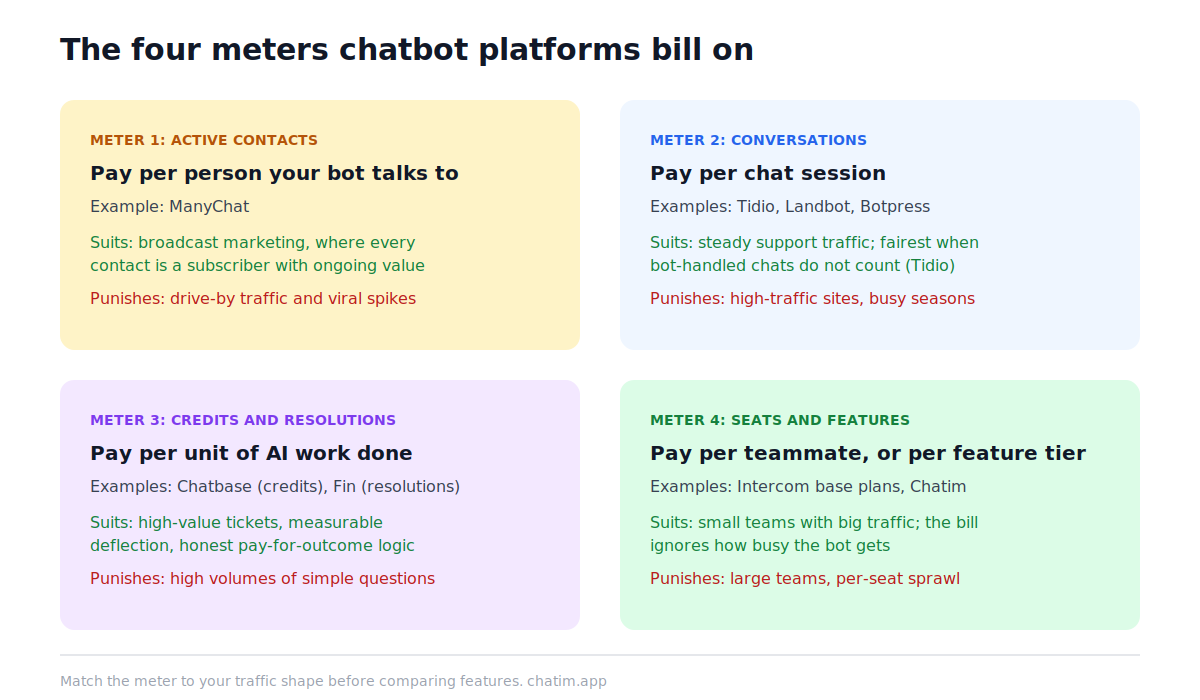
The four meters chatbot platforms bill on
Contacts: platforms like ManyChat count every person your bot has talked to this billing period, which suits broadcast-style marketing where each contact has ongoing value. Conversations: Tidio, Landbot, and Botpress count chat sessions, which suits support traffic where most visitors come once. Credits and resolutions: AI-first platforms count work done, either message credits spent (Chatbase), support tasks handled (eesel AI), or issues the AI actually resolved (Fin), which reads fair but makes bills scale with your busiest weeks. Seats: classic per-agent pricing, which only bites when your team grows. None of these is wrong, but each punishes a different usage shape, and the most expensive mistake in this market is putting a high-traffic support bot on a per-conversation meter or a small team on a per-seat enterprise plan.
11 chatbot platforms compared
Annual-billing rates where vendors publish both; details and caveats in each section below.
| Platform | Best for | Free plan | Paid entry | The meter |
|---|---|---|---|---|
| Chatim | Website bot + live chat on one widget | Unlimited chats, chatbot flows | From $9/mo | Team access and features |
| Tidio | SMB support with optional AI | 50 billable conversations/mo | From $24.17/mo | Conversations (human replies) |
| eesel AI | AI support alongside an existing helpdesk | $50 trial credit; no permanent free plan | $0.40 per ticket or chat session | Tasks handled, regardless of outcome |
| ManyChat | Instagram + Messenger marketing | 25 active contacts | From $14/mo | Active contacts |
| Chatfuel | Free social automation | Chatfuel Light, permanent | AI PRO $49/mo | Usage limits by plan |
| Chatbase | AI agent trained on your content | 50 message credits/mo | From $32/mo | Message credits |
| Intercom (Fin) | AI resolutions at helpdesk scale | None (14-day trial) | $29/seat/mo + $0.99/resolution | Seats + resolutions |
| Landbot | No-code visual flows | 100 chats/mo | From €32/mo | Chats |
| Collect.chat | Conversational forms | 100 responses/mo | From $14/mo | Responses |
| Botpress | Developer control, self-hosting | Capped free tier; open source | See vendor pricing page | Conversations |
| Voiceflow | Designing complex AI agents | See vendor pricing page | See vendor pricing page | See vendor pricing page |
Website-first platforms with live chat built in
1. Chatim: chatbot flows and live chat on one free plan
Full disclosure: Chatim is built by the team behind this blog, so judge this entry with that in mind. We put it first because of where the free plan draws its line: automation is included, not withheld. The free plan ships unlimited live chat conversations, rule-based flows built in the visual chatbot builder, and a multi-channel contact button, with no credit card and no conversation cap; a gallery of ready-made chatbot templates covers the common jobs from lead capture to booking. The meter is team access and features rather than traffic: paid plans start at $9/month, and Chatim AI conversations start on paid tiers, with every limit listed on the pricing page. The shape fits small teams that want one widget doing both jobs, a bot covering nights and a human taking over days, without a per-conversation bill that grows with success.
2. Tidio: conversation-capped plans plus Lyro AI
Tidio pairs a live chat inbox with flow automation and its Lyro AI agent, and its meter has an unusually fair definition: a billable conversation is one where a human agent replies, while bot-handled, spam, and unanswered chats are free. The free plan covers 50 billable conversations a month with 10 seats included; paid plans start at $24.17/month billed annually, and Lyro starts at $32.50/month for 50 AI conversations with the first 50 free. The catch to model before committing is growth: busy support traffic burns through conversation quotas quickly, and the upper tiers are custom-priced. Our Tidio alternatives guide covers the escape routes if the meter stops fitting.
AI support layered on an existing helpdesk
3. eesel AI: support automation on a per-task model
eesel AI suits teams that want AI support without replacing their existing helpdesk. It learns from past tickets, help articles, and connected company knowledge to answer questions, draft replies, triage requests, and escalate cases to a human. Teams can test it on historical tickets and start with reviewed drafts before enabling automatic responses. The billing unit is a task: one support ticket or chat session costs $0.40, including the messages within it. Standard pricing has no platform fee, per-seat fee, or monthly minimum, and new accounts receive $50 in free usage. The trade-off is that tasks are billed regardless of outcome, and an existing helpdesk subscription remains a separate cost. It fits teams comparing support automation tools that work with their current systems, rather than teams looking only for a visual flow builder.
Social and messaging automation
4. ManyChat: Instagram and Messenger on a contact meter
For comment-to-DM automation, story replies, and drip sequences on Instagram and Messenger, ManyChat is the category default, and its March 2026 repricing made the ladder clearer: free covers 25 active contacts on 2 channels, Essential starts at $14/month, and Pro at $29/month adds WhatsApp or SMS. The meter is active contacts, anyone the bot exchanged messages with in the billing period, which rewards broadcast marketing (each contact is a subscriber with ongoing value) and punishes drive-by traffic. Worth knowing: the free tier is genuinely a trial-sized 25 contacts, not the generous free plan it once was, and AI features are a paid add-on. If the contact meter or channel focus does not fit, our ManyChat alternative guide maps the options.
5. Chatfuel: the permanently free Light plan
Chatfuel spent 2026 simplifying into exactly two offers: Chatfuel Light, a permanently free plan covering Instagram, Facebook, and WhatsApp automations with a shared inbox and flow builder, and AI PRO at $49/month as the single self-serve paid tier. That makes Light the strongest genuinely-free entry point in social automation right now, with the honest caveat that usage limits apply and the ceiling is one paid plan rather than a ladder you can climb gradually. A Meta and WhatsApp partner, it fits businesses that live in DMs and want automation without a subscription until AI features justify one. The Chatfuel alternatives post covers where teams go when they outgrow the two-plan structure.
AI agents trained on your own content
This category also includes quote-only enterprise players like Ada, where every price is a conversation with sales; the two below publish their numbers.
6. Chatbase: credit-metered AI agents
Chatbase is the fastest path from "here is my help center" to a working AI agent: point it at your content, and the bot answers in your voice with advanced models from OpenAI, Anthropic, and others on paid tiers. The free plan is an evaluation sandbox (50 message credits a month, and idle agents are deleted after 14 days of inactivity), with paid plans from $32/month billed annually. The meter is message credits, and the fine print is where budgets go to die: each plan includes one AI agent with extra agents billed separately, and branding removal is a paid add-on. Model the credit math against your traffic before committing; our Chatbase alternatives guide lists the neighbors if the numbers do not work.
7. Intercom (now Fin): pay for resolutions, not conversations
Intercom renamed itself Fin in May 2026 after its AI agent, and Salesforce has agreed to acquire the company in a deal that had not closed as of July 2026, worth factoring into a long-term platform bet. The pricing is two meters stacked: helpdesk seats from $29/seat/month annually, plus Fin AI at $0.99 per successful resolution with a 50-outcome monthly minimum. Pay-per-resolution is the most honest AI meter on this list (you pay when the bot actually solves something), and also the one that scales fastest with volume, so the math rewards teams with high-value tickets rather than high-volume simple ones. There is no free plan, only a 14-day trial. For the seat-based half of the equation, our Intercom alternatives guide covers the field.
Visual flow builders and forms
8. Landbot: no-code flows, priced in euros
Landbot builds the kind of guided, button-driven conversations that feel like a friendly form: strong for lead qualification, surveys, and WhatsApp flows, all assembled in a genuinely pleasant visual editor. Pricing now displays in euros: the free Sandbox covers 100 chats a month, and paid plans start at €32/month billed annually (€40 monthly) for 500 chats including 100 AI chats. The meter is chats, and the WhatsApp-specific plans carry their own quotas, so read the plan page that matches your channel rather than the headline grid. Fit check and neighbors are in our Landbot alternatives guide.
9. Collect.chat: conversational forms on a response meter
Collect.chat occupies a narrower niche deliberately: it replaces static forms with chat-style question flows, and it charges by completed responses rather than traffic. The 2026 repricing moved in the customer's favor: free now covers 100 responses a month, the Lite plan dropped to $14/month billed yearly, and the $29 Standard tier removed the response cap entirely. There is no trial, but paid plans carry a 30-day money-back guarantee. If your bot's whole job is capturing structured answers (bookings, quotes, applications), paying per response is the rare meter that maps exactly to value received.
Developer and open-source options
10. Botpress: developer control, with self-hosting as the exit
Botpress is where teams land when they need what hosted platforms will not give: deep customization, custom LLM integrations, or data residency via self-hosting the open-source core on their own infrastructure. The hosted cloud moved to conversation-based plans in May 2026 and the lineup has shifted more than once since, with a free tier carrying a monthly conversation cap; treat any specific figure you find in third-party roundups as stale and check the vendor's pricing page directly. The honest trade is engineering time for control: self-hosting is free in license fees and expensive in attention. It earns its place on this list as the platform you graduate to, not start on.
11. Voiceflow: design-first agent building
Voiceflow approaches the problem from the design side: it is the tool teams use to map, prototype, and ship complex AI agent conversations, with collaboration features closer to a design tool than a chat widget. It advertises multi-channel deployment and developer-friendly APIs, and it publishes its plan tiers on its own site, which is where to check them since we have not independently verified its pricing. It suits product teams building conversation experiences as a core feature, which is a different job than dropping a support bot on a website, and that difference is exactly why it rounds out this list.
Which chatbot platform fits your situation
Take Chatim if you want one free widget doing chatbot flows and live chat on your website, and the option to add AI later without switching platforms. Take Tidio if you want an SMB support suite where bot-handled chats stay free. Take eesel AI if you are keeping your current helpdesk and want AI drafting and triage on top of it, billed per ticket. Take ManyChat if your business happens on Instagram, or Chatfuel if it does and you need free to stay free. Take Chatbase if "train an AI on my docs this afternoon" is the whole requirement, and Fin if you are an established support org ready to pay per solved ticket. Take Landbot or Collect.chat when the bot is really a beautiful form. Take Botpress when your engineers have opinions, and Voiceflow when conversation design is the product. And whichever way you lean, decide with the meter, not the feature grid: chatbot builders converge on features, but a mismatched meter compounds every month.
After the pick: flows first, AI second
The pattern that works on every chatbot platform above is the same one we recommend everywhere: launch a small rule-based flow for your predictable conversations, read the transcripts, then add an AI chatbot for the open-ended questions the flow cannot branch around, a path covered step by step in how to build an AI chatbot. Whether the investment pays is a math question, not a faith question, and the chatbot ROI framework (with the free calculator inside it) turns your traffic and ticket numbers into an answer before you spend a dollar.
More on this from our team: live chat vs chatbot, chatbot vs AI agent, and the best live chat software.
Frequently Asked Questions
What is a chatbot platform?
The system you build and run bots on: the flow or AI editor, the channels it deploys to (website, Instagram, WhatsApp), the analytics, and the handoff to humans. It is distinct from the bot itself, which is just one thing you build on it, and switching platforms later usually means rebuilding flows.
Which chatbot platform is best overall?
There is no best overall, only a best fit for your traffic shape and channel. Website support with a small team points to Chatim or Tidio, Instagram marketing points to ManyChat or Chatfuel, training an AI on your docs points to Chatbase, and enterprise resolution volume points to Fin. Decide with the pricing meter first, features second.
What is the best free chatbot platform?
Depends on the channel. For a website bot, Chatim's free plan includes unlimited chats and chatbot flows with no conversation cap. For social automation, Chatfuel Light is permanently free across Instagram, Facebook, and WhatsApp. Most other free tiers are evaluation-sized: 25 contacts on ManyChat, 50 message credits on Chatbase, 100 chats on Landbot.
How much does a chatbot platform cost?
As of July 2026, self-serve entry plans cluster between $9 and $49 per month, with AI features often priced separately: Lyro from $32.50 on Tidio, $0.99 per resolution on Fin, credit packs on Chatbase. Enterprise and quote-only vendors publish no numbers. Always verify on the vendor's pricing page, since several platforms repriced during 2026.
What does a pricing meter mean, and why does it matter?
The meter is the unit the platform counts to bill you: active contacts, conversations, message credits, AI resolutions, or team seats. It matters more than the sticker price because it decides how your bill grows. High-traffic support on a per-conversation meter gets expensive fast, while a per-seat plan barely notices traffic.
Which chatbot platform is best for Instagram?
ManyChat is the category default for comment-to-DM automation, story replies, and drip campaigns, with Chatfuel as the strongest free alternative. Both are Meta partners. The trade-off is the meter: ManyChat counts active contacts, so a viral post that floods your bot with new people raises the bill.
Which chatbot platform works with WhatsApp?
Several, at different depths: ManyChat adds WhatsApp on its Pro tier, Chatfuel includes it in the free Light plan, and Landbot sells dedicated WhatsApp plans with their own quotas. WhatsApp-first businesses with broadcast needs should also look at dedicated WhatsApp platforms, since per-conversation fees from Meta apply on top of any platform's subscription.
Do I need to know how to code to use a chatbot platform?
Not for most of this list. Chatim, Tidio, ManyChat, Chatfuel, Chatbase, Landbot, and Collect.chat are built around visual editors and templates. Code becomes relevant at the developer end: Botpress rewards engineering time with control and self-hosting, and Voiceflow sits between design tool and developer platform.
What is the difference between a chatbot platform and live chat software?
Live chat software connects visitors to humans in real time; a chatbot platform automates conversations without a human present. The categories have merged in practice, and most teams need both halves: a bot for predictable questions and off-hours, humans for everything else, ideally in one widget so the handoff is seamless.
Are AI chatbot platforms worth paying for?
When the math works. An AI agent trained on your content typically resolves a meaningful share of repetitive questions, so the test is whether the subscription and usage fees cost less than the agent time saved. Run your own traffic and ticket numbers through an ROI calculation before committing to per-resolution or credit-based pricing.
Can I switch chatbot platforms later?
Yes, but flows rarely transfer: each platform has its own editor format, so switching means rebuilding conversations and re-verifying integrations. Contact lists and transcripts usually export. That switching cost is a reason to start on a free plan that can grow, and to keep your bot's knowledge source (FAQ pages, help docs) outside the platform.
What happened to Intercom?
The company renamed itself Fin in May 2026, after its AI agent, while keeping the Intercom product name and domain in use. Salesforce agreed to acquire the company in June 2026, with the deal still pending as of July 2026. Pricing continues as helpdesk seats plus per-resolution AI fees.
Is there a fully open-source chatbot platform?
Botpress is the most complete option: the core is open source and can be self-hosted for free in license terms, with data residency and custom LLM integration as the payoff. Rasa is the other established name for conversational AI teams. The real cost of both is engineering attention rather than subscription fees.
Related articles
More in Chatbots & AI → Facebook Messenger Chatbot: The 2026 Guide + 5 Platforms
How Messenger chatbots work now: comment-to-DM automation, click-to-Messenger ads, 5 platforms compared, and when a contact button is enough.
 Chatbot Templates: 26 Free, Ready-to-Use Flows (2026)
26 free chatbot templates organized by goal and industry, what a good template contains, and the five edits that turn a ready-made flow into your own bot.
 Best WhatsApp Chatbots in 2026: 7 Platforms Compared
7 WhatsApp chatbot platforms compared, with both bills modeled: subscriptions and Meta fees. Plus the free path if you only need a WhatsApp button.
 How to Build an AI Chatbot Without Writing Code (2026)
How to build an AI chatbot step by step: pick an approach, prepare your content, train the bot, set guardrails, test it, and launch it in a day.