Chatbot vs AI Agent: Where the Line Actually Sits (2026)
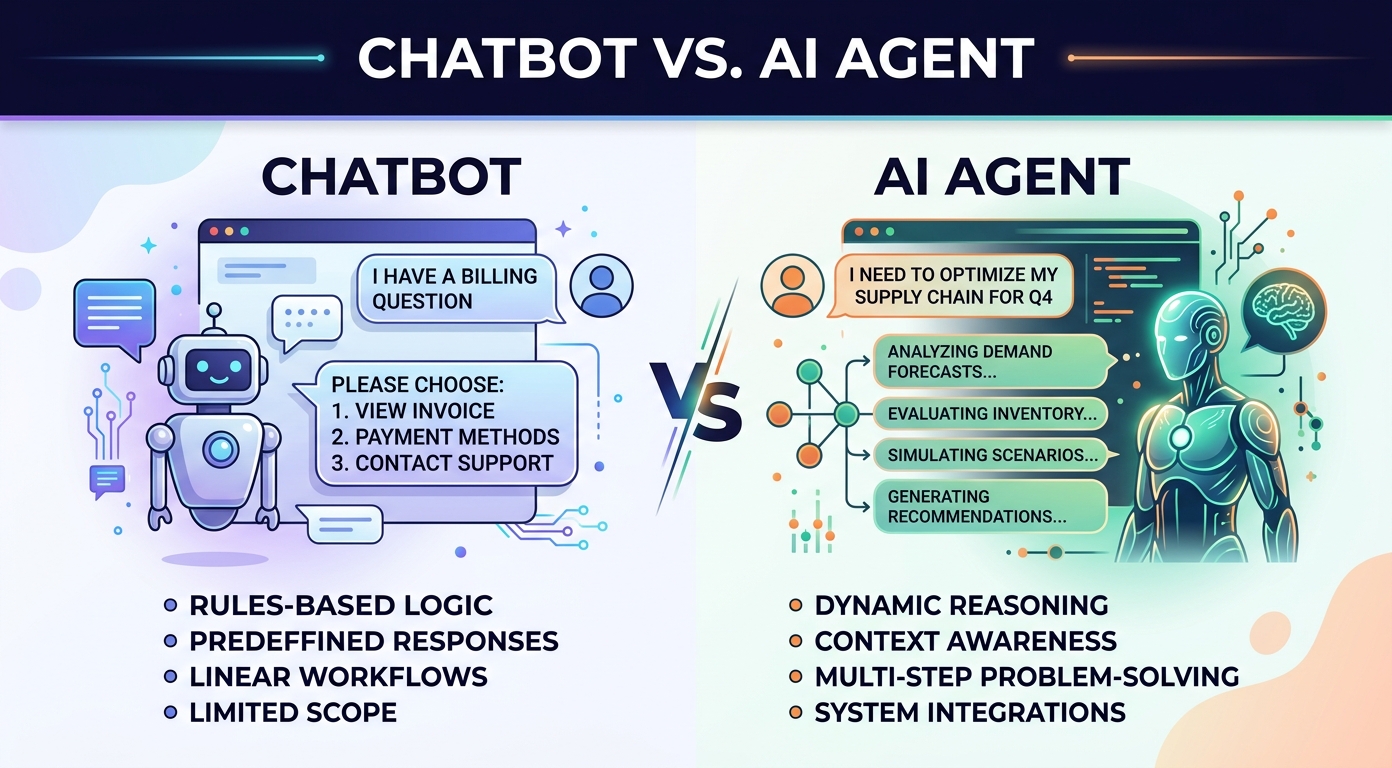
The difference between a chatbot and an AI agent comes down to one word: initiative. A chatbot converses; it answers the question in front of it and waits for the next one. An AI agent acts; given a goal, it plans steps, uses tools, and works toward an outcome, asking for input only when it needs one. The comparison of chatbot vs AI agent matters right now because vendors are renaming everything an agent, buyers are unsure what they are being sold, and the honest answer, as usual, sits on a spectrum rather than a fence.
This guide draws the line precisely, shows where it blurs in practice, and gives a working rule for how much autonomy a support or sales workflow should actually get.
What a chatbot means now
The word covers two generations. The scripted kind walks users through menus and fires pre-written replies; it still runs half the internet's widgets and is still the right tool for rigid, structured tasks. The modern kind is grounded conversational AI: it understands free-form questions and composes answers from content you control, typically your site and knowledge base, escalating to a human when unsure. Our chatbot guide covers both generations in depth. The important point for this comparison: even the modern kind is fundamentally reactive. It responds to what the user says, one turn at a time, and its worst-case failure is a wrong answer.
What an AI agent actually is
An agent adds three things on top of conversation. A goal: not "answer this question" but "resolve this refund request" or "get this meeting booked." Tools: the ability to look things up and change things in other systems, such as reading an order status, updating a subscription, or creating a ticket. And planning: deciding which steps to take, in which order, without a human scripting the sequence. That is why the failure modes differ in kind, not degree: a chatbot's mistake is a wrong sentence, while an agent's mistake is a wrong action, and wrong actions have consequences that outlive the conversation.
Chatbot vs AI agent at a glance
| Chatbot | AI agent | |
|---|---|---|
| Core job | Answer questions in conversation | Complete goals across systems |
| Initiative | Reactive, one turn at a time | Plans multi-step sequences |
| Reach | Your content | Your content plus your tools and systems |
| Worst-case failure | A wrong answer | A wrong action |
| Oversight needed | Guardrails on what it may say | Permissions on what it may do |
| Ready today for | Support answers, lead capture, FAQ | Narrow, reversible, well-logged tasks |
| Example | "Your plan includes three seats" | "I have upgraded you to five seats and prorated the invoice" |
Where the line blurs in practice
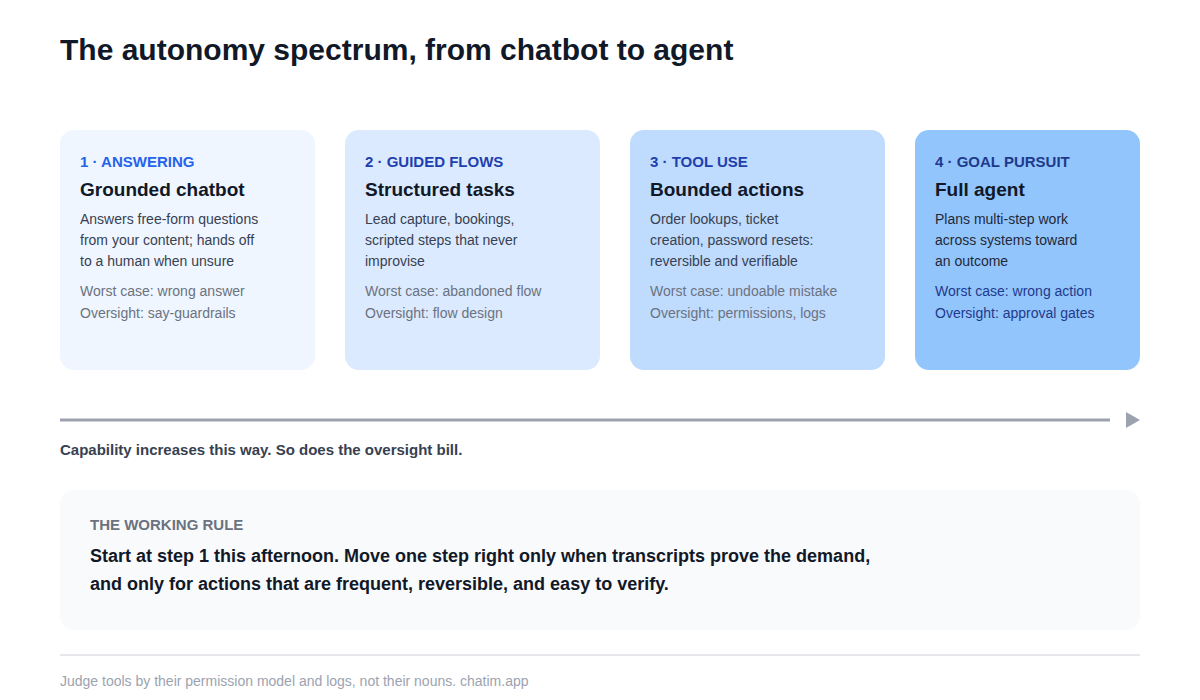
Most deployed systems already live between the poles. A chatbot with a booking flow performs an action. A bot wired to an order-status integration reads from another system. The moment your bot can create a ticket or update a record, it has a foot in agent territory, whatever the marketing calls it. The useful question is therefore not "is this an agent?" but "what exactly is it permitted to do, and what happens when it is wrong?" Renaming a chatbot an agent changes neither answer, and a surprising amount of the current agent conversation is exactly that renaming. Judge tools by their permission model and their logs, not their nouns.
Which one does your business need?
Sequence, not choice. Nearly every business should start with the conversational layer: a grounded bot answering real questions with a clean handoff to live chat. It delivers most of the value, carries the least risk, and its transcripts teach you exactly which actions are worth automating next. Add agency task by task from that evidence: the best first candidates are actions that are frequent, reversible, easy to verify, and bounded, such as sending a password reset, booking a meeting, or creating a properly tagged ticket. Each addition should clear three questions before it ships: what is the worst thing this action can do, who finds out when it happens, and how is it undone. Actions that are rare, irreversible, or high-stakes (refund exceptions, account deletion, anything legal) stay with humans, agent era or not. The pattern that wins is the same one that wins in customer support generally: automate facts first, then bounded actions, and keep judgment human.
Autonomy is a budget, not a switch
Whatever the tool is called, safe deployments ration autonomy the same way. Explicit permissions: the system can touch only the tools it was granted, with limits (amounts, counts, categories) enforced outside the conversation. Approval gates: consequential steps produce a proposed action a human confirms, until the log proves the proposal is always right. Full logging: every action traceable to the conversation that caused it. And reversibility bias: automate undoable things first, so early mistakes cost an apology rather than a customer. Teams that expand autonomy along that path get agent benefits without agent headlines.
What this means for support and sales teams
The near-term shape is not robots replacing teams; it is the queue changing texture. The conversational layer absorbs questions. Bounded agent actions absorb the clicking (the ticket creation, the booking, the status lookup) that used to surround every answer. What remains for people is what was always hardest to hire for anyway: judgment, exceptions, and relationships. Teams choosing tools now should weight the boring capabilities (grounding quality, handoff design, permission model, logs) over demo theater; our live chat software comparison evaluates the chat-plus-bot field on exactly those lines.
A sensible way to start
Start at the chatbot end of the spectrum this afternoon: ground a bot in your top twenty questions, wire the human handoff, and read transcripts for two weeks. The transcripts will nominate your first agent-style automation better than any roadmap session, and free tiers cover the whole experiment; paid plans earn consideration when the bot is demonstrably carrying volume. Whichever label wins the naming war, the businesses that benefit will be the ones that expanded autonomy at the speed of their own evidence, one bounded task at a time.
More on this from our team: AI chatbots, conversational AI, and live chat vs chatbot.
Frequently Asked Questions
What is the difference between a chatbot and an AI agent?
Initiative. A chatbot is reactive: it answers the question in front of it, one turn at a time, from content it was given. An agent is goal-directed: it plans steps, uses tools in other systems, and works toward an outcome like resolving a request or booking a meeting. The failure modes differ accordingly: a wrong answer versus a wrong action.
Is an AI agent just a rebranded chatbot?
Often, yes. A real agent has a permission model, tool access, and multi-step planning; a renamed chatbot has a new landing page. The test is concrete: ask what the system is permitted to do in other systems, what limits are enforced outside the conversation, and what the action log looks like. If the answers are thin, it is a chatbot wearing a lanyard.
What is agentic AI?
The umbrella term for systems that pursue goals with some independence: planning steps, calling tools, and adjusting as results come back. In business software it shows up as assistants that do things (update records, create tickets, book time) rather than only saying things.
What can an AI agent do that a chatbot cannot?
Cross the line from information to action: look up an order in another system, change a subscription, issue a bounded refund, create and route a ticket, book the meeting rather than linking a calendar. Anything that changes state outside the conversation is agent territory.
What are examples of AI agents in customer service?
A system that receives a cancellation request, checks the account's plan and history, applies the retention policy it was given, processes the correct change, and leaves a logged summary for the team. Narrower and more common: automated password resets, meeting booking, order-status lookups, and ticket creation with correct tags.
Do I need a chatbot or an AI agent?
In sequence, not competition: start with a grounded bot answering your real questions with human handoff, then add agency task by task where the evidence supports it. The transcripts from the conversational layer are the best roadmap for which actions to automate next.
Are AI agents safe for a small business to use?
Bounded ones, yes. Safety comes from rationing autonomy: explicit tool permissions with hard limits, approval gates on consequential steps, complete logs, and automating reversible actions first. An agent that can only do undoable, verifiable things is a productivity tool; one with broad permissions and no gates is a liability.
Can a chatbot become an agent over time?
That is the normal path. A bot gains a booking flow, then an order-status integration, then ticket creation, and each addition moves it along the autonomy spectrum. Platforms increasingly ship this as a progression, which lets a team expand capability without switching products.
What should never be delegated to an agent?
Actions that are rare, irreversible, or high-stakes: refund exceptions, account deletion, legal commitments, anything involving an upset customer's relationship with you. The rule of thumb holds across tools: automate facts first, then bounded actions, and keep judgment human.
How do AI agents actually work?
A language model handles the conversation and the planning; a tool layer exposes specific actions the system may call; a permission layer enforces what is allowed regardless of what the model decides; and a log records everything. The quality of that outer scaffolding, not the model, is what separates production systems from demos.
Will AI agents replace support teams?
They change the texture of the work rather than remove it: questions and routine clicking get absorbed, while judgment, exceptions, and relationships remain human. Teams that pair a grounded bot with bounded automations typically redeploy attention rather than reduce it.
How much does this cost to try?
The conversational starting point is typically free: free tiers cover a grounded bot, the widget, and handoff. Agent-style capabilities usually arrive with paid tiers and integrations. As always in this category, prefer predictable per-plan pricing over per-resolution metering, which charges you most when the system works best.
How should I evaluate tools that call themselves agents?
Ignore the noun and inspect four things: how answers are grounded in your content, how the human handoff works mid-conversation, what the permission model enforces outside the conversation, and what the action log shows. Tools strong on those four are safe to grow with, whatever they are called this quarter.
Related articles
More in Comparisons → Live Chat vs Chatbot: Which One Does Your Website Need?
Live chat vs chatbot in plain terms: what each does best, where each fails, and the bot-first, human-close handoff pattern that beats running either alone.
 Help Desk vs Service Desk: The Real Difference (2026)
Help desk vs service desk in one line: issue-fixing vs service lifecycle. The five differences that matter, why the terms blur, and which one you need.
 Zoho Desk vs Zendesk in 2026: The Price Gap, Examined
Zoho Desk vs Zendesk in 2026: included AI vs a quiet meter, and where Zendesk earns it
 Zoho Desk vs Freshdesk in 2026: Value Against Value
Zoho Desk vs Freshdesk in 2026: included AI vs a session meter, and the telephony math