What Is Conversational AI? A Plain-English Guide (2026)
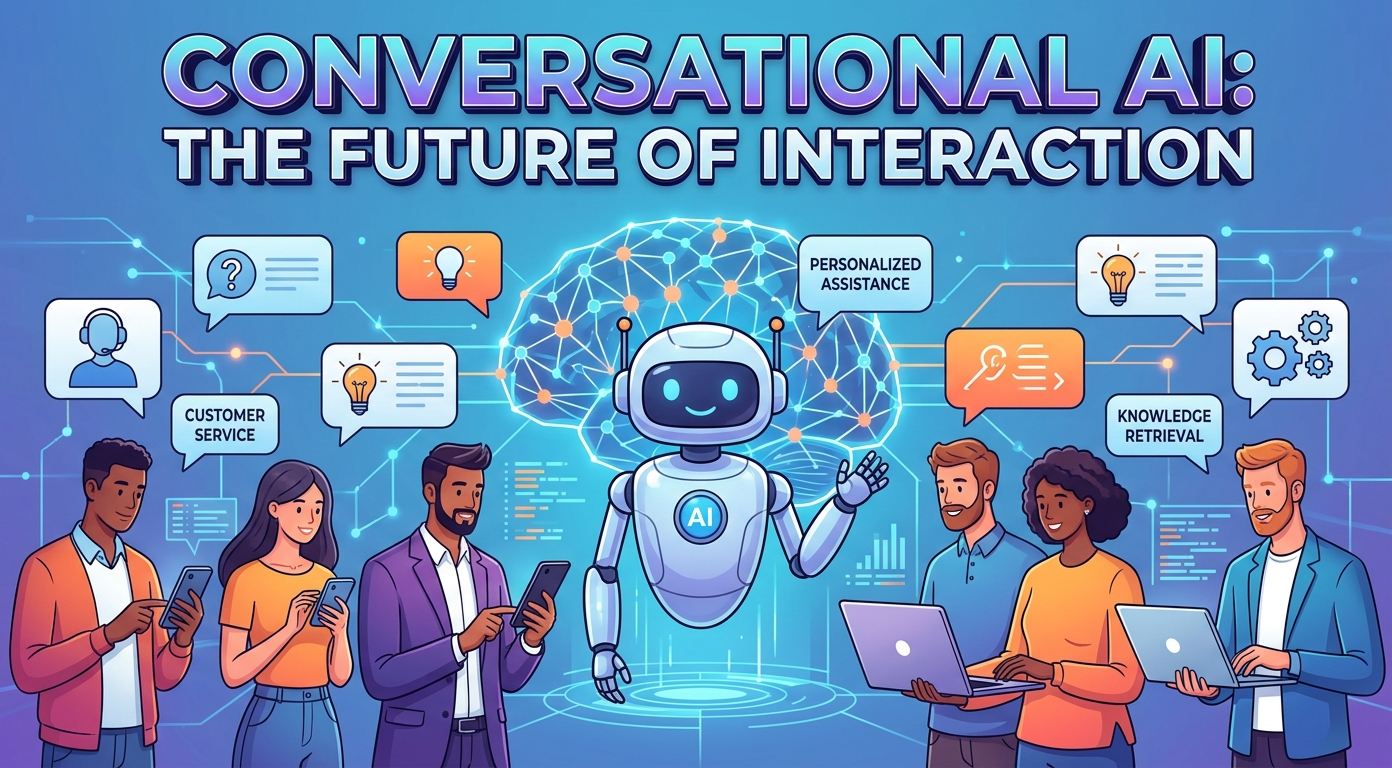
Conversational AI is the branch of artificial intelligence that lets software hold a natural back-and-forth with a person: understanding what was meant rather than just what was typed, responding in fluent language, and remembering the thread of the conversation. It is the capability underneath things you already use, from the support bot on a website to the assistant on a phone, and in the last few years it has jumped from clumsy to convincing. This guide explains what conversational AI actually is, how it works, how it differs from a chatbot, where businesses meet it, and how to put it to work without a data science team.
No background is assumed; where a term has a precise meaning, the guide gives it in plain English.
What is conversational AI?
A working definition: software that can conduct a conversation, not just react to commands. Three abilities separate conversation from command-response. Understanding: it interprets free-form language, including typos, slang, and phrasings nobody predicted. Generation: it composes replies in natural sentences instead of selecting from canned responses. And context: it remembers what was said three messages ago, so "how much does that cost?" refers to the plan you were just discussing, not to nothing.
The umbrella covers text and voice alike. A website support bot, an in-app assistant, a voice system that replaces the press-3-for-billing phone menu, and the drafting help inside a support inbox are all the same underlying capability wearing different interfaces.
How it works: the four components
Modern systems stack four components, and knowing them helps you judge any tool's claims.
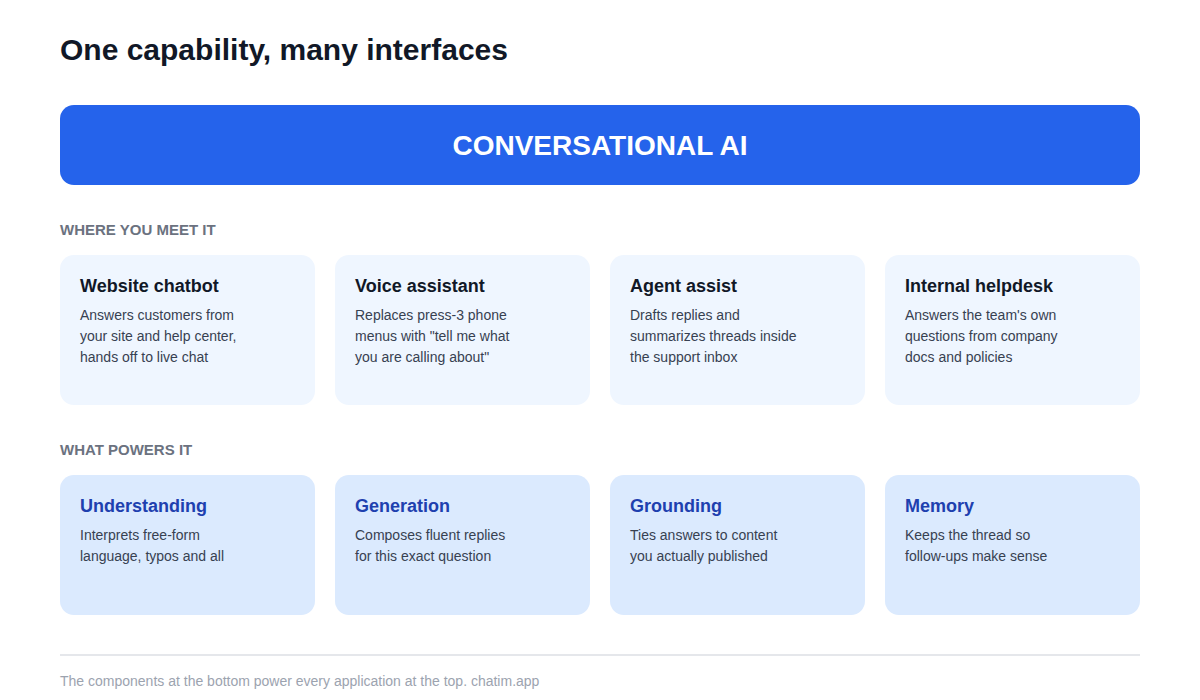
Understanding and generation
Large language models supply both halves of the conversation. They arrive already fluent, trained on broad language, which is why today's systems handle phrasing that older intent-matching bots dead-ended on. Fluency, though, is not knowledge: a raw model speaks beautifully about everything and reliably about nothing in particular, which is where the next component comes in.
Grounding and memory
Grounding ties the model's answers to a specific body of content, such as a company's help center and policies, so replies come from something the business actually published. In practice this is retrieval: find the relevant passages, then compose the answer from them. The quality of that content sets the ceiling, which is why a current, well-kept knowledge base quietly matters more than any model choice. Memory is the conversational thread itself, plus whatever durable context the system is allowed to keep between sessions.
Conversational AI vs chatbot: the difference
The two terms get used interchangeably, but the relationship is simple: a chatbot is an application; conversational AI is the capability. Older chatbots existed without any AI at all, walking users through scripted menus, and plenty of those still run today. Conversational AI is what upgraded the category: the same widget on the same website, now able to understand a free-form question and answer it from real content. Our chatbot guide covers the application side in depth, including the scripted kind and when scripted flows are still exactly right.
A second neighboring term, generative AI, is broader still: it names models that produce content of any kind (text, images, code). The conversational slice specializes in dialogue, wrapped with the grounding, memory, and guardrails that make dialogue useful in a business setting.
Where you meet it in a business
Customer-facing first: website and in-app support bots answering from company content, sales assistants qualifying visitors and booking meetings, and voice systems replacing rigid phone menus with a sentence: "tell me what you are calling about." Team-facing second: assist tools inside the support inbox drafting replies and summarizing threads, and internal helpdesks answering employees' questions from company docs. The same four components power all of it; what changes is who is talking and what content the system is grounded in. For most small businesses, the website support-and-sales bot is the first contact with the technology, and our customer support setup is where it usually lands.
What it changes for a business
Three shifts matter more than the demos. Availability: routine questions get answered at any hour, in the language the customer writes in, without anyone on call. Capacity: the repetitive half of a queue stops consuming human attention, and the humans move to conversations where judgment and empathy earn their keep. And insight: every conversation is a transcript, and mining transcripts for what customers actually ask is the cheapest user research most companies never do. None of these require replacing a team; the honest deployments augment one.
What it still cannot do
Fluency without limits is a liability, and the failures are predictable. Models can state wrong things confidently when asked beyond their grounding, which is why serious deployments restrict scope and escalate on low confidence instead of guessing. Judgment calls (refund exceptions, upset customers, anything with stakes) belong with people, assisted by the machine rather than replaced by it. And the technology inherits the quality of its content: pointed at stale docs, it recites stale answers fluently. Every one of these limits is manageable with configuration; none of them disappears by buying a better model.
How to adopt it without a data science team
The build-it-yourself era is over for mainstream uses. No-code platforms ship the four components assembled: you point the system at your content, set its scope and tone, wire the handoff to live chat, and test before launch. The practical adoption path is narrow and boring on purpose: start with your top twenty real questions, ground the system in accurate answers to them, launch scoped, and expand weekly from transcripts. Teams comparing platforms can start from our live chat software comparison, which covers the tools that bundle conversational AI with chat and a shared inbox.
A sensible starting point
Treat the first month as an experiment with a budget of one afternoon and zero dollars. Free tiers cover a grounded bot on your site with human handoff, which is enough to learn whether the technology earns a bigger role in your stack; paid plans can wait for the transcript volume that justifies them. The winners in this category are not the businesses that adopted the most impressive system; they are the ones that grounded a modest system in accurate content and read what their customers said back to it.
More on this from our team: AI chatbots, chatbot vs AI agent, and AI customer service.
Frequently Asked Questions
What is conversational AI?
It is the branch of artificial intelligence that lets software hold a natural conversation: understanding free-form language, generating fluent replies, and keeping the thread of context. It powers website chatbots, voice assistants, in-app helpers, and the drafting tools inside support inboxes.
What is the difference between conversational AI and a chatbot?
A chatbot is an application; conversational AI is the capability that can power it. Menu-driven chatbots exist with no AI at all, and conversational AI shows up in places that are not chatbots, like voice systems and agent-assist tools. When a chat widget understands free-form questions and answers from real content, that is the capability at work.
Is conversational AI the same as generative AI?
It is a slice of it. Generative AI names models that produce content of any kind: text, images, code. The conversational branch specializes in dialogue and adds what dialogue needs to be useful in business: grounding in specific content, memory of the thread, and guardrails on scope.
How does conversational AI work?
Four components stack: a language model supplies understanding and fluent generation; grounding ties answers to a specific body of content through retrieval; and memory keeps the conversational thread so follow-up questions make sense. Business systems add guardrails that decide when to answer and when to hand off to a person.
Are the popular AI assistants conversational AI?
Yes; general-purpose assistants are the most visible examples of the technology. The business versions differ in scoping rather than kind: they answer from a company's own content, follow its tone and topic rules, and escalate to the company's team, instead of speaking broadly about everything.
Does conversational AI work for voice as well as text?
Yes. Speech recognition converts the caller's words to text, the same understanding and grounding pipeline produces the answer, and speech synthesis reads it back. That is how press-3-for-billing phone menus are being replaced by systems that simply ask what you are calling about.
What are examples of conversational AI in customer service?
A website bot answering product and policy questions from the help center, an in-app assistant unblocking a stuck user, agent assist drafting replies and summarizing threads inside the inbox, and voice systems triaging phone calls. Most small businesses meet the technology first as a support-and-sales bot on their own site.
Does my business need conversational AI?
The honest test is your queue: if a meaningful share of questions are repetitive and answerable from content you could write down, the technology will pay for its setup time. If every conversation is a bespoke judgment call, start with better tooling for humans instead, and revisit when volume grows.
How accurate is it, and can it make things up?
Ungrounded models can state wrong things fluently, which is the technology's best-known failure. Business deployments manage it by grounding answers in retrieved company content, restricting scope, escalating on low confidence, and reviewing transcripts. Configured that way, the system declines or hands off instead of improvising.
How do I get started without machine learning expertise?
Use a no-code platform that ships the components assembled. The work that remains is editorial, not technical: write accurate answers to your top real questions, point the system at them plus your site, set scope and handoff, test adversarially, and expand from transcripts. The first working version is an afternoon.
What does it cost for a small business?
Entry is typically free: free tiers in the chat category include a grounded bot, the website widget, and basic handoff. Paid plans scale with team seats and automation depth. Watch the pricing meter more than the sticker: per-conversation pricing grows the bill exactly when the system succeeds.
Will it replace human support and sales teams?
It replaces the repetitive portion of conversations, not the roles. Questions with one right answer automate well; decisions, exceptions, and relationships do not. The durable pattern is augmentation: machines absorb volume and drafting, people keep judgment and stakes.
How do I measure whether it is working?
Conversations resolved without a human that did not return within a few days, handoff rate with transcript quality, and satisfaction on automated conversations tracked as a trend. Add a weekly transcript read; the questions the system missed are the to-do list that makes next month better than this one.