25 Chatwoot Alternatives: Open Source and Hosted (2026)
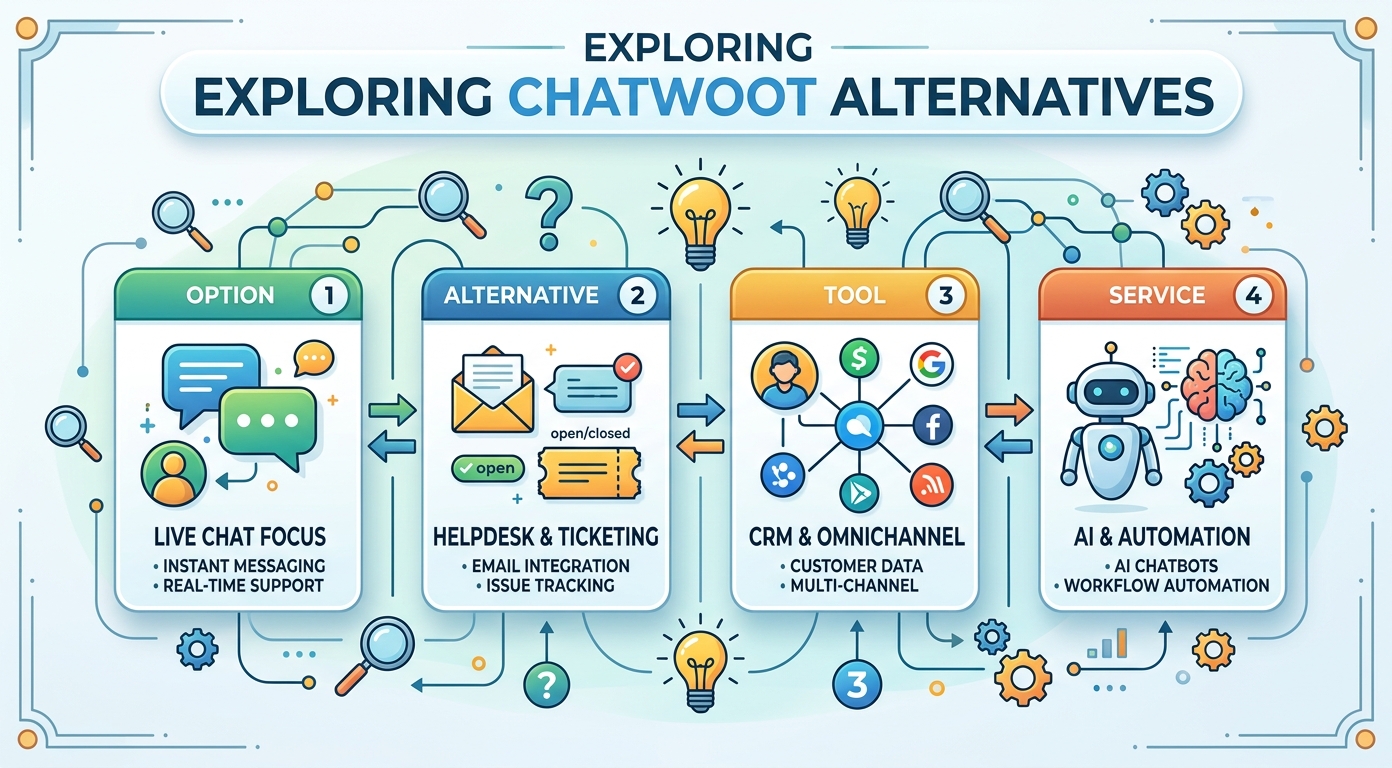
Your shortlist of Chatwoot alternatives depends on which half of Chatwoot you care about: other open-source support platforms you can self-host (Zammad, FreeScout, Tiledesk, Rocket.Chat) and hosted customer service suites that trade control for zero maintenance (Tidio, Crisp Chat, Zendesk, Freshdesk). Chatwoot is the best-known open-source customer support platform: a shared inbox, website live chat, help center, and Captain AI in one product, available as a free self-hosted Community Edition or as Chatwoot Cloud. Cloud pricing as of July 2026: a free Hacker plan (up to 2 agents, 500 conversations per month, 30-day data retention), Startups at $19 per agent per month billed annually, Business at $39, and Enterprise at $99, with a 15-day trial. Every paid plan includes monthly Captain AI credits (300 to 800), with additional credits at $20 per 1,000.
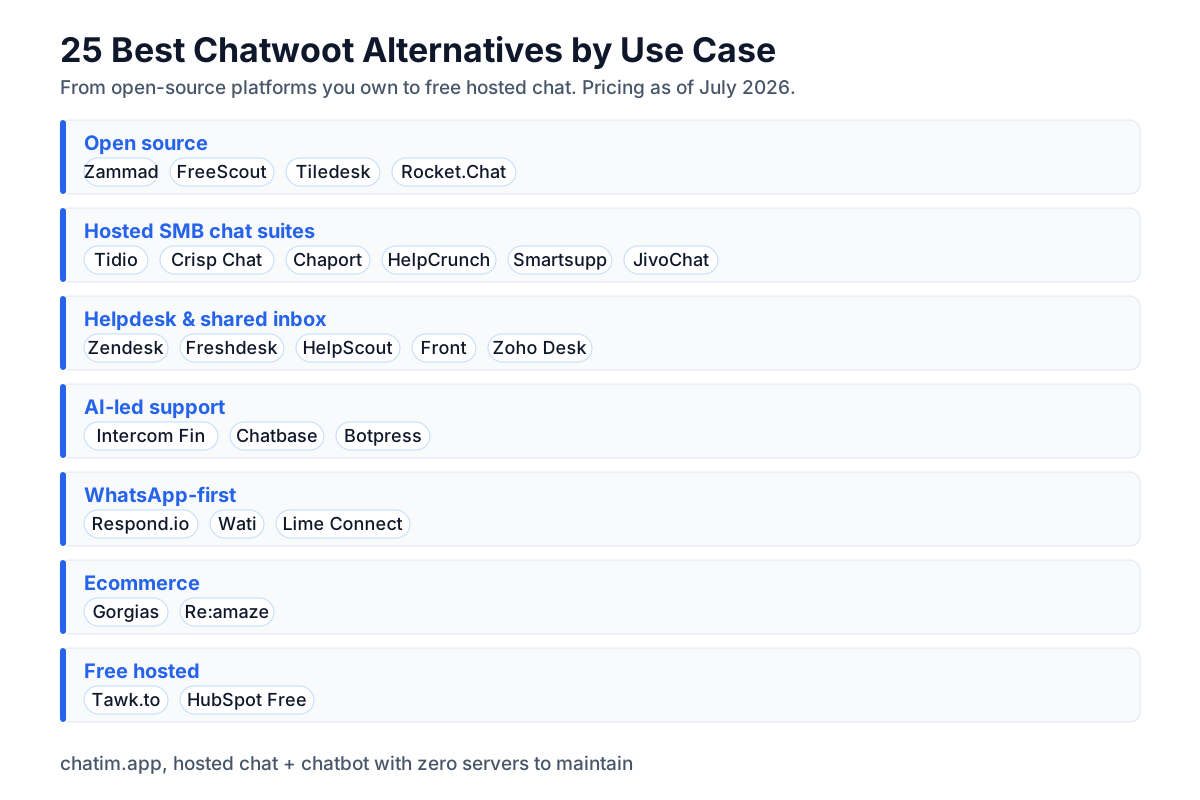
If self-hosting maintenance, Captain AI credit metering, the limited free cloud tier, or the US-hosted cloud do not fit your team, this guide ranks the 25 best Chatwoot alternatives in 2026. The list is organized by use case (open-source platforms, SMB live chat suites, helpdesk and shared inbox, AI-led support, WhatsApp-first messaging, ecommerce, free), with published pricing where available, key features, and the type of team each Chatwoot alternative fits best. You will also find a quick comparison table, a recap of what Chatwoot does well, a five-step buyer framework, and a 15-item FAQ. Tiers quoted are the vendors' published July 2026 prices; verify before purchase.
Why teams leave Chatwoot
Chatwoot occupies a rare position: real open source with a polished hosted option. Teams usually start shopping for a Chatwoot alternative when one of five limits shows up.
- Self-hosting is an ops commitment. The Community Edition is free, but upgrades, backups, scaling, and security patching are on your team. If the maintainer leaves, the helpdesk becomes technical debt.
- Captain AI is credit-metered. Paid cloud plans include 300 to 800 credits per month; beyond that, credits cost $20 per 1,000. AI-heavy teams should model usage before committing.
- The free cloud tier is tight. Hacker covers 2 agents and 500 conversations per month with 30-day retention. Growing teams hit those walls quickly.
- Cloud data lives in the United States. Chatwoot Cloud runs on AWS with US servers. EU-resident teams either self-host or pick a vendor with EU hosting.
- Ecosystem depth. Chatwoot's integrations are solid but thinner than Zendesk's marketplace or the Shopify-native depth of ecommerce helpdesks like Gorgias.
The side-by-side comparison table
The table below compares every Chatwoot alternative in this guide on the two questions buyers ask first: is there a free plan, and what does the entry paid tier cost.
| Chatwoot alternative | Best for | Free plan | Paid from (as of July 2026) |
|---|---|---|---|
| Zammad | Open-source helpdesk and ticketing | Yes, self-hosted | Self-host free; hosted tiers on vendor page |
| FreeScout | Lightweight open-source shared inbox | Yes, self-hosted | Self-host free; paid modules on vendor page |
| Tiledesk | Open-source chat plus chatbots | Yes, self-hosted | Self-host free; cloud tiers on vendor page |
| Rocket.Chat | Open-source team chat with omnichannel | Yes, self-hosted | See vendor pricing page |
| Tidio | Live chat plus Lyro AI | Yes, 50 conversations/month | Starter $24.17 per workspace (annual) |
| Crisp Chat | Multichannel inbox, workspace pricing | Yes, 2 seats | Mini $45 per workspace |
| Chaport | Simple SMB chat, flat tiers | Yes, 2 operators | Pro from $29 (annual) |
| HelpCrunch | Chat plus email marketing | 14-day trial | Basic $12 per user (annual) |
| Smartsupp | Low flat tiers by operator count | Yes, 1 operator, 25 conversations/month | Solo $17 (annual) |
| JivoChat | Chat plus phone plus social | Yes, basic features | Basic from $28 per agent (annual) |
| Zendesk | Enterprise ticketing suite | Trial only | Suite Team $55 per agent (annual) |
| Freshdesk | SMB ticketing with a free plan | $0 for 1-2 agents (6 months) | Growth $19 per agent (annual) |
| HelpScout | Shared inbox with a human tone | Yes, up to 5 users | Standard $25 per user |
| Front | Shared inbox for email-heavy teams | 14-day trial | Starter $19 per seat (annual) |
| Zoho Desk | Budget ticketing in the Zoho suite | Yes, up to 3 users | Standard $14 per user (annual; Express $7) |
| Intercom | Fin AI agent on a full suite | Trial only | Essential $29 per seat (annual) + Fin usage |
| Chatbase | AI agent trained on your content | Yes, 50 credits/month | Hobby $32 per month (annual) |
| Botpress | Developer-grade AI agents | Yes, 100 conversations/month | Plus $150 per month (annual) |
| Respond.io | WhatsApp-led multichannel inbox | 7-day trial | Starter $79 per month |
| Wati | WhatsApp broadcasts plus chatbot | 7-day trial | Growth $59 per month (annual) |
| Userlike (Lime Connect) | GDPR-aligned WhatsApp support | Yes, 1 seat, 200 conversations | Pro from €87 per month (min 3 seats) |
| Gorgias | Shopify-native helpdesk | Trial only | Basic $50/month helpdesk, $77 with AI (annual) |
| Re:amaze | Multi-brand ecommerce support | 14-day trial | Basic $29 per user ($26.10 annual) |
| Tawk.to | Free unlimited-agent chat | Yes, unlimited agents | $0 core; Remove Branding $29 (annual) |
| HubSpot Service Hub | Free chat inside a CRM | Yes, free tools | Starter from $7 per seat (list $20) |
Pricing and features change frequently, verify on each vendor's official pricing page before purchase. Some prices shown above reflect annual billing. Where a price is not listed, published tiers changed too often to verify for this article; check the vendor pricing page. Currency is USD unless otherwise noted (Userlike / Lime Connect tiers are quoted in EUR). Chatwoot pricing was as listed on the vendor’s pricing page in July 2026.
Chatim: hosted chat plus chatbot without the ops burden
Disclosure: Chatim is our own product. Chatwoot's Community Edition trades subscription fees for server maintenance. For SMB teams that want live chat plus a chatbot working today, with no infrastructure to run and predictable per-plan pricing, Chatim offers a hosted widget with native Shopify and WordPress integrations and a free tier for small teams.
Try Chatim free at chatim.app →
The open-source contenders
If open source is the requirement (data control, no per-agent fees, code you can extend), these four are the serious candidates. All are free to self-host; ops cost is the real price.
Zammad, open-source helpdesk and ticketing
Zammad is the most mature open-source helpdesk: email ticketing, web, chat, and social channels with strong search, text modules, and granular permissions. The self-hosted core is free under an open-source license, with hosted plans published on the vendor's site. Compared with Chatwoot, Zammad leans ticket-first rather than chat-first, which suits teams whose volume arrives by email. Best for organizations replacing an aging ticket system that want ownership without enterprise licensing.
FreeScout, lightweight open-source shared inbox
FreeScout is a free, self-hosted shared inbox in the HelpScout mold: clean mailbox UI, notes, assignments, and a large catalog of inexpensive paid modules (live chat, knowledge base, integrations) that extend the core. It runs happily on modest hosting, making it the lowest-infrastructure route to an owned helpdesk. Best for small teams with a part-time sysadmin and email-centric support.
Tiledesk, open-source chat with chatbot design
Tiledesk combines website live chat with a visual chatbot builder and human handoff, self-hostable under an open-source license with cloud tiers on the vendor's site. It is the closest open-source match to Chatwoot's chat-plus-automation combination, with a stronger emphasis on designed bot flows. Best for teams that want an owned stack where the bot does structured work before an agent joins.
Rocket.Chat, open-source team chat with omnichannel support
Rocket.Chat is primarily an open-source team communication platform (a self-hosted Slack analog) that added an omnichannel module: website live chat, email, and messenger channels routed to internal teams. Self-hosting is free, with paid tiers published on the vendor's site. Pick it when internal chat and customer chat should live in one owned system; pick Chatwoot when customer support is the whole job.
Best hosted SMB chat suites
These are the tools teams actually move to when they stop wanting to run servers: hosted, quick to set up, and priced for small teams.
Tidio, live chat plus Lyro AI
Tidio pairs a polished widget with the Lyro AI agent (add-on from $32.50 per month) on workspace pricing: free tier with 50 conversations per month, Starter at $24.17 per month billed annually, Growth from $49.17. Strong Shopify and WordPress apps. It is the most common hosted landing spot for teams leaving self-hosted chat. Full guide: Tidio alternatives.
Crisp Chat, flat workspace pricing with unlimited chats
Crisp bundles chat, email, WhatsApp, Instagram, a knowledge base, and campaigns into one inbox: free 2-seat plan, Mini at $45 per month for 4 seats, Essentials at $95 for 10. The feature set overlaps heavily with Chatwoot Cloud at a similar mid-team price point, minus the open-source escape hatch. Full guide: Crisp Chat alternatives.
Chaport, flat-tier simplicity
Chaport keeps it minimal: clean widget, auto-invitations, multichannel connections, chatbots on the Unlimited tier. Free for 2 operators; Pro from $29 per month billed annually, Unlimited from $99 with unlimited operators. Best for teams that want chat running in an afternoon with no ops at all. See Chaport alternatives.
HelpCrunch, chat plus email marketing
HelpCrunch combines live chat, a shared inbox, a knowledge base, popups, and email campaigns: Basic at $12 per user per month billed annually ($15 monthly), Pro at $20, Unlimited at $495 flat. It covers support plus lifecycle marketing in one subscription, something Chatwoot does not attempt. Full guide: HelpCrunch alternatives.
Smartsupp, operator-count pricing
Smartsupp's free plan covers 1 operator with 25 conversations per month, with Solo at $17 per month billed annually and Plus at $25 (3 operators), both unlimited-agent. Visitor recordings and an AI shopping assistant target ecommerce. The flat model undercuts per-agent cloud pricing for bigger teams. See Smartsupp alternatives.
JivoChat, one agent app for every channel
JivoChat lands website chat, telephony (via its Telephony Plus module), email, and social messengers in one agent app: free basic plan, Basic from $28 per agent per month billed annually (Professional $42). It adds a voice channel through its telephony module at SMB pricing. Full guide: JivoChat alternatives.
Best helpdesk and shared inbox alternatives
Pick from this group when tickets, SLAs, and reporting matter more than the chat widget.
Zendesk, the enterprise yardstick
Zendesk Suite bundles ticketing, messaging, help center, voice, and AI agents ($1.50 per resolution) with the deepest integration marketplace in the category. Suite Team is $55 per agent per month billed annually; a ticketing-only Support Team plan starts from $19. The polar opposite of self-hosting: maximum ecosystem, maximum per-agent cost. Full guide: Zendesk alternatives.
Freshdesk, SMB ticketing with a real free plan
Freshdesk offers ticketing, collaboration, a knowledge base, and Freddy AI, with a $0-for-6-months program for 1-2 agents and paid tiers from $19 per agent per month billed annually (Growth). It is the most common hosted ticket-first alternative for teams outgrowing an owned helpdesk without enterprise budgets.
HelpScout, the human-tone inbox
HelpScout hides ticket numbers from customers and keeps agents in a clean shared inbox with Docs and Beacon chat. Free covers up to 5 users; Standard is $25 per user per month, Plus $45. Closest hosted analog to FreeScout (which cloned its model) with none of the maintenance. Full guide: HelpScout alternatives.
Front, the email-centric team inbox
Front unifies email, chat, SMS, and social in a collaborative inbox with assignments and SLA rules: Starter at $19 per seat per month billed annually, Growth at $59. Best for ops and logistics teams living in email threads. See Front alternatives.
Zoho Desk, the Zoho-suite value pick
Zoho Desk runs from a free 3-user plan to Standard at $14 per user per month, Professional at $23, and Enterprise at $40, all billed annually, with tight Zoho CRM and SalesIQ integration. The value pick for teams already on Zoho. See Zoho alternatives.
Best AI-led Chatwoot alternatives
Chatwoot's Captain AI assists agents and answers from your help center on metered credits. These platforms make the AI the centerpiece.
Intercom, the AI-first support platform
Intercom's Fin resolves conversations against your help content, with everything unresolved landing in a staffed inbox with routing and reporting. Essential is $29 per seat per month billed annually plus per-resolution Fin usage. The strongest AI-plus-humans combination, at the highest total cost in this guide. Full breakdown: Intercom alternatives.
Chatbase, AI agent trained on your content
Chatbase trains an AI support agent on your website and documents and deploys it to web, Slack, WhatsApp, Messenger, or Instagram, with advanced OpenAI, Anthropic, and Gemini models on paid tiers. Free tier with 50 message credits; Hobby at $32 per month billed annually, Standard at $120 with helpdesk, voice, and API access. Pick it when the bot is the product; pair it with a human channel for escalations.
Botpress, developer-grade AI agents
Botpress gives developers a visual flow builder plus LLM orchestration, deployable to web, WhatsApp, Messenger, Slack, and Teams. Free tier with 100 conversations per month and AI usage included; Plus at $150 per month billed annually (250 conversations). An open-source core is also published, which keeps it on self-hosting shortlists alongside Chatwoot itself.
The WhatsApp-first options
Chatwoot connects WhatsApp via the Business API, but messaging-first platforms make it the core product.
Respond.io, messaging channels as the product
Respond.io unifies WhatsApp, Instagram, Messenger, Telegram, and SMS with automation workflows and broadcasts, priced by monthly active contacts: Starter at $79 per month, Growth at $159. Best when support volume lives in messaging apps rather than on the website. Full guide: Respond.io alternatives.
Wati, WhatsApp-only automation for SMBs
Wati is a WhatsApp Business Platform partner for SMBs: broadcasts, a no-code chatbot, and a team inbox from $59 per month billed annually (Growth, 3 users), with message charges passed through. The lower-cost entry into serious WhatsApp support.
Userlike (now Lime Connect), WhatsApp support the GDPR way
Userlike, rebranded to Lime Connect after its September 2025 acquisition, pairs website chat with WhatsApp channels and EU data residency: free 1-seat plan (200 conversations), Pro from €87 per month (minimum 3 seats). The hosted answer to the EU-hosting concern that pushes some teams toward self-hosted Chatwoot. Full guide: Userlike alternatives.
Ecommerce-first Chatwoot replacements
Chatwoot's ecommerce workflows are general-purpose. These two are built around the order.
Gorgias, ecommerce support that sells
Gorgias surfaces Shopify, BigCommerce, and WooCommerce order data next to every conversation and automates where-is-my-order replies, on ticket-volume pricing that is never per agent: helpdesk-only Basic at $50 per month billed annually (300 tickets), or $77 with the optional AI Agent (30 automated interactions, then $1.50 each). Full guide: Gorgias alternatives.
Re:amaze, cheap seats with AI included
Re:amaze handles chat, email, social, and push with first-class multi-brand support for operators running several storefronts: Basic at $29 per user per month ($26.10 annual), plus a flat-rate volume tier with unlimited agents. See Re:amaze alternatives.
Free options that hold up
Chatwoot's Hacker plan and Community Edition are already free; these two are the hosted free options to compare.
Tawk.to, the free-forever option
Tawk.to keeps live chat free with unlimited agents and chats, monetizing through add-ons (Remove Branding at $29 per month billed annually, AI Assist from $29). No ticketing engine, no self-hosting, no server bills. The zero-cost hosted baseline every self-hosting plan should be compared against. Full guide: Tawk.to alternatives.
HubSpot Service Hub, chat bundled with the CRM
HubSpot's free tools bundle live chat, a shared inbox, ticketing basics, and the CRM, with Starter from $7 per seat per month (list $20). Every conversation lands on the contact record. Costs ramp at Professional ($90-$100 per seat), so model the growth path. See HubSpot alternatives.
A short framework for deciding
Five questions turn 25 options into a shortlist.
- 1. Is open source the requirement or the habit? If data ownership or extensibility is contractual, shortlist Zammad, FreeScout, Tiledesk, and Rocket.Chat. If open source was just the free entry point, a hosted free tier (Tawk.to, HubSpot, Tidio, Smartsupp) may cost less than your server time.
- 2. Count the real ops budget. Price self-hosting honestly: server costs, upgrade windows, backups, and the bus factor. Compare that number against Chatwoot Cloud, Crisp, or Tidio at your seat count.
- 3. Chat-first or ticket-first? Chat-first teams fit the SMB suites (Tidio, Crisp, Chaport, Smartsupp, JivoChat). Ticket-first teams fit Zammad, Freshdesk, Zendesk, HelpScout, Zoho Desk, or Front.
- 4. Where must data live? EU residency: self-host, or pick Userlike / Lime Connect and EU-hosted plans. US cloud is fine: everything on this list qualifies.
- 5. How much AI, on whose meter? Credit-metered AI (Chatwoot Captain, Crisp, Chatbase, Tawk.to AI Assist) suits predictable volume; per-resolution (Zendesk, Intercom Fin) scales with outcomes; bundled AI (Tidio Lyro add-on, Freshdesk Freddy) is easiest to budget.
Chatwoot: strengths and price tags
Switching is not always the right call. Chatwoot remains the reference open-source support platform, and its cloud pricing is competitive even against closed rivals.
What Chatwoot does well: a genuinely open-source Community Edition you can self-host free; a shared inbox spanning live chat, email, and social channels; help center and team features on every paid plan; Captain AI (assistant, copilot, summarization) with 300 to 800 bundled credits on paid tiers; a free Hacker cloud plan for 2 agents; transparent per-agent pricing ($19 Startups, $39 Business, $99 Enterprise, billed annually) with a 15-day trial; API-based data export; and a free Startups plan for open-source projects and nonprofits.
Where it falls short: self-hosting demands real ops capacity; Captain AI credits meter at $20 per 1,000 beyond the bundle; the Hacker plan caps at 500 conversations per month with 30-day retention; cloud hosting is US-only; voice arrives only on higher tiers; and the integration catalog trails Zendesk's marketplace and Shopify-native helpdesks.
Questions buyers ask
For the broader chat landscape, see our guides on the best live chat platforms, Tidio alternatives, Crisp Chat alternatives, and Zendesk alternatives. For platform-specific picks, see WordPress live chat plugins and live chat for Shopify.
If price is the deciding factor, our best free live chat software roundup collects the tools with genuinely usable free plans.
Frequently Asked Questions
What is Chatwoot?
Chatwoot is an open-source customer support platform that combines a shared inbox, website live chat, email and social channels, a help center, and Captain AI. It ships two ways: a free self-hosted Community Edition, and Chatwoot Cloud with a free Hacker plan (up to 2 agents, 500 conversations per month, 30-day retention) and paid tiers at $19 (Startups), $39 (Business), and $99 (Enterprise) per agent per month billed annually, each bundling 300 to 800 Captain AI credits. Cloud runs on AWS in the United States.
What is the best Chatwoot alternative in 2026?
It depends on why you are leaving. For another open-source platform: Zammad (ticket-first), FreeScout (lightweight shared inbox), Tiledesk (chat plus bots), or Rocket.Chat (team chat plus omnichannel). For a hosted SMB suite: Tidio, Crisp Chat, or Chaport. For ticket-first hosted helpdesks: Freshdesk, Zendesk, HelpScout, or Zoho Desk. For AI-led support: Intercom Fin or Chatbase. For WhatsApp: Respond.io or Wati. For ecommerce: Gorgias. For free hosted chat: Tawk.to.
Is Chatwoot free?
Yes, two ways. The open-source Community Edition is free to self-host with no per-agent fees; you pay in servers and maintenance time. Chatwoot Cloud's Hacker plan is free for up to 2 agents with 500 conversations per month and 30-day data retention. Paid cloud plans start at $19 per agent per month billed annually. Chatwoot also offers its Startups plan free to open-source projects and nonprofits on request.
How much does Chatwoot cost?
As of July 2026, per the vendor’s published pricing: Cloud Hacker free (2 agents, 500 conversations/month); Startups $19 per agent per month billed annually with unlimited conversations and 300 Captain AI credits; Business $39 with 500 credits; Enterprise $99 with 800 credits and 3-year retention. Additional Captain AI credits cost $20 per 1,000. Self-hosting the Community Edition is free; paid self-hosted enterprise plans are quoted separately. A 15-day free trial covers the cloud plans.
What is the best open-source Chatwoot alternative?
Zammad is the most mature open-source helpdesk if your volume is ticket- and email-first. FreeScout is the lightest option, a self-hosted shared inbox in the HelpScout mold that runs on modest hosting with inexpensive add-on modules. Tiledesk is the closest match to Chatwoot's chat-plus-chatbot combination, with a visual bot builder. Rocket.Chat fits when internal team chat and customer omnichannel should live in one owned system. All four are free to self-host; compare ops effort, not license fees.
Should I self-host Chatwoot or use a hosted alternative?
Self-host when data ownership, residency, or extensibility is a hard requirement and you have ops capacity for upgrades, backups, and security patching. Choose hosted when the team is small or ops time is scarce: at 2-5 agents, hosted suites like Tidio ($24.17 per month), Chaport ($29), Smartsupp ($20), or Chatwoot's own cloud often cost less than the server and admin hours self-hosting consumes. Price the bus factor honestly: an unmaintained helpdesk is a liability.
Which Chatwoot alternative is best for a small business?
Hosted SMB suites fit best: Tidio (free tier, Starter $24.17 per month billed annually, Lyro AI optional), Chaport (free for 2 operators, Pro from $29), Smartsupp (Solo $17, annual), or HelpCrunch ($12 per user, annual). If budget is zero, Tawk.to gives free unlimited-agent chat, and HubSpot Service Hub bundles free chat with a CRM. Among open-source options, FreeScout has the lowest maintenance footprint for a small team.
Which Chatwoot alternative has the best AI?
Intercom's Fin is the strongest AI resolution engine, resolving conversations against your help content with per-resolution pricing on top of seats from $29 per month. Chatbase (from $32 per month billed annually) leads for standalone AI agents trained on your content with frontier-model access. Botpress is the developer-grade option with an open-source core. Among hosted suites, Tidio's Lyro (from $32.50 per month) is the simplest bundled AI. Chatwoot's own Captain AI is competitive if the bundled 300-800 credits cover your volume.
Does Chatwoot support WhatsApp, and what are the WhatsApp-first alternatives?
Chatwoot connects WhatsApp through the WhatsApp Business API on paid plans. If WhatsApp is your dominant channel, messaging-first platforms usually serve better: Wati (from $59 per month billed annually) for broadcasts plus a no-code chatbot, Respond.io (from $79, priced by monthly active contacts) for deeper automation across WhatsApp, Instagram, Messenger, Telegram, and SMS, and Userlike / Lime Connect (Pro from €87, minimum 3 seats) for WhatsApp support with EU data residency.
How does Chatwoot compare with Zendesk?
Chatwoot is open-source and chat-first with transparent per-agent cloud pricing ($19-$99); Zendesk is a closed enterprise suite (Suite Team $55 per agent per month billed annually) with the deepest integration marketplace, workflow automation, and analytics in the category, plus AI Agents at $1.50 per resolution. Teams pick Chatwoot for ownership and cost control, Zendesk for enterprise process depth. Midsize teams that want neither extreme often land on Freshdesk or HelpScout.
How does Chatwoot compare with Tidio?
Both are chat-first SMB tools. Tidio is hosted-only, faster to set up, priced per workspace (free tier; Starter $24.17 per month billed annually), with Lyro AI as an add-on and strong Shopify and WordPress apps. Chatwoot offers open-source self-hosting, a more helpdesk-like shared inbox, and per-agent cloud pricing from $19. Pick Tidio for speed and ecommerce integrations; pick Chatwoot for data ownership or when per-agent pricing beats workspace pricing at your team size.
How does Chatwoot compare with Crisp Chat?
Feature overlap is high: both bundle a multichannel inbox, knowledge base, and AI. Crisp is hosted-only and priced per workspace (free 2-seat plan; Mini $45 per month for 4 seats; Essentials $95 for 10), which beats per-agent pricing for mid-size teams. Chatwoot prices per agent ($19-$99) and adds the self-hosted escape hatch. At 4-10 agents, compare Crisp's workspace total against Chatwoot Startups times seats; below that, Chatwoot's free options usually win.
Can I migrate from Chatwoot to another platform easily?
Yes. Chatwoot's API exports conversations, contacts, and reports, and its data-ownership stance makes extraction straightforward. Most hosted helpdesks (Zendesk, Freshdesk, HelpScout, Gorgias) import contacts and tickets via CSV or native importers. Re-install the new chat widget, port canned responses and help center articles, and run both systems in parallel through one support cycle using the destination's free trial (14-30 days across this list) before cutting over.
Is Chatwoot GDPR-compliant if the cloud is US-hosted?
Chatwoot Cloud runs on AWS with servers in the United States, and Chatwoot advises teams with residency requirements to contact them; self-hosting the Community Edition in your own EU infrastructure is the direct answer to strict residency needs. Hosted alternatives with EU alignment include Userlike / Lime Connect (EU data residency, Pro from €87 per month, minimum 3 seats). For any vendor, confirm current data-processing terms directly before relying on them for compliance.
What is the best free Chatwoot alternative?
For hosted free tiers: Tawk.to (unlimited agents and chats at $0, branding removal $29 per month billed annually), HubSpot Service Hub free tools (chat plus CRM), Tidio (50 conversations per month), Smartsupp (25 conversations, 1 operator), Chaport (2 operators), and Freshdesk (1-2 agents, 6 months). For self-hosted free: FreeScout, Zammad, Tiledesk, and Rocket.Chat, plus Chatwoot's own Community Edition, which remains the benchmark the others are measured against.
Related articles
More in Alternatives → 25 Rocket.Chat Alternatives for Chat and Support (2026)
Rocket.Chat tries to be team chat and support chat at once. 25 alternatives that pick a lane or do both, self-hosted and cloud
 25 LivePerson Alternatives for 2026: Enterprise to SMB
LivePerson does not publish pricing. These 25 alternatives range from Genesys-scale suites to Tidio-simple tools, and most show theirs openly.
 25 Kustomer Alternatives for Ecommerce CX Teams in 2026
Kustomer moved to quote-only pricing. These 25 alternatives, from Gorgias to Zendesk, mostly publish theirs; compared for ecommerce CX
 25 Dixa Alternatives in 2026: From Gorgias to Zendesk
Dixa's all-in-one promise, delivered 25 other ways: Shopify-deep Gorgias, budget-voice LiveAgent, enterprise Zendesk and lighter chat tools.