25 Dixa Alternatives in 2026: From Gorgias to Zendesk

The Dixa alternatives worth shortlisting fall on either side of a line: ecommerce CX platforms that match its consumer-brand focus (Gorgias, Re:amaze, Richpanel, Kustomer) and omnichannel helpdesks that match its bundled phone-plus-chat-plus-email model at lower entry prices (LiveAgent, Zendesk, JivoChat). Dixa is an omnichannel customer service platform for consumer brands: every plan bundles a full contact center (phone, IVR, call recording), all digital channels including WhatsApp, Instagram, Messenger, and SMS, a knowledge base, intelligent routing, and Mim, its AI agent, priced at a flat €0.35 per conversation. Plans as listed in July 2026: Growth at €89 per agent per month, Ultimate at €139, and Prime at €179, sold through a demo with guided onboarding rather than a self-serve trial. Dixa's own pricing FAQ describes the platform as structured for mid-market teams rather than small operations.
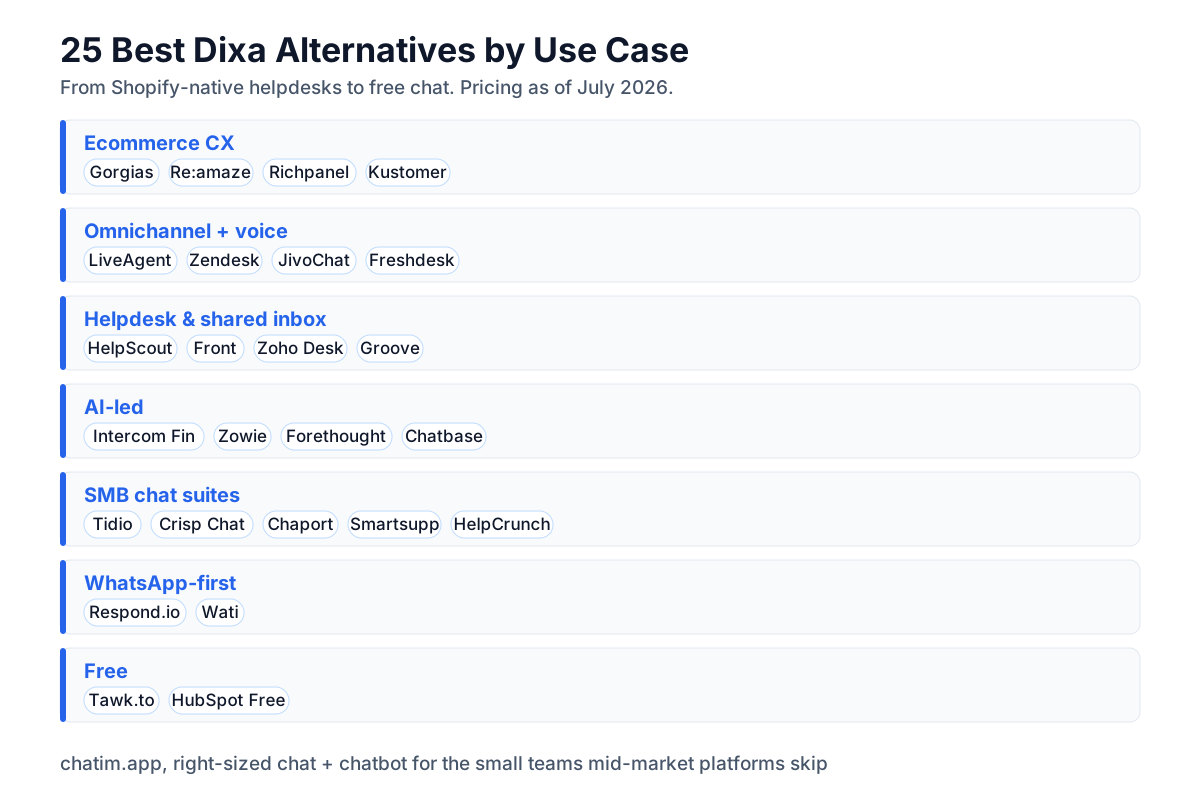
If the demo-led sales motion, the mid-market design center, or paying for a bundled contact center you do not use do not fit your team, this guide ranks the 25 best Dixa alternatives in 2026. The list is organized by use case (ecommerce CX, omnichannel with bundled voice, helpdesk and shared inbox, AI-led automation, SMB chat suites, WhatsApp-first messaging, free options), with published pricing where available, key features, and the type of team each Dixa alternative fits best. You will also find a quick comparison table, a recap of what Dixa does well, a five-step buyer framework, and a 15-item FAQ. Quoted prices are the July 2026 published tiers; the vendor's own page is always the source of truth.
When Dixa stops fitting
Dixa's bundle is coherent: one platform, every channel, AI included. The reasons teams shop for a Dixa alternative are mostly about size and shape.
- Built for mid-market, by its own description. Dixa's pricing FAQ states the platform works best with meaningful contact volume and is structured for mid-market teams rather than small operations. A 3-agent store is not the design center.
- No self-serve trial (as of July 2026). Every rollout starts with a demo and guided onboarding (typically 2 to 4 weeks). Teams that want to install a widget today are outside the motion.
- The entry price includes channels you may not use. Growth at €89 per agent per month bundles a full contact center. If nobody calls you, a chat-first tool at a quarter of the price covers the actual workload.
- Add-ons stack on the higher tiers. AI Co-Pilot, Quality Assurance, AI Auto QA, Advanced Insights, voice transcription, and SSO (below Prime) are seat-based or paid add-ons, so the effective per-seat cost climbs with maturity.
- AI is still a usage line. Mim's flat €0.35 per conversation is predictable and fairer than per-resolution billing, but high-volume automation still accumulates a real monthly number; model it against bundled-AI suites.
Dixa alternatives side by side
The table below compares every Dixa alternative in this guide on the two questions buyers ask first: is there a free plan, and what does the entry paid tier cost.
| Dixa alternative | Best for | Free plan | Paid from (as of July 2026) |
|---|---|---|---|
| Gorgias | Shopify-native helpdesk, ticket pricing | Trial only | Basic $50/month helpdesk, $77 with AI (annual) |
| Re:amaze | Multi-brand ecommerce support | 14-day trial | Basic $29 per user ($26.10 annual) |
| Richpanel | Ecommerce support with self-service portal | Trial | See vendor pricing page |
| Kustomer | Enterprise CX on a customer timeline | Demo | Quote-based (July 2026) |
| LiveAgent | Helpdesk plus chat plus call center | 30-day trial | Small Business $15 per agent (annual) |
| Zendesk | Enterprise suite, voice add-on | Trial only | Suite Team $55 per agent (annual) |
| JivoChat | Chat plus phone plus social, SMB pricing | Yes, basic features | Basic from $28 per agent (annual) |
| Freshdesk | SMB ticketing, voice via Freshcaller | $0 for 1-2 agents (6 months) | Growth $19 per agent (annual) |
| HelpScout | Shared inbox with a human tone | Yes, up to 5 users | Standard $25 per user |
| Front | Shared inbox with customer context | 14-day trial | Starter $19 per seat (annual) |
| Zoho Desk | Budget ticketing inside the Zoho suite | Yes, up to 3 users | Standard $14 per user (annual; Express $7) |
| Groove (now Helply) | Outcome-priced helpdesk, AI included | Demo | $1 per ticket, 250-ticket monthly minimum |
| Intercom | Fin AI agent on a full suite | Trial only | Essential $29 per seat (annual) + Fin usage |
| Zowie | AI agents for ecommerce CX | Demo | Quote-based |
| Forethought | Agentic AI on your existing helpdesk | Demo | Quote-based |
| Chatbase | AI agent trained on your content | Yes, 50 credits/month | Hobby $32 per month (annual) |
| Tidio | Live chat plus Lyro AI | Yes, 50 conversations/month | Starter $24.17 per workspace (annual) |
| Crisp Chat | Multichannel inbox, workspace pricing | Yes, 2 seats | Mini $45 per workspace |
| Chaport | Simple SMB chat, flat tiers | Yes, 2 operators | Pro from $29 (annual) |
| Smartsupp | Low flat tiers by operator count | Yes, 1 operator, 25 conversations/month | Solo $17 (annual) |
| HelpCrunch | Chat plus email marketing | 14-day trial | Basic $12 per user (annual) |
| Respond.io | WhatsApp-led multichannel inbox | 7-day trial | Starter $79 per month |
| Wati | WhatsApp broadcasts plus chatbot | 7-day trial | Growth $59 per month (annual) |
| Tawk.to | Free unlimited-agent chat | Yes, unlimited agents | $0 core; Remove Branding $29 (annual) |
| HubSpot Service Hub | Free chat inside a CRM | Yes, free tools | Starter from $7 per seat (list $20) |
Pricing and features change frequently, verify on each vendor's official pricing page before purchase. Some prices shown above reflect annual billing. Where no number appears, the vendor either sells by quote or changes published tiers too often to cite. Currency is USD unless otherwise noted (Dixa quotes EUR and GBP). Dixa pricing was as listed on the vendor’s pricing page in July 2026.
Chatim: right-sized for the teams Dixa is not built for
Disclosure: Chatim is our own product. Dixa says it plainly: the platform is structured for mid-market operations. If you are the small team it is not built for, Chatim covers the front line (live chat plus a chatbot that deflects repetitive questions) with predictable per-plan pricing, native Shopify and WordPress integrations, a free tier, and a widget you can install today, no demo call required.
Try Chatim free at chatim.app →
The ecommerce-native picks
Dixa targets high-performing consumer brands. These four fight for the same customers, each with a different pricing shape.
Gorgias, Shopify-first customer support
Gorgias connects natively to Shopify, BigCommerce, and WooCommerce, surfacing order data next to every conversation and automating where-is-my-order and refund replies. Pricing is ticket-based and never per agent: helpdesk-only Basic runs $50 per month billed annually (300 tickets) and Pro $300 (2,000 tickets); adding the optional AI Agent lifts those to $77 and $471, with allowances of 30 and 190 automated interactions and overage at $1.50 each. Where Dixa prices per agent with usage-based AI, Gorgias prices per ticket, which favors lean teams with high automation. Full guide: Gorgias alternatives.
Re:amaze, per-seat ecommerce support
Re:amaze handles chat, email, social, and push in one inbox with first-class multi-brand support for operators running several storefronts. Basic is $29 per user per month ($26.10 annual), Pro $49, Plus $69, plus a flat-rate volume tier with unlimited agents. A fraction of Dixa's per-agent price for teams that do not need bundled telephony. See Re:amaze alternatives.
Richpanel, self-service-first ecommerce support
Richpanel pairs an ecommerce helpdesk with a customer self-service portal that lets shoppers track orders, request returns, and resolve common issues without an agent. Pricing tiers are published on the vendor's site. Strongest when deflection at the source, not agent tooling, is the goal.
Kustomer, the customer-record platform
Kustomer organizes support around a customer timeline rather than tickets, with AI across the platform and omnichannel messaging including voice. As of July 2026 its packages are quote-based through a demo, the same sales motion as Dixa. Enterprise consumer brands should shortlist both and compare on data model and total cost at their channel mix.
Best omnichannel alternatives with bundled voice
Dixa's strongest card is the contact center in every plan. These four bundle voice at very different price points.
LiveAgent, helpdesk plus chat plus call center at SMB pricing
LiveAgent bundles email ticketing, live chat, a knowledge base, social channels, and a real built-in call center (IVR, routing, recordings) from $15 per agent per month billed annually (Small Business) up to $69 (Enterprise), with a 30-day trial. It is the most direct budget answer to Dixa's bundle: the same channel breadth at roughly a sixth of the entry price, minus the mid-market AI layer.
Zendesk, the enterprise suite with voice as an add-on
Zendesk Suite covers ticketing, messaging, help center, and AI agents priced per automated resolution (check Zendesk's page for the current rate), with full contact-center capability as a paid add-on. Suite Team is $55 per agent per month billed annually. Dixa's own comparison argues its bundle beats Zendesk's stacked add-ons on per-seat math; Zendesk counters with the deepest marketplace and admin ecosystem in the category. Model both at your seat count. Full guide: Zendesk alternatives.
JivoChat, the budget omnichannel app
One app for chat, email, social, and calls is JivoChat's pitch, with phone support arriving via its Telephony Plus module. There is a free basic plan; paid tiers run $28 (Basic) and $42 (Professional) per agent per month billed annually. For small teams that want Dixa's channel shape without mid-market pricing, this is the closest fit on the list. Full guide: JivoChat alternatives.
Freshdesk, SMB ticketing with voice via Freshcaller
Freshdesk covers ticketing, collaboration, a knowledge base, and Freddy AI from a 6-month $0 program for 1-2 agents and Growth at $19 per agent per month billed annually, with telephony sold separately through Freshcaller. The unbundled counter-model: pay for voice only if you use it.
Helpdesk and shared inbox picks
If voice is not in your channel mix, these four cover email-and-chat support without the contact-center premium.
HelpScout, human-tone support at seat pricing
HelpScout keeps agents in a clean shared inbox with Docs and Beacon chat; customers never see ticket numbers. Free for up to 5 users, Standard at $25 per user per month, Plus at $45. Full guide: HelpScout alternatives.
Front, the inbox that knows the customer
Front unifies email, chat, SMS, and social in a collaborative inbox with SLA rules and CRM integrations: Starter at $19 per seat per month billed annually, Growth at $59. Best for relationship-heavy operations living in email threads. Full guide: Front alternatives.
Zoho Desk, budget helpdesk with suite ties
Zoho Desk runs from a free 3-user plan to Standard at $14 per user per month billed annually (Express $7), with tight Zoho CRM integration. If you already run on Zoho, it is the obvious value pick. See Zoho alternatives.
Groove (now Helply), helpdesk priced per resolution
Groove has relaunched as Helply, replacing per-user tiers with outcome pricing: $1 per ticket with unlimited seats, AI included on every ticket, a 250-ticket monthly minimum, and annual contracts from $3,000. A different answer to the same small-team question Dixa declines: pay for volume, not heads.
Top AI-led replacements
Dixa's Mim prices AI per conversation (€0.35 flat). These four price the same automation differently; the winning model depends on your volume and resolution rate.
Intercom, where Fin leads the product
Intercom's Fin resolves conversations against your help content, priced per resolution on top of seats (Essential $29 per seat per month billed annually). Per-resolution means you pay for outcomes; per-conversation (Dixa) means you pay for volume. High resolution rates favor Dixa's model, low ones favor Intercom's. Full breakdown: Intercom alternatives.
Zowie, the ecommerce AI specialist
Zowie builds AI agents for consumer brands with order-aware actions and brand-voice control, quote-based via demo. It competes head-on with Mim for the ecommerce automation budget; benchmark both on your own traffic before committing.
Forethought, AI layered onto your helpdesk
Forethought layers autonomous resolution, triage, and agent-assist onto the helpdesk you already run, trained on historical tickets, quote-based. The path that adds Dixa-style automation without replacing the system of record.
Chatbase, AI answers from your own content
Chatbase trains an AI support agent on your website and documents: free 50-credit tier, Hobby at $32 per month billed annually, Standard at $120 with helpdesk, voice, and API access. The self-serve entry into AI support, at a price a small team can expense.
Chat suites sized for SMBs
Dixa is explicit that small operations are not its design center. These five are built for exactly that segment.
Tidio, freemium chat with an AI agent
Tidio pairs a polished widget with the Lyro AI agent (add-on from $32.50 per month): free tier with 50 conversations per month, Starter at $24.17 per month billed annually on workspace pricing, with strong Shopify and WordPress apps. The most complete small-team translation of Dixa's chat-plus-AI promise. Full guide: Tidio alternatives.
Crisp Chat, unlimited conversations per workspace
Crisp bundles chat, email, WhatsApp, Instagram, a knowledge base, campaigns, and a lightweight CRM: free 2-seat plan, Mini at $45 per month for 4 seats, Essentials at $95 for 10. Workspace pricing beats per-agent math as teams grow. Full guide: Crisp Chat alternatives.
Chaport, flat pricing for small teams
Chaport: free for 2 operators, Pro from $29 per month billed annually, Unlimited from $99 with unlimited operators and chatbots. Live in an afternoon. See Chaport alternatives.
Smartsupp, flat pricing per operator
Smartsupp's free plan covers 1 operator and 25 conversations per month; paid tiers run Solo $17 per month billed annually (1 operator), Plus $25 (3 operators), and Expert $83 (5 or more), all with unlimited conversations, plus an AI shopping assistant add-on aimed at ecommerce. See Smartsupp alternatives.
HelpCrunch, inbox plus campaigns on one bill
HelpCrunch combines live chat, a shared inbox, a knowledge base, popups, and email campaigns: Basic at $12 per user per month billed annually ($15 monthly), Pro at $20. Support plus lifecycle messaging in one subscription. Full guide: HelpCrunch alternatives.
WhatsApp-led Dixa replacements
Dixa bundles WhatsApp among its channels. If messaging apps carry most of your volume, these two specialize.
Respond.io, broadcasts and bots across messengers
Respond.io pulls WhatsApp, Instagram, Messenger, Telegram, and SMS into one automated inbox with broadcast campaigns, billed by monthly active contacts (Starter $79 per month, Growth $159). Full guide: Respond.io alternatives.
Wati, WhatsApp automation for small teams
Wati, a WhatsApp Business Platform partner, sells SMBs broadcasts, a no-code chatbot, and a team inbox; Growth starts at $59 per month billed annually (3 users), with message charges billed through.
Best free Dixa alternatives
As of July 2026, Dixa's published plans include no free tier and no self-serve trial. These two start at zero, today.
Tawk.to, always-free live chat
Tawk.to remains the genuinely free option: unlimited agents and chats at $0, with optional add-ons for branding removal ($29 per month billed annually) and AI Assist (from $29). Full guide: Tawk.to alternatives.
HubSpot Service Hub, support inside the CRM
Service Hub's chat, shared inbox, and ticketing basics ship free with the CRM, with Starter at $7 per seat per month (list $20); conversations file onto the customer record on their own. See HubSpot alternatives.
Choosing a Dixa alternative: a buyer framework
Five questions turn 25 options into a shortlist.
- 1. Do you actually need bundled voice? If phone is a real channel, compare Dixa against LiveAgent ($15) and JivoChat ($28) before accepting mid-market pricing. If nobody calls, drop the contact-center premium entirely and pick from the chat suites or helpdesks.
- 2. What is your team size, honestly? Dixa says mid-market. Under roughly 10 agents, Gorgias, Tidio, Re:amaze, Groove, and Smartsupp deliver the workload at SMB prices. At enterprise scale, Zendesk and Kustomer join the shortlist.
- 3. Which AI pricing model fits your funnel? Per-conversation (Dixa Mim at €0.35) rewards high resolution rates. Per-resolution (Intercom Fin at $0.99, Zendesk's AI agents) rewards low ones. Per-ticket (Gorgias) folds automation into volume pricing. Credit-based (Chatbase) suits predictable low volume. Run your last quarter's numbers through all four.
- 4. Self-serve or guided? Dixa, Kustomer, Zowie, and Forethought sell through demos with guided onboarding. Everything else in this guide starts self-serve with a trial or free tier, which is also the cheapest way to evaluate.
- 5. Where does your commerce data live? Shopify-centric teams get the deepest order context from Gorgias and Richpanel. Multi-brand operators should weigh Re:amaze. If customer data lives in a CRM, HubSpot's free tier is the zero-cost proof of concept.
Dixa at a glance: strengths and pricing
Switching is not always the right call. For the mid-market consumer brands Dixa targets, the bundle is one of the most coherent in the category.
What Dixa does well: every channel in every plan (phone, email, chat, WhatsApp, Instagram, Messenger, SMS) with a real contact center (IVR, recording, callback, voicemail) included; Mim AI agent in every plan at a flat €0.35 per conversation with no allowance caps and no per-seat AI component; intelligent routing, SLAs, and real-time analytics standard; native Shopify, Klaviyo, and 35-plus integrations; knowledge base included; guided onboarding with a dedicated success manager, live in 2 to 4 weeks; and a seasonal-agent add-on for peak-period scaling.
Where it falls short for typical teams: no free plan and no self-serve trial as of July 2026; listed pricing starts at €89 per agent per month, with AI Co-Pilot, Quality Assurance, AI Auto QA, Advanced Insights, voice transcription, and SSO (below Prime) as paid add-ons; the platform is explicitly structured for mid-market contact volume; and small chat-first teams end up funding a contact center they never route a call through.
FAQ: the short answers
For the broader landscape, see our guides on the best live chat platforms, Gorgias alternatives, Re:amaze alternatives, and Zendesk alternatives. Platform-specific rankings live in live chat for Shopify and WordPress live chat plugins.
Watching the budget? Our best free live chat software roundup collects the tools with genuinely usable free plans.
Frequently Asked Questions
What is Dixa?
Dixa is an omnichannel customer service platform aimed at consumer brands. Every plan bundles a full contact center (phone, IVR, call recording, callback, voicemail), all digital channels (email, live chat, WhatsApp, Instagram, Messenger, SMS), a knowledge base, intelligent routing, SLAs, real-time analytics, and Mim, its AI agent. Plans as listed in July 2026: Growth at €89 per agent per month, Ultimate at €139, Prime at €179, sold through a demo with guided onboarding (typically 2 to 4 weeks) rather than a self-serve trial.
What is the best Dixa alternative in 2026?
For ecommerce brands: Gorgias (Shopify-native, ticket-based, helpdesk from $50 per month billed annually) or Re:amaze (multi-brand, from $29 per user). For the bundled-voice model at lower cost: LiveAgent ($15 per agent per month billed annually) or JivoChat ($28). For enterprise scale: Zendesk or Kustomer. For AI-led automation: Intercom Fin or Zowie. For small teams: Tidio, Smartsupp, or Chaport. For a free start: Tawk.to or HubSpot Service Hub's free tools.
How much does Dixa cost?
As listed on the live pricing page in July 2026: Growth at €89 per agent per month, Ultimate at €139, and Prime at €179 (EUR and GBP pricing shown; annual billing advertised at 20 percent savings). Mim, the AI agent, is usage-priced at a flat €0.35 per conversation with no per-seat component. AI Co-Pilot, Quality Assurance, AI Auto QA, Advanced Insights, voice transcription, SSO (below Prime), collaboration users, and seasonal agents are add-ons. There is no free plan; every rollout starts with a demo.
Does Dixa have a free trial?
No. Dixa's own pricing FAQ states there is no self-serve trial; every rollout is guided, with a dedicated success manager and hands-on onboarding, and most teams go live in 2 to 4 weeks. If you want to evaluate hands-on before talking to sales, alternatives with free tiers or self-serve trials include Gorgias, LiveAgent (30-day trial), Tidio, Smartsupp, Chaport, Tawk.to, HubSpot Service Hub, Freshdesk, and Zoho Desk.
Is Dixa suitable for small businesses?
By its own description, no: Dixa's pricing FAQ says the platform is structured for mid-market teams rather than small operations and works best with meaningful contact volume. Small teams get better economics from Tidio (free tier, then $24.17 per month billed annually), Smartsupp (Solo $17, annual), Chaport (from $29), Helply, ex-Groove ($1 per ticket), or Tawk.to (free), all of which install self-serve without a demo cycle.
How does Dixa's AI pricing work compared with competitors?
Dixa prices Mim per conversation at a flat €0.35, regardless of whether the AI resolves the conversation or hands it to a human, with no allowance caps. Intercom's Fin and Zendesk's AI Agents price per resolution ($0.99 at Intercom; check Zendesk's page for its current rate), so you pay for counted outcomes. Gorgias folds automation into per-ticket volume pricing. Chatbase meters message credits. Which model wins depends on your funnel: high AI resolution rates favor per-conversation pricing, low ones favor per-resolution. Run last quarter's volumes through each formula before deciding.
How does Dixa compare with Gorgias?
Both target ecommerce brands. Gorgias is Shopify-native with ticket-based pricing (helpdesk-only Basic $50 per month billed annually, never per agent) and installs self-serve in minutes; it has no bundled phone contact center. Dixa bundles voice, all channels, and Mim AI from €89 per agent per month, sold through a demo with guided onboarding, and targets mid-market volume. Small and midsize Shopify merchants usually get there faster with Gorgias; brands with real phone volume and larger teams are Dixa's design center.
How does Dixa compare with Zendesk?
Dixa's pitch is bundle coherence: phone, all channels, routing, and AI included in one per-agent price, and its own comparison argues the equivalent Zendesk stack (Suite seat plus contact-center and Copilot add-ons) costs more per seat. Zendesk counters with published self-serve pricing (Suite Team $55 per agent per month billed annually), the deepest integration marketplace in the category, and per-resolution AI agents (check Zendesk's page for current rates). Model both at your actual seat count and channel mix; the winner flips depending on whether you use the whole Dixa bundle.
How does Dixa compare with LiveAgent?
Both bundle a real call center with helpdesk and chat. LiveAgent starts at $15 per agent per month billed annually (about a sixth of Dixa's listed entry price), offers a 30-day self-serve trial, and suits SMBs; its AI is simpler and social channels cost extra on lower tiers. Dixa adds mid-market depth: Mim AI in every plan, intelligent routing with external data, knowledge-centered service, and guided onboarding. Teams under roughly 10 agents usually find LiveAgent sufficient; scaling consumer brands with automation goals are Dixa's target.
How does Dixa compare with Kustomer?
Both are demo-led, mid-market-to-enterprise CX platforms for consumer brands. Kustomer's differentiator is its customer-timeline data model (support organized around the person, not tickets) with quote-based packages as of July 2026. Dixa's is bundle transparency: listed per-agent prices (€89 to €179) with every channel and flat-rate per-conversation AI included. Kustomer leans data-model depth, Dixa leans channel-and-AI economics. Enterprise DTC brands should demo both against the same test scenarios.
Which Dixa alternative is best for Shopify stores?
Gorgias is the strongest pick: native Shopify integration surfaces order data in every conversation, automates where-is-my-order and refund flows, and prices by ticket volume, never per agent (helpdesk-only Basic $50 per month billed annually; $77 with the optional AI Agent). Richpanel adds a customer self-service portal that deflects tickets before they reach an agent. Re:amaze suits multi-storefront operators. Among chat-first tools, Tidio and Smartsupp both ship strong Shopify apps, and Dixa itself integrates Shopify natively if you stay.
Which Dixa alternative has the best bundled phone support?
LiveAgent is the value leader: IVR, call routing, recordings, callback, and voicemail bundled with ticketing and chat from $15 per agent per month billed annually. JivoChat bundles phone with chat and social from $28 per agent. At enterprise scale, Zendesk adds full contact-center capability as a paid add-on on top of Suite plans. If phone is occasional rather than core, consider an unbundled setup: a chat suite plus a standalone VoIP line often costs less than any bundled seat.
Can I migrate from Dixa to an alternative easily?
Plan three moves: channels, knowledge, and history. Channels re-point cleanly (website widget swap, phone number porting to the new telephony provider, social and WhatsApp reconnection). Knowledge base articles export and re-import into the destination's help center. Conversation history and contact exports archive for compliance; most helpdesks import contacts via CSV. Rebuild routing rules and Mim automations in the new platform's tools, run both systems in parallel on a traffic slice, and time the cutover to your renewal date.
Is there a free Dixa alternative?
Dixa's published plans include no free tier (as of July 2026), so the free plan landscape is a real contrast: Tawk.to offers free live chat with unlimited agents; HubSpot Service Hub's free tools bundle chat, ticketing basics, and the CRM; Tidio (50 conversations per month), Smartsupp (25 conversations, 1 operator), Chaport (2 operators), and Crisp Chat (2 seats) all keep usable free chat tiers; Freshdesk (1-2 agents, 6 months) and Zoho Desk (3 users) cover free ticketing. None bundles a phone contact center for free; for occasional calls, pair a free chat tool with a low-cost VoIP line.
Who should stay on Dixa?
Mid-market consumer brands that use the whole bundle: real phone volume flowing through the included contact center, multiple digital channels routed intelligently, Mim automating a meaningful share of conversations at the flat per-conversation rate, and a team large enough to benefit from guided onboarding and a success manager. If that describes your operation, the per-seat math Dixa publishes against stacked-add-on competitors is genuinely competitive. The evaluation worth running is your renewal quote against Zendesk, Kustomer, and Gorgias at your actual channel mix.
Related articles
More in Alternatives → 25 Rocket.Chat Alternatives for Chat and Support (2026)
Rocket.Chat tries to be team chat and support chat at once. 25 alternatives that pick a lane or do both, self-hosted and cloud
 25 LivePerson Alternatives for 2026: Enterprise to SMB
LivePerson does not publish pricing. These 25 alternatives range from Genesys-scale suites to Tidio-simple tools, and most show theirs openly.
 25 Kustomer Alternatives for Ecommerce CX Teams in 2026
Kustomer moved to quote-only pricing. These 25 alternatives, from Gorgias to Zendesk, mostly publish theirs; compared for ecommerce CX
 25 Chatwoot Alternatives: Open Source and Hosted (2026)
Want Chatwoot without the self-hosting, or open source without Chatwoot? 25 alternatives both ways, with licensing notes