25 Rocket.Chat Alternatives for Chat and Support (2026)

The closest Rocket.Chat alternatives depend on which Rocket.Chat you use: the open-source team messaging platform (where Mattermost, Zulip, and Element are the peers), or the omnichannel customer chat module (where Chatwoot, Tidio, and dedicated support platforms do the job full-time). Rocket.Chat itself has moved upmarket: as of July 2026 it positions its enterprise plans as a Secure CommsOS for commercial, government, and defense organizations, with air-gapped deployment, FIPS-validated cryptography, and Matrix federation, and all enterprise pricing is quote-based rather than published per-seat. A free Starter plan covers technical evaluation, small businesses, and nonprofits, and the open-source Community edition remains free to self-host.
If the enterprise sales motion, the self-hosting ops burden, or an omnichannel module that is secondary to team messaging do not fit your team, this guide ranks the 25 best Rocket.Chat alternatives in 2026. The list is organized by use case (open-source team chat, hosted team chat, open-source support platforms, hosted SMB chat suites, helpdesk and ticketing, AI chatbots, WhatsApp-first, free hosted chat), with published pricing where available, key features, and the type of team each Rocket.Chat alternative fits best. You will also find a quick comparison table, a recap of what Rocket.Chat does well, a five-step buyer framework, and a 15-item FAQ. All figures are published vendor pricing as of July 2026 and worth re-checking at purchase time.
Where Rocket.Chat starts to pinch
Rocket.Chat earned its base as the self-hosted Slack alternative. Its current enterprise focus is exactly why several kinds of teams now shop elsewhere.
- Enterprise pricing is quote-based. The commercial, government, and defense plans are sold through sales conversations, not a published per-seat page. Small teams that just want a price and a checkout flow face procurement friction.
- The pivot targets sovereignty buyers. Air-gapped deployment, IL6 authorization, and FINRA-ready compliance are the headline features. If your requirement is a team chat room or a website support widget, you are not the design center anymore.
- Self-hosting is an ops commitment. The Community edition is free, but upgrades, scaling, and security patching are on your team, same as any owned platform.
- Omnichannel is a module, not the product. Customer-facing chat rides on top of a team messaging architecture. Dedicated support platforms ship deeper inboxes, routing, bots, and ecommerce integrations.
- Team messaging has stronger specialists. For pure internal chat, Mattermost, Zulip, and Element each beat a general-purpose deployment on at least one axis (developer workflows, threaded conversations, decentralized federation).
Every pick in a single table
The table below compares every Rocket.Chat alternative in this guide on the two questions buyers ask first: is there a free plan, and what does the entry paid tier cost.
| Rocket.Chat alternative | Best for | Free plan | Paid from (as of July 2026) |
|---|---|---|---|
| Mattermost | Self-hosted team chat for dev teams | Yes, self-hosted | See vendor pricing page |
| Zulip | Threaded open-source team chat | Yes, self-hosted + cloud free tier | See vendor pricing page |
| Element | Decentralized Matrix messaging | Yes, self-hosted | See vendor pricing page |
| Nextcloud Talk | Chat inside a self-hosted workspace | Yes, self-hosted | See vendor pricing page |
| Slack | Mainstream hosted team chat | Yes, limited history | See vendor pricing page |
| Microsoft Teams | Team chat inside Microsoft 365 | Yes, limited | Bundled with Microsoft 365 plans |
| Discord | Community and voice-first chat | Yes | Optional Nitro add-ons |
| Chatwoot | Open-source customer support | Yes, self-hosted + free cloud (2 agents) | Startups $19 per agent (annual) |
| Zammad | Open-source helpdesk and ticketing | Yes, self-hosted | Self-host free; hosted tiers on vendor page |
| FreeScout | Lightweight open-source shared inbox | Yes, self-hosted | Self-host free; paid modules |
| Tiledesk | Open-source chat plus chatbots | Yes, self-hosted | Self-host free; cloud tiers on vendor page |
| Tidio | Live chat plus Lyro AI | Yes, 50 conversations/month | Starter $24.17 per workspace (annual) |
| Crisp Chat | Multichannel inbox, workspace pricing | Yes, 2 seats | Mini $45 per workspace |
| Chaport | Simple SMB chat, flat tiers | Yes, 2 operators | Pro from $29 (annual) |
| Smartsupp | Low flat tiers by operator count | Yes, 1 operator, 25 conversations/month | Solo $17 (annual) |
| JivoChat | Chat plus phone plus social | Yes, basic features | Basic from $28 per agent (annual) |
| Zendesk | Enterprise ticketing suite | Trial only | Suite Team $55 per agent (annual) |
| Freshdesk | SMB ticketing with a free plan | $0 for 1-2 agents (6 months) | Growth $19 per agent (annual) |
| HelpScout | Shared inbox with a human tone | Yes, up to 5 users | Standard $25 per user |
| Botpress | Developer-grade AI agents | Yes, 100 conversations/month | Plus $150 per month (annual) |
| Chatbase | AI agent trained on your content | Yes, 50 credits/month | Hobby $32 per month (annual) |
| Respond.io | WhatsApp-led multichannel inbox | 7-day trial | Starter $79 per month |
| Wati | WhatsApp broadcasts plus chatbot | 7-day trial | Growth $59 per month (annual) |
| Tawk.to | Free unlimited-agent chat | Yes, unlimited agents | $0 core; Remove Branding $29 (annual) |
| HubSpot Service Hub | Free chat inside a CRM | Yes, free tools | Starter from $7 per seat (list $20) |
Pricing and features change frequently, verify on each vendor's official pricing page before purchase. Some prices shown above reflect annual billing. Where a price is not listed, the vendor either sells by quote or publishes tiers that change too often to verify for this article. Rocket.Chat's enterprise plans were quote-based as of July 2026.
Chatim: customer chat without the platform overhead
Disclosure: Chatim is our own product. Rocket.Chat treats customer-facing chat as one module of a larger communications platform. If the actual requirement is a website chat widget with a chatbot, run by a small team with no infrastructure to manage, Chatim does that one job with predictable per-plan pricing, native Shopify and WordPress integrations, and a free tier.
Try Chatim free at chatim.app →
Best open-source team chat alternatives
If Rocket.Chat is your internal messaging platform, these are the peers: self-hostable, open source, and each stronger than a general-purpose deployment on at least one axis.
Mattermost, self-hosted team chat for technical teams
Mattermost is the most direct Rocket.Chat replacement for internal messaging: channels, threads, calls, and workflow automation, self-hosted or cloud, with deep developer tooling (playbooks, integrations with GitLab, GitHub, and CI systems). The open-source edition is free to self-host, with paid tiers published on the vendor's site. It is the default pick for engineering-led organizations that want an owned Slack replacement with an active enterprise roadmap.
Zulip, threaded conversations that scale
Zulip's topic-based threading model keeps busy channels readable in a way flat streams cannot: every message belongs to a topic, so asynchronous teams can catch up without scrolling. It is fully open source, self-hostable for free, with a hosted cloud that includes a free tier and paid tiers on the vendor's site. Best for distributed and open-source communities where conversations outlive the workday.
Element, decentralized messaging on Matrix
Element is the flagship client for the Matrix protocol: end-to-end encrypted, federated messaging where every organization can run its own homeserver and still talk to others. Self-hosting is free; managed hosting and enterprise tiers are on the vendor's site. Notably, Rocket.Chat itself supports Matrix federation, so Element is both an alternative and an interoperability partner. Best for organizations that want sovereignty without a single-vendor platform.
Nextcloud Talk, chat inside a self-hosted workspace
Nextcloud Talk adds chat, calls, and screen sharing to the Nextcloud file-and-office suite, so teams that already self-host documents get messaging in the same stack. Free to self-host, with enterprise subscriptions on the vendor's site. The pick when the real goal is one owned workspace rather than a best-of-breed chat tool.
Best hosted team chat alternatives
When the ops burden is the reason to leave, these are the hosted defaults.
Slack, the mainstream team chat standard
Slack remains the reference hosted team messenger: channels, huddles, workflow automation, and the deepest app directory in the category. The free tier keeps limited message history, with paid tiers published on the vendor's pricing page. Teams leaving self-hosted platforms usually land here first, trading data control for zero maintenance and universal familiarity.
Microsoft Teams, chat inside Microsoft 365
Teams bundles chat, meetings, and file collaboration with Microsoft 365, which makes it the practical default for organizations already paying for Office. A limited free tier exists, and paid capability arrives through Microsoft 365 plans rather than a standalone price. Strongest when calendar, documents, and identity already live in the Microsoft stack.
Discord, community and voice-first chat
Discord is voice-native, free at the core, and organized around persistent community servers rather than corporate workspaces. Optional Nitro subscriptions add media limits and perks. It is the pragmatic pick for developer communities, gaming-adjacent teams, and public communities that outgrew a self-hosted server.
Best open-source customer support alternatives
If you deployed Rocket.Chat for the omnichannel module, these open-source platforms make customer support the whole product.
Chatwoot, the open-source support platform
Chatwoot is the closest open-source swap for Rocket.Chat's omnichannel side: a shared inbox, website live chat, email and social channels, help center, and Captain AI. Self-hosting the Community Edition is free; Chatwoot Cloud offers a free 2-agent plan and paid tiers from $19 per agent per month billed annually (300 to 800 bundled AI credits by tier, extra credits $20 per 1,000). Support is the core product, not a module, which shows in the inbox depth.
Zammad, the open-source ticketing veteran
Zammad is the mature open-source helpdesk: email ticketing, web and chat channels, granular permissions, and strong search. Free to self-host, with hosted plans on the vendor's site. Ticket-first rather than chat-first, which fits teams whose support volume arrives by email.
FreeScout, the free self-hosted inbox
FreeScout delivers a clean HelpScout-style shared inbox that runs on modest hosting, extended by inexpensive paid modules (live chat, knowledge base, integrations). Free to self-host. The lowest-infrastructure route to an owned support inbox for a small team.
Tiledesk, open-source bots plus live chat
Tiledesk pairs website live chat with a visual chatbot builder and human handoff, self-hostable free with cloud tiers on the vendor's site. The pick when an owned stack should include designed bot flows, not just an inbox.
Hosted chat suites for small teams
Hosted, quick to deploy, and priced for small support teams: the practical replacements when the omnichannel module was the whole point.
Tidio, widget plus Lyro AI
Tidio pairs a polished widget with the Lyro AI agent (add-on from $32.50 per month): free tier with 50 conversations per month, Starter at $24.17 per month billed annually. Strong Shopify and WordPress apps make it the common ecommerce landing spot. Full guide: Tidio alternatives.
Crisp Chat, one workspace fee for every channel
Crisp bundles chat, email, WhatsApp, Instagram, a knowledge base, and campaigns: free 2-seat plan, Mini at $45 per month for 4 seats, Essentials at $95 for 10. Workspace pricing beats per-agent math for mid-size teams. Full guide: Crisp Chat alternatives.
Chaport, the no-frills flat-rate pick
Chaport keeps chat minimal: free for 2 operators, Pro from $29 per month billed annually, Unlimited from $99 with unlimited operators and chatbots. Running in an afternoon, no ops. See Chaport alternatives.
Smartsupp, budget chat by operator count
Smartsupp's free plan covers 1 operator and 25 conversations per month; Solo is $17 per month billed annually and Plus $25 (3 operators), with unlimited conversations, visitor recordings, and an AI shopping assistant add-on. See Smartsupp alternatives.
JivoChat, chat and telephony combined
JivoChat lands website chat, phone with IVR, email, and social messengers in one agent app: free basic plan, Basic from $28 per agent per month billed annually (Professional $42). The voice channel comes standard, no platform assembly required. Full guide: JivoChat alternatives.
Best helpdesk and ticketing alternatives
When support needs process (SLAs, routing, reporting), a dedicated helpdesk replaces both the module and the maintenance.
Zendesk, the full-suite incumbent
Zendesk Suite is the yardstick the rest get measured against, bundling ticketing, messaging, help center, voice, and AI agents (around $1.50 per resolution) in one subscription, with the deepest integration marketplace in the category. Expect $55 per agent per month billed annually for Suite Team, with a ticketing-only Support Team plan from $19. Full guide: Zendesk alternatives.
Freshdesk, SMB ticketing that starts free
Freshdesk covers ticketing, collaboration, a knowledge base, and Freddy AI, with a 6-month $0 program for 1-2 agents and Growth at $19 per agent per month billed annually. The most common hosted ticket-first landing spot for teams leaving owned infrastructure.
HelpScout, email-first support without ticket numbers
HelpScout keeps agents in a clean shared inbox with Docs knowledge base and Beacon chat; customers never see ticket numbers. Free for up to 5 users, Standard at $25 per user per month. Full guide: HelpScout alternatives.
Best AI chatbot alternatives
If the plan was to bolt bots onto Rocket.Chat, these two make automation the starting point instead.
Botpress, the developer's bot stack
Botpress pairs a visual flow builder with LLM orchestration, deployable to web, WhatsApp, Messenger, Slack, and Teams, with an open-source core for self-hosters. Free tier (100 conversations per month, AI usage included); Plus at $150 per month billed annually. The natural bot layer for teams that keep an owned stack.
Chatbase, train a bot on your docs
Chatbase trains an AI support agent on your website and documents, deploying to web, Slack, WhatsApp, Messenger, or Instagram with frontier-model access on paid tiers: free 50-credit tier, Hobby at $32 per month billed annually, Standard at $120 with helpdesk, voice, and API. Pick it when the bot is the product.
WhatsApp-led alternatives
Rocket.Chat connects WhatsApp through its omnichannel module; these platforms make messaging channels the core product.
Respond.io, the multichannel messaging inbox
Respond.io unifies WhatsApp, Instagram, Messenger, Telegram, and SMS with automation and broadcasts, priced by monthly active contacts: Starter at $79 per month, Growth at $159. Full guide: Respond.io alternatives.
Wati, the WhatsApp Business partner route
Wati focuses SMBs on WhatsApp alone: a team inbox, broadcasts, and a no-code chatbot, with Growth at $59 per month billed annually for 3 users and Meta message charges passed through.
The zero-budget picks
Both free forever, both zero-ops: the baseline every self-hosting plan should be compared against.
Tawk.to, unlimited agents at zero cost
Tawk.to gives live chat away, unlimited agents and chats included, and makes its money through add-ons (Remove Branding at $29 per month billed annually, AI Assist from $29). No servers, no license terms to track. Full guide: Tawk.to alternatives.
HubSpot Service Hub, the CRM-first route
HubSpot Service Hub rides on the free CRM: live chat, shared inbox, and ticketing basics cost nothing, and Starter runs $7 per seat per month (list $20). Chats attach themselves to the contact record. See HubSpot alternatives.
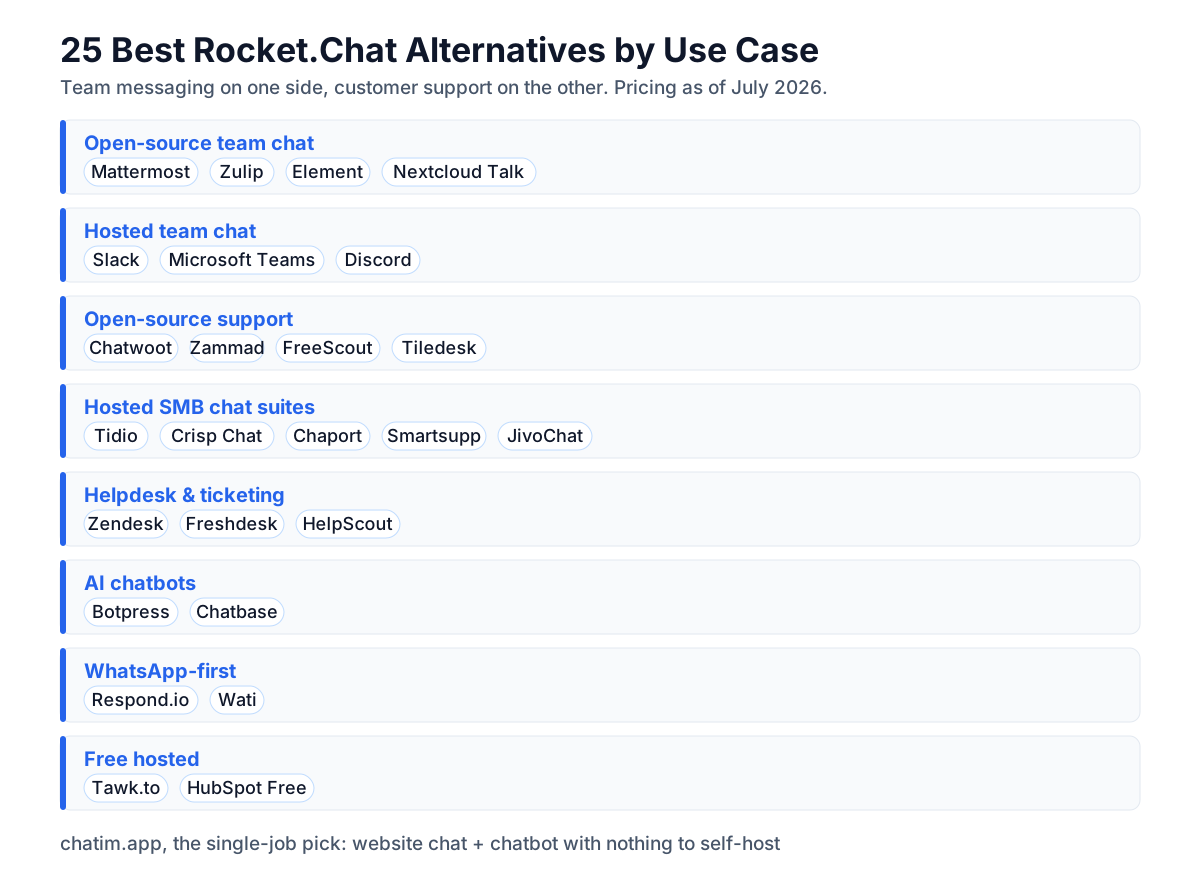
The decision checklist
Five questions turn 25 options into a shortlist.
- 1. Which Rocket.Chat are you replacing? Internal team messaging points to Mattermost, Zulip, Element, Slack, or Teams. The customer-facing omnichannel module points to Chatwoot, the hosted SMB suites, or a helpdesk. Splitting the two jobs across two right-sized tools usually beats one platform doing both halfway.
- 2. Is open source a requirement or a habit? Contractual data ownership keeps you in the open-source columns (Mattermost, Zulip, Element, Chatwoot, Zammad, FreeScout, Tiledesk). If it was just the free entry point, hosted free tiers (Slack free, Tawk.to, Tidio, HubSpot) may cost less than your server time.
- 3. Price the ops honestly. Server costs, upgrade windows, backups, and the bus factor are the real subscription. Compare that number against hosted pricing at your seat count before defaulting to self-host.
- 4. Who buys it? Quote-based enterprise sales (Rocket.Chat's current model) suits procurement departments. Card-and-checkout tools (everything in the SMB columns) suit teams that need chat working this week.
- 5. Where must data live? Sovereignty requirements favor self-hosted Matrix (Element), Mattermost, or Chatwoot in your own infrastructure; Rocket.Chat's own government plans remain a strong fit there, which is worth admitting before migrating away.
Rocket.Chat at a glance: strengths and positioning
Switching is not always the right call, and Rocket.Chat's current focus is a genuine strength for the buyers it now targets.
What Rocket.Chat does well: a free, open-source Community edition for self-hosting; messaging, calls, and screen sharing in one platform; Matrix protocol federation for cross-organization collaboration; deployment options spanning on-prem, private cloud, air-gapped, and SCIF-ready environments; compliance depth (HIPAA-supportive, FINRA and MiFID II ready, GDPR-configurable, DoD authorization up to IL6); sovereign AI that runs inside your infrastructure; and a free Starter plan for small businesses, nonprofits, and evaluation.
Where it falls short for typical teams: enterprise pricing is quote-based rather than published; the product's design center is now regulated and defense-grade deployments, not SMB chat; self-hosting carries real ops cost; the omnichannel customer chat module is secondary to team messaging; and dedicated support platforms ship deeper agent tooling, bots, and ecommerce integrations out of the box.
Quick answers for switchers
For the customer-support side of this decision, see our guides on the best live chat platforms, Tidio alternatives, Crisp Chat alternatives, and Zendesk alternatives. If the decision is platform-driven, try WordPress live chat plugins and live chat for Shopify.
Watching the budget? Our best free live chat software roundup collects the tools with genuinely usable free plans.
Frequently Asked Questions
What is Rocket.Chat?
Rocket.Chat is an open-source communications platform: team messaging (channels, threads, calls, screen sharing), an omnichannel module for customer-facing chat, and Matrix protocol federation. As of July 2026 it positions its enterprise offering as a Secure CommsOS for commercial, government, and defense organizations, with air-gapped and SCIF-ready deployment, FIPS-validated cryptography, and DoD authorization up to IL6. Enterprise pricing is quote-based; a free Starter plan covers small businesses, nonprofits, and evaluation, and the open-source Community edition is free to self-host.
What is the best Rocket.Chat alternative in 2026?
It depends on which job Rocket.Chat does for you. For internal team messaging: Mattermost (developer-led teams), Zulip (threaded async conversations), Element (decentralized Matrix), or hosted options like Slack and Microsoft Teams. For the customer-facing omnichannel side: Chatwoot (open-source support), Tidio or Crisp Chat (hosted SMB suites), Zendesk or Freshdesk (ticket-first helpdesks). Many teams do best splitting the two jobs across two right-sized tools.
Is Rocket.Chat free?
The open-source Community edition is free to self-host, and a free Starter plan exists for technical evaluation, small businesses, and nonprofits. The commercial, government, and defense enterprise plans are quote-based as of July 2026 rather than published per-seat prices. Self-hosting carries the usual ownership costs: servers, upgrades, backups, and security patching.
How much does Rocket.Chat cost?
As of July 2026, Rocket.Chat does not publish per-seat enterprise pricing; commercial, government, and defense plans are sold by quote. The Starter plan is free for small teams and evaluation, and the open-source Community edition is free to self-host. If you need a published price and checkout flow, hosted alternatives publish theirs: Chatwoot Cloud from $19 per agent per month billed annually, Tidio from $24.17 per workspace, Freshdesk from $19 per agent, Zendesk Suite Team at $55 per agent.
What is the best open-source Rocket.Chat alternative for team chat?
Mattermost is the most direct swap: self-hosted channels, threads, calls, and deep developer tooling with an active enterprise roadmap. Zulip wins for asynchronous teams thanks to its topic-based threading, and its cloud has a free tier. Element (on the Matrix protocol) wins for decentralization and end-to-end encryption, and since Rocket.Chat supports Matrix federation, you can even migrate gradually. Nextcloud Talk fits teams that already self-host the Nextcloud workspace. All are free to self-host.
What is the best Rocket.Chat alternative for customer support?
Chatwoot is the closest open-source replacement for Rocket.Chat's omnichannel module: shared inbox, live chat, email and social channels, and Captain AI, free to self-host or from $19 per agent per month billed annually in the cloud. Hosted SMB suites (Tidio, Crisp Chat, Chaport, Smartsupp, JivoChat) replace it with zero ops, and ticket-first teams should look at Freshdesk, Zendesk, or HelpScout. Support-dedicated platforms ship deeper inboxes, routing, and bots than a messaging platform's module.
How does Rocket.Chat compare with Mattermost?
Both are open-source, self-hostable team messaging platforms. Mattermost focuses squarely on technical teams: developer workflow integrations, playbooks, and an SMB-reachable commercial model with published tiers. Rocket.Chat's differentiators are Matrix federation, the omnichannel customer chat module, and its 2026 enterprise focus on regulated, government, and defense deployments with quote-based pricing. For a straightforward engineering team chat, Mattermost is usually the simpler fit; for sovereignty-grade compliance requirements, Rocket.Chat's enterprise plans are purpose-built.
How does Rocket.Chat compare with Slack?
Slack is hosted-only, zero-maintenance, and has the deepest app ecosystem in team chat, with a free tier (limited history) and published paid tiers. Rocket.Chat offers what Slack cannot: self-hosting, data sovereignty, air-gapped deployment, and open-source extensibility. The decision is control versus convenience. Teams that left Slack for data-residency reasons should compare Rocket.Chat against Mattermost and Element before deciding; teams leaving Rocket.Chat for simplicity usually land on Slack or Microsoft Teams.
How does Rocket.Chat compare with Chatwoot?
They approach from opposite ends. Rocket.Chat is a team messaging platform with a customer-facing omnichannel module; Chatwoot is a customer support platform, full stop: shared inbox, live chat widget, help center, and Captain AI. Both are open source with hosted clouds. If your Rocket.Chat deployment exists mainly to run customer chat, Chatwoot (self-hosted free, or cloud from $19 per agent per month billed annually) will feel like an upgrade; if internal comms is the main job, stay in the team-chat column.
Can I migrate from Rocket.Chat to another platform easily?
For team chat, the common destinations publish importers or migration guides: Mattermost has an import path, Element bridges through Matrix federation (which Rocket.Chat itself supports, enabling gradual migration), and hosted tools like Slack start clean with history exports archived. For the omnichannel side, customer contact history exports and the new platform's widget replaces the old one on your site. Plan the two migrations separately, run old and new in parallel briefly, and archive the Rocket.Chat database for compliance before decommissioning.
Is there a Rocket.Chat alternative with government-grade compliance?
Element (Matrix) is the strongest open alternative for sovereignty: end-to-end encryption, federation, and self-hosted homeservers, widely used in European public sectors. Mattermost also serves government deployments with self-hosted control. That said, air-gapped, SCIF-ready, IL6-authorized deployment is precisely what Rocket.Chat's defense plans are built for, so if those requirements are yours, evaluate Rocket.Chat's own government and defense tiers seriously before migrating away; few alternatives match that spectrum.
What is the best free Rocket.Chat alternative?
For team chat: Zulip's cloud free tier, Slack's free plan (limited history), Discord (free, voice-first), or self-hosting Mattermost, Zulip, Element, or Nextcloud Talk at infrastructure cost. For customer support: Tawk.to (free with unlimited agents), HubSpot Service Hub free tools, Chatwoot's free cloud plan (2 agents) or free self-hosted Community Edition, Tidio (50 conversations per month), and Smartsupp (25 conversations, 1 operator). Rocket.Chat's own free Starter plan is also worth comparing before you migrate.
Which Rocket.Chat alternative is best for a small business?
For internal chat, Slack free or Microsoft Teams (if you already pay for Microsoft 365) beat running your own server. For website customer chat, hosted SMB suites fit best: Tidio (free tier, Starter $24.17 per month billed annually), Chaport (free for 2 operators, Pro from $29), Smartsupp (Solo $17, annual), or Tawk.to free. Small teams rarely have the ops capacity that makes self-hosted platforms economical; a quote-based enterprise sales process is usually the opposite of what they need.
Does Rocket.Chat support WhatsApp, and what are the WhatsApp-first alternatives?
Rocket.Chat's omnichannel module can connect WhatsApp through business API integrations. If WhatsApp is the primary support channel, messaging-first platforms serve better: Wati (from $59 per month billed annually) for broadcasts and a no-code chatbot, and Respond.io (from $79, priced by monthly active contacts) for automation across WhatsApp, Instagram, Messenger, Telegram, and SMS. Support suites like Crisp Chat also bundle WhatsApp alongside website chat.
Why did Rocket.Chat move upmarket, and what does it mean for existing users?
As of 2026 Rocket.Chat's public positioning centers on its Secure CommsOS enterprise plans for commercial, government, and defense buyers: air-gapped deployment, FIPS-validated cryptography, clearance-based access control, and compliance frameworks like FINRA, NIS2, and DORA. For sovereignty-driven organizations this is a strength. For small teams it means published per-seat pricing is gone and the product roadmap prioritizes regulated deployments, which is exactly when evaluating SMB-friendly alternatives (hosted suites for support, Mattermost or Zulip for team chat) makes sense. The open-source Community edition remains available.
Related articles
More in Alternatives → 25 LivePerson Alternatives for 2026: Enterprise to SMB
LivePerson does not publish pricing. These 25 alternatives range from Genesys-scale suites to Tidio-simple tools, and most show theirs openly.
 25 Kustomer Alternatives for Ecommerce CX Teams in 2026
Kustomer moved to quote-only pricing. These 25 alternatives, from Gorgias to Zendesk, mostly publish theirs; compared for ecommerce CX
 25 Dixa Alternatives in 2026: From Gorgias to Zendesk
Dixa's all-in-one promise, delivered 25 other ways: Shopify-deep Gorgias, budget-voice LiveAgent, enterprise Zendesk and lighter chat tools.
 25 Chatwoot Alternatives: Open Source and Hosted (2026)
Want Chatwoot without the self-hosting, or open source without Chatwoot? 25 alternatives both ways, with licensing notes