25 Kustomer Alternatives for Ecommerce CX Teams in 2026
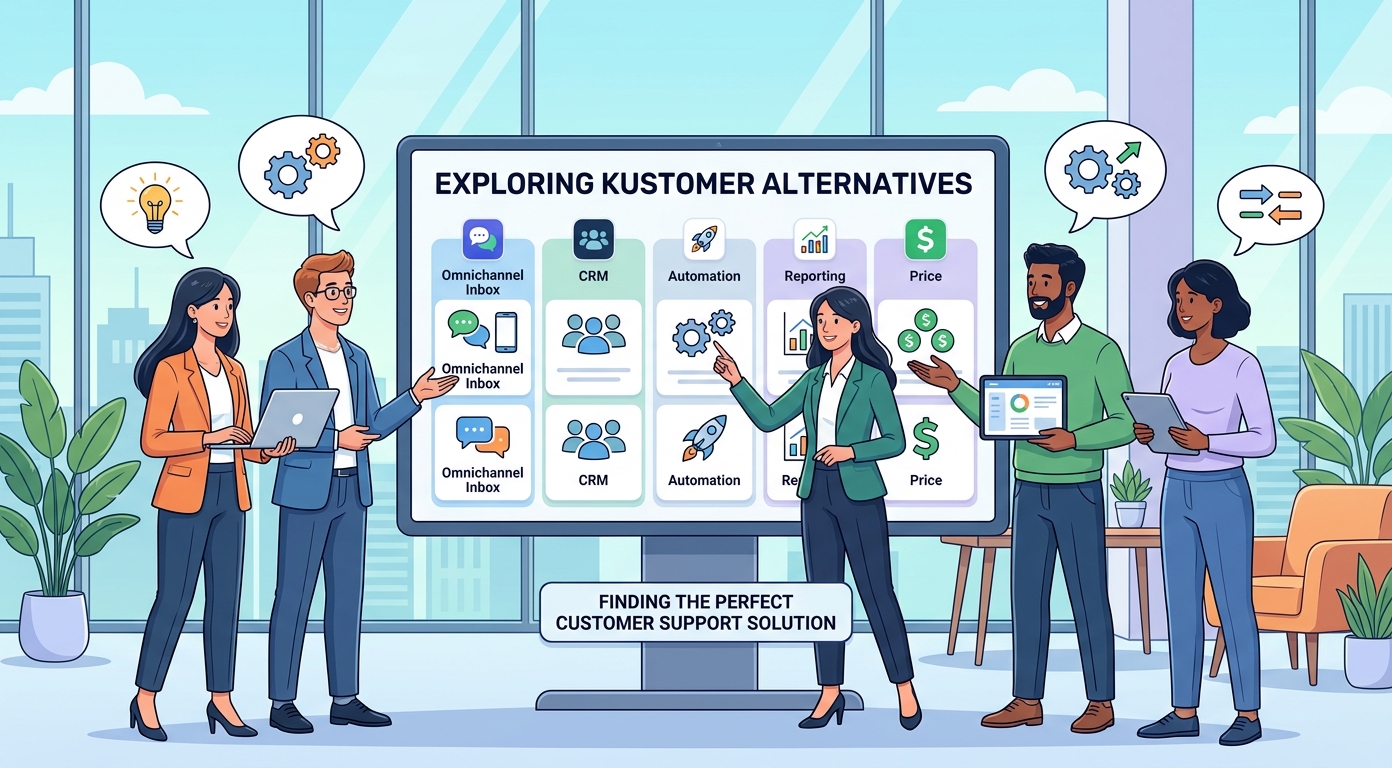
Kustomer alternatives cluster around two profiles: ecommerce helpdesks that match its order-aware, customer-centric support model at published prices (Gorgias, Re:amaze, Richpanel), and full customer service suites that match its enterprise scale (Zendesk, Freshdesk, Intercom). Kustomer is an enterprise CX platform built around a customer timeline: instead of tickets, every order, conversation, and event merges into one customer profile, with AI (Kustomer Concierge, AI Profiles, Agent Team Assistant) layered across chat, email, text, voice, and social channels. As of July 2026, Kustomer pricing is quote-based through a sales demo rather than published per-seat tiers, some omnichannel configuration may require a statement of work and an implementation fee, and voice and WhatsApp usage are pay-as-you-go.
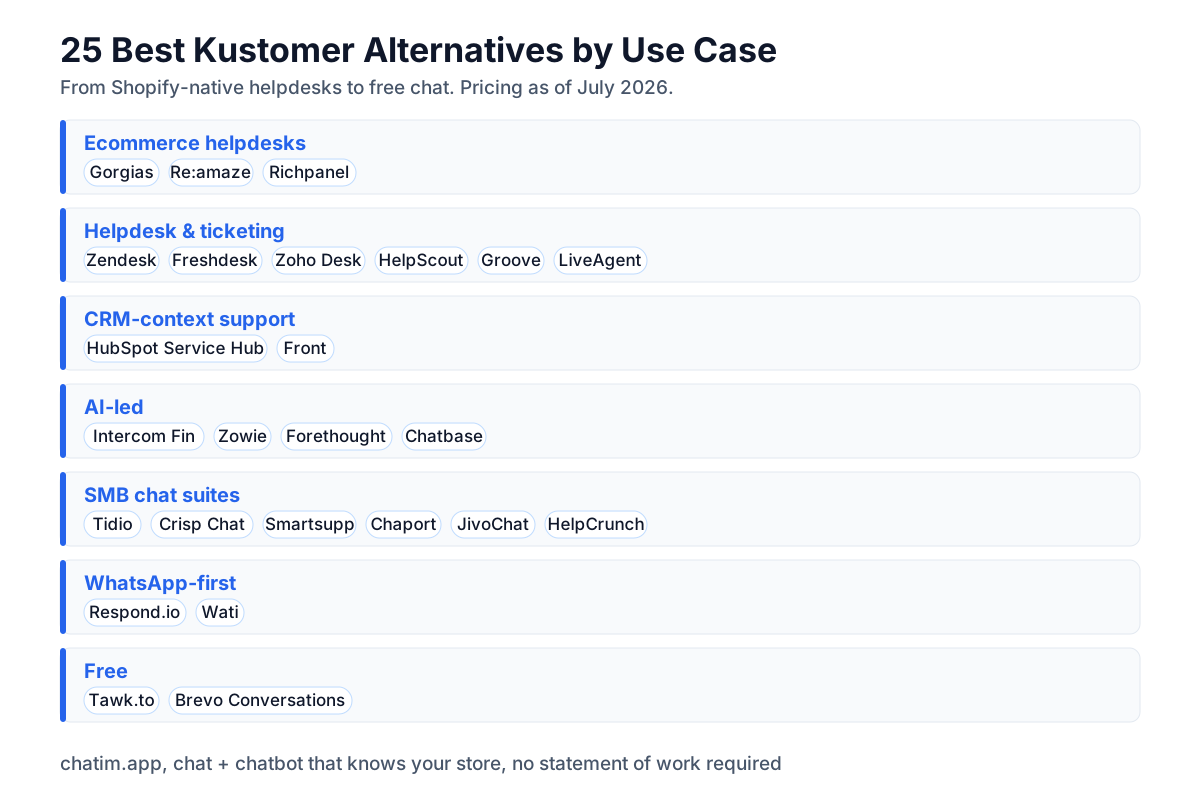
If the demo-led sales motion, the enterprise implementation weight, or per-contract pricing do not fit your team, this guide ranks the 25 best Kustomer alternatives in 2026. The list is organized by use case (ecommerce helpdesks, general helpdesk and ticketing, CRM-context support, AI-led automation, SMB chat suites, WhatsApp-first messaging, free options), with published pricing where available, key features, and the type of team each Kustomer alternative fits best. You will also find a quick comparison table, a recap of what Kustomer does well, a five-step buyer framework, and a 15-item FAQ. Prices reflect published tiers at July 2026; treat the vendor page as the final word.
When Kustomer stops fitting
Kustomer's customer-timeline model is genuinely different from ticket-based helpdesks. The reasons teams shop for a Kustomer alternative are usually about fit and procurement, not the concept.
- Quote-based pricing. Packages are sold through a scheduled demo, with terms set per contract. Teams that want published unit economics and a self-serve start are outside the model.
- Implementation weight. Kustomer's own pricing page notes that some omnichannel configuration may require a statement of work and an implementation fee. Budget for setup, not just seats.
- Usage add-ons. Voice (talk, SMS, transcription) and WhatsApp are pay-as-you-go, and HIPAA compliance is a paid add-on subscription, so total cost depends on channel mix.
- Sized for consumer brands at scale. The platform shines for high-volume B2C operations with rich customer data. A small support team pays enterprise overhead for context it could get from a Shopify-native helpdesk.
- Ecommerce specialists moved fast. Gorgias, Re:amaze, and Richpanel now deliver order-aware support with published SMB pricing, and suites like Zendesk and Intercom bundle AI agents with transparent per-resolution or per-seat costs.
Kustomer alternatives side by side
The table below compares every Kustomer alternative in this guide on the two questions buyers ask first: is there a free plan, and what does the entry paid tier cost.
| Kustomer alternative | Best for | Free plan | Paid from (as of July 2026) |
|---|---|---|---|
| Gorgias | Shopify-native helpdesk, ticket pricing | Trial only | Basic $50/month helpdesk, $77 with AI (annual) |
| Re:amaze | Multi-brand ecommerce support | 14-day trial | Basic $29 per user ($26.10 annual) |
| Richpanel | Ecommerce support with self-service portal | Trial | See vendor pricing page |
| Zendesk | Enterprise ticketing suite | Trial only | Suite Team $55 per agent (annual) |
| Freshdesk | SMB-to-midmarket ticketing | $0 for 1-2 agents (6 months) | Growth $19 per agent (annual) |
| Zoho Desk | Budget ticketing inside the Zoho suite | Yes, up to 3 users | Standard $14 per user (annual; Express $7) |
| HelpScout | Shared inbox with a human tone | Yes, up to 5 users | Standard $25 per user |
| Groove (now Helply) | Outcome-priced helpdesk, AI included | Demo | $1 per ticket, 250-ticket monthly minimum |
| LiveAgent | Helpdesk plus chat plus call center | 30-day trial | Small Business $15 per agent (annual) |
| HubSpot Service Hub | Support on the CRM record | Yes, free tools | Starter from $7 per seat (list $20) |
| Front | Shared inbox with customer context | 14-day trial | Starter $19 per seat (annual) |
| Intercom | Fin AI agent on a full suite | Trial only | Essential $29 per seat (annual) + Fin usage |
| Zowie | AI agents for ecommerce CX | Demo | Quote-based |
| Forethought | Agentic AI on your existing helpdesk | Demo | Quote-based |
| Chatbase | AI agent trained on your content | Yes, 50 credits/month | Hobby $32 per month (annual) |
| Tidio | Live chat plus Lyro AI | Yes, 50 conversations/month | Starter $24.17 per workspace (annual) |
| Crisp Chat | Multichannel inbox with mini-CRM | Yes, 2 seats | Mini $45 per workspace |
| Smartsupp | Low flat tiers by operator count | Yes, 1 operator, 25 conversations/month | Solo $17 (annual) |
| Chaport | Simple SMB chat, flat tiers | Yes, 2 operators | Pro from $29 (annual) |
| JivoChat | Chat plus phone plus social | Yes, basic features | Basic from $28 per agent (annual) |
| HelpCrunch | Chat plus email marketing | 14-day trial | Basic $12 per user (annual) |
| Respond.io | WhatsApp-led multichannel inbox | 7-day trial | Starter $79 per month |
| Wati | WhatsApp broadcasts plus chatbot | 7-day trial | Growth $59 per month (annual) |
| Tawk.to | Free unlimited-agent chat | Yes, unlimited agents | $0 core; Remove Branding $29 (annual) |
| Brevo Conversations | Free chat inside the Brevo suite | Yes | Pro about €13 per month |
Pricing and features change frequently, verify on each vendor's official pricing page before purchase. Some prices shown above reflect annual billing. Missing prices mean the vendor quotes by sales call or repricing moves too fast to pin down here. Currency is USD unless otherwise noted. Kustomer's packages were quote-based as of July 2026.
Chatim: customer context without the contract
Disclosure: Chatim is our own product. Kustomer's promise is support with full customer context at enterprise scale. For SMB teams, the practical version of that promise is a chat widget that knows the store: Chatim pairs live chat and a chatbot with native Shopify and WordPress integrations, predictable per-plan pricing, and a free tier, no statement of work required.
Try Chatim free at chatim.app →
Best ecommerce Kustomer alternatives
Kustomer's stronghold is consumer brands. These three deliver the same order-aware support model with published pricing and faster setup.
Gorgias, ticket-volume pricing for ecommerce
Gorgias connects natively to Shopify, BigCommerce, and WooCommerce, pulling order data next to every conversation and automating where-is-my-order and refund replies. Bills track ticket volume rather than seats: helpdesk-only Basic is $50 per month billed annually (300 tickets) and Pro $300 (2,000 tickets); adding the optional AI Agent lifts those to $77 and $471, with allowances of 30 and 190 automated interactions and overage at $1.50 each. For DTC teams, this is the most direct Kustomer replacement at SMB economics. Full guide: Gorgias alternatives.
Re:amaze, GoDaddy's ecommerce support brand
Re:amaze handles chat, email, social, and push in one inbox with first-class multi-brand support, the pick for operators running several storefronts. Per-user tiers run $29 for Basic ($26.10 annual), $49 for Pro, and $69 for Plus, with a flat-rate volume plan that removes the agent limit. See Re:amaze alternatives.
Richpanel, ecommerce support with a self-service portal
Richpanel pairs an ecommerce helpdesk with a customer self-service portal that lets shoppers track orders, request returns, and resolve common issues without an agent, cutting ticket volume at the source. The full tier list is public on the vendor's site. Strongest when deflection, not just agent efficiency, is the goal.
The helpdesk and ticketing route
When the requirement is a proven customer service platform rather than a customer-timeline data model, these six cover every budget.
Zendesk, enterprise support at seat pricing
Zendesk Suite bundles ticketing, messaging, help center, voice, and AI agents ($1.50 per resolution) with the deepest integration marketplace in customer service. Suite Team is $55 per agent per month billed annually, Professional $115. For enterprises leaving Kustomer, this is the default comparison with published math. Full guide: Zendesk alternatives.
Freshdesk, SMB-to-midmarket ticketing
Freshdesk covers ticketing, collaboration, a knowledge base, and Freddy AI with a 6-month $0 program for 1-2 agents and Growth at $19 per agent per month billed annually, Pro at $55, Enterprise at $89. The gentle-learning-curve pick for teams that want process without enterprise procurement.
Zoho Desk, low-cost ticketing for Zoho shops
Zoho Desk runs from a free 3-user plan to Standard at $14 per user per month billed annually (Express $7), with tight Zoho CRM integration that delivers a light version of Kustomer's customer-context promise inside the Zoho ecosystem. See Zoho alternatives.
HelpScout, the friendly shared inbox
HelpScout parks the whole team in one clean shared inbox, with Docs and Beacon chat alongside; customers never see ticket numbers. A free plan covers up to 5 users; paid tiers are $25 per user per month on Standard and $45 on Plus. Best for brands that want conversational quality without platform weight. Full guide: HelpScout alternatives.
Groove (now Helply), the outcome-billed inbox
Groove has relaunched as Helply, replacing per-user tiers with outcome pricing: $1 per ticket, unlimited seats, AI included, 250-ticket monthly minimum, annual contracts from $3,000. Best for teams that want costs tied to volume rather than headcount.
LiveAgent, helpdesk plus chat plus call center
LiveAgent bundles email ticketing, live chat, a knowledge base, social channels, and a real built-in call center (IVR, routing, recordings) at per-agent pricing: Small Business at $15 per agent per month billed annually up to Enterprise at $69, with a 30-day trial. The value pick when voice support matters and budgets are SMB-sized.
Best CRM-context alternatives
Kustomer's core idea is support with full customer context. These two deliver that context from a CRM rather than a proprietary timeline.
HubSpot Service Hub, support on the CRM record
HubSpot's free tools bundle live chat, a shared inbox, and ticketing basics directly on the HubSpot CRM record, with Starter from $7 per seat per month (list $20) and deeper AI and automation on paid hubs (Professional at $90-$100 per seat). Every conversation lands with full contact, deal, and marketing history attached, the closest published-pricing analog to Kustomer's context model. See HubSpot alternatives.
Front, shared inbox with customer context
Front unifies email, chat, SMS, and social in a collaborative inbox with internal comments, SLA rules, and CRM integrations that surface customer data beside every thread. Starter is $19 per seat per month billed annually; Growth at $59 adds the workflow depth. Best for relationship-heavy B2C and logistics operations. Full guide: Front alternatives.
The AI-first picks
Kustomer ships AI across its platform (Concierge, AI Profiles, Agent Assistant). These four approach the same automation goal from different angles.
Intercom, premium support with per-outcome AI
Intercom's Fin resolves conversations against your help content and hands the rest to a staffed inbox with routing and reporting. $29 per seat per month billed annually buys Essential, with Fin usage billed per resolution on top. The strongest published-pricing AI resolution engine. Full breakdown: Intercom alternatives.
Zowie, AI-led support for online brands
Zowie builds AI agents for consumer brands: automated resolution across chat, email, and social with order-aware actions and brand-voice control. Quote-based via demo, like Kustomer itself, but purpose-built for retail automation rates. Shortlist both and compare automation benchmarks on your own traffic.
Forethought, agentic AI on your existing helpdesk
Forethought layers autonomous resolution, triage, and agent-assist onto the helpdesk you already run (Zendesk, Salesforce, and others), trained on historical tickets. Quote-based. The low-migration option: modernize automation without changing the system of record.
Chatbase, DIY AI support agents
Chatbase trains an AI support agent on your website and documents and deploys it to web, Slack, WhatsApp, Messenger, or Instagram: free 50-credit tier, Hobby at $32 per month billed annually, Standard at $120 with helpdesk, voice, and API access. The self-serve entry into AI support automation.
Best SMB chat suites
Most teams researching Kustomer alternatives run support volumes that a right-sized chat suite covers at a fraction of the cost.
Tidio, chat and Lyro on one workspace
Tidio couples one of the category's most polished widgets with Lyro, its AI agent (add-on from $32.50 per month): free tier with 50 conversations per month, Starter at $24.17 per month billed annually on workspace pricing, with strong Shopify and WordPress apps. Full guide: Tidio alternatives.
Crisp Chat, multichannel inbox with a mini-CRM
Crisp bundles chat, email, WhatsApp, Instagram, a knowledge base, campaigns, and a lightweight CRM into one workspace-priced inbox: free 2-seat plan, Mini at $45 per month, Essentials at $95 for 10 seats. The mini-CRM gives small teams a taste of the customer-context model. Full guide: Crisp Chat alternatives.
Smartsupp, the ecommerce-lean budget pick
Smartsupp prices by operator count: after the free plan (1 operator, 25 conversations a month), Solo runs $17 per month billed annually, Plus $25 for 3 operators, and Expert $83 for 5 or more, each with unlimited conversations and an optional AI shopping assistant aimed at stores. See Smartsupp alternatives.
Chaport, budget chat that installs fast
Chaport stays deliberately simple: free for 2 operators, Pro from $29 per month billed annually, Unlimited from $99 with unlimited operators and chatbots. You can have chat running the same afternoon. See Chaport alternatives.
JivoChat, omnichannel on an SMB budget
JivoChat merges website chat, email, and social messengers with telephony (the Telephony Plus module) into a single agent workspace. Pricing starts free, then Basic at $28 per agent per month billed annually and Professional at $42. The budget omnichannel pick. Full guide: JivoChat alternatives.
HelpCrunch, the lifecycle messaging combo
HelpCrunch folds email marketing into the support stack: live chat, shared inbox, knowledge base, popups, and campaigns at $12 per user per month billed annually ($15 monthly) on Basic and $20 on Pro. One subscription covers support and lifecycle messaging. Full guide: HelpCrunch alternatives.
WhatsApp-centric picks
On Kustomer, WhatsApp is a pay-as-you-go channel. If messaging apps carry your volume, these two make them the core product.
Respond.io, the contact-based messaging platform
Respond.io treats messaging channels as the core product: WhatsApp, Instagram, Messenger, Telegram, and SMS in a single inbox with automation and broadcasts, priced on monthly active contacts at $79 (Starter) and $159 (Growth) per month. Full guide: Respond.io alternatives.
Wati, WhatsApp inbox and bot on a budget
Wati gives SMBs a WhatsApp-first stack (broadcasts, no-code chatbot, team inbox) from $59 per month billed annually on Growth with 3 users; message charges pass through at cost.
Best free Kustomer alternatives
At the opposite end of the enterprise demo: free, self-serve, live today.
Tawk.to, the zero-dollar incumbent
Tawk.to charges nothing for the core product, unlimited agents and unlimited chats included, and sells the extras instead: branding removal at $29 per month billed annually and AI Assist from $29. Full guide: Tawk.to alternatives.
Brevo Conversations, free chat inside the Brevo suite
Brevo Conversations (the successor to Chatra, which Brevo acquired) offers a free chat plan inside the wider Brevo marketing suite, with Pro at about €13 per month adding automation. A practical free start for teams already using Brevo for email.
Choosing a Kustomer alternative: a buyer framework
Five questions turn 25 options into a shortlist.
- 1. Is the customer-timeline model the requirement? If support must see orders, history, and events on one profile, shortlist HubSpot (CRM-native), Gorgias and Richpanel (commerce-native), and Front (CRM-integrated). If tickets work fine, the helpdesk column costs less.
- 2. What does your channel mix cost? Kustomer meters voice and WhatsApp pay-as-you-go. Price your real volumes against Respond.io or Wati (messaging-first) and LiveAgent or JivoChat (bundled voice).
- 3. Published pricing or procurement? If the demo-and-contract motion is the problem, filter to self-serve vendors: everything in this guide except Zowie and Forethought publishes prices or starts free.
- 4. How much AI, on whose meter? Per-resolution (Zendesk, Intercom Fin) scales with outcomes; credit-based (Chatbase) suits predictable volume; quote-based automation (Zowie, Forethought) mirrors Kustomer's own model.
- 5. What scale are you really at? Thousands of daily conversations across brands justifies the enterprise column. Hundreds a week belongs with Gorgias, Re:amaze, or an SMB suite at a tenth of the total cost.
Kustomer at a glance: strengths and positioning
Switching is not always the right call. Kustomer's data model remains genuinely differentiated for the brands it serves.
What Kustomer does well: the customer timeline (support organized around people, not tickets); omnichannel messaging across chat, email, text, voice, and social with 300-brand support; AI throughout the platform (Kustomer Concierge, AI Profiles, Agent Team Assistant, Envoy, AI summaries, two-way translation); deep customization (custom objects, attributes, insight panes); enterprise security (SAML SSO, SCIM, custom permission sets, data masking); and scale features like smart routing, SLA management, and real-time supervision.
Where it falls short for typical teams: quote-based packages behind a scheduled demo; possible statement-of-work implementation fees for omnichannel configuration; pay-as-you-go voice and WhatsApp on top of subscriptions; HIPAA as a paid add-on; and enterprise overhead that small and midsize support teams will pay for without loading.
The questions everyone asks
To zoom out from Kustomer specifically, the guides on the best live chat platforms, Gorgias alternatives, Re:amaze alternatives, and Zendesk alternatives. Dedicated platform rankings: live chat for Shopify and WordPress live chat plugins.
Watching the budget? Our best free live chat software roundup collects the tools with genuinely usable free plans.
Frequently Asked Questions
What is Kustomer?
Kustomer is an enterprise customer experience platform built around a customer timeline: instead of tickets, every order, conversation, and event merges into one customer profile. It covers omnichannel messaging (chat, email, text, voice, and social including Facebook, Instagram, and WhatsApp), smart routing, SLA management, and AI features including Kustomer Concierge, AI Profiles, an Agent Team Assistant, AI summaries, and two-way message translation. As of July 2026, packages are quote-based through a scheduled demo.
What is the best Kustomer alternative in 2026?
For DTC and ecommerce brands: Gorgias (Shopify-native, ticket-based, helpdesk from $50 per month billed annually), Re:amaze (multi-brand, from $29 per user), or Richpanel (self-service portal). For enterprise scale with published pricing: Zendesk (Suite Team $55 per agent plus $1.50 per AI resolution) or Intercom (Fin AI from $29 per seat). For CRM-context support: HubSpot Service Hub. For retail AI automation on Kustomer's own quote-based model: Zowie. For small teams: Tidio, Crisp Chat, or Smartsupp.
How much does Kustomer cost?
As of July 2026, Kustomer does not display per-seat prices on its pricing page; packages are sold through a scheduled demo with terms set per contract. The page also notes that some omnichannel configuration may require a statement of work and an implementation fee, that Kustomer Voice (talk, SMS, transcription) and WhatsApp are pay-as-you-go, and that HIPAA compliance is a paid add-on. If you need published economics, Zendesk, Intercom, Gorgias, and the SMB suites in this guide all publish theirs.
Does Kustomer have a free plan or trial?
Kustomer's sales motion runs through a scheduled demo as of July 2026; there is no self-serve free tier. If you want to start without a sales cycle: Gorgias offers a trial with ticket-based pricing (helpdesk-only Basic $50 per month billed annually; $77 with the optional AI Agent), Freshdesk offers a 6-month free program for up to 2 agents (not a permanent free plan) and Zoho Desk has a free plan, HubSpot Service Hub's free tools include chat and ticketing on the CRM, Tidio and Smartsupp keep free chat tiers, and Tawk.to is free with unlimited agents.
Which Kustomer alternative is best for Shopify and ecommerce?
Gorgias is the most direct pick: native Shopify, BigCommerce, and WooCommerce integrations surface order data next to every conversation, with automation for where-is-my-order and refund flows on ticket-volume pricing (helpdesk-only Basic $50 per month billed annually, never per agent). Re:amaze adds first-class multi-brand support for multi-storefront operators. Richpanel leads on customer self-service deflection. Zowie is the AI-automation specialist for consumer brands. Among chat suites, Tidio and Smartsupp ship strong Shopify apps.
Which Kustomer alternative keeps the customer-context model?
HubSpot Service Hub is the closest published-pricing analog: every conversation lands on the CRM contact record with deal and marketing history attached, free tools included and Starter from $7 per seat per month (list $20). Front surfaces CRM data beside every thread in its shared inbox (from $25 per seat). Gorgias and Richpanel deliver commerce-specific context (orders, fulfillment, returns). Crisp Chat includes a lightweight built-in CRM at SMB pricing. Zoho Desk pairs with Zoho CRM for the same effect inside the Zoho ecosystem.
How does Kustomer compare with Gorgias?
Both serve ecommerce support, at different scales and sales motions. Gorgias publishes ticket-based pricing, never per agent (helpdesk-only Basic $50 per month billed annually; $77 with the optional AI Agent), connects natively to Shopify in minutes, and targets SMB-to-midmarket DTC brands. Kustomer is quote-based, organizes everything on a customer timeline rather than tickets, spans voice and 300 brands, and targets enterprise consumer operations, with possible implementation fees for omnichannel setup. High-volume multi-channel brands justify Kustomer; most Shopify merchants get there faster with Gorgias.
How does Kustomer compare with Zendesk?
Zendesk is ticket-based with published pricing (Suite Team $55 per agent per month billed annually; AI Agents $1.50 per resolution) and the deepest integration marketplace in customer service. Kustomer replaces the ticket with a customer timeline and sells by quote. Zendesk wins on ecosystem, transparent economics, and admin talent availability; Kustomer wins when the unified customer profile across brands and channels is the core requirement. Enterprises usually shortlist both; the pricing model difference decides procurement speed.
How does Kustomer compare with Intercom?
Intercom centers on messaging plus Fin, one of the strongest AI resolution engines, with published pricing (Essential $29 per seat per month billed annually; Fin billed per resolution). Kustomer centers on the customer timeline with AI layered across the platform, sold by quote. Intercom starts self-serve and scales into the enterprise; Kustomer starts enterprise. Teams whose primary goal is AI deflection usually benchmark Fin first; teams whose primary goal is unified customer data across brands lean Kustomer.
What are the best AI alternatives to Kustomer's AI features?
Intercom Fin (per-resolution on published seat pricing) is the benchmark AI resolution engine. Zowie mirrors Kustomer's quote-based model with retail-focused AI agents and order-aware actions. Forethought layers agentic AI onto the helpdesk you already run (the lowest-migration path). Chatbase (from $32 per month billed annually) is the self-serve option: train an agent on your content in an afternoon. Zendesk AI Agents price automation at a flat $1.50 per resolution.
Can I migrate from Kustomer to an alternative easily?
Plan three moves: data, channels, and automation. Export customers, conversations, and custom objects via Kustomer's API or exports; most destinations (Zendesk, Gorgias, Freshdesk, HubSpot) import contacts and history via CSV or native importers, though timeline-style custom objects may flatten into ticket fields. Channels (chat widget, social accounts, WhatsApp numbers) re-point to the new platform. Automation rebuilds in the destination's tools. Run both in parallel on a traffic slice, and time cutover to your contract renewal.
Which Kustomer alternative is best for a small business?
Skip the enterprise column. Gorgias covers order-aware ecommerce support on ticket-based pricing, never per agent (helpdesk-only Basic $50 per month billed annually). Tidio (free tier; Starter $24.17 per month billed annually) and Smartsupp (Solo $17, annual) cover website chat with AI options. Helply, ex-Groove ($1 per ticket) and Freshdesk ($0 for 1-2 agents for 6 months, then from $19) cover ticketing. HubSpot's free tools add CRM context at $0. All publish prices and deploy without an implementation contract.
Which Kustomer alternative handles voice and phone support?
Kustomer meters voice pay-as-you-go. LiveAgent bundles a real call center (IVR, routing, recordings) with ticketing and chat from $15 per agent per month billed annually, the strongest voice value at SMB pricing. JivoChat bundles telephony via its Telephony Plus module on paid plans from $28 per agent. At enterprise scale, Zendesk's Suite includes voice. Price your actual call volume against Kustomer's usage rates before assuming bundled is cheaper.
Which Kustomer alternative is best for WhatsApp?
Kustomer supports WhatsApp Business accounts with pay-as-you-go usage. If WhatsApp carries real volume, messaging-first platforms cost less to run: Wati (from $59 per month billed annually) for broadcasts and a no-code chatbot, Respond.io (from $79, priced by monthly active contacts) for automation across WhatsApp, Instagram, Messenger, Telegram, and SMS. Crisp Chat bundles WhatsApp alongside website chat on workspace pricing ($45 per month for 4 seats).
Is there a free Kustomer alternative?
For chat: Tawk.to (free, unlimited agents), HubSpot Service Hub free tools (chat plus ticketing on the CRM), Tidio (50 conversations per month), Smartsupp (25 conversations, 1 operator), Chaport (2 operators), and Brevo Conversations (free plan inside the Brevo suite). For ticketing: Freshdesk (1-2 agents, 6 months) and Zoho Desk (3 users). None replicates the full customer-timeline model at $0, but HubSpot's free CRM-attached inbox comes closest for small teams.
Related articles
More in Alternatives → 25 Rocket.Chat Alternatives for Chat and Support (2026)
Rocket.Chat tries to be team chat and support chat at once. 25 alternatives that pick a lane or do both, self-hosted and cloud
 25 LivePerson Alternatives for 2026: Enterprise to SMB
LivePerson does not publish pricing. These 25 alternatives range from Genesys-scale suites to Tidio-simple tools, and most show theirs openly.
 25 Dixa Alternatives in 2026: From Gorgias to Zendesk
Dixa's all-in-one promise, delivered 25 other ways: Shopify-deep Gorgias, budget-voice LiveAgent, enterprise Zendesk and lighter chat tools.
 25 Chatwoot Alternatives: Open Source and Hosted (2026)
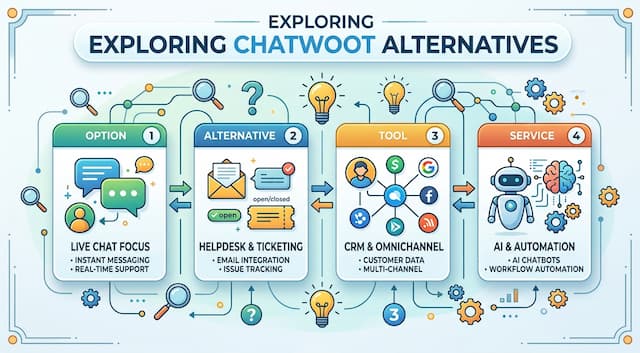
Want Chatwoot without the self-hosting, or open source without Chatwoot? 25 alternatives both ways, with licensing notes