Live Chat vs Chatbot: Which One Does Your Website Need?
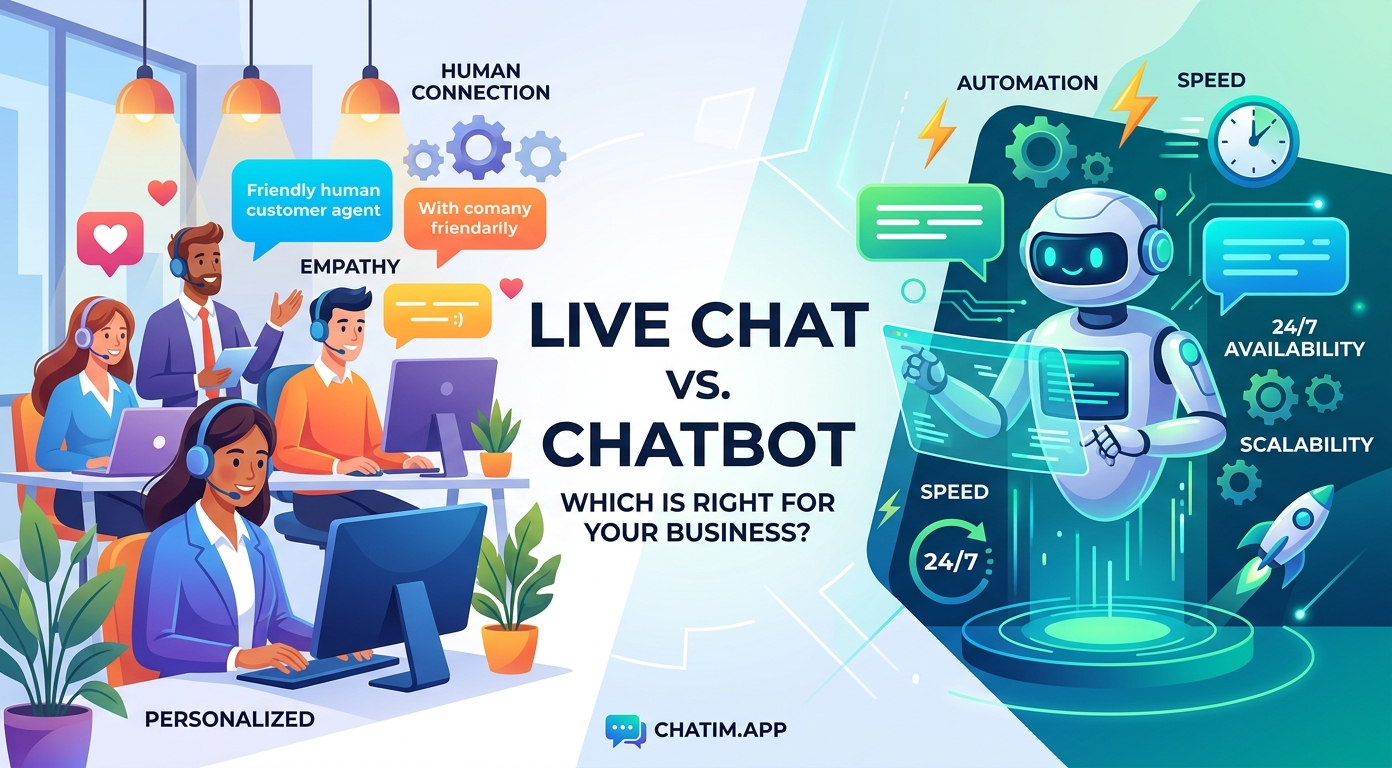
Live chat vs chatbot is a false choice dressed up as a decision: live chat is a human answering your website visitors in real time, a chatbot is software answering them automatically, and the businesses that get the most from either almost always run both. The real questions are narrower and more useful: which conversations deserve a human, which ones a bot handles better than a human ever will, and how the handoff between them should work. This guide answers those, with a plain comparison first for anyone who just needs the definitions.
One disclosure up front: we make a product that does both, which is exactly why we think the versus framing is the wrong one. Judge the arguments on their logic.
Live chat vs chatbot at a glance
| Live chat | Chatbot | |
|---|---|---|
| Who answers | A human agent, in real time | Software: rule-based flows or AI |
| Availability | Business hours (or expensive shifts) | 24/7, instantly, at any volume |
| Best at | Judgment, empathy, edge cases, sales conversations | Repetitive questions, lead capture, routing, after-hours |
| Weak at | Scale and nights; humans queue | Novel problems, emotion, ambiguity |
| Cost shape | Scales with headcount | Scales with almost nothing |
| Customer feeling when done right | Heard and helped | Unblocked instantly |
| Customer feeling when done wrong | Waiting in a queue | Trapped in a loop |
What live chat is
Live chat is a widget on your website or app where visitors type a message and a person on your team answers in real time. Its superpower is timing plus judgment: it catches a visitor at the moment of doubt (pricing question, checkout hesitation, setup problem) and applies a human brain to whatever shape the problem takes. Its limits are human too: agents sleep, queue, and cost money per conversation, which is why pure live chat gets expensive exactly when it starts working, when volume grows.
What a chatbot is
A chatbot is software that holds the conversation itself: rule-based flows that walk visitors through defined paths (questions, menus, forms), or AI chatbots that answer in free language from your docs and knowledge base. Its superpower is scale and patience: the five hundredth "what are your hours" gets the same instant, correct answer as the first, at three in the morning, in any volume. Its limit is the edge: novel problems, angry customers, and ambiguous situations where the right move is judgment, not retrieval.
The differences that actually matter
Coverage. A bot never closes. If your visitors browse at night or across timezones (they do), the bot is the difference between capturing that demand and reading about it in analytics.
Cost shape. Live chat scales linearly with people; a bot's marginal conversation is nearly free. That is not an argument for replacing humans; it is an argument for not spending humans on questions a lookup can answer.
Resolution depth. Humans resolve ambiguity, exceptions, and emotion. Bots resolve the known. Teams get in trouble when they assign either one the other's half.
Sales weight. High-intent conversations (pricing, plans, "will this work for us") close better with a human, and buyers know the difference. The bot's sales job is earlier: qualify, answer the basics, book the call, capture the lead when nobody is awake.
Failure modes. Live chat fails as a queue; a chatbot fails as a loop. Both failures have the same fix: an honest, visible path to the other channel.
When live chat wins
Choose the human when the conversation is high-stakes or high-ambiguity: pre-sales questions from serious buyers, billing disputes, angry customers whose real need is to be heard, technical problems that require diagnosis rather than lookup, and any conversation where the customer has already fought a bot somewhere else today. Live chat also wins in tiny operations with low traffic: if you get five chats a day, you do not have a scale problem, and the personal touch is your advantage. Our live chat statistics roundup covers what responsiveness does to conversion in these moments.
When a chatbot wins
Choose the bot when the question repeats: hours, shipping, returns policy, password resets, "how do I" setup questions, order status, and lead capture on landing pages. Add every hour a human is not available; an answer at 2 a.m. beats an apology at 9 a.m. And add the front-door job: greeting, qualifying, and routing, so the human conversation starts with the context already collected instead of with "can I have your email". Done well, visitors do not resent the bot, because it does the one thing they came for: it unblocks them immediately. Done badly (no exit, fake human names, loops), it converts a support question into a churn story, which is why the chatbot satisfaction guide spends most of its time on exits and honesty.
The setup that beats both: bot first, human close
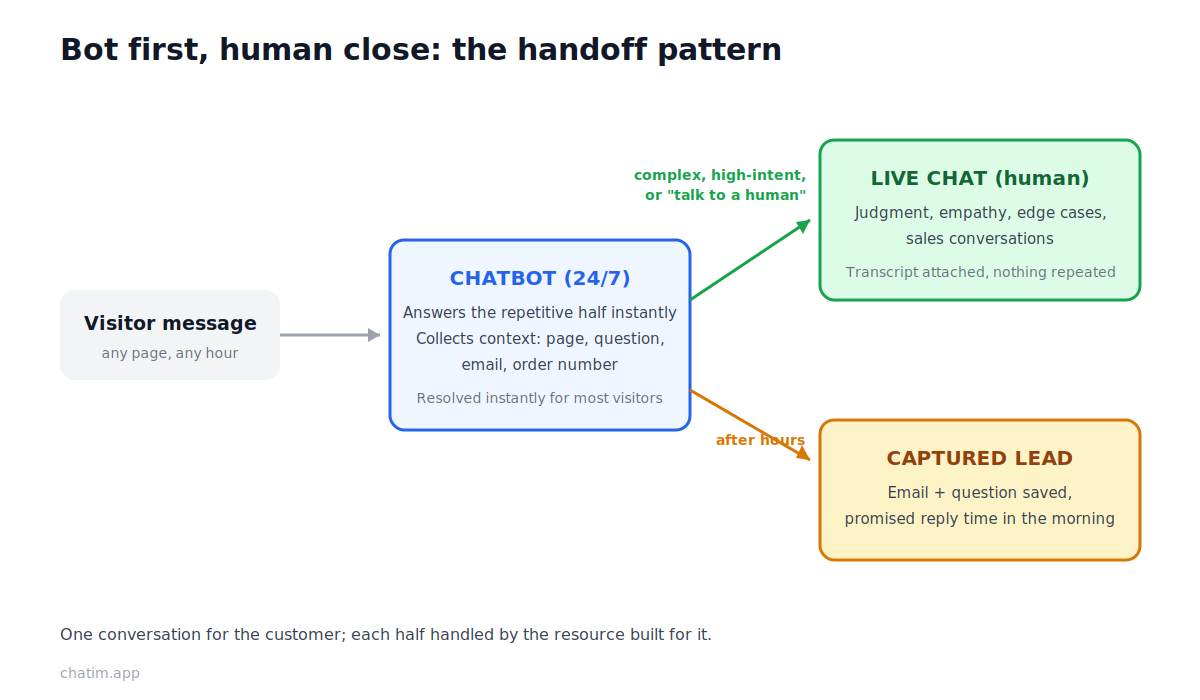
The pattern that outperforms either extreme is boring and effective. The chatbot greets and answers the repetitive half instantly, around the clock. It collects context as it goes: the page, the question, the email, the order number. The moment a conversation crosses a line (explicit request, detected frustration, high-intent topic, or simply "talk to a human"), it hands off to live chat with the transcript attached, so the customer never repeats themselves. After hours, the same handoff becomes a captured lead with a promised reply time. The customer experiences one conversation; behind it, each half went to the resource built for it. That is the whole argument, and it is why the versus question dissolves in practice: the customer support template is that exact pattern, prebuilt.
What AI chatbots changed (and what they did not)
AI moved the boundary, not the principle. An AI chatbot trained on your documentation answers free-form questions that would have stumped a rule-based flow, which shifts a real slice of conversations from "needs a human" to "handled instantly." What AI did not change: accountability and edge cases. It still needs your content to be right, its answers still need a human escape hatch, and high-stakes conversations still close better with a person. Treat AI as the bot's ceiling rising, not the human's floor disappearing, and keep the handoff pattern exactly where it was.
Choosing for your business, in one paragraph
If you are a small team with real traffic: bot first for coverage, humans for the conversations the bot escalates; this is the highest-leverage setup per dollar. If you are tiny with little traffic: live chat alone is fine, add the bot when the same five questions start repeating. If you are considering bot-only with no human path: do not; the loop failure mode costs more than the agents you saved. And if you are comparing tools for either half, our live chat software comparison covers the field, free tiers included. The honest summary of live chat vs chatbot is that the versus was never the decision; the handoff was.
Related reading: AI chatbot for your website, chatbot vs AI agent, and live chat best practices.
Frequently Asked Questions
What is the difference between live chat and a chatbot?
Live chat is a human agent answering website visitors in real time through a chat widget. A chatbot is software holding the conversation automatically, either through rule-based flows or AI answering from your content. Live chat brings judgment and empathy; a chatbot brings instant answers at any hour and any volume. Most effective setups run both with a handoff between them.
Which is better, live chat or a chatbot?
Neither is better overall; they are built for different halves of the conversation load. Chatbots win on repetitive questions, after-hours coverage, lead capture, and routing. Live chat wins on ambiguity, emotion, diagnosis, and high-intent sales conversations. The setup that outperforms either alone is bot-first with a human handoff.
Can a chatbot replace live chat completely?
Not safely. A bot-only setup with no human path fails on edge cases, ambiguity, and frustrated customers, and its failure mode (the loop with no exit) actively damages trust. Bots can absorb the majority of repetitive volume, but every bot needs a visible escape hatch to a person or, after hours, a captured contact with a promised reply time.
Do customers prefer live chat or chatbots?
Customers prefer whichever unblocks them fastest for their specific question. For simple lookups (hours, order status, how-to), an instant bot answer beats waiting for a human. For complex or emotional issues, people strongly prefer a human. Resentment appears when the channels are miscast: humans queueing on trivial questions, or bots trapping people on hard ones.
What is live chat on a website?
A chat widget embedded on a website or app where visitors type messages and a team member replies in real time. It catches questions at the moment they block a purchase or a workflow, which is why response speed in live chat correlates with conversion: the visitor is still on the page when the answer arrives.
What is a chatbot used for?
The repetitive, definable half of conversations: answering common questions instantly, greeting and qualifying visitors, capturing leads after hours, collecting context (email, order number, issue type), and routing conversations to the right person. AI chatbots extend this to free-form questions answered from your documentation and knowledge base.
How does the handoff between a chatbot and live chat work?
The bot handles the conversation until a trigger fires: the visitor asks for a human, the topic is high-intent or sensitive, or the bot cannot answer. It then transfers to a live agent with the transcript and collected context attached, so the customer never repeats themselves. After hours, the handoff becomes a captured lead with a promised reply time.
When should a small business add a chatbot to live chat?
When the same questions dominate the chat log week after week, or when messages arrive outside business hours and go unanswered until morning. Both signals mean a bot would absorb real volume. A tiny store with five chats a day can stay human-only comfortably; the bot earns its place as repetition and after-hours demand grow.
Are AI chatbots better than rule-based chatbots?
They answer a wider range: AI chatbots respond to free-form questions using your documentation, where rule-based flows only walk defined paths. Rule-based flows remain better for structured jobs (lead forms, booking, routing) because they are predictable. Many setups combine both: flows for structure, AI for open questions, human handoff for the rest.
Does live chat or a chatbot convert better for sales?
They convert different stages. Bots convert coverage: capturing and qualifying leads that would otherwise bounce, especially after hours. Humans convert decisions: pricing and fit questions from serious buyers close better with a person. The combined pattern (bot qualifies, human closes) outperforms either channel doing both jobs.
What are the downsides of chatbots?
The known ones: they fail on novel or ambiguous problems, they frustrate people when there is no exit to a human, and an AI bot is only as accurate as the content it answers from. All three are design problems more than technology problems, solved by honest bot identity, a visible human path, and maintained source content.
How much does live chat vs a chatbot cost?
The cost shapes differ more than the price tags: live chat costs scale with the humans answering (headcount, hours), while a chatbot's additional conversations cost almost nothing once it is set up. Many tools, including free tiers, bundle both, which is why the practical question is usually not which to buy but how to split the conversation load between them.
Can live chat and a chatbot run in the same widget?
Yes, and that is the standard modern setup: one widget where the bot greets, answers the repetitive half, and hands conversations to human agents with context attached. To the visitor it is one continuous conversation; behind it, each message goes to whichever resource (software or human) is built for it.
Related articles
More in Comparisons → Help Desk vs Service Desk: The Real Difference (2026)
Help desk vs service desk in one line: issue-fixing vs service lifecycle. The five differences that matter, why the terms blur, and which one you need.
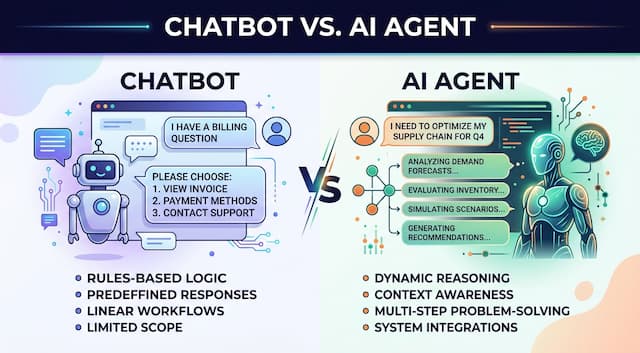 Chatbot vs AI Agent: Where the Line Actually Sits (2026)
Chatbot vs AI agent in plain terms: what each one does, where the line blurs, and how to add autonomy to support and sales without losing control.
 Zoho Desk vs Zendesk in 2026: The Price Gap, Examined
Zoho Desk vs Zendesk in 2026: included AI vs a quiet meter, and where Zendesk earns it
 Zoho Desk vs Freshdesk in 2026: Value Against Value
Zoho Desk vs Freshdesk in 2026: included AI vs a session meter, and the telephony math