Live Chat Best Practices: A Working Playbook (2026)

Most live chat best practices articles read like they were written by someone who has never taken a shift in the queue. This one is a working playbook: the habits that make chat feel effortless to the visitor and sustainable for the team, the settings that quietly decide whether the widget helps or nags, and the numbers that tell you the truth about how you are doing. Everything here works for a team of one; most of it is about judgment and configuration rather than headcount or budget.
If you are still choosing a tool, start with our live chat software comparison and come back; this page assumes the widget is installed and asks how to run it well.
Speed is the promise the channel makes
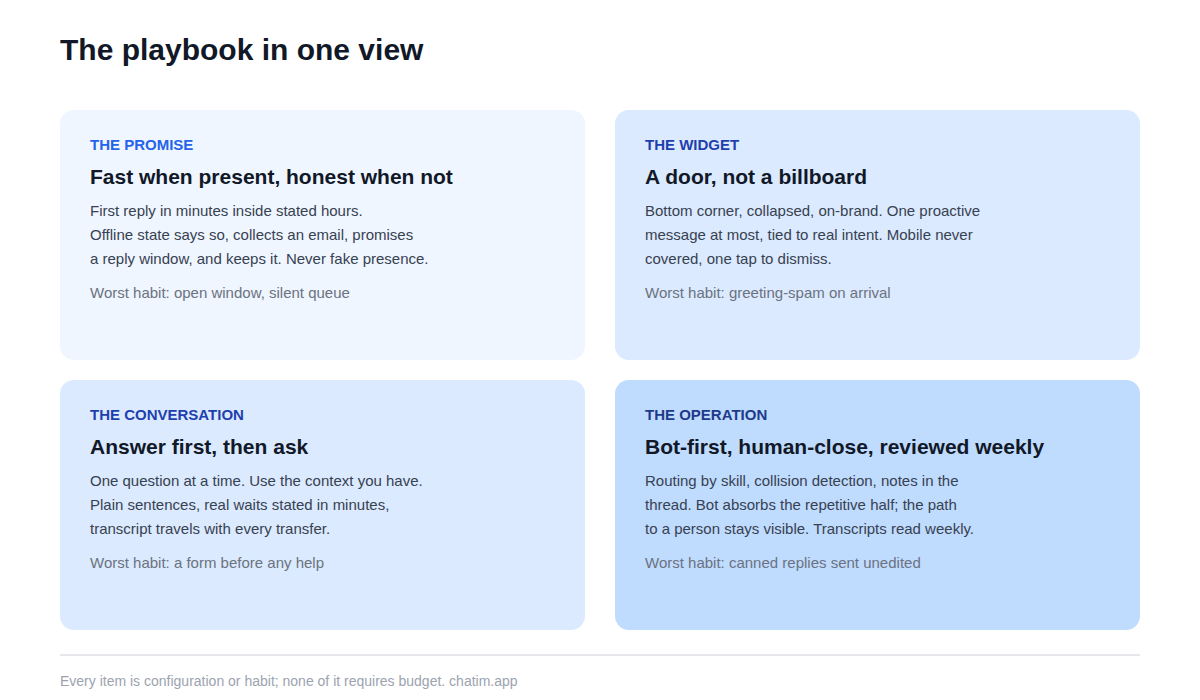
Chat implies minutes the way email implies hours; a visitor who wanted to wait would have written an email. That gives you two honest options for any given hour of the day: staff the widget so first replies arrive within a few minutes, or say clearly that you are away and set the expectation you can actually meet. What kills trust is the third option most sites choose by accident: an open chat window, a typing indicator of silence, and an answer the next afternoon. Decide your real coverage hours, meet the promise inside them, and change the widget's behavior outside them.
Be honest about being away
The offline state is a best practice most teams never configure. When nobody is on shift, the widget should say so, collect an email, promise a reply window, and keep that promise. Pair it with a bot that covers the routine questions after hours and the offline state stops being a dead end at all: the visitor either gets the answer immediately or knows exactly when a person will follow up. Faking presence, by contrast, converts one disappointed visitor into someone who distrusts the widget forever, and they rarely give it a second chance.
Set the widget up to help, not to nag
Bottom corner, collapsed by default, styled to match your site. Restraint with proactive messages: at most one, tied to real intent like a long pause on the pricing page, never fired on arrival. A good welcome message earns its place by being specific and short rather than chirpy. On mobile, the collapsed widget must not cover buttons, and the open chat must close in one tap. The test for every setting is the same: does this help a visitor who has a question, without taxing the majority who do not?
Run the conversation like a professional
The craft inside the chat window is small and learnable. Open with an answer-shaped reply, not a form: if the question is clear, answer it, and collect details afterward only if needed. Ask one question at a time; a message with three questions gets one answer. Watch the context you already have (the page they are on, the plan they are on) so they never have to explain what your own tools can tell you. Write like a person, in short plain sentences, and match the visitor's energy rather than a script's. When you need time, say so with a number: "give me five minutes to check" beats a silent gap every time. And when a colleague takes over, the transcript goes with the conversation, so the visitor never repeats themselves.
Team habits that survive growth
Past a team of one, the failures move between people. Routing sends billing questions to whoever can see invoices and technical ones to whoever can read logs. Collision detection stops two agents answering the same thread. Internal notes keep the context in the conversation instead of in someone's head. Canned responses are for the sentences you type ten times a day, and the practice that keeps them healthy is editing the first line to fit this visitor before sending; a reply that opens with their situation reads as service, one that opens with boilerplate reads as deflection. Weekly, someone reads a sample of transcripts, because that is where every other habit on this page is actually inspected.
Pair chat with a bot, in the right order
The strongest setup on most sites is bot-first for the repetitive half and human-close for everything else. The bot absorbs password resets, plan questions, and after-hours volume instantly; the human takes over the moment stakes or emotion appear, with the transcript attached. Two rules keep the pairing honest: the path to a person stays visible in every conversation, and the bot answers only from content you keep current. Done this way, the bot does not replace the chat team; it clears the queue so the team's minutes go where minutes matter.
The numbers that keep you honest
Four cover a small team. First response time inside stated hours, because it is the promise the channel makes. Resolution rate on first contact, tracked separately from conversations that needed a follow-up. CSAT on closed conversations, read as a trend, and read alongside its comments, which are where the real information lives. And missed chats: conversations that started and got no reply in time, which is the single most damaging number on the list and the easiest one to hide from yourself. For category context on any of these, our live chat statistics roundup collects the published research; your own trend line still beats it for decisions.
Mistakes to avoid, and where to start
The recurring sins: pretending to be online, greeting-spamming every visitor, opening with a contact form before any help, pasting unedited boilerplate, transferring without the transcript, and treating the chat log as a record instead of a to-do list. None of them costs money to fix. If you are starting from zero, the order that works is: set real coverage hours and the honest offline state, write ten short answers to your most-asked questions, turn restraint up on proactive messages, and put a weekly half hour of transcript reading in the calendar. The live chat itself is free to run at small scale, and paid plans only matter once volume and team size make the team habits above load-bearing.
More on this from our team: live chat vs chatbot, lead generation through live chat, and SaaS customer support.
Frequently Asked Questions
What are live chat best practices?
The short list: reply in minutes inside stated hours and be honest when away, keep the widget helpful rather than pushy, answer before you ask for details, carry context so visitors never repeat themselves, pair a bot with a visible path to a human, and read transcripts weekly. Most of it is configuration and habit, not budget.
What is a good response time for live chat?
Fast enough that the visitor stays in the flow they were in, which in practice means the first human reply lands within a few minutes during stated hours. More important than any target is the match between promise and delivery: a widget that says 'we reply in about ten minutes' and does so outperforms one that implies instant and delivers eventually.
Does live chat need to be available 24/7?
No, and pretending it is causes more damage than closing at night ever will. Set real coverage hours, meet them, and configure the offline state to collect an email with a promised reply window. A bot covering routine questions after hours closes most of the gap without anyone losing sleep.
Should chat pop up automatically with a message?
Sparingly. One proactive message tied to real intent, like a long pause on the pricing page, can start good conversations; a greeting fired at every arrival teaches visitors to close widgets on reflex. If unsure, launch with proactive messages off and add one deliberate trigger later, judged by its own transcripts.
Are canned responses bad practice?
Unedited ones are. The healthy version treats a canned response as a starting draft: the facts are pre-written, and the first line gets edited to address this visitor's situation before sending. That keeps speed without the boilerplate feel that makes people ask for a manager.
How do I handle an angry customer in chat?
Acknowledge before you solve: one sentence that shows you read what happened, then concrete next steps with times attached. Do not paste policy, do not hand them to a bot, and do not make them re-explain after a transfer. Chat's speed is an advantage here; a fast, human, specific reply defuses most of what slow templated email inflames.
Should a bot or a human answer first?
For most sites, bot-first with a fast, visible path to a human. The bot resolves the repetitive half instantly and around the clock; the human takes anything with stakes, emotion, or ambiguity, receiving the transcript so nothing is repeated. The setup fails only when the path to a person is hidden to protect the numbers.
How many chats can one agent handle at once?
There is no universal number worth quoting; capacity depends on question complexity and how much context the tooling surfaces. Watch your own signals instead: when response times inside conversations stretch, transfers get sloppy, or CSAT comments mention feeling rushed, concurrency is too high, whatever the count says.
How should a chat conversation end?
With the loop closed: confirm the thing is solved or say exactly what happens next and when, invite the visitor to come back if it resurfaces, and let them have the last word. Post-resolution surveys are fine when they are one tap; three-question forms after a thirty-second answer are how good interactions earn bad ratings.
What metrics should a small team track for chat?
Four: first response time inside stated hours, first-contact resolution, CSAT as a trend with its comments read, and missed chats. Missed chats deserve the most attention; it is the number that quietly measures broken promises, and it is invisible unless you go looking.
When should a chat move to email or a call?
When the problem needs more than the window suits: attachments and long investigations move to email with a promised follow-up time; high-emotion or high-complexity situations sometimes deserve an offered call. The practice that matters is carrying the transcript and context across the move so the visitor never starts over.
Do these practices work for a team of one?
A team of one benefits most. Honest hours plus an offline state, a bot on the repetitive half, ten pre-written answers, and restraint on proactive messages give a solo founder coverage that looks like a support team from the outside, for roughly an afternoon of setup.
What does good live chat cost to run?
At small scale, typically nothing: free tiers in the category cover the widget, a bot, and the basic inbox. Costs arrive with agent seats and automation depth as the team grows. The scarce resource in a good chat operation is not money; it is the weekly attention paid to transcripts.
Related articles
More in Live chat → Best Free Live Chat Software in 2026: 11 Truly Free Tools
11 free live chat software tools compared: seat limits, conversation caps, branding rules, and which free plan scales with you.
 Customer Service Scripts: 45+ Live Chat Templates (2026)
45+ customer service scripts, written for live chat and adaptable to phone and email: greetings, troubleshooting, apologies, sales, and closings.
 Live Chat Statistics and Trends to Know
Live chat statistics and trends explained: what the data shows about customer preference, satisfaction, response time, sales impact, and AI chatbots.
 Live Chat Lead Generation: The Complete Guide
Live chat lead generation explained: how to turn website visitors into qualified leads with proactive chat, smart qualifying questions, and the right tools.