Zoho Desk vs Zendesk in 2026: The Price Gap, Examined
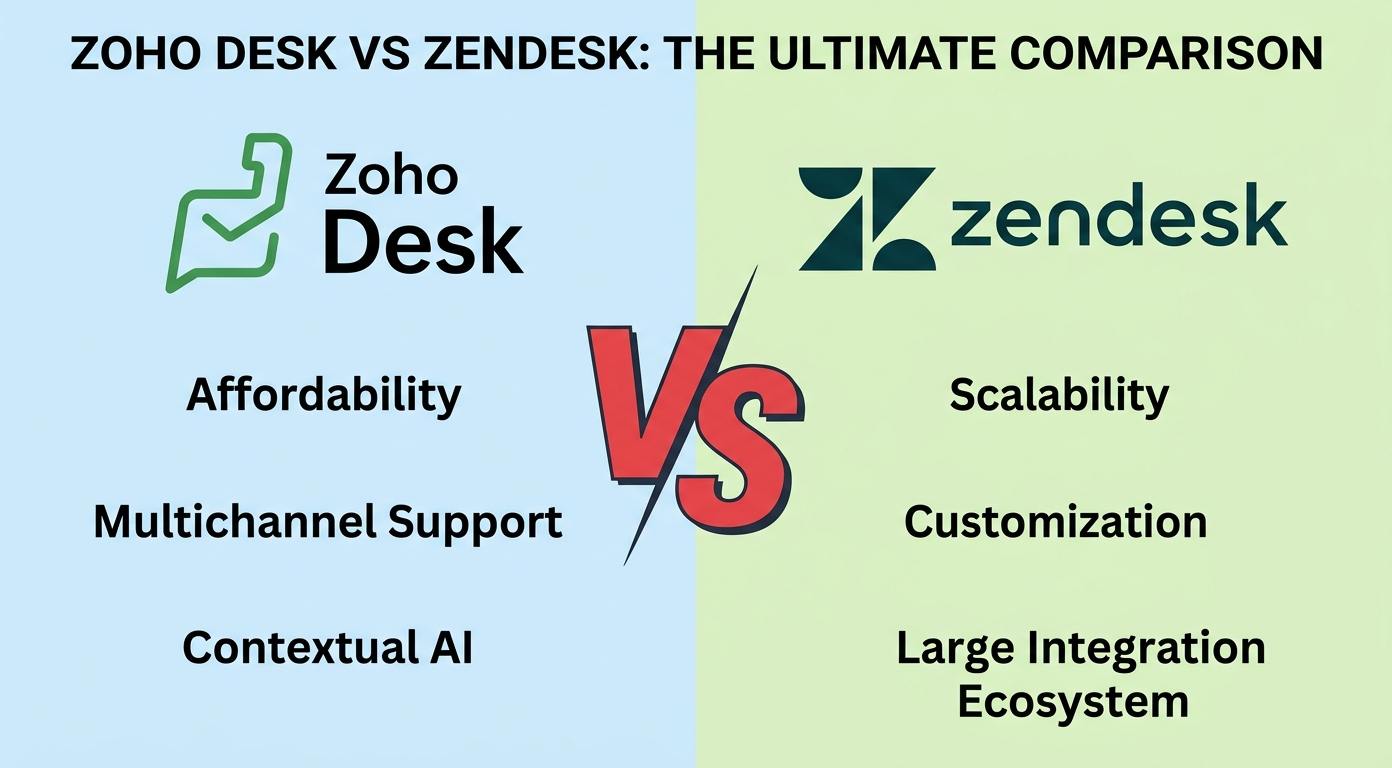
Price is the loudest fact in Zoho Desk vs Zendesk: Zoho's most expensive tier, $40 per user per month billed annually, costs less than Zendesk's middle one at $55, and sits miles under Suite Professional at $115. That gap is not a rounding error, it is the whole argument, and it would end the comparison in a sentence if price were the only axis. It is not. Zendesk is the category default for reasons that survive the sticker shock: the deepest process machinery in support software, a marketplace and admin talent pool nobody matches, and omnichannel messaging that Zoho assembles from a second product. Meanwhile Zoho counters with things Zendesk simply does not sell: a free-forever plan, telephony inside a $23 tier, and AI included in the price instead of metered per resolution. Here is the whole trade, priced at July 2026 published rates.
The gist of Zoho Desk vs Zendesk
| Zoho Desk | Zendesk | |
|---|---|---|
| Ladder | $7, $14, $23, $40, all published | $19 (ticketing only), $55, $115, Enterprise by quote |
| Free plan | Yes, forever: 3 user licenses | None; 14-day trial at Suite Professional defaults |
| AI agent | Answer bot and AI assistant included at $40; no meter published | Billed per automated resolution; rate not displayed |
| Agent copilot | AI support assistant inside Enterprise | Copilot add-on, $50 per agent |
| Voice | Telephony from $23, multi-level IVR at $40 | In the Suite, plus $83 Contact Center add-on |
| Live chat | At $40, via Zoho SalesIQ | Native messaging in every Suite plan |
| Process depth | Blueprints from $23, skills routing at $40 | Routing, SLA, workforce and QA tooling, deepest available |
| Fine print | Local taxes billed on top of listed prices | Add-ons itemized; AI rate requires a sales conversation |
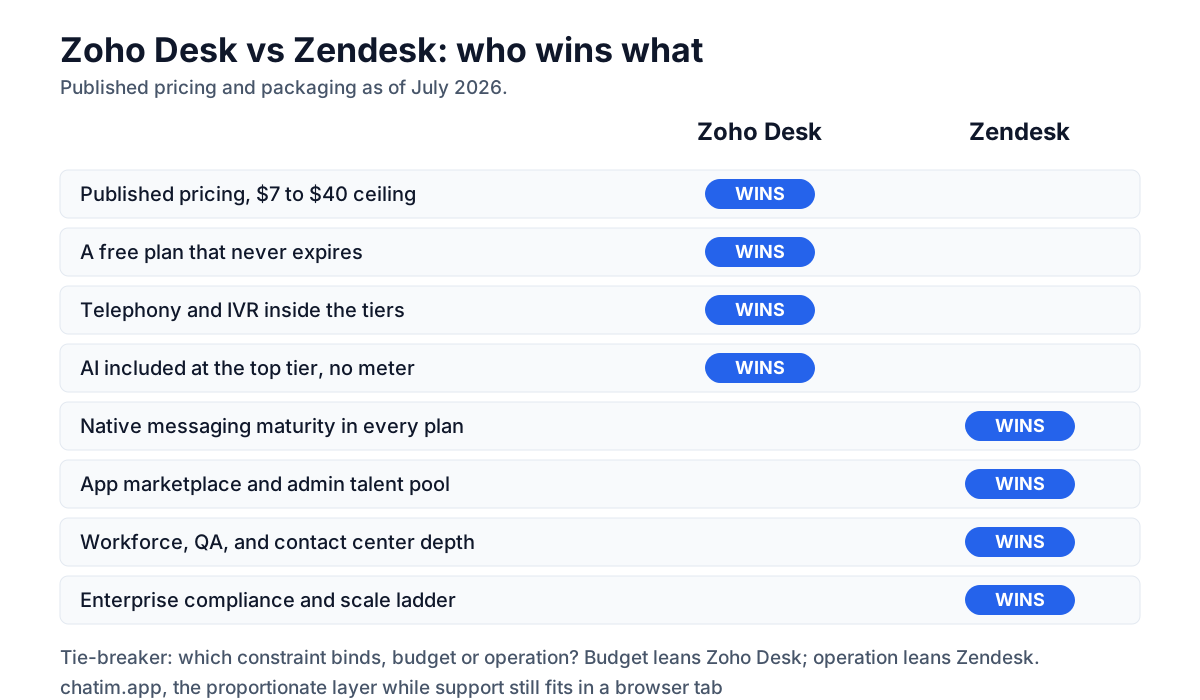
If the budget is the constraint, Zoho Desk wins before the meeting starts. If the support operation is the constraint, headcount, channels, compliance, process, Zendesk keeps the crown it has held for a decade. Most real decisions are about which constraint is binding this year.
Published annual-billing prices as of July 2026. Zoho adds local taxes to the figures above; Zendesk's AI pricing requires contact with sales. Verify both pages before budgeting.
The discount suite and the default one
Zoho Desk: the low-price ladder, suite included
Zoho Desk runs the pricing playbook Zoho uses everywhere: publish everything, undercut everyone. Express at $7 per user per month billed annually handles email, social and web-form tickets with workflows; Standard at $14 adds messaging, generative AI, a knowledge base and the ASAP widget; Professional at $23 is the star, adding built-in telephony, Blueprints process flows, multi-department support and webhooks; Enterprise at $40 finishes with the Answer bot, an AI support assistant, live chat via Zoho SalesIQ, multi-level IVR and a sandbox. Three agents ride free forever. Around it sits the Zoho universe, CRM, SalesIQ, Projects and the rest, which is the quiet reason many Zoho Desk customers never leave: the helpdesk is one tile in a suite their business already pays for. Zoho advertises free guided migration and claims 50 percent faster deployments than competitors; both are the vendor's own marketing.
Zendesk: the category default, priced like it
Zendesk remains what "helpdesk" means in most procurement documents. The Suite bundles ticketing, native messaging, email, help center and voice from $55 per agent per month billed annually (Suite Team), deepens at $115 (Suite Professional) and goes quote-only at Enterprise, with ticketing-only Support Team at $19. Extras are itemized: Copilot at $50 per agent, Workforce Engagement at $50, an $83 Contact Center, and AI agents billed per automated resolution at a rate the pricing page does not print, commonly published around $1.50. What the premium buys is operational: the deepest routing and SLA machinery in the market, a QA and workforce layer, a marketplace with an app for everything, and the largest pool of admins and consultants who already know the product.
Pricing: a ceiling below the other's midpoint
Run a 10-agent team down both ladders at July 2026 rates. On Zoho: $140 a month at Standard, $230 at Professional with the phone system included, $400 at Enterprise with AI, chat and IVR included. On Zendesk: $550 at Suite Team, $1,150 at Suite Professional, plus $500 if every agent gets Copilot, plus the AI meter at whatever rate your contract lands on. The annualized spread between Zoho's top and Zendesk's mid-pro configuration runs from $4,800 to well past $13,800, before Zendesk's add-ons. Zendesk's legitimate rebuttals: Suite Team at $55 is closer to Zoho's $40 than the headline gap suggests and includes stronger native messaging; the quote-only Enterprise tier buys compliance and scale features Zoho does not offer at any price; and organizations pay the Zendesk premium partly for hiring liquidity, since staffing a Zendesk admin is a solved problem. And always add Zoho's own asterisk: local taxes land on top of every listed number.
AI: flat-fee tiers vs the per-resolution meter
Zoho includes its AI in the seat price and publishes no meter: generative features from $14, the Answer bot and AI support assistant at $40, no per-conversation or per-resolution charge listed anywhere on the pricing page. Zendesk meters: AI agents bill per automated resolution, counted only when no human takes over, at an unprinted rate commonly published around $1.50, with Copilot separate at $50 per agent. At 1,000 AI-resolved conversations a month, a 10-agent Zoho Enterprise account pays its flat $400 and nothing more, while the same volume on Zendesk adds roughly $1,500 at the commonly cited rate to whatever the seats cost. The two honest brakes on that math: Zendesk's AI agents carry far more public benchmarking and deployment evidence than Zoho's Answer bot, and unmetered does not mean unlimited, Zoho's page states no usage terms, so get them in writing before betting the budget on flat-fee AI. Pilot both against your fifty most common questions; included AI that answers 30 percent of them is worth less than metered AI that answers 70.
The third option: Chatim under both ladders
Disclosure: Chatim is our own product. If ten agents and process machinery are not your reality, neither ladder is your problem yet. Chatim handles website chat and chatbot automation at predictable per-plan pricing with a free tier and native Shopify and WordPress integrations; it is the proportionate answer while your support fits in a browser tab, and it hands off cleanly to either suite when it stops fitting.
Try Chatim free at chatim.app →
Ecosystem, admin, and where Zendesk earns it
Zendesk's premium concentrates in three places Zoho cannot reach yet. The marketplace: thousands of support-specific apps, meaning the integration you will need next quarter likely exists today, versus Zoho's healthy but Zoho-centric catalog. The operational layer: workforce management, QA tooling and analytics depth that turn a support floor into a managed system, where Zoho's story largely ends at reports and dashboards. And the people market: Zendesk admins, consultants and migration shops are abundant, which de-risks every future change. Zoho's counter-ecosystem argument is different in kind: if your business already runs Zoho CRM, Books or One, Desk inherits shared data and vendor consolidation that no Zendesk integration fully replicates, and Blueprints at $23 delivers enforced process flows that Zendesk buyers only see at multiples of the price. Buy Zendesk for the depth around the queue; buy Zoho for the suite around the business.
Channels and voice: SalesIQ against the Suite
Channel coverage looks similar on datasheets and diverges in the plumbing. Zendesk ships messaging natively in every Suite plan, chat, social and email in one workspace, with voice built in and an $83 per agent Contact Center when phone gets serious. Zoho covers email and social from $7, business messaging from $14, telephony from $23 with IVR at $40, and delivers live chat at Enterprise through SalesIQ, a second Zoho product bolted into the console. For phone-first SMB support, Zoho's bundled telephony at $23 is the standout bargain in this whole comparison; for chat-and-messaging operations, Zendesk's native workspace is the more mature tool and the SalesIQ hop is the tax Zoho charges its own bargain hunters.
Calling it for your situation
Zoho Desk is the move when...
- Budget is binding: every rung from $7 to $40, and three agents free forever.
- Phone support at SMB scale: telephony at $23 and IVR at $40, no add-on products.
- You want AI without a meter: Answer bot and assistant inside the $40 seat.
- Your company already lives in Zoho: Desk joins CRM and SalesIQ on one vendor bill.
Zendesk is the move when...
- Support is an operation: routing, SLA, workforce and QA depth pay for themselves.
- Chat and messaging lead your channels: the native Suite workspace outclasses the SalesIQ route.
- The marketplace matters: niche integrations and hire-ready admins on demand.
- Enterprise requirements loom: compliance, scale and a quote-tier built for them.
Getting out, getting in
Traffic on this route runs mostly downhill, from Zendesk's prices toward Zoho's, and Zoho paves it: free expert-guided migration is advertised on its pricing page, and its importers treat Zendesk as a first-class source. Going upmarket the other way, Zendesk's onboarding ecosystem and migration partners make the move routine, if never free. In both directions the automation layer rebuilds natively, Blueprints on one side, triggers and macros on the other, and the AI configurations start over regardless. Trial both honestly: 15 days on Zoho, 14 on Zendesk (which defaults to Suite Professional with Copilot, so trim the trial config to the tier you would actually buy). For the rest of the field, see our guides to Zoho alternatives, Zendesk alternatives, HelpScout alternatives, JivoChat alternatives, and the full ranking of the best live chat software.
Comparing other tools in this space? See our breakdowns of Zoho Desk vs Freshdesk, Zendesk vs Freshdesk, Intercom vs Zendesk, and Help Scout vs Zendesk.
Frequently Asked Questions
Is Zoho Desk or Zendesk better in 2026?
Zoho Desk if budget is the binding constraint: its entire ladder runs $7 to $40 per user per month billed annually, three agents are free forever, telephony ships at $23, and AI is included at $40 with no meter. Zendesk if the support operation is the constraint: native messaging in every Suite plan, the deepest routing, workforce and QA tooling in the category, the biggest app marketplace, and an enterprise tier built for compliance and scale. Price the constraint, not the brand.
How much cheaper is Zoho Desk than Zendesk?
Substantially, at July 2026 published prices. Zoho's top tier ($40) costs less than Zendesk's middle Suite Team tier ($55) and about a third of Suite Professional ($115). For 10 agents that is $400 a month on Zoho Enterprise, AI and IVR included, against $550 to $1,150 on Zendesk before Copilot ($50 per agent) and metered AI resolutions. Two caveats: Zoho bills local taxes on top of its stickers, and Zendesk's higher tiers contain operational depth Zoho does not sell.
How much does Zoho Desk cost in 2026?
Zoho Desk publishes Express at $7, Standard at $14, Professional at $23, and Enterprise at $40 per user per month on annual billing, with a free-forever edition for 3 users. Professional adds built-in telephony and Blueprints; Enterprise adds the Answer bot, AI assistant, live chat via Zoho SalesIQ, and multi-level IVR. Yearly billing saves up to 34 percent versus monthly, and local taxes are charged in addition. Confirm on zoho.com before budgeting.
How much does Zendesk cost compared to that?
Zendesk publishes Support Team at $19 per agent per month (ticketing only), Suite Team at $55, and Suite Professional at $115 on annual billing, with Suite Enterprise by quote. Add-ons are itemized: Copilot $50 per agent, Workforce Engagement $50, Contact Center $83, plus AI agents billed per automated resolution at a rate the pricing page does not display. There is no free plan; the 14-day trial defaults to Suite Professional with Copilot enabled. As of July 2026.
How does AI pricing differ between Zoho Desk and Zendesk?
Zoho bundles AI into its tiers: generative features from Standard, the Answer bot and AI support assistant inside the $40 Enterprise seat, with no consumption meter published. Zendesk meters AI per automated resolution at an unprinted rate commonly published around $1.50, plus the $50 Copilot. At 1,000 monthly AI resolutions, that is $0 marginal on Zoho against roughly $1,500 at Zendesk's cited rate. Balance that against evidence: Zendesk's AI has a far larger public track record, and Zoho's unmetered AI comes without published usage terms, so confirm limits in writing.
Does Zoho Desk really include phone support?
Yes, and it is the standout bargain in this matchup. Telephony is built into the Professional tier at $23 per user per month, and multi-level IVR arrives with Enterprise at $40, no separate telephony product required. Zendesk includes voice in its Suite plans and sells advanced call-center tooling as an $83 per agent add-on, which is a deeper stack at several times the cost. SMB phone-and-email teams should price Zoho Professional first and make everything else beat it.
What are Blueprints and does Zendesk have an equivalent?
Blueprints, included from Zoho's $23 Professional tier, let you draw enforced ticket processes: stages, allowed transitions, and required actions that guide agents through defined paths. Zendesk covers similar ground through triggers, macros, routing rules and SLA policies, with more raw power and more assembly, and its guided-workflow depth concentrates in the $115-plus tiers. If enforced process at a low price is the requirement, Blueprints is the headline feature; if unlimited process flexibility is, Zendesk's toolkit goes further.
How do live chat and messaging compare?
This is Zendesk's cleanest win. Native messaging, web, mobile and social, ships in every Suite plan inside one agent workspace. Zoho Desk offers business messaging from Standard but delivers real live chat only at the $40 Enterprise tier, through Zoho SalesIQ, a second product integrated into the console. Chat-led teams get the more mature experience from Zendesk; teams where chat is a side channel can bank Zoho's savings and accept the SalesIQ arrangement.
Is Zoho Desk good enough for enterprise support?
It stretches further than its price suggests, skills-based routing, sandbox, custom modules and multi-brand help centers all live in the $40 tier, but Zendesk's quote-tier Enterprise exists for requirements Zoho does not address at any price: advanced compliance programs, workforce management and QA at scale, and the ecosystem of enterprise integrations and certified admins. Mid-market teams can genuinely run on Zoho; large regulated operations usually cannot, and that boundary is where Zendesk's premium stops being optional.
What fine print should I check on each side?
Zoho: local taxes are added to every listed price, the up-to-34-percent savings apply to yearly billing, and the included AI has no published usage terms, so request them. Zendesk: the AI resolution rate is not printed and must come from sales, the trial defaults to Suite Professional with Copilot (so trial invoices overstate Suite Team costs), and the add-ons that make comparisons fair, Copilot, Contact Center, Workforce Engagement, are all separate line items. Neither list is scandalous; both move real money.
How hard is switching between Zoho Desk and Zendesk?
Zendesk-to-Zoho is the paved direction: Zoho advertises free expert-guided migration and imports Zendesk data as a first-class source, which pairs naturally with the price motivation most switchers have. Zoho-to-Zendesk runs through Zendesk's importers and partner ecosystem, reliably but at consulting rates. Both directions rebuild automations natively and restart AI configurations. Use the trials, 15 days on Zoho, 14 on Zendesk, to pilot with real tickets before moving anything.
Do I need either Zoho Desk or Zendesk yet?
If your support is website visitors asking pre-sale and how-to questions, probably not yet. Both suites earn their seats when ticket volume, routing and multi-agent process arrive. Until then, a chat-first layer answers the actual traffic: our own Chatim pairs live chat with chatbot automation on a free tier with native Shopify and WordPress integrations (disclosure: Chatim is our product), and it defers this comparison until the queue, not the widget, is your bottleneck.
Related articles
More in Comparisons → Live Chat vs Chatbot: Which One Does Your Website Need?
Live chat vs chatbot in plain terms: what each does best, where each fails, and the bot-first, human-close handoff pattern that beats running either alone.
 Help Desk vs Service Desk: The Real Difference (2026)
Help desk vs service desk in one line: issue-fixing vs service lifecycle. The five differences that matter, why the terms blur, and which one you need.
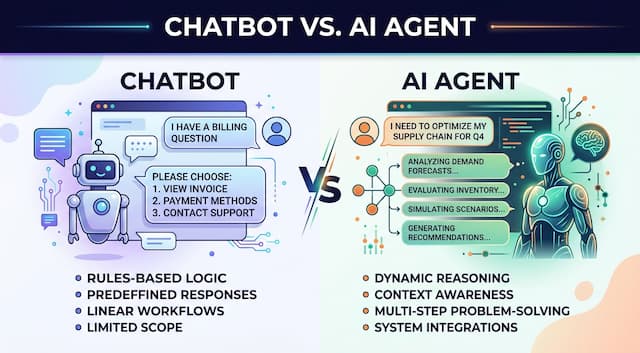 Chatbot vs AI Agent: Where the Line Actually Sits (2026)
Chatbot vs AI agent in plain terms: what each one does, where the line blurs, and how to add autonomy to support and sales without losing control.
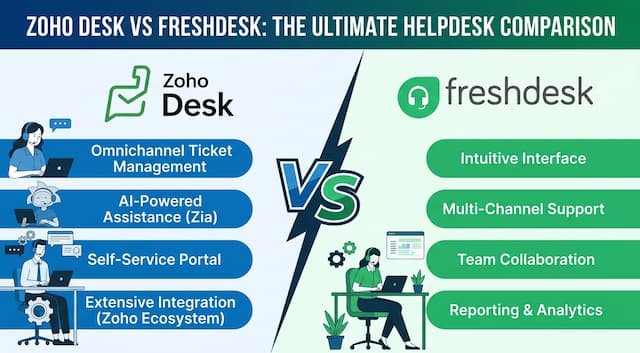 Zoho Desk vs Freshdesk in 2026: Value Against Value
Zoho Desk vs Freshdesk in 2026: included AI vs a session meter, and the telephony math