Intercom vs Zendesk in 2026: Seats, Fin, and Real Costs
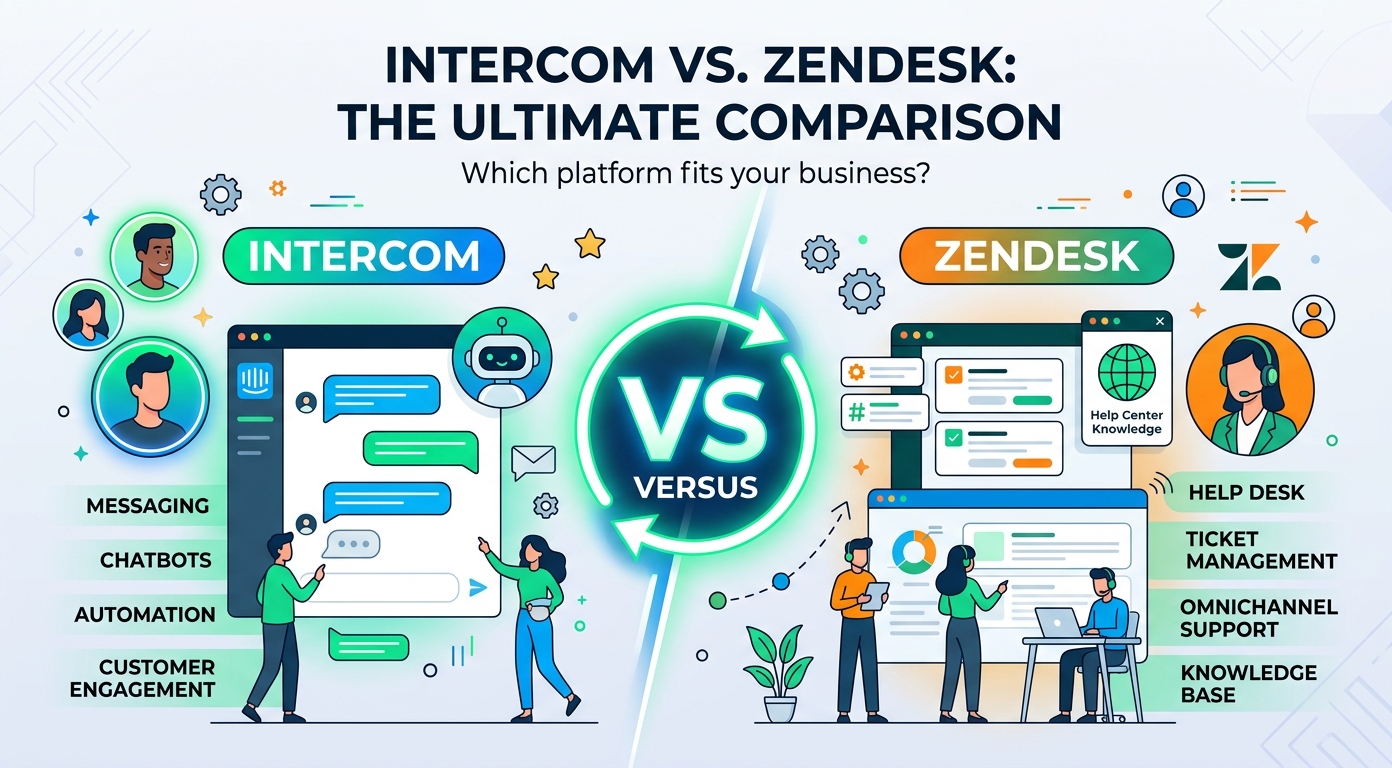
Intercom vs Zendesk comes up on almost every support software shortlist, and 2026 has made the choice unusually clear-cut. Intercom is an AI-first messaging platform: Fin, its AI agent, leads the product, with seats from $29 per month and AI billed at $0.99 per outcome. Zendesk is a ticketing-first suite: the deepest helpdesk process machinery in the category, from $19 per agent for basic ticketing or $55 for the full Suite, with AI agents billed per automated resolution. All figures reflect the vendors’ published pricing as of July 2026. Intercom rebranded as Fin in May 2026, and Salesforce signed a definitive agreement to acquire the company in June 2026 (the deal has not yet closed); this post keeps the Intercom name most buyers still search for.
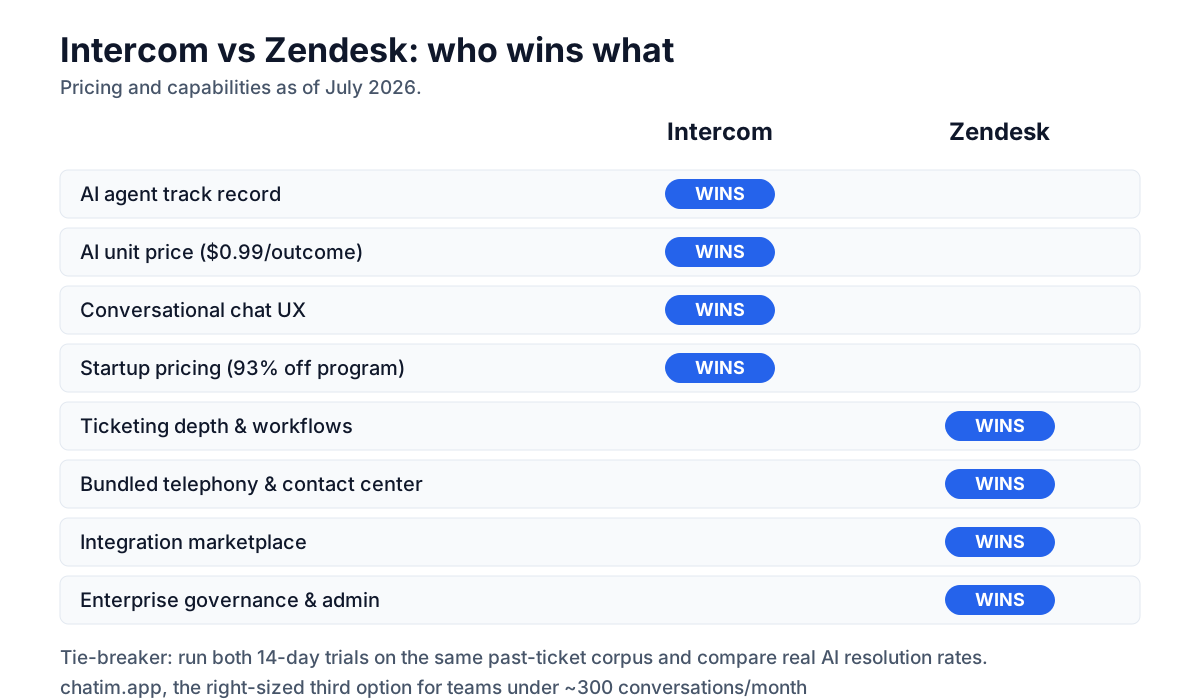
Short verdict: pick Intercom if AI deflection and modern messaging are the goal and you accept usage-based AI costs. Pick Zendesk if ticket workflow, voice, and an admin ecosystem matter more than chat UX. Small teams priced out of both have a third option covered below.
Intercom vs Zendesk at a glance
| Intercom | Zendesk | |
|---|---|---|
| Entry price (annual) | Essential $29 per seat/month | Support Team $19 per agent/month (ticketing only) |
| Full-platform tier | Advanced $85 per seat/month | Suite Team $55 per agent/month |
| Top published tier | Expert $132 per seat/month | Suite Professional $115 per agent/month (Enterprise by quote) |
| AI agent pricing | Fin: $0.99 per outcome | Per automated resolution (commonly published around $1.50) |
| Agent AI assistant | Copilot $29 per agent/month (unlimited) | Copilot $50 per agent/month |
| Voice/phone | Pay-as-you-go channel | Telephony in Suite; Contact Center add-on $83 per agent/month |
| Free trial | 14 days, self-serve | 14 days (defaults to Suite Professional + Copilot) |
| Design center | AI-first messaging and support | Ticketing process at scale |
Pricing as listed on the vendors' pricing pages in July 2026, annual billing shown. Zendesk does not display its per-resolution AI rate on the pricing page; verify current rates before budgeting. Prices shift regularly; confirm on each vendor's page before buying.
Intercom and Zendesk in plain terms
Intercom in 2026: Fin first, platform second
Intercom rebuilt itself around Fin, an AI agent that resolves support conversations against your help content and past tickets, billed at $0.99 per outcome. The platform around it covers the Messenger widget, a shared inbox with ticketing, help center, and outbound messaging, with seats at Essential $29, Advanced $85 (includes 20 free Lite seats), and Expert $132 (50 Lite seats), billed annually. Notably, Fin also sells standalone: you can run it on top of Zendesk or Salesforce with no Intercom seats at all, which tells you where Intercom believes its edge sits. Live chat, support email, and in-app messages are included on every plan; email campaigns, SMS, WhatsApp, and phone are pay-as-you-go channels. Add-ons include Copilot ($29 per agent, unlimited use), the Pro analytics pack ($99 per month), and Proactive Support Plus ($99 per month). Early-stage startups can get 93 percent off through Intercom's program.
Zendesk in 2026: the ticketing benchmark with AI layered in
Zendesk remains the reference implementation of support process: tickets, routing, SLAs, macros, and reporting, wrapped in the largest integration marketplace in customer service. Support Team at $19 per agent per month covers email ticketing alone; the real product is the Suite, at $55 per agent (Suite Team, which includes AI agents, knowledge base, omnichannel routing, messaging, and telephony) and $115 (Suite Professional, adding admin Copilot, App Builder, skills-based routing, and IVR), with Suite Enterprise sold by quote. AI agents are included in every plan and billed per automated resolution, counted only when the AI resolves a request without human escalation; the per-resolution rate is not displayed on the pricing page. Copilot for agents is a $50 per agent add-on, a Workforce Engagement bundle runs $50, and a full Contact Center add-on is $83 per agent. Zendesk also now markets Forethought AI agents as a partner option inside its ecosystem, a signal of how central autonomous AI has become to its roadmap.
Pricing: seat math vs usage math
The list prices mislead in both directions, because each platform bills a different mix of seats and usage.
Intercom's real cost is seats plus Fin outcomes. A 5-agent team on Advanced pays $425 per month in seats. If Fin resolves 500 conversations that month, that is another $495. The counterweight: every Fin outcome is a conversation your agents did not handle, and Advanced includes 20 free Lite seats for collaborators who only need visibility.
Zendesk's real cost is seats plus add-ons plus resolutions. The same 5-agent team on Suite Team pays $275 per month, noticeably cheaper per seat. But agent Copilot is $50 per agent (vs $29 at Intercom, July 2026 prices), the full contact center is $83 per agent, and AI resolutions are metered on top at a rate the pricing page does not display. Teams that stack Suite plus Copilot plus voice routinely land above the equivalent Intercom bundle, which is exactly the math competitors like Dixa now advertise against Zendesk.
How to compare honestly: take last month's conversation volume, estimate the share AI could resolve (both vendors' trials will tell you within two weeks), and price both stacks at your seat count with the add-ons you would actually buy. The winner flips depending on whether your volume is chat-heavy (favors Intercom's inclusive channels) or process-heavy (favors Zendesk's Suite bundling).
AI: Fin vs Zendesk AI agents
This is the axis the whole decision now turns on.
Fin is the most battle-tested AI agent in the market: it answers from your help content, takes actions on external systems, and hands off to agents with context. Intercom publishes customer results claiming resolution rates around 50 percent and higher, and prices every outcome at a flat $0.99. The definition matters: an outcome is billed when Fin delivers it, and Intercom markets a money-back guarantee around Fin performance. Fin standalone on a non-Intercom helpdesk is the low-commitment way to test it.
Zendesk AI agents are included in every Suite plan and billed per automated resolution, defined as a request resolved without human escalation, so abandoned conversations do not bill. The rate is not displayed on the pricing page (it has commonly been published around $1.50 per resolution), and higher tiers add intelligent triage, auto-assist, and generative voice AI. Zendesk's Copilot ($50 per agent) focuses on agent efficiency rather than autonomous resolution, and the Forethought partnership adds a second autonomous-AI option inside the ecosystem.
Net: if autonomous deflection rate is your KPI, Fin has the stronger public track record and cheaper per-unit price; if you want AI woven into an existing ticket process with per-resolution billing that only counts clean resolutions, Zendesk's model is easier to defend to a CFO. Run both trials on the same corpus of past tickets before believing either vendor's number.
The third option: Chatim for teams priced out of both
Disclosure: Chatim is our own product. A 3-person support team does not need Suite workflows or $0.99-per-outcome metering to answer website chat. Chatim covers live chat plus a chatbot at predictable per-plan pricing with a free tier and native Shopify and WordPress integrations, which is the practical answer for SMBs comparing two enterprise bills.
Try Chatim free at chatim.app →
Inbox, ticketing, and workflow
Zendesk's ticket engine is still the deeper machine: skills-based routing, SLA policies, approval workflows (Enterprise), sandboxes, and two decades of admin patterns that support-ops hires already know. Intercom's inbox is faster and friendlier for conversational support, with workflows automation on Advanced and above, but complex multi-queue routing, change management, and governance remain Zendesk's home turf. If your support org has a dedicated admin, Zendesk rewards them; if nobody owns the tooling full-time, Intercom's defaults carry further out of the box.
Channels and ecosystem
Zendesk Suite bundles messaging, email, help center, and telephony natively, and its marketplace of integrations is the largest in the category; almost every support-adjacent tool ships a Zendesk app first. Intercom includes live chat, email, and in-app messaging on all plans, prices SMS, WhatsApp, and phone as pay-as-you-go channels, and its app store is smaller but covers the mainstream stack. For voice-heavy operations, compare Zendesk's bundled telephony (plus the $83 Contact Center add-on for complex needs) against Intercom's usage-priced phone before deciding; that line item alone can settle the argument.
Reporting and administration
Zendesk's prebuilt dashboards, custom reporting, and workforce-engagement add-on serve managed support operations; Suite Professional adds quick reports and admin Copilot. Intercom ships pre-built reports on all plans and sells deeper conversation intelligence through the Pro add-on ($99 per month for CX scores, topics, and monitors across 1,000 conversations). Enterprises with BI teams usually find Zendesk's data model easier to pipe into a warehouse; Intercom's analytics are more opinionated and faster to read day to day.
The verdict, by use case
Pick Intercom if...
- AI deflection rate is the KPI, and you want the AI agent with the strongest public track record at $0.99 per outcome.
- Your support is conversational: website chat, in-app messages, and a modern Messenger matter more than ticket taxonomy.
- Your team is lean and nobody owns support tooling full-time; Intercom's defaults and Copilot at $29 carry further without an admin.
- You are an early-stage startup: the 93 percent discount program makes Intercom the cheapest serious platform for your first two years.
- You might keep your current helpdesk: Fin standalone lets you buy the AI without the migration.
Pick Zendesk if...
- Ticket process is the product: SLAs, skills routing, approval workflows, sandboxes, and governance for a scaled support org.
- Voice is core: Suite bundles telephony, and the Contact Center add-on covers IVR-heavy operations.
- You want the ecosystem: the largest marketplace, the deepest pool of experienced admins, and warehouse-friendly data.
- Per-resolution AI billing (only clean, non-escalated resolutions count) is easier to justify internally than per-outcome metering.
- You need entry-level ticketing today at $19 with a clean upgrade path into the Suite.
Switching costs, in both directions
Moving between the two is routine in 2026: both publish importers and partner tooling for tickets, contacts, and help-center articles. The real cost is process rebuild (macros, routing rules, automations do not port cleanly) and retraining. Plan a 2-4 week parallel run, migrate the knowledge base first (both AI agents train from it), and time the cutover to your renewal. If AI is the reason you are switching to Intercom, test Fin standalone on your current helpdesk first; if you are leaving Intercom for process depth, run Zendesk's 14-day Suite Professional trial against a copy of your real queue. For the broader field beyond these two, see our guides to Intercom alternatives and Zendesk alternatives, the full ranking of the best live chat software, and for ecommerce-specific stacks, Gorgias alternatives and live chat for Shopify.
For more head-to-head comparisons, see Intercom vs Drift, Zendesk vs Freshdesk, Intercom vs HubSpot, and Help Scout vs Zendesk.
Frequently Asked Questions
Is Intercom or Zendesk better in 2026?
They win different jobs. Intercom is the pick when AI deflection and conversational support lead: Fin has the strongest public track record among AI agents, priced at $0.99 per outcome on seats from $29 per month. Zendesk is the pick when ticket process leads: SLAs, skills routing, bundled telephony, and the largest integration marketplace, on Suite plans from $55 per agent per month. Small teams that need neither should compare right-sized tools before paying for either platform.
Which is cheaper, Intercom or Zendesk?
On list price, Zendesk starts lower ($19 ticketing-only, $55 full Suite vs Intercom's $29 Essential and $85 Advanced, all annual, as of July 2026). On total cost, it depends on add-ons and AI usage: Zendesk's agent Copilot is $50 per agent versus Intercom's $29, its Contact Center add-on is $83, and AI resolutions meter on top. Intercom bills Fin at $0.99 per outcome. Price both at your seat count with your realistic AI volume; the winner flips either way.
How much does Intercom cost in 2026?
As listed on the vendor’s pricing page in July 2026, billed annually: Essential $29 per seat per month, Advanced $85 (includes 20 free Lite seats), Expert $132 (50 Lite seats). Fin AI Agent is included on every plan and billed at $0.99 per outcome, and also sells standalone on other helpdesks with no seats required. Add-ons: Copilot $29 per agent (unlimited), Pro analytics $99 per month, Proactive Support Plus $99 per month. Live chat and support email are included; SMS, WhatsApp, phone, and email campaigns are pay-as-you-go.
How much does Zendesk cost in 2026?
As listed on the vendor’s pricing page in July 2026, billed annually: Support Team $19 per agent per month (email ticketing only), Suite Team $55 (adds AI agents, knowledge base, omnichannel, messaging, telephony), Suite Professional $115 (adds admin Copilot, App Builder, skills routing, IVR), Suite Enterprise by quote. Add-ons: Copilot $50 per agent, Workforce Engagement $50, Contact Center $83. AI agents bill per automated resolution; the rate is not displayed on the pricing page, so confirm it with sales before budgeting.
What happened to Zendesk Suite Growth?
As of July 2026, Zendesk's pricing page lists Support Team ($19), Suite Team ($55), Suite Professional ($115), and Suite Enterprise (by quote); the $89 Suite Growth tier that previously sat between Team and Professional is no longer displayed. If you are on Growth today, your contract terms govern; for new purchases the jump is now $55 to $115, which makes the Suite Team tier the default for most midsize teams.
How is Fin priced compared with Zendesk AI agents?
Fin bills $0.99 per outcome, on every Intercom plan, and Intercom markets a performance guarantee around it. Zendesk bills per automated resolution, counted only when the AI resolves a request without human escalation (abandoned conversations do not bill); the rate is not shown on its pricing page but has commonly been published around $1.50 per resolution. Fin's unit price is lower; Zendesk's counting rule is stricter. The only honest comparison is running both trials against the same historical tickets and dividing the bill by real resolutions.
Can I use Intercom's Fin with Zendesk?
Yes. Intercom sells Fin as a standalone AI agent that runs on top of your existing helpdesk, including Zendesk and Salesforce, with no Intercom seats required, at the same $0.99 per outcome. Setup is marketed as under an hour: Fin answers from your help content across email, chat, and phone, and hands off to agents in your existing inbox. This is the lowest-commitment way to test Intercom's AI without migrating your ticket system, and a real option for staying on Zendesk process with Fin economics.
Which has better live chat, Intercom or Zendesk?
Intercom. The Messenger remains the reference conversational widget: in-app messages, product tours (via add-on), and a faster agent inbox for chat-first support. Zendesk's messaging is competent and fully integrated with its ticket engine, but its center of gravity is process, not chat UX. If website chat is most of your volume and you do not need Suite workflows, also compare right-sized chat platforms before paying enterprise prices; that segment exists precisely for this case.
Which is better for ecommerce, Intercom or Zendesk?
Both integrate with Shopify and the major platforms, and both now push AI agents at ecommerce FAQ volume (order status, returns). Zendesk brings deeper ticket workflows for high-volume operations; Intercom brings Fin's deflection and a slicker buyer-facing chat. That said, ecommerce-native helpdesks (Gorgias, Re:amaze) surface order data next to every conversation at SMB prices and win most Shopify and WooCommerce shortlists under roughly 300 tickets per month. See our Gorgias alternatives guide for that landscape.
Which is better for a small business, Intercom or Zendesk?
Neither is designed for very small teams. Intercom's Essential at $29 per seat plus $0.99 per Fin outcome is the friendlier entry, and its Early Stage program (93 percent off) is unbeatable if you qualify. Zendesk's $19 Support Team covers plain ticketing but the AI-and-messaging Suite starts at $55. For a team of 1-5 answering website chat, right-sized tools (Chatim, Tidio, Crisp Chat, Tawk.to) deliver chat plus a chatbot at a fraction of either bill; see our best live chat software guide for that tier.
Is it hard to migrate from Zendesk to Intercom, or the reverse?
It is routine in both directions: both vendors publish importers and partner tooling for tickets, contacts, and help-center content. The real work is process rebuild (macros, routing rules, automations, and reports do not port cleanly) and agent retraining. Plan a 2-4 week parallel run, move the knowledge base first since both AI agents train on it, benchmark AI resolution on the same corpus during trials, and time the cutover to your renewal date to avoid double-paying.
Do Intercom and Zendesk offer free trials?
Both offer 14-day self-serve trials, as of July 2026. Zendesk's defaults to Suite Professional with the Copilot add-on included, so evaluate whether the tier you would actually buy ($55 Suite Team) covers what you tested. Intercom's trial includes its add-ons. Neither has a free forever plan; if free matters, that is a different product category (Tawk.to, Chatim's free tier, HubSpot's free tools).
Which integrates with more tools, Intercom or Zendesk?
Zendesk, decisively at the ecosystem level: its marketplace is the largest in customer service, and most support-adjacent vendors ship a Zendesk integration first. Intercom's app store covers the mainstream stack (Salesforce, HubSpot, Slack, Shopify, and hundreds more) and its APIs are developer-friendly, but the long tail belongs to Zendesk. Zendesk's data model is also the easier one to pipe into a warehouse, which matters once a BI team owns support reporting.
Do I need Intercom or Zendesk at all?
Count conversations, not features. Under roughly 300 conversations per month, a widget-first tool with a chatbot covers the workload at $0-$50 per month total; both Intercom and Zendesk exist for volumes and processes above that. The honest sequence: start right-sized, instrument your volume, and graduate when routing, SLAs, or AI deflection at scale actually bind. Our guides to Intercom alternatives and Zendesk alternatives map both the cheaper and the adjacent options.
Related articles
More in Comparisons → Live Chat vs Chatbot: Which One Does Your Website Need?
Live chat vs chatbot in plain terms: what each does best, where each fails, and the bot-first, human-close handoff pattern that beats running either alone.
 Help Desk vs Service Desk: The Real Difference (2026)
Help desk vs service desk in one line: issue-fixing vs service lifecycle. The five differences that matter, why the terms blur, and which one you need.
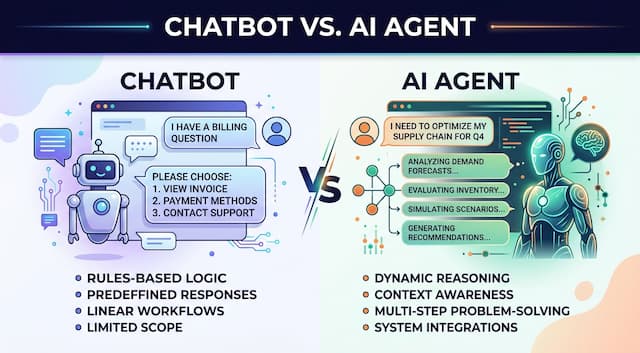 Chatbot vs AI Agent: Where the Line Actually Sits (2026)
Chatbot vs AI agent in plain terms: what each one does, where the line blurs, and how to add autonomy to support and sales without losing control.
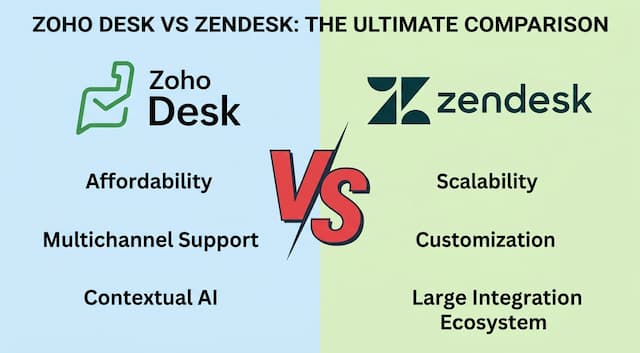 Zoho Desk vs Zendesk in 2026: The Price Gap, Examined
Zoho Desk vs Zendesk in 2026: included AI vs a quiet meter, and where Zendesk earns it