HelpScout vs Zendesk in 2026
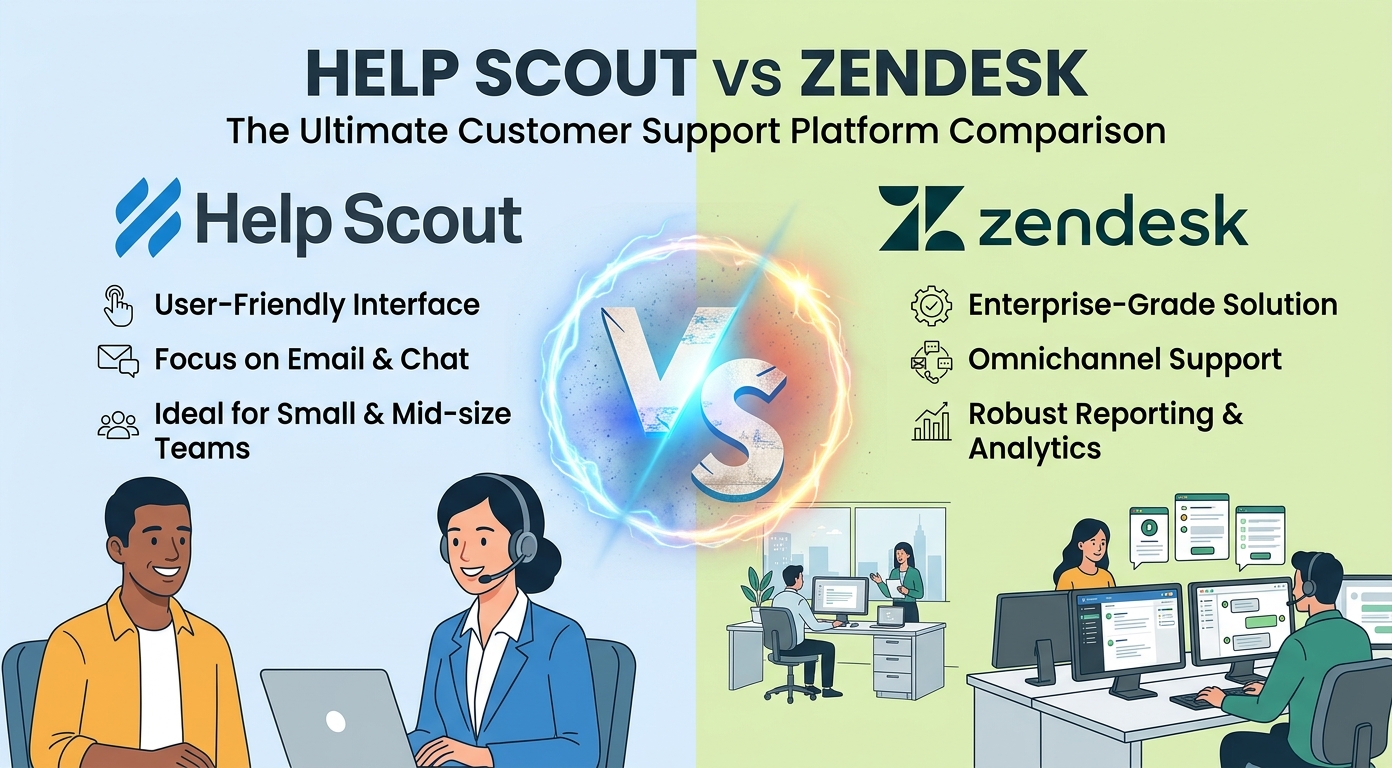
HelpScout vs Zendesk starts as a culture question: the shared inbox that hides ticket numbers from customers, versus the suite that made tickets an industry standard. In 2026 it is also suddenly a pricing question, because the two now sell AI at very different meters: HelpScout's AI Answers runs $0.75 per resolution with monthly spending caps and a 3-month free trial, while Zendesk bills per automated resolution at a rate its pricing page does not display. Seats tell the same story: HelpScout runs $25 to $75 per user with a free 5-user plan; Zendesk Suite runs $55 to $115 per agent plus add-ons. The numbers below are published July 2026 tiers.
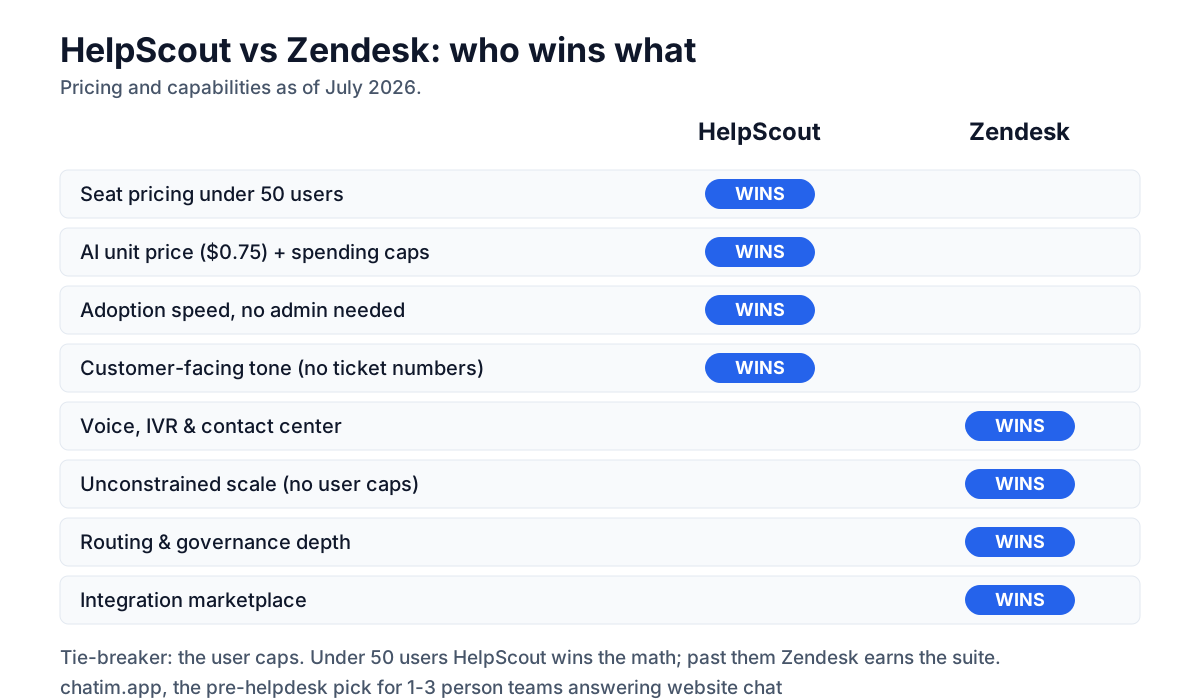
Short verdict: teams under about 50 users who want fast adoption, a human tone, and the cheapest credible AI meter should start at HelpScout. Operations that need voice, skills routing, governance, or unconstrained scale belong on Zendesk. The user caps decide more cases than the feature lists do.
HelpScout vs Zendesk in 60 seconds
| HelpScout | Zendesk | |
|---|---|---|
| Free plan | Yes: 5 users, 1 Inbox, 1 Docs site | Trial only (14 days, defaults to Suite Professional) |
| Entry paid (annual) | Standard $25/user (up to 25 users) | Support Team $19/agent (ticketing only); Suite Team $55 |
| Scale tier | Plus $45 (up to 50 users); Pro $75 (unlimited, min 10) | Suite Professional $115; Enterprise by quote |
| AI agent pricing | AI Answers $0.75/resolution, spending caps, 3-month free trial | Per automated resolution, rate not displayed (commonly cited around $1.50) |
| Agent AI assist | AI Assist all plans; unlimited AI Drafts from Plus | Copilot add-on $50/agent |
| Voice | Via integrations (Aircall preferred pricing at Pro) | Telephony in Suite; Contact Center add-on $83/agent |
| User limits | Caps by tier: 25 / 50 / unlimited | No caps |
| Design center | Human-tone shared inbox, fast adoption | Ticketing process at scale |
Pricing as listed on the vendors' pricing pages in July 2026, annual billing shown (HelpScout annual saves 16 percent). Both price lists change; check the vendor pages before committing.
HelpScout and Zendesk, defined
HelpScout in 2026: the human-tone inbox with the cheapest AI meter
HelpScout deliberately looks like email: customers never see ticket numbers, agents work in a clean shared inbox, and the learning curve is famously flat. Standard at $25 per user per month (annual) covers up to 25 users with live chat, Instagram, Messenger, WhatsApp, a basic SLA, and the AI Inbox assistant; Plus at $45 (up to 50 users) adds advanced workflows, two advanced SLA policies, unlimited AI Drafts, round robin routing, Salesforce, Jira, and HubSpot integrations, and 15 light users; Pro at $75 (unlimited users, 10 minimum) adds SSO, HIPAA, 50 light users, and a strategic account manager. The Free plan carries 5 users, 1 Inbox, and 1 Docs site. The headline in 2026 is AI Answers: an autonomous agent over your knowledge base at $0.75 per resolution, with the strictest counting rule in the market (no charge if the customer escalates, asks again, or clicks still-need-help), optional monthly spending caps, and a 3-month unlimited free trial. HelpScout's calculator claims a 73 percent average resolution rate; treat that as their number.
Zendesk in 2026: the suite, unconstrained
Zendesk is the reference support suite: ticketing, messaging, help center, voice, and workforce tools with the largest integration marketplace in the category and no ceiling on team size. Support Team at $19 per agent per month covers email ticketing; Suite Team at $55 adds AI agents, knowledge base, omnichannel routing, messaging, and telephony; Suite Professional at $115 adds admin Copilot, App Builder, skills-based routing, and IVR; Suite Enterprise is quote-based. AI agents are included in every plan and billed per automated resolution (counted only without human escalation), though the rate is not displayed on the pricing page; agent Copilot is a $50 add-on and a full Contact Center runs $83 per agent. Where HelpScout optimizes for adoption, Zendesk optimizes for administration: routing depth, governance, sandboxes, and a hiring market full of experienced Zendesk admins.
Pricing: caps, seats, and the AI meters
Worked examples with July 2026 published prices, annual billing.
A 5-agent team: HelpScout Standard costs $125 per month; Zendesk Suite Team costs $275. Add AI on both: 200 AI resolutions run $150 at HelpScout's published $0.75 (after the 3-month free trial), while Zendesk's meter adds roughly $300 at its commonly cited rate, on top of seats. For small teams the totals are not close, and HelpScout's free 5-user plan means the smallest teams pay nothing at all.
A 40-agent operation: HelpScout requires Plus ($45, cap 50 users), $1,800 per month; Zendesk Suite Team runs $2,200 with no cap and voice included. At this size the comparison is legitimately close, and Zendesk's routing depth starts earning its premium. Past 50 users, HelpScout means Pro at $75 (unlimited, min 10), and the price advantage flips to Zendesk for pure seats.
The cap trap and the meter trap: HelpScout's tier caps (25, then 50 users) force plan jumps as you hire, which is the cost curve to model before committing. Zendesk's trap is additive: Copilot at $50 per agent and Contact Center at $83 stack quickly, and its AI rate lives in a sales conversation. HelpScout's spending caps on AI Answers, by contrast, make the AI line item literally cappable, a procurement feature no other major vendor matches at this price.
AI: AI Answers vs Zendesk AI agents
HelpScout AI Answers is the value story of 2026: $0.75 per resolution, counted under the strictest rule in the market (any escalation, follow-up question, or still-need-help click voids the charge; one charge per conversation maximum), with optional monthly spend caps and a 3-month unlimited free trial to measure real resolution rates before paying. It answers from your Docs knowledge base and custom sources, and pairs with included assist features (AI Assist everywhere, unlimited AI Drafts from Plus).
Zendesk AI agents are deeper operationally: intelligent triage, auto assist, and generative voice AI on higher tiers, trained on your help center, billed per automated resolution with the same only-clean-resolutions philosophy but an undisplayed rate. The surrounding machinery (routing on intent, workforce management) is what enterprises actually buy.
Net: on unit economics and transparency, HelpScout wins outright: a published $0.75 with caps versus an unpublished ~$1.50, as of July 2026. On AI woven through enterprise workflow, Zendesk remains ahead. Run HelpScout's 3-month AI trial and a Zendesk trial on the same knowledge base; the resolution-rate delta, not the list price, decides the real cost per deflected ticket.
The third option: Chatim for teams below both
Disclosure: Chatim is our own product. A 2-person team fielding website questions needs neither a suite nor a seat ladder. Chatim bundles live chat and chatbot automation at predictable per-plan pricing with a free tier and native Shopify and WordPress integrations; graduate to a helpdesk when process, not tooling, becomes the bottleneck.
Try Chatim free at chatim.app →
Adoption, tone, and day-to-day experience
HelpScout's core bet is that support is a conversation, not a case: no ticket numbers in customer view, an inbox agents learn in an hour, saved replies and workflows that a non-admin can build, and Docs plus Beacon delivering self-service without a project plan. Zendesk assumes a support operation: powerful views, macros, skills routing, and SLA machinery that reward a dedicated admin and formal processes. Teams that adopt HelpScout ship in a week and rarely need training; teams that adopt Zendesk gain capabilities HelpScout does not attempt to match, and pay for them in configuration time. Match the tool to whether anyone owns support tooling as a job.
Channels, integrations, and scale
Zendesk bundles voice natively and sells a full contact center add-on; HelpScout handles phone and SMS through integrations, with preferred Aircall pricing at Pro, which is fine for occasional calls and wrong for a call center. Messaging channels are close to parity now (both cover live chat, Messenger, Instagram, and WhatsApp; HelpScout added WhatsApp to Standard). On integrations, Zendesk's marketplace is the deepest in the industry; HelpScout covers 100-plus apps including Salesforce, Jira, and HubSpot from Plus, which satisfies most mid-market stacks. On raw scale, Zendesk has no user caps and enterprise governance (sandboxes, custom roles, approval workflows); HelpScout's Pro tier reaches unlimited users with SSO and HIPAA but stays a shared inbox at heart.
Where each one is the right call
Lean HelpScout if...
- Your team is under 50 users: the $25-$45 tiers undercut Suite pricing at every size that fits the caps.
- AI cost control matters: $0.75 per resolution, published, cappable, with a 3-month free trial to verify rates.
- Nobody owns support tooling full-time: adoption in days, no admin required.
- Customer tone is brand-critical: conversations, not ticket numbers.
- Phone is occasional: integrations cover it without paying for bundled telephony.
Lean Zendesk if...
- Voice is core: bundled telephony, IVR, and a real contact center add-on.
- You are past 50 users or heading there: no caps, and per-seat pricing beats HelpScout Pro at scale.
- Routing is a discipline: skills-based routing, intelligent triage, SLA machinery, governance.
- The ecosystem matters: the largest marketplace and admin talent pool in support.
- You want AI embedded in enterprise workflow, not just deflection at the front door.
Migrating in either direction
Migrations run both directions weekly: both vendors and third-party services move tickets, contacts, and knowledge content, and both offer trials long enough to run in parallel (HelpScout 15 days plus the 3-month AI Answers trial; Zendesk 14 days on Suite Professional). Move the knowledge base first, since both AI agents train on it, rebuild workflows natively (HelpScout workflows and Zendesk triggers do not port), and benchmark two numbers during the parallel run: first-response time and AI resolution rate on identical questions. Time the cutover to your renewal. For the broader field, see our guides to HelpScout alternatives and Zendesk alternatives, plus Front alternatives for the shared-inbox direction, Intercom alternatives for the AI-first direction, and the full ranking of the best live chat software.
For more head-to-head comparisons, see Freshdesk vs Help Scout, Zendesk vs Freshdesk, Intercom vs Zendesk, and HubSpot vs Zendesk.
Frequently Asked Questions
Is HelpScout or Zendesk better in 2026?
For teams under about 50 users, HelpScout: cheaper seats ($25-$45 per user billed annually), a free 5-user plan, adoption without an admin, and AI Answers at a published $0.75 per resolution with spending caps. For operations needing voice, skills routing, governance, or unconstrained scale, Zendesk: bundled telephony, the deepest marketplace, and no user caps, from $55 per agent for the full Suite. HelpScout's tier caps (25, then 50 users) decide many cases by themselves.
Which is cheaper, HelpScout or Zendesk?
Under the caps, HelpScout, clearly: 5 agents cost $125 versus $275 on Suite Team, and HelpScout's AI runs a published $0.75 per resolution versus Zendesk's undisplayed rate (commonly cited around $1.50) plus a $50 Copilot add-on versus included assist features. At 40-plus users the gap narrows (Plus $45 versus Suite Team $55 with voice included), and past 50 users HelpScout Pro at $75 flips the seat math toward Zendesk. All as of July 2026.
How much does HelpScout cost in 2026?
As listed on the vendor’s pricing page in July 2026, annual billing (saves 16 percent): Free (5 users, 1 Inbox, 1 Docs site, 100 contacts per month), Standard $25 per user (up to 25 users), Plus $45 (up to 50 users, 15 light users), Pro $75 (unlimited users, minimum 10, SSO, HIPAA, 50 light users). Extra Inboxes $10 per month, extra Docs sites $20. AI Answers is an add-on at $0.75 per resolution with optional monthly spending caps and a 3-month unlimited free trial. Note: the Pro tier was previously published at $65; it is $75 as of July 2026.
How much does Zendesk cost in 2026?
As listed on the vendor’s pricing page in July 2026, billed annually: Support Team $19 per agent per month (email ticketing only), Suite Team $55 (AI agents, knowledge base, omnichannel, messaging, telephony), Suite Professional $115 (admin Copilot, App Builder, skills routing, IVR), Suite Enterprise by quote. Copilot ($50 per agent), Workforce Engagement ($50), and Contact Center ($83) are all separate line items. AI agents bill per automated resolution at a rate not displayed on the pricing page.
How does HelpScout's AI Answers pricing work?
AI Answers charges $0.75 per resolution, and the counting rule is the strictest among major vendors: a resolution is billed only if the customer receives an AI response and does not escalate, search the knowledge base, ask more questions, or click still-need-help, and only one resolution is charged per conversation regardless of how many questions the AI answers. You can set a monthly spending cap that automatically disables AI Answers when reached, and new accounts get 3 months of unlimited free resolutions to measure real rates before paying, all per the vendor’s published terms as of July 2026.
How do HelpScout AI Answers and Zendesk AI agents compare?
On unit economics and transparency, HelpScout: a published $0.75 per resolution with spending caps and a 3-month free trial, versus Zendesk's undisplayed rate (commonly cited around $1.50) confirmed in sales conversations. On operational depth, Zendesk: intelligent triage, auto assist, generative voice AI, and routing integration on higher tiers. Both count only clean, non-escalated resolutions. The honest test is running both trials on the same knowledge base and comparing cost per actually-deflected conversation, not list prices.
What are HelpScout's user limits?
Tier caps, as of July 2026: Free up to 5 users, Standard up to 25, Plus up to 50 (plus 15 light users), Pro unlimited with a 10-user minimum (plus 50 light users). Light users can view and collaborate without a full seat. These caps are the platform's real scaling constraint: a growing team gets forced plan jumps at 25 and 50 users, so model your hiring curve against the tiers. Zendesk has no user caps on any plan.
Does HelpScout have a free plan, and does Zendesk?
HelpScout yes: 5 users, 1 Inbox, 1 Docs site, 100 contacts per month, as of July 2026, plus 15-day trials of paid tiers and 3 free months of AI Answers. Zendesk no: a 14-day trial that defaults to Suite Professional with Copilot included, then paid plans from $19 (ticketing) or $55 (Suite). For the smallest teams that difference alone often settles it; note what you trial on Zendesk is not the $55 tier you would likely buy.
Which is better for phone support?
Zendesk, structurally: telephony ships in the Suite, IVR arrives at Professional, and the $83 per agent Contact Center add-on covers real call operations with workforce tools around it. HelpScout treats voice as an integration (Aircall with preferred pricing at Pro, and others), which handles occasional calls fine and is the wrong architecture for a call center. If phone is your primary channel, this axis alone should decide the comparison.
Which is easier to adopt and run?
HelpScout, by design: the inbox reads like email, customers never see ticket numbers, non-admins build workflows, and teams are typically productive within days without training. Zendesk rewards administration: views, macros, skills routing, and SLA machinery that a dedicated admin turns into real operational leverage, with configuration time as the price. The practical question is whether support tooling is somebody's job; if not, HelpScout's defaults will carry you further.
Is it hard to migrate between HelpScout and Zendesk?
No; both directions are routine, with native importers and third-party migration services covering conversations, contacts, and knowledge content. Move the knowledge base first (both AI agents train on it), rebuild automations natively since workflows and triggers do not port, and run the trials in parallel (HelpScout 15 days plus 3 months of free AI; Zendesk 14 days) benchmarking first-response time and AI resolution on identical questions. Cut over at your renewal to avoid double-paying.
Do I need HelpScout or Zendesk at all?
Count users and conversations. A 1-3 person team fielding website chat fits free and SMB tools (Chatim's free tier, HelpScout Free itself, Tawk.to) before either paid ladder makes sense. HelpScout earns its seats when a real team shares an inbox with process; Zendesk earns its Suite when routing, voice, and governance become disciplines. Our guides to HelpScout alternatives and Zendesk alternatives map the adjacent options in both directions.
Related articles
More in Comparisons → Live Chat vs Chatbot: Which One Does Your Website Need?
Live chat vs chatbot in plain terms: what each does best, where each fails, and the bot-first, human-close handoff pattern that beats running either alone.
 Help Desk vs Service Desk: The Real Difference (2026)
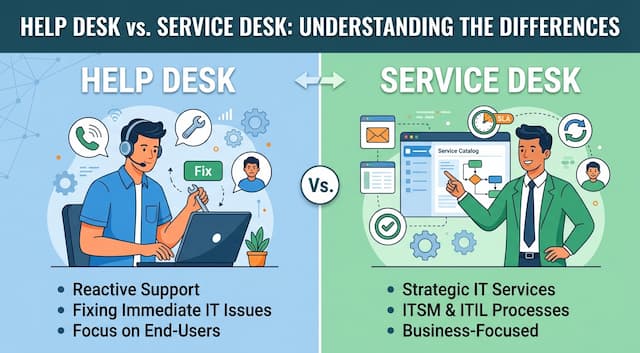
Help desk vs service desk in one line: issue-fixing vs service lifecycle. The five differences that matter, why the terms blur, and which one you need.
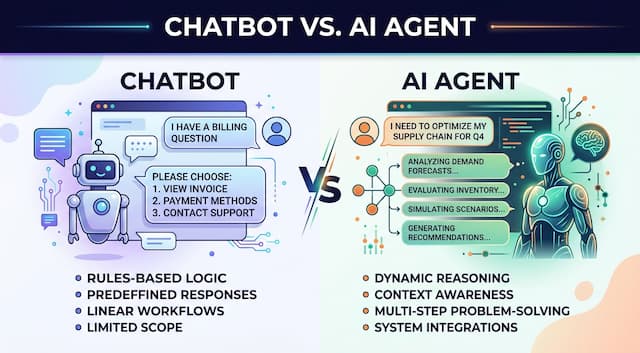 Chatbot vs AI Agent: Where the Line Actually Sits (2026)
Chatbot vs AI agent in plain terms: what each one does, where the line blurs, and how to add autonomy to support and sales without losing control.
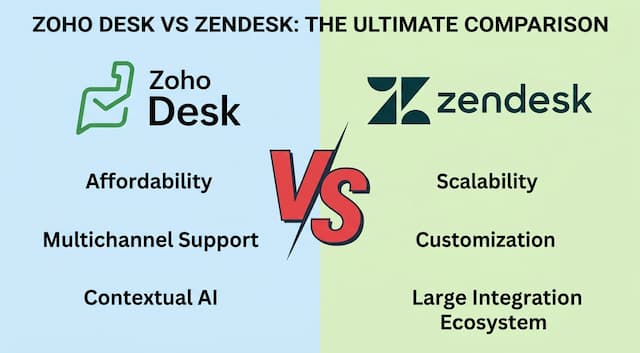 Zoho Desk vs Zendesk in 2026: The Price Gap, Examined
Zoho Desk vs Zendesk in 2026: included AI vs a quiet meter, and where Zendesk earns it