Intercom vs HubSpot in 2026: Fin, Breeze, and Seat Math
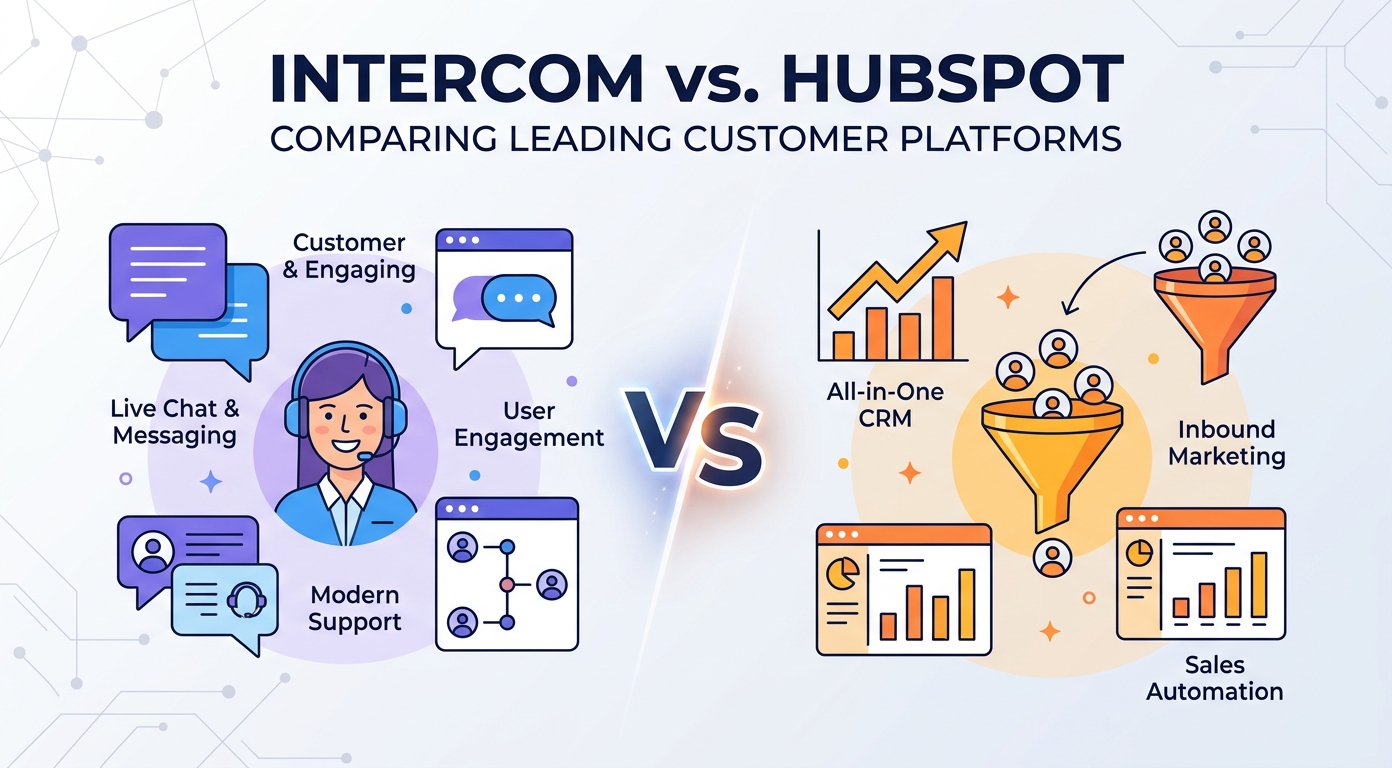
Intercom and HubSpot are both really selling you an AI agent with a platform attached; the Intercom vs HubSpot decision is about which platform you want the AI attached to. Intercom attaches Fin, its flagship AI agent at a printed $0.99 per outcome, to the sharpest support inbox and messenger in the business, priced per seat at $29 to $132. HubSpot attaches its Breeze Customer Agent, metered in credits that compute to roughly $0.45 per resolved conversation, to the CRM your marketing and sales teams may already use, with seats advertised from a promotional $7 up to $150 plus mandatory onboarding fees at the upper tiers. Both companies publish enough numbers to price the whole decision in advance, which is rarer than it should be in this category. Here is that math, at July 2026 advertised rates, and the team shapes each platform actually fits.
First, the one-table answer
| Intercom | HubSpot Service Hub | |
|---|---|---|
| Center of gravity | The support inbox and messenger | The CRM record |
| Seats | Essential $29, Advanced $85, Expert $132 (annual) | Starter from $7 promo (list $20), Pro from $90, Enterprise $150 |
| Extra fees | None mandatory; add-ons priced separately | Required onboarding: $1,500 Pro, $3,500 Enterprise |
| Free option | No free plan; Early Stage startups get 93 percent off | Free tools for up to 2 users |
| AI agent | Fin, $0.99 per outcome, included on every plan | Breeze Customer Agent, 50 credits per resolution (Pro and up) |
| AI unit math | Printed $0.99 per outcome | About $0.45 per resolution at $9 per 1,000 credits |
| Light seats | 20 free Lite seats at Advanced, 50 at Expert | View-only access free; paid features per seat |
| Wider platform | Support plus proactive messaging add-ons | Marketing, sales, content and data hubs on one record |
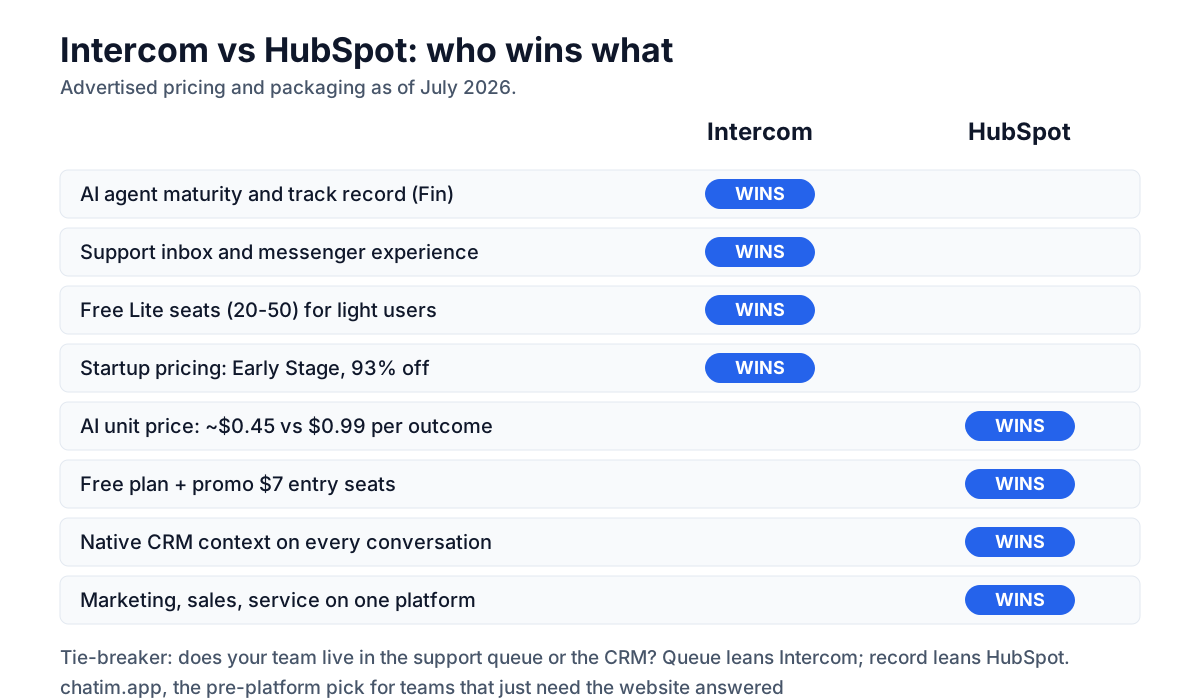
Rule of thumb: SaaS and product companies whose support lives in a messenger buy Intercom and rarely regret it; SMBs already running HubSpot marketing or sales buy Service Hub and get CRM context nobody else can sell them. The interesting cases are in between, and they usually come down to the AI meters and the fee lines.
Advertised prices, July 2026: Intercom's are annual per-seat rates, HubSpot's include promotional entry pricing against struck list prices. Both change; read the live pricing pages before signing.
The messenger company and the CRM company
Intercom: AI-first support, priced per seat plus outcomes
Intercom rebuilt itself around Fin, and the packaging shows it. Every plan includes the messenger, shared inbox, help center and Fin itself: Essential at $29 per seat per month billed annually, Advanced at $85 with the Workflows automation builder and 20 free Lite seats, Expert at $132 with 50. Fin bills a flat, printed $0.99 per outcome on top, works from day one, and can even run standalone on Zendesk or Salesforce, which tells you how confident Intercom is in the agent versus the suite. Add-ons are itemized: Copilot for agents at $29 per agent, Pro analytics at $99 per month, Proactive Support Plus at $99. There is no free plan, but the Early Stage program gives qualifying startups 93 percent off in year one, and Intercom publishes customer results claiming 50 to 70 percent resolution rates with a money-back performance guarantee in its Fin marketing; treat those as the vendor's numbers.
HubSpot Service Hub: service built into the CRM
Service Hub is the support wing of HubSpot's customer platform, so every ticket, chat and survey lands on the same contact record marketing and sales use. The free tier covers 2 users; Starter is advertised at $7 per seat per month against a $20 list price; Professional, from $90 plus a required $1,500 onboarding fee, unlocks the help desk workspace, knowledge base, customer portal and the Breeze Customer Agent; Enterprise at $150 (plus $3,500 onboarding) adds conditional SLAs, skill-based routing and journey analytics. AI runs on HubSpot Credits, published at $9 per 1,000 on annual billing, with the Customer Agent drawing 50 credits per resolved conversation, about $0.45 each, and 3,000 credits included monthly at Professional. HubSpot advertises 70 percent-plus automatic resolution; same rule, vendor's number.
Pricing: seats, promos, and the fees between the lines
At the entry, HubSpot wins on arithmetic alone: $0 for two users, then promotional $7 seats, against Intercom's $29 Essential with no free plan. The one exception is funded startups, where Intercom's Early Stage discount turns Advanced into single-digit seat prices for a year and usually flips the decision. In the middle, the platforms converge in list price and diverge in fine print: five agents cost $425 per month on Intercom Advanced versus $450 on Service Hub Professional, but HubSpot adds its one-time $1,500 onboarding while Intercom charges nothing to start, and Intercom's 20 free Lite seats cover managers and engineers who only need visibility, where HubSpot prices collaboration by seat type. At the top, Expert at $132 undercuts Enterprise at $150 plus $3,500 onboarding, though by then the real bill on both sides is the AI meter, not the seats. Model a year, not a month: seats plus onboarding plus expected AI outcomes is the honest comparison, at July 2026 rates.
AI: Fin outcomes vs Breeze credits
Both meters bill success, which makes this a fair fight and a rare one. Fin charges a printed $0.99 per outcome, on every plan, with Intercom's definition counting when Fin delivers the resolution; Breeze draws 50 credits per resolved conversation, which computes to about $0.45 at HubSpot's published credit price, with the first 60 or so covered by Professional's included credits. On unit price HubSpot is roughly half of Intercom's rate. On evidence the order reverses: Fin is the category's most-benchmarked agent, sold standalone onto competitors' helpdesks, with public customer results (Intercom's own) in the 50-to-70-percent range, while HubSpot's 70-percent-plus claim is younger and comes with less public detail. Two budgeting notes keep the math honest: HubSpot Credits are shared across its AI features, so the Customer Agent competes with data enrichment for the same pool, and both vendors let you pilot before committing, Fin through trials on your own plan and Breeze through 14 days of unmetered use with a new Professional or Enterprise seat. Run both against the same hundred real conversations and let the measured resolution rate, times the unit price, decide.
The third option: Chatim at pre-platform size
Disclosure: Chatim is our own product. If you are choosing between these two because your website needs answering rather than because you need a platform, the proportionate move is neither $425 a month of seats nor an onboarding fee. Chatim bundles live chat and chatbot automation on predictable per-plan pricing with a free tier and native Shopify and WordPress integrations, and it will not object when you eventually graduate to Fin or Breeze; by then you will know your real conversation volume, which is exactly what both meters charge for.
Try Chatim free at chatim.app →
Inbox depth vs record depth
Intercom's depth is in the conversation layer: the inbox is fast and keyboard-driven, Workflows automate routing and follow-ups without an admin hire, the messenger and help center feel like consumer software, and proactive messaging (tours, outbound, checklists) lives in the same tool, some of it behind the $99 add-ons. HubSpot's depth is in the record: every conversation enriches a contact that marketing scores, sales works and reporting spans, and the customer-success workspace, health scores and surveys read from that same spine. Intercom integrates with CRMs including HubSpot; HubSpot's inbox is serviceable rather than beloved. Teams that live inside the support queue notice Intercom's polish daily; teams that live in pipeline reviews notice HubSpot's context weekly. Neither notices the other's advantage until they need it.
Channels, email, and where each ecosystem leans
Intercom includes web and in-app messaging, email and the help center on every plan, with SMS, WhatsApp and phone sold as usage-priced channels; its ecosystem leans SaaS, with integrations and templates built around product-led companies. HubSpot covers chat, email, calling minutes by tier (500 to 12,000), a WhatsApp integration capped at 1,000 messages per month, and Facebook Messenger, with a 2,000-plus app marketplace that leans go-to-market rather than support-specific. High-volume WhatsApp or phone operations should price Intercom's usage channels and HubSpot's caps against a real month before treating either as unlimited. Ecommerce stores comparing these two should also look sideways at the dedicated ecommerce helpdesks before paying platform prices for storefront questions.
Settling it by team shape
Intercom suits you if...
- Support is product-led: messenger-first, in-app, with Fin deflecting the FAQ layer.
- You want the most proven AI agent and will pay $0.99 per outcome for the track record.
- Lite seats matter: 20 to 50 teammates need visibility without paid seats.
- You qualify for Early Stage: 93 percent off year one rewrites the entry math.
HubSpot suits you if...
- Marketing or sales already runs on HubSpot: support joins the record, not another silo.
- AI cost per resolution decides it: credit math near half of Fin's printed rate.
- You are starting from $0 to $7 seats and can grow into Professional later.
- One vendor across the customer lifecycle beats a best-of-breed stack.
Crossing over, either way
Migrations here are routine but never free of rebuild work: conversations, contacts and help-center content move with importers and partner tools, while Workflows, bots and routing rules are re-authored natively on the destination. The pairing strategy is also legitimate: plenty of companies run HubSpot as CRM with Intercom as the support layer, synced by the native integration, and unwind it later in whichever direction won. Before any contract, run the two AI agents on an identical batch of real conversations, compare measured resolution rates against each vendor's advertised ones, and price a full year including onboarding fees, add-ons and expected outcomes. For adjacent options, see our guides to Intercom alternatives, HubSpot alternatives, Crisp Chat alternatives, Freshchat alternatives, and the full ranking of the best live chat software.
For more head-to-head comparisons, see Intercom vs Zendesk, HubSpot vs Zendesk, Intercom vs Drift, and Tidio vs Intercom.
Frequently Asked Questions
Is Intercom or HubSpot better in 2026?
For product-led SaaS teams whose support lives in a messenger, Intercom: the sharpest inbox in the category, Fin included on every plan at a printed $0.99 per outcome, and 20 to 50 free Lite seats on the upper tiers. For SMBs already running HubSpot marketing or sales, Service Hub: support lands on the CRM record everyone uses, entry runs from $0 to a promotional $7 seat, and its Breeze Customer Agent computes to roughly half of Fin's unit price. Pick by center of gravity, then verify with trials.
How much does Intercom cost in 2026?
Intercom's annual-billing seat prices are Essential at $29, Advanced at $85 (with the Workflows builder and 20 free Lite seats), and Expert at $132 (50 Lite seats). Fin is included on every plan and bills $0.99 per outcome on top. Add-ons: Copilot at $29 per agent, Pro analytics $99 per month, Proactive Support Plus $99. There is no free plan, but the Early Stage program offers qualifying startups 93 percent off. As of July 2026; confirm on intercom.com.
How much does HubSpot Service Hub cost in 2026?
HubSpot advertises free tools for up to 2 users, Starter from a promotional $7 per seat per month (list $20), Professional from $90 plus a required one-time $1,500 onboarding fee, and Enterprise from $150 plus $3,500 onboarding. AI runs on HubSpot Credits at a published $9 per 1,000 annually, with 500 to 5,000 credits included by tier. As of July 2026; the promotional stickers change, so check the live page.
How do Fin and Breeze Customer Agent compare on price?
Both bill on success, which makes the comparison clean. Fin charges a printed $0.99 per outcome on every Intercom plan. Breeze draws 50 HubSpot Credits per resolved conversation, which computes to about $0.45 at the published $9 per 1,000 credit rate, roughly half Fin's price, with about 60 resolutions covered by Professional's included credits each month. Remember that HubSpot Credits are shared across its AI features, and that unit price only matters multiplied by the resolution rate you measure yourself.
Which AI agent is actually better, Fin or Breeze?
Fin carries the stronger public evidence: it is sold standalone onto Zendesk and Salesforce, benchmarked constantly, and backed by Intercom-published customer results claiming 50 to 70 percent resolution plus money-back performance marketing. HubSpot advertises 70 percent-plus automatic resolution for its Customer Agent, but with a shorter public track record. Both figures are vendor numbers. Run both agents on the same hundred real conversations, measure, and multiply by the unit prices before deciding.
Does Intercom have a free plan like HubSpot?
No. Intercom starts at Essential, $29 per seat per month billed annually, with trials but no permanent free tier. HubSpot's free tools cover up to 2 users with live chat, ticketing basics and the CRM. The exception that matters: Intercom's Early Stage program gives qualifying startups 93 percent off for the first year, which brings Advanced seats to single digits and is usually a better deal than HubSpot's free tier for funded teams.
What are Intercom Lite seats and HubSpot's seat types?
Intercom's Advanced plan includes 20 free Lite seats and Expert includes 50: teammates who need to read conversations, get context or step in occasionally without a full paid seat, which is where engineers, PMs and managers usually sit. HubSpot offers free view-only access, but working features are priced per seat by type. For companies where many people touch support occasionally, Intercom's Lite allocation is a real line-item saving; count who actually needs hands on the queue before comparing seat bills.
We already use HubSpot CRM. Is Service Hub the obvious support choice?
It is the default, not the automatic winner. Staying inside HubSpot means every ticket enriches the records marketing and sales already work, one bill, one admin surface. The reasons teams still bolt Intercom onto a HubSpot CRM: a faster inbox, a more proven AI agent, in-app messaging for product-led onboarding, and Lite seats. The native integration syncs the two well, so run the pairing during a trial and keep whichever layer earns its seats.
Which is cheaper for a 5-person support team?
On seats alone they nearly tie at list: Intercom Advanced runs $425 per month against Service Hub Professional at $450, both annual billing. The separators are around the seats: HubSpot adds a required $1,500 onboarding fee in year one, Intercom adds nothing mandatory; Intercom throws in 20 Lite seats, HubSpot includes the CRM and about 60 AI resolutions of monthly credits. At July 2026 prices, year one favors Intercom slightly, and the AI meters decide anything beyond that.
How do the channels compare, especially WhatsApp and phone?
Intercom includes messenger, in-app, email and help center everywhere, and sells SMS, WhatsApp and phone as usage-priced channels, so heavy volume shows up on the invoice transparently. HubSpot includes calling minutes by tier (500 on Starter up to 12,000 on Enterprise) and caps its WhatsApp integration at 1,000 messages per month. If WhatsApp or voice is a primary channel at volume, price Intercom's usage rates and test HubSpot's caps against a real month before choosing either.
Is it easy to migrate between Intercom and HubSpot?
The data moves easily: conversations, contacts and help-center articles transfer with importers and partner tooling in both directions, and the native integration can bridge the two during a transition. The rebuild cost is the automation layer: Intercom Workflows and Fin configurations versus HubSpot workflows and bot setups are re-authored, not ported. Budget the rebuild, pilot the destination's AI on real conversations first, and keep the old tool read-only for a quarter.
Do I need Intercom or HubSpot at all yet?
If the job is answering website visitors and capturing leads, not orchestrating a platform, then not yet. Both earn their prices when volume, teams and lifecycle process arrive. Until then a chat-first tool covers the front line: our own Chatim pairs live chat with chatbot automation on a free tier with native Shopify and WordPress integrations (disclosure: Chatim is our product), and the conversation volume you learn from it is exactly the number Fin's and Breeze's meters will eventually bill.
Related articles
More in Comparisons → Live Chat vs Chatbot: Which One Does Your Website Need?
Live chat vs chatbot in plain terms: what each does best, where each fails, and the bot-first, human-close handoff pattern that beats running either alone.
 Help Desk vs Service Desk: The Real Difference (2026)
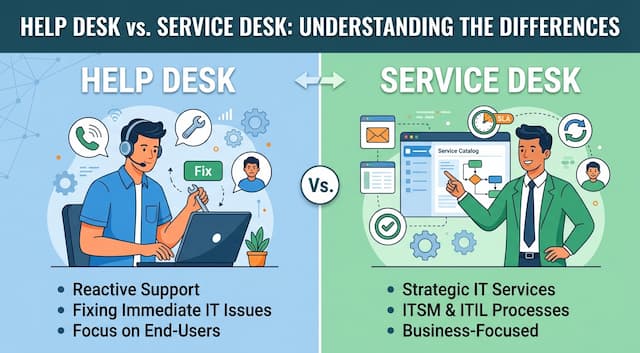
Help desk vs service desk in one line: issue-fixing vs service lifecycle. The five differences that matter, why the terms blur, and which one you need.
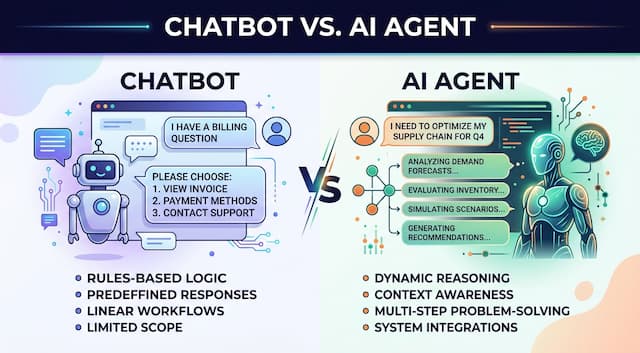 Chatbot vs AI Agent: Where the Line Actually Sits (2026)
Chatbot vs AI agent in plain terms: what each one does, where the line blurs, and how to add autonomy to support and sales without losing control.
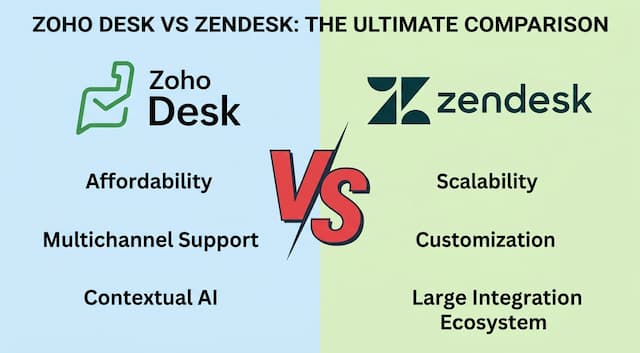 Zoho Desk vs Zendesk in 2026: The Price Gap, Examined
Zoho Desk vs Zendesk in 2026: included AI vs a quiet meter, and where Zendesk earns it