Help Desk vs Service Desk: The Real Difference (2026)
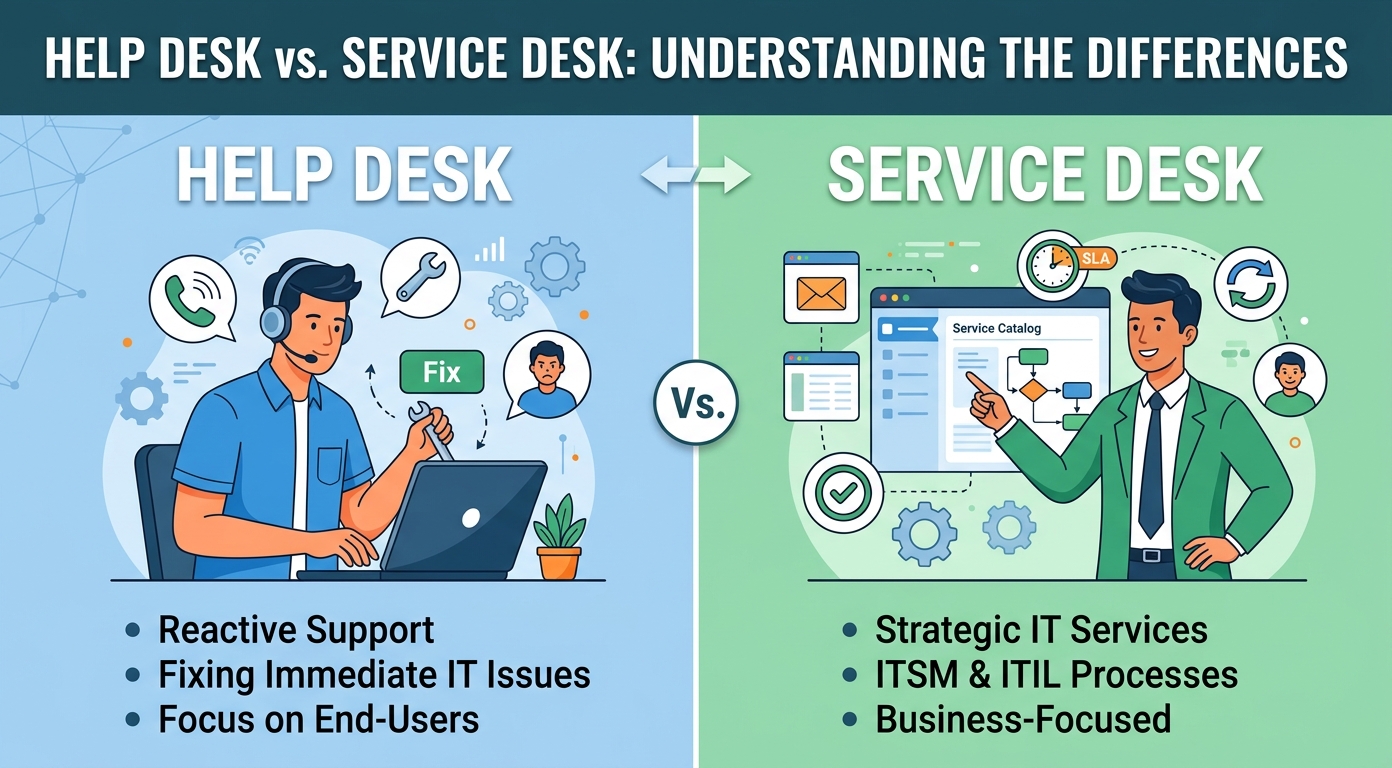
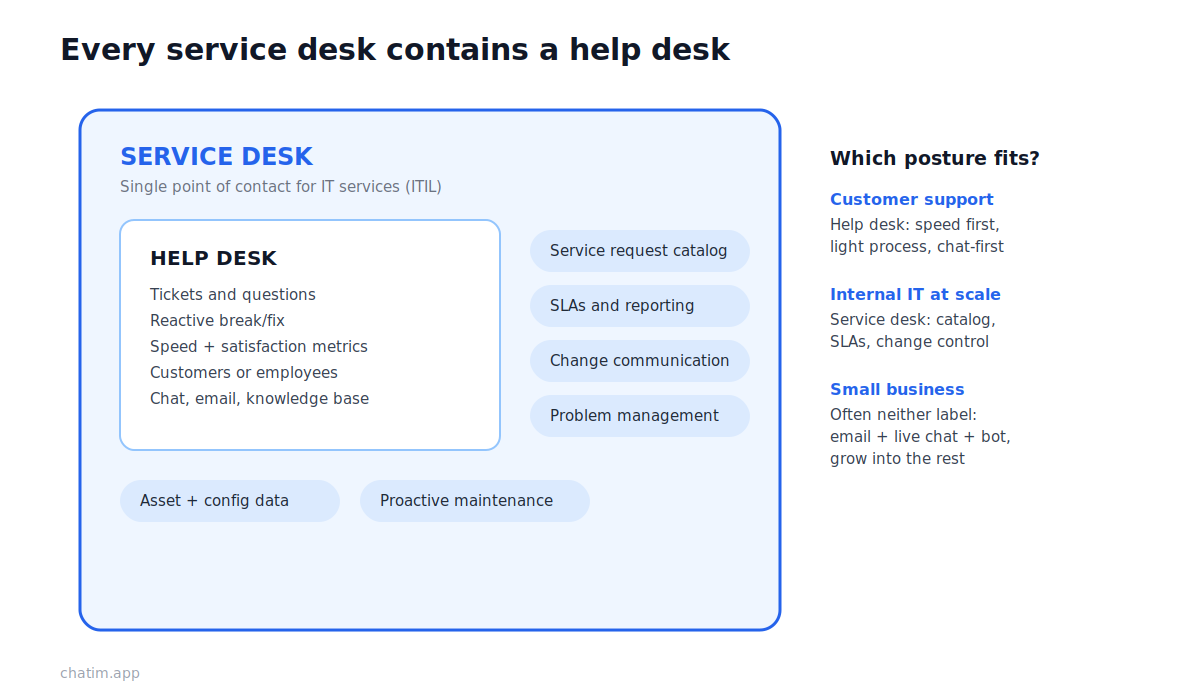
Help desk vs service desk comes down to scope: a help desk fixes problems as they arrive, while a service desk manages the entire lifecycle of IT services, of which fixing problems is one part. A help desk is reactive by design (something broke, someone needs help, a ticket gets resolved). A service desk, a term rooted in the ITIL framework, is the single point of contact between a service provider and its users, handling incidents but also service requests, change communication, and the processes around them. If you only remember one line, remember this one: every service desk contains a help desk, but most help desks are not service desks.
That is the short answer. The rest of this guide unpacks the differences that actually matter in practice, why the two terms blur inside real companies, and how to decide which one your business needs, including the honest answer that many small businesses need neither label, just a fast way to answer the people writing to them.
Help desk vs service desk at a glance
| Help desk | Service desk | |
|---|---|---|
| Core job | Resolve issues and questions as they come in | Manage IT service delivery end to end |
| Posture | Reactive: break/fix, question/answer | Reactive + proactive: incidents, requests, changes, problems |
| Framework | None required; process-light | Typically aligned with ITIL / ITSM practices |
| Audience | Customers or employees | Primarily employees and internal service users |
| Scope of records | Tickets and conversations | Tickets plus service catalog, SLAs, change records, asset data |
| Success metric | Speed and satisfaction per interaction | Service health: uptime, SLA compliance, request throughput |
What a help desk is
A help desk is the function (and usually the software) that receives questions and problems, turns them into trackable conversations or tickets, and drives each one to resolution. The unit of work is the individual issue: a customer cannot log in, an order looks wrong, the printer refuses to exist. Help desks live or die on response speed, clear ownership of each ticket, and a knowledge base that absorbs the repetitive questions. They serve external customers as often as employees, which is why "help desk" is the word you hear in customer support contexts. Our guide to help desk software covers the tooling side in depth.
What a service desk is
A service desk is a broader operational function defined in the ITIL framework as the single point of contact between the IT organization and its users. It handles the same incidents a help desk handles, but wraps them in service management: a catalog of services users can request (new laptop, software access, onboarding), formal SLAs, change and problem management processes, and often asset and configuration data. The unit of work is the service, not the ticket. That is why service desks measure things like SLA compliance and service availability rather than only ticket counts. The term belongs mostly to internal IT; comparison shopping in that world runs through IT service desk software rather than customer support tools.
The five differences that matter in practice
Scope. Help desk: solve this issue. Service desk: run this service, of which issues are one signal.
Process weight. A help desk can run well on an inbox, a chat widget, and discipline. A service desk implies defined processes for incidents, requests, changes, and problems, usually ITIL-shaped.
Audience. Help desks face customers or employees. Service desks almost always face employees and internal service users; nobody offers their customers a change-management process.
Proactivity. Help desks react. Service desks also plan: maintenance windows, communicated changes, problem records that chase root causes across many incidents.
Metrics. Help desks track response time, resolution time, and satisfaction. Service desks add SLA compliance, request throughput, and service availability. Different scoreboards produce different behavior, which is the practical reason the naming matters at all.
Why the terms blur in real companies
Vendors blurred the words first: many products marketed as help desks ship SLA timers and service catalogs, and many "service desk" products get used as plain ticket queues. Teams blur them next, because titles outlive org changes and the person running "the service desk" at a fifty-person company is usually running a help desk with a nicer name. The distinction stays useful anyway, as a test of intent: if you are being asked to add SLAs, a request catalog, and change communication, someone is asking you to build a service desk, whatever the tool is called. If you are being asked to answer customers faster, that is a help desk problem, and process weight will slow it down, not speed it up.
Which one does your business need?
Internal IT for a growing company (roughly 50+ employees, compliance requirements, managed hardware and access): you will grow into a service desk, and adopting its vocabulary early keeps audits and onboarding sane. Customer-facing support for a SaaS, ecommerce, or services business: you need a help desk posture, speed first, process only where repetition demands it. And for many small businesses, the honest answer is neither label: what they need is one reliable front door (email plus a live chat with chatbot answering the repetitive half), a shared view of open conversations, and a short list of saved answers. Grow into ticketing when volume demands it; grow into service management when someone genuinely asks for a service catalog, and not a day sooner.
Choosing tools without overbuying
Match the tool to the posture, not the marketing page. If your work is customer conversations, a chat-first stack with a chatbot and a knowledge base covers more ground per dollar than an ITSM suite, and our help desk software roundup maps that field. If your work is internal IT services with SLAs and asset tracking, shop the service desk category instead, and accept the process weight as the price of control. The expensive mistake in both directions is the same one: buying the other side's tool because the demo looked thorough, then paying every day in configuration for features whose problems you do not have.
Frequently Asked Questions
What is the difference between a help desk and a service desk?
A help desk resolves individual issues and questions as they arrive: reactive, ticket-by-ticket, focused on speed. A service desk, a term from the ITIL framework, is the single point of contact for IT services and manages the whole service lifecycle: incidents plus service requests, SLAs, change communication, and related processes. Every service desk contains a help desk; most help desks are not service desks.
Is a service desk the same as a help desk?
No, though the terms get used interchangeably. The help desk is the issue-resolution part. The service desk wraps that in service management: a request catalog, SLAs, change and problem processes, and often asset data. In many companies the practical difference is small because the 'service desk' is used as a plain ticket queue.
What does ITIL say about service desks?
ITIL defines the service desk as the single point of contact between the service provider and its users, responsible for handling incidents and service requests and for communication with users. That framing is why 'service desk' implies defined processes and service-level thinking rather than only answering tickets.
What is a help desk used for?
Receiving questions and problems from customers or employees, turning them into trackable conversations or tickets, and driving each to resolution. Typical channels are email, live chat, and a knowledge base for self-serve answers. Success is measured per interaction: response time, resolution time, and satisfaction.
What is a service desk used for?
Running IT service delivery for an organization: resolving incidents, fulfilling service requests from a catalog (access, hardware, onboarding), meeting SLAs, communicating changes and maintenance, and tracking problems to root causes. Its success metrics are service-level ones: SLA compliance, availability, and request throughput.
Is a service desk only for internal IT?
Almost always. The service desk concept assumes an organization providing defined services to its users, which fits employees and internal customers. Customer-facing support teams use help desk posture and tools, because external customers want answers and resolutions, not change-management processes.
Which is better, a help desk or a service desk?
Neither is better; they solve different problems. Customer-facing support needs help desk posture: speed first, light process. Internal IT at a growing or regulated company needs service desk posture: catalogs, SLAs, and change control. The mistake is buying one posture's tooling for the other posture's problem.
What is the difference between a help desk ticket and a service request?
A ticket (incident) is unplanned: something is broken or unclear and needs fixing. A service request is planned and standard: access to a system, a new laptop, a software install, chosen from a defined catalog. Service desks track the two separately because they follow different processes and different service-level expectations.
Do small businesses need a help desk or a service desk?
Usually neither label at first. Most small businesses need one reliable front door for questions: email plus live chat, a shared view of open conversations, saved answers for the repetitive ones, and a chatbot covering after-hours. Ticketing earns its place when volume grows; service management earns its place when someone genuinely needs a service catalog and SLAs.
Can a chatbot work with a help desk or service desk?
Yes, and it plays a different role in each. On a help desk it deflects the repetitive customer questions and collects context before a human takes over. On a service desk it can front the request catalog: password resets, access requests, and status checks are the classic automatable service requests.
What is the difference between a service desk and ITSM?
ITSM (IT service management) is the whole discipline of designing, delivering, and improving IT services. The service desk is one function within ITSM: the contact point where users meet those services. ITSM also covers practices the service desk does not own alone, like change enablement, asset management, and continual improvement.
What metrics do help desks and service desks track?
Help desks track per-interaction metrics: first response time, resolution time, and customer satisfaction. Service desks add service-level metrics: SLA compliance, request throughput, and service availability. The scoreboard shapes behavior, which is the most practical reason to be deliberate about which posture you are running.
Can one tool work as both a help desk and a service desk?
Many tools market both capabilities, and functionally the overlap is large: both manage queues of work with statuses and assignments. The practical test is whether you need a service catalog, SLA policies, and change records. If yes, choose a tool built for service management; if no, a lighter help desk stack is faster to run and cheaper to own.