Chatbot ROI: How to Calculate What a Bot Is Worth (2026)
Most chatbot ROI content is a vendor waving someone else's percentages at you. This guide does the opposite: it gives you the framework to calculate the return on an AI chatbot from your own numbers, because your queue, your cost per conversation, and your close rate are the only inputs that predict anything about your business. The arithmetic is short enough to fit on a napkin, honest enough to survive your accountant, and it occasionally comes out negative, which is exactly why it is worth doing before you commit to a paid plan.
If you are still learning what the modern bots actually do, start with our chatbot guide; this page assumes you know and asks only whether one pays.
The right way to ask the ROI question
Return on investment is value created minus cost, divided by cost. Simple, except both halves get miscounted. The classic value mistake is counting every bot conversation as a win, including the ones where the visitor gave up; the only conversations that count are the ones resolved without a human that did not come back. The classic cost mistake is counting only the subscription and forgetting the real bill: the setup afternoon, the weekly transcript review, and the content upkeep that keeps answers true. Get those two definitions right and the rest is multiplication.
What an AI chatbot actually costs
Four lines. The subscription, which at the start is often zero: free tiers in this category cover the widget, the bot, and training on your content, and paid plans enter when volume and team seats do. Setup: one honest afternoon of preparing answers to your top questions, plus the hour of installation. Maintenance: the weekly transcript read and the content fixes it generates, perhaps an hour or two a week done properly. And the risk line, the one nobody budgets: a badly configured bot that traps or misleads customers costs trust, which is why the guardrail work is part of the investment, not an optional extra. Watch the pricing meter too: per-conversation and per-resolution pricing scales your cost with your success, which quietly rewrites the ROI as you grow.
The four value streams
Every credible chatbot business case draws on the same four streams; they just mix differently by business.
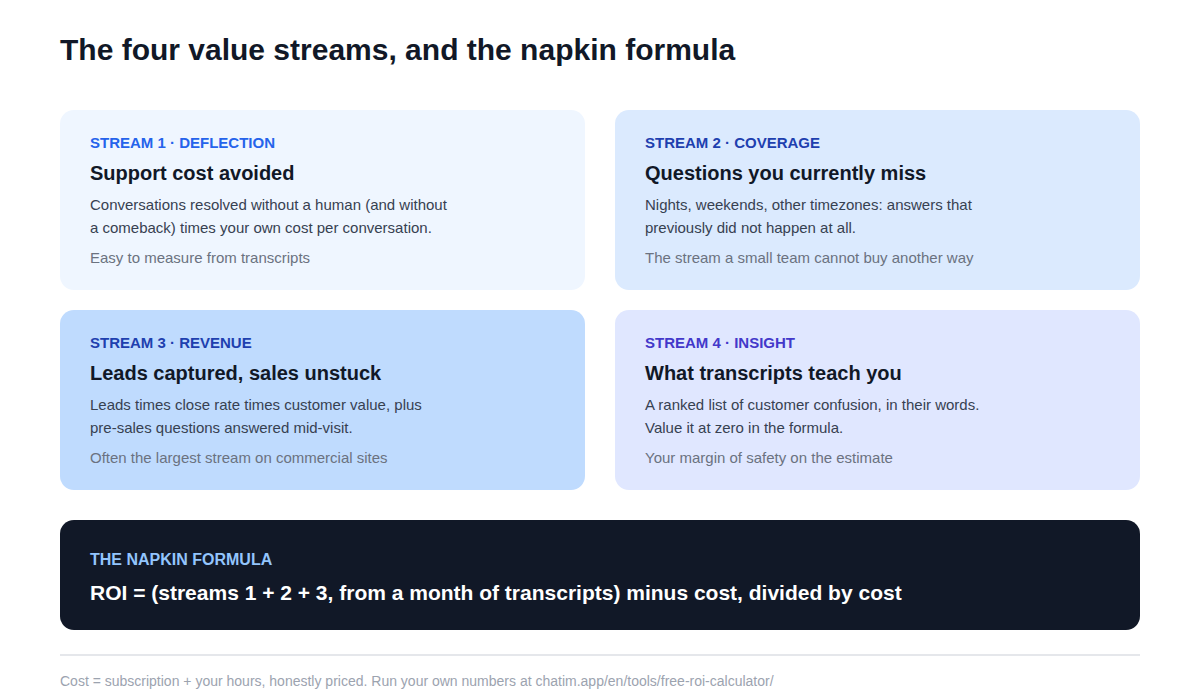
Deflection: support cost avoided
Each conversation the bot resolves cleanly is a conversation your team did not handle. Value it at your own cost per conversation: loaded team cost for time spent on support, divided by conversations handled. If you have never computed that number, it is the single most useful piece of homework in this post, and it makes every future support decision easier, bot or no bot.
Coverage: the questions you currently miss
Some share of resolved conversations happen when nobody was on shift: nights, weekends, other timezones. Those are not deflected costs; they are answers that previously did not happen, and some of them were pre-sales questions from visitors who would otherwise have left. Value them separately, because they are the stream a small team literally cannot buy any other way.
Revenue: leads captured and sales unstuck
A bot that answers a pricing question mid-visit, captures a lead, or unblocks a checkout is doing sales work. Count captured leads times your close rate times what a customer is worth to you. This stream routinely dwarfs the support math on commercial sites, and it is the reason the widget belongs on the pricing page, not just the help center.
Insight: the stream nobody invoices
Transcripts are a ranked list of what confuses your customers, in their own words. Priced at what user research costs, this stream is real money; priced in the formula, leave it at zero and treat it as the margin of safety on your estimate.
A formula you can defend
Monthly value = (conversations resolved without a human that did not return) times (your cost per conversation) plus (after-hours resolutions valued the same way) plus (leads captured times close rate times customer value). Monthly cost = subscription plus (hours spent on setup and upkeep times what your time is worth). ROI = value minus cost, divided by cost. Nothing in it requires a spreadsheet, but if you would rather not do the arithmetic by hand, our free ROI calculator runs exactly this calculation from your inputs.
A worked example, with illustrative numbers
The numbers below are round and invented for arithmetic's sake; substitute your own. A store handles 600 support conversations a month at a cost of 4 dollars each. After a scoped launch, transcripts show the bot cleanly resolving 200 a month (800 dollars of handling avoided), 50 of them after hours, and capturing 20 leads a month of which 2 become customers worth 30 dollars a month each (60 dollars of new recurring revenue, compounding as it stacks). Costs: a 50-dollar plan plus 6 hours of upkeep a month valued at 40 dollars an hour (290 dollars all-in). First-month value of roughly 860 dollars against 290 of cost is a return of about 2 to 1, before counting the compounding subscriptions or the insight stream. Run the same shape with your inputs; the conclusion will be yours instead of ours.
When the ROI is genuinely negative
Four situations reliably sink the math, and pretending otherwise would make the rest of this page worthless. A low-volume queue of bespoke questions: nothing repetitive to automate means nothing to deflect. Content nobody will maintain: the bot answers from stale pages, trust erodes, and the risk line eats the return. Metered pricing on a high-volume site: the meter can grow faster than the value. And the bot-as-wall configuration, where deflection is achieved by exhausting people rather than helping them; the spreadsheet shows a return while live chat requests, complaints, and churn quietly book the loss elsewhere. If any of these describes your situation, fix the underlying condition first or skip the bot with a clear conscience.
How to measure it on your own queue
Run a 30-day experiment instead of a projection. Before launch, write down your baseline: monthly conversations, cost per conversation, after-hours misses, leads from the site. Launch a scoped bot on a free tier, trained on your top twenty questions, with a clean human handoff. Then count four things from transcripts: resolved-without-return, after-hours resolutions, leads captured, and handoffs requested. Plug the month's numbers into the formula (or the calculator) and let the result make the upgrade, expand, or abandon decision. For category-level numbers to sanity-check against, our live chat statistics roundup collects the published research; use it for context, never as a substitute for your own month of data.
The napkin version
If the repetitive half of your queue is real and your content is accurate, the arithmetic usually clears the bar, because the biggest cost line starts at zero and the setup is an afternoon. If your queue is small and bespoke, it usually does not, and no vendor percentage changes that. The tools that make the experiment cheapest are the chat-plus-bot platforms with usable free tiers; our live chat software comparison ranks them, and the 30-day plan above turns whichever one you pick into your own answer rather than an article's.
More on this from our team: AI chatbots, AI customer service, and how to build an AI chatbot.
Frequently Asked Questions
What is chatbot ROI?
The return on what a bot costs you (subscription, setup time, weekly upkeep) measured against the value it creates: support conversations resolved without a human, after-hours coverage, leads captured, and the insight buried in transcripts. Formally: value minus cost, divided by cost.
How do I calculate the ROI of an AI chatbot?
Multiply conversations the bot resolves cleanly (without the customer coming back) by your own cost per conversation, add after-hours resolutions and captured leads valued at close rate times customer value, then subtract the subscription and the hours you spend on upkeep. A month of real transcripts beats any projection.
What is the average ROI of a chatbot?
Published averages exist, but they blend businesses whose queues, costs, and traffic have nothing in common with yours, which makes them decoration rather than evidence. The defensible number comes from a 30-day scoped experiment on your own queue; category research is useful only as a sanity check.
What does an AI chatbot cost?
Four lines: the subscription (often zero to start, since free tiers cover a grounded bot and widget), a setup afternoon, an hour or two a week of transcript review and content upkeep, and the risk cost of a badly configured bot, which is avoided with guardrails rather than money. Watch for per-conversation metering, which scales cost with success.
How long does a chatbot take to pay back?
The structure is unusual: the main cost can be zero at the start, so payback on a free tier is immediate if the bot resolves anything at all. The real question is whether the value justifies the time you invest and, later, the paid plan; the 30-day measurement answers both.
What is a deflection rate, and is it the right metric?
It is the share of conversations handled without a human, and on its own it is gameable: a bot that exhausts people into leaving scores beautifully. The honest version counts only conversations resolved without the customer returning within a few days, read alongside satisfaction and handoff-request rates.
Can a chatbot increase revenue, not just cut costs?
On commercial sites the revenue stream is often the larger one: pre-sales questions answered mid-visit, leads captured with qualifying questions, meetings booked, checkouts unblocked. Value it as leads times close rate times customer worth, and put the widget where buying decisions happen, including the pricing page.
What metrics should I track to prove the return?
Four from transcripts: resolved-without-return, after-hours resolutions, leads captured, and handoff requests. Pair them with your pre-launch baseline (monthly conversations, cost per conversation, site leads) so the comparison is against your own history rather than a vendor's case study.
How do I know my cost per conversation?
Take the loaded cost of the time your team spends on support in a month and divide it by conversations handled. Founders doing their own support should price their hour honestly, since founder time is usually the scarcest input in the whole calculation.
When is a chatbot not worth it?
Four reliable cases: a small queue of bespoke questions with nothing repetitive in it, documentation nobody will keep current, metered pricing on a very high-volume site, and any configuration that hides the path to a human. In those situations, fix the underlying condition first or skip the bot entirely.
Does a chatbot reduce headcount?
In small teams it usually redirects hours rather than eliminating roles: the repetitive half of the queue disappears and the time moves to judgment work, onboarding, and the backlog. The honest business case is capacity and coverage, not layoffs, and cases built on layoffs tend to under-deliver.
Can I measure this without analytics tooling?
Yes; the whole framework runs on transcript counting and napkin math. Any platform with a conversation log supports it, and a free ROI calculator can do the arithmetic from a handful of inputs. The discipline is in the counting rules, not the tooling.
Do the soft benefits belong in the calculation?
Speed, satisfaction trends, and transcript insight are real but hard to price, so the defensible habit is to value them at zero in the formula and treat them as the margin of safety. If the math clears the bar without them, the decision is easy; if it only clears with them, run another month before paying.
Related articles
More in Chatbots & AI → Facebook Messenger Chatbot: The 2026 Guide + 5 Platforms
How Messenger chatbots work now: comment-to-DM automation, click-to-Messenger ads, 5 platforms compared, and when a contact button is enough.
 Chatbot Templates: 26 Free, Ready-to-Use Flows (2026)
26 free chatbot templates organized by goal and industry, what a good template contains, and the five edits that turn a ready-made flow into your own bot.
 Best WhatsApp Chatbots in 2026: 7 Platforms Compared
7 WhatsApp chatbot platforms compared, with both bills modeled: subscriptions and Meta fees. Plus the free path if you only need a WhatsApp button.
 Best Chatbot Platforms in 2026: 10 Builders Compared
10 chatbot platforms compared by what their pricing actually meters, with free plans, AI features, and a pick for each use case