Best Shopify Apps for Customer Service in 2026: 9 Compared

Choosing the best Shopify apps for customer service starts with an unglamorous truth: in ecommerce, most support conversations are about orders. Where is it, can I change it, how do I return it. So the tools below are compared on the thing that actually separates them, how deeply they see and act on your Shopify order data, alongside verified pricing and what each free plan really includes. One honesty note up front: this list mixes true Shopify App Store apps with tools that install by code snippet instead, and each entry says which it is. All pricing reflects vendor pages as verified in July 2026; check the vendor's page before you commit, because this category repriced repeatedly this year.
The short version of the whole guide: match the tool to your ticket shape. Order-status and returns traffic wants a helpdesk that can act on orders; pre-sale questions want chat on the storefront; and a small store might need nothing more than the free native option.
Integration depth is the real feature list
Every tool here advertises a Shopify integration, but the word covers four very different depths. At the surface, a chat widget simply runs on your storefront and knows nothing about orders. One level down, the inbox shows order context next to the conversation, so agents stop asking for order numbers. Deeper still, agents (and AI) can act on orders from inside the helpdesk: refunds, cancellations, address changes, without opening Shopify admin. And at the floor is Shopify Inbox, which is not integrated with Shopify so much as it is Shopify. Deeper is not automatically better; depth costs money, and a store drowning in pre-sale questions needs the storefront layer, not the refund layer. Decide which layer your ticket shape lives in, then shop within it.
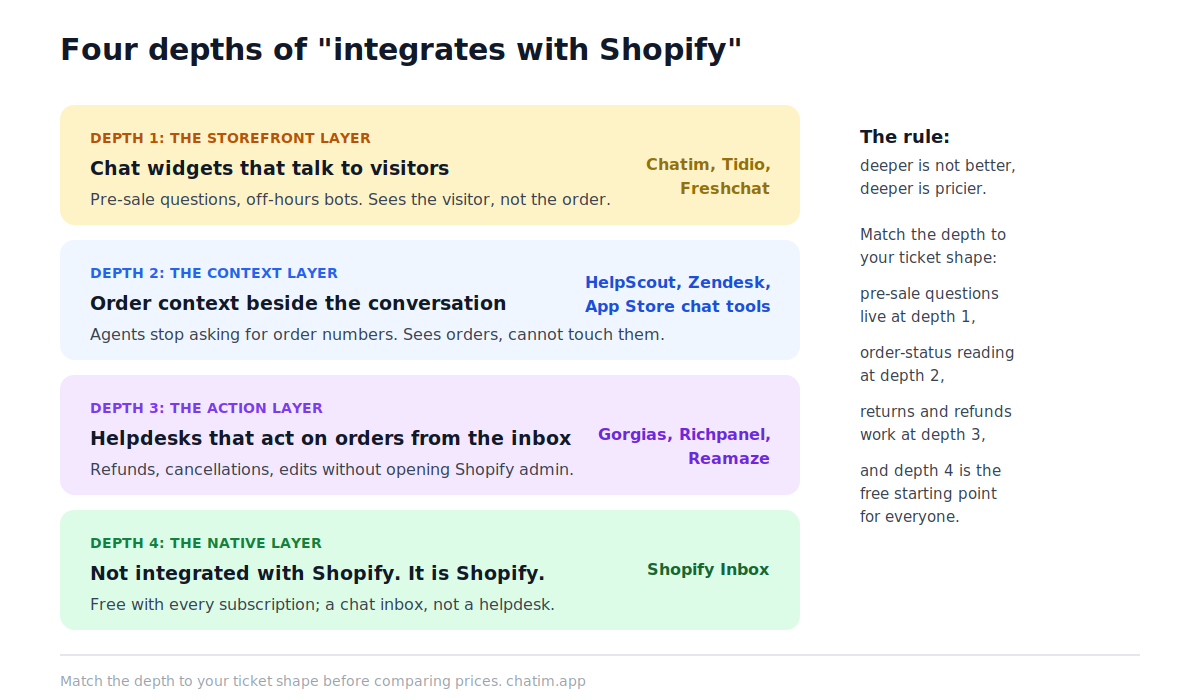
9 Shopify customer service tools compared
Every customer service app below distributes through the Shopify App Store except where the install column says otherwise. Annual-billing rates where vendors publish both, per each vendor's page as of July 2026.
| Tool | Category | Free plan | Paid entry | Install |
|---|---|---|---|---|
| Shopify Inbox | Native chat | Free with any Shopify subscription | Included | Built into Shopify |
| Chatim | Chat + chatbot widget | Unlimited chats, chatbot flows | From $9/mo | Code snippet or GTM (not App Store) |
| Tidio | Chat + AI suite | 50 billable conversations/mo | From $24.17/mo | Shopify App Store |
| Gorgias | Ecommerce helpdesk | None (trial) | From $50/mo helpdesk-only | Shopify App Store |
| Richpanel | AI-first ecommerce helpdesk | None | $99/seat/mo + $0.20/AI conversation | Shopify App Store |
| Reamaze | Ecommerce helpdesk | None (trial) | From $26.10/user/mo annual | Shopify App Store |
| Zendesk | General helpdesk | None (trial) | Suite from $55/agent/mo | Shopify App Store |
| HelpScout | General helpdesk | 5 users, 1 inbox, 100 contacts/mo | From $25/user/mo | Shopify App Store |
| Freshchat | Chat + AI (Freshworks) | Up to 10 agents | From $19/agent/mo | Shopify App Store |
The native layer
1. Shopify Inbox: the free default every store should start from
Shopify Inbox is free with any Shopify subscription, lives inside Shopify admin and the mobile apps, and connects the storefront chat widget with Shop app messaging. Because it ships from Shopify itself, the integration question disappears: order context is simply there. The limits are equally clear: it is a chat inbox with quick replies and basic automated answers, not a helpdesk (no ticketing across email and social at scale) and not a customer-facing AI agent. The right way to use it is as the baseline: run it until the day you can name the specific thing it will not do, and let that thing pick your next tool from the categories below.
The storefront layer: chat and chatbots
2. Chatim: free chat and chatbot flows, installed by snippet
Full disclosure twice over: Chatim is built by the team behind this blog, and it is not distributed through the Shopify App Store. It installs on a Shopify store the same way analytics tools do, by pasting a code snippet into the theme or deploying through Google Tag Manager, with a step-by-step Shopify guide and a GTM guide in the docs. What you get for that one-time setup is the strongest free storefront layer in this list: unlimited chats, rule-based chatbot flows for pre-sale questions and lead capture, and a multi-channel contact button, with paid plans from $9/month and every limit on the pricing page. The honest fit: pre-sale conversations and off-hours coverage on the storefront, not order actions inside an agent inbox; the live chat for Shopify page covers the setup end to end.
3. Tidio: the App Store's favorite chat-plus-AI suite
Tidio is the natural comparison point: a polished App Store install, order context in the inbox, flows, and the Lyro AI agent on top. The free plan covers 50 billable conversations a month (only human-agent replies count against it, which is genuinely fair), paid plans start at $24.17/month billed annually, and Lyro starts at $32.50/month with the first 50 AI conversations free. The watch-item is the meter: a busy storefront burns conversation quota fast, and upper tiers go custom. Where it beats the snippet-installed tools is order data in the agent view; where it loses is the bill's growth curve, mapped in our Tidio alternatives guide.
The action layer: helpdesks built for ecommerce
4. Gorgias: the ecommerce helpdesk default
Gorgias is the tool most Shopify merchants graduate to when email, chat, and social tickets need one inbox that can act on orders: refunds and edits happen inside the helpdesk, and its own trust bar claims it powers conversations for a large share of Shopify brands. Pricing needs stating carefully because the page has an AI toggle: the helpdesk alone starts at $50/month billed annually (a $10 Starter tier exists on monthly billing), and with the optional AI Agent bundle the Basic tier becomes $77/month, with automated-interaction allowances by tier and overage billed per interaction. It is never priced per agent, the page's own claim, which suits lean teams with ticket volume. No free plan. Our Gorgias alternatives guide covers the field around it.
5. Richpanel: the AI-first bet with a guarantee
Richpanel compresses the decision into one offering: $99 per seat per month plus $0.20 per AI-handled conversation, wrapped in a bold promise, a 50% AI-resolution guarantee with your money back if it misses within 30 days, as the company states it. There is no free plan and no stated trial; the guarantee stands in for both. The shape fits stores that already believe in AI deflection and want the vendor to share the risk; the flat per-conversation AI price is also the easiest AI meter on this list to model in a spreadsheet before buying.
6. Reamaze: the flexible-pricing sleeper
Reamaze (a GoDaddy brand) is the quiet value pick among ecommerce helpdesks, mostly because it prices two ways: per agent from $26.10/user/month billed annually, or a flat volume plan at $59/month with unlimited team members and a monthly cap of 500 responded conversations, a shape nothing else on this list offers and a genuine fit for stores with many hands but modest volume. AI resolutions come metered: a small monthly allowance is included by tier, then billed per additional resolution. A 14-day full-featured trial, no credit card. The trade-off is gravity: it has less ecosystem momentum than Gorgias, which matters if you lean on prebuilt integrations.
The platform layer: general helpdesks with Shopify apps
7. Zendesk: the enterprise standard, Shopify included
Zendesk is what you pick when Shopify is one channel among many and the org needs the full apparatus: omnichannel routing, a serious knowledge base, and AI agents billed per automated resolution (the per-resolution rate is not displayed on its pricing page, so model it with sales before committing). The Suite starts at $55/agent/month billed annually; a $19 ticketing-only Support tier exists but excludes the messaging features most stores are shopping for. The Shopify app brings order context into tickets. The honest caveat is fit: for a single-store team, the per-agent stack plus add-ons is easy to overbuy, which is exactly the situation our Zendesk alternatives guide was written for.
8. HelpScout: the shared-inbox path with a real free tier
HelpScout added something rare for 2026: a genuinely free tier (up to 5 users, one inbox, 100 contacts a month), making it the cheapest way for a small store to get a proper shared inbox next to a Shopify order sidebar. Standard runs $25/user/month with live chat and social channels included, and AI Answers bills at $0.75 per resolution with spending caps available. User caps by tier are the scaling constraint to know about in advance. It fits teams that want helpdesk discipline with an email-first feel rather than a contact-center feel; the HelpScout alternatives guide maps the neighbors.
9. Freshchat: the generous free plan among suites
Freshchat keeps a permanent free plan covering up to 10 agents with the chat widget and shared inbox, unusual generosity at the suite end of the market, with paid plans from $19/agent/month billed annually and Freddy AI sessions metered on top. One precision note: Freshchat's free plan survived 2026, while sibling Freshdesk replaced its own free tier with an intro program, so check which Freshworks product a given claim describes. The fit is teams that want a suite's channel breadth on a startup budget and will tolerate AI sessions being counted. Alternatives are mapped in our Freshchat alternatives guide.
Which tool fits your store
The selector for customer service apps is the same as everywhere else in this guide: ticket shape first. Take Shopify Inbox first if you have not tried it; it is free and native, and its ceiling will introduce itself. Take Chatim when the gap is the storefront: pre-sale questions, off-hours coverage, and chatbot flows on a free plan, installed by snippet in an afternoon. Take Tidio when you want chat plus AI as one App Store install with order context. Take Gorgias when order actions in the inbox become the daily bottleneck, Richpanel when you want AI deflection with the vendor sharing the risk, and Reamaze when the flat volume plan matches a many-hands, modest-volume team. Take Zendesk when Shopify is one channel of many, HelpScout when a disciplined shared inbox is the actual need, and Freshchat when ten agents on a free plan is the budget reality. If the need is specifically chat on the storefront, our best live chat for Shopify guide goes deeper on that layer alone.
Beyond the inbox: automate before you staff
Whichever layer you buy, the sequencing advice is the same: automate the predictable before hiring for the exceptional. A Shopify chatbot handling order-status and shipping questions removes the tickets that burn agents out without making customers happier, and support quality compounds into growth, a connection covered in how to promote your Shopify store, where responsive support is one of the levers. Start at the cheapest layer that addresses your ticket shape, measure for a month, and buy depth only when the transcripts demand it.
More on this from our team: live chat for WooCommerce, live chat for BigCommerce, and live chat vs chatbot.
Frequently Asked Questions
What is the best Shopify app for customer service?
Depends on your ticket shape. Order-status and returns traffic points to an ecommerce helpdesk like Gorgias, Richpanel, or Reamaze that can act on orders from the inbox. Pre-sale questions point to storefront chat like Chatim or Tidio. Small stores should start with the free native Shopify Inbox and upgrade only when they can name what it will not do.
Does Shopify have built-in customer service tools?
Yes. Shopify Inbox is free with any Shopify subscription and runs inside Shopify admin and the mobile apps, connecting storefront chat with Shop app messaging. It covers chat with quick replies and basic automated answers, but it is not a full helpdesk and has no customer-facing AI agent.
Is Shopify Inbox enough for my store?
For many small stores, yes, and it costs nothing to find out. The ceiling appears when you need ticketing across email and social channels, deeper automation, or an AI agent answering customers directly. Run Inbox until one of those gaps shows up in practice, then choose the category that fills it.
What is the best free customer service app for Shopify?
Shopify Inbox is free with every subscription and natively integrated. Beyond it, Chatim's free plan has unlimited chats with chatbot flows (installed by code snippet rather than the App Store), Freshchat covers up to 10 agents free, HelpScout offers a 5-user free tier, and Tidio's free plan covers 50 billable conversations a month.
Can I use a chat tool that is not in the Shopify App Store?
Yes. Any tool that provides a JavaScript snippet installs on a Shopify storefront through the theme code or Google Tag Manager, the same way analytics tools do. The trade-off is integration depth: snippet-installed widgets talk to visitors but do not see order data inside an agent inbox the way App Store helpdesk integrations do.
What is the difference between a chat widget and a helpdesk?
A chat widget lives on the storefront and handles conversations in the moment, ideally with a bot covering off-hours. A helpdesk lives with your team and manages conversations across channels as tickets, with order context and actions like refunds inside the inbox. Growing stores usually end up with one of each, connected.
How much do Shopify customer service apps cost?
As of July 2026: free tiers exist from Shopify Inbox, Chatim, Freshchat, HelpScout, and Tidio. Paid entry points range from $9 to $55 per month depending on category, with ecommerce helpdesks like Gorgias from $50 monthly (annual billing) and Richpanel at $99 per seat. AI features are usually metered separately. Verify on each vendor's pricing page.
What does pay-per-resolution AI pricing mean?
You pay only when the AI fully resolves a conversation without escalating to a human. Rates in this category as of July 2026 include HelpScout at $0.75 per resolution, Reamaze at $0.85 beyond plan allowances, and Richpanel at a flat $0.20 per AI-handled conversation. It reads fair, but bills scale with traffic, so model it against your volume.
Is Gorgias worth it for a small Shopify store?
Its pricing is volume-based rather than per-agent, so it suits lean teams with real ticket volume. The helpdesk alone starts at $50 per month on annual billing with a $10 starter tier on monthly billing, and the optional AI agent raises the bill by tier. A store with light volume may be overbuying compared to Inbox plus a chat widget.
What is WISMO and why does it matter for app choice?
WISMO stands for where is my order, the single most common ecommerce support question. If order-status questions dominate your inbox, prioritize tools that surface order data automatically or answer status questions with automation, because every WISMO ticket a bot or integration absorbs is agent time returned.
Do these tools work on WooCommerce or BigCommerce too?
Most of them, yes. The general helpdesks and chat widgets in this guide are platform-agnostic, and snippet-installed tools work anywhere you can add code. The main Shopify-specific entries are Shopify Inbox and the deep order-action integrations of the ecommerce helpdesks, which have platform-specific equivalents.
Should I automate support before hiring an agent?
Automate the predictable first. A chatbot answering order-status, shipping, and returns questions removes the repetitive tickets that burn agents out, and it works around the clock. Hire when the remaining conversations, the judgment calls and exceptions, exceed what your current team handles well.
How do I choose between all these categories?
Read your last fifty conversations and sort them into pre-sale questions, order-status and returns, and everything else. Pre-sale dominance points to storefront chat, order-work dominance points to an ecommerce helpdesk, and channel sprawl points to a general helpdesk. Buy the cheapest layer that addresses the biggest pile, then measure for a month.
Related articles
More in Ecommerce & platforms → Best Shopify Apps to Increase Sales & Conversions (2026)
12 Shopify apps to increase sales and conversions, sorted by the lever each one pulls: AOV, hesitant visitors, lost carts, trust, repeat buyers.
 WooCommerce Chatbot: What It Does and How to Add One (2026)
What a WooCommerce chatbot does for a store: product and order questions answered from your own pages, plus how to add one without plugin bloat.
 Wix Chatbot: How to Add One and What It Can Do (2026)
What a Wix chatbot can do for your site: answer service questions, capture leads politely, help with bookings and store orders, and cover after-hours.
 Webflow Live Chat: How to Add It and Hand It Off (2026)
How to add live chat to a Webflow site, keep it on-design, turn it into a lead engine on marketing sites, and ship it as an agency deliverable.