Best Shopify Apps to Increase Sales & Conversions (2026)
More sales rarely comes from installing the "best" app. It comes from fixing the one thing that is quietly costing you orders: hesitant shoppers who leave, carts that stall, low average order value (AOV), or traffic that never converts into contacts you can market to later. So this guide to the best Shopify apps to increase sales and conversions sorts the most popular tools by the lever each one pulls, so you can match an app to your actual bottleneck instead of stacking apps that overlap. You get a simple framework, a buying checklist, twelve breakdowns, and a comparison table to decide fast.
A note on figures: prices below are drawn from each app's Shopify App Store listing and vendor pages as of September 2026. Plans change often, so verify on the App Store before you install. One more disclosure: the list mixes App Store apps with one tool that installs by code snippet instead (Chatim, built by the team behind this blog), and the entry says so.
First, know which lever you are pulling
"Increase sales and conversions" is not one job. It is five. Each lever fixes a different leak, and each maps to a different type of app.
- Convert hesitant visitors: shoppers who have questions and leave before buying. Fixed by live chat and on-page conversion tools.
- Raise average order value (AOV): orders that are smaller than they could be. Fixed by gift-with-purchase, bundle, and upsell/cross-sell apps.
- Recover and re-engage: visitors and carts you have already paid to acquire but lost. Fixed by email, SMS, and popup apps.
- Build trust: new shoppers who do not yet believe you. Fixed by product review and social-proof apps.
- Retain and repeat: one-time buyers who never come back. Fixed by loyalty and rewards apps.
The table below maps each lever to the app category that serves it. Use it to spot which row matches your biggest problem right now.
| Lever | What it fixes | App category |
|---|---|---|
| Convert hesitant visitors | Drop-off from unanswered questions | Live chat, on-page conversion |
| Raise AOV | Small orders | Gift-with-purchase, bundles, upsell/cross-sell |
| Recover and re-engage | Lost visitors and carts | Email, SMS, popups |
| Build trust | Low buyer confidence | Product reviews, social proof |
| Retain and repeat | No second purchase | Loyalty and rewards |
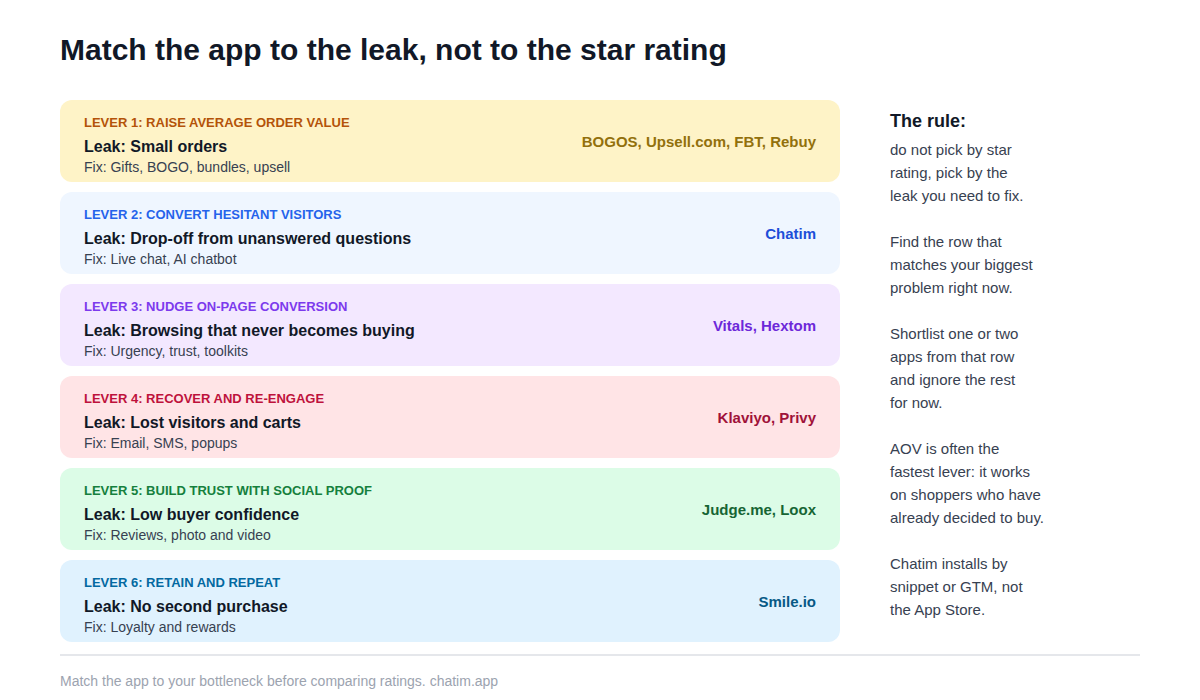
Next step: pick the one lever that matches your biggest leak. That row tells you which section below to read first.
What to check before you install any app
Every app you add is a commitment: to a monthly cost, to page weight, and to setup time. Run each candidate through these five checks before you install.
- Shopify compatibility. Confirm it supports what you actually use: your theme (Online Store 2.0), checkout, POS, subscriptions, or Shopify Markets if you sell internationally. A "Built for Shopify" badge is a good baseline signal.
- Pricing model. Flat monthly pricing is predictable. Usage-based pricing (per order, per contact, per ticket) scales with you, which is fine until a busy month produces a surprise bill. Model the cost at your real volume.
- Page-speed impact. Storefront apps add scripts. Test your product and cart pages before and after install, because a slower store converts worse, which can cancel out the app's benefit.
- Support quality. Read recent one- and two-star reviews, not just the average. Look for how the developer responds to billing and bug complaints.
- Overlap with your stack. If two apps do the same job, you pay twice and add weight twice. Map features against what you already run.
Watch out for app bloat. More apps is not more sales. Each one adds cost and page weight, and several may fight over the same part of the page (the cart, the product page, the checkout). Add deliberately, one lever at a time, and remove anything you are not actively using.
Next step: shortlist no more than one or two apps per lever, then read their breakdowns below.
Lever 1: raise average order value
Each tool below follows the same structure: who it is best for, pricing, an overview, key features, and honest limitations. Tools are grouped by the lever they pull, starting with AOV. These apps grow the size of orders you are already winning, which is often the fastest lever because it works on shoppers who have already decided to buy.
1. BOGOS Free Gift, Bundle & Upsell: gift-with-purchase, BOGO and bundles
Best for: stores that want to raise AOV and conversion with Shopify free gifts with purchase, BOGO/BXGY offers, and bundles.
Pricing: free plan available; paid plans available (verify current tiers on the App Store). Developer: Secomapp.
BOGOS is one of the longer-established promotion apps on Shopify: its App Store listing cites 92,000+ brands, including more than 5,000 Shopify Plus stores, and 11+ years on the platform. That track record matters for a promotions app, because gift and discount logic touches your cart and checkout, where reliability is not optional. The app is built around a single idea: give shoppers a reason to add more to the cart. Whether that reason is a free gift over a threshold, a buy-one-get-one deal, or a discounted bundle, BOGOS handles the offer logic and displays it across the storefront.
Key features:
- Free gift with purchase (GWP), including gift-by-threshold and gift-by-product rules
- Buy X Get Y (BXGY) and BOGO offers
- Product bundles and volume/tiered discounts
- Cart goals and progress messaging to nudge shoppers toward the next threshold
- Offer scheduling and targeting for campaigns like BFCM
Limitations. Because BOGOS spans gifts, BOGO, and bundles, the settings run deep: plan a little setup time to get offer rules and display exactly right. If you only ever need one simple offer type, a narrower app may be quicker to configure, though you would lose the flexibility to test other offer styles later. For offer ideas to run through it, see our discount code ideas post.
2. Upsell.com (formerly ReConvert): post-purchase upsells
Best for: stores that want one-click upsells on the thank-you and post-purchase pages, where extra offers cannot hurt the original conversion.
Pricing: free plan available; paid plans scale with order volume (verify current tiers). Developer: Upsell.com (formerly ReConvert).
Upsell.com owns the post-purchase moment. Once a shopper has paid, it shows a one-click offer they can accept without re-entering payment details, so nothing you present there can drag down the original sale. That safety is the reason many stores start their AOV work post-purchase before touching pre-purchase upsells. The drag-and-drop editor builds thank-you-page funnels without code.
Key features:
- One-click post-purchase and thank-you-page upsells
- Drag-and-drop funnel builder
- Cart and checkout upsell options
- Targeting rules (minimum order value, product, source)
- Segmentation to show different offers to different shoppers
Limitations. Pricing is usage-based, and some App Store reviews (as of September 2026) mention billing surprises when order or usage counts spike: model your spend at real volume and watch charges after the trial. The app was recently rebranded from ReConvert to Upsell.com, so older third-party reviews may reference the previous name.
3. Frequently Bought Together: product-page cross-sell
Best for: stores that want Amazon-style "customers also bought" bundles on the product page.
Pricing: free plan available; paid plan from $9.99/month. Developer: Code Black Belt.
Built by Code Black Belt in 2017 to bring Amazon's classic feature to Shopify, this app shows a small set of complementary products on the product page with a one-click "add all to cart" button. The recommendations are AI-driven, trained on a large volume of order data, and tuned automatically to popular themes. It is a focused product-page tool rather than a whole-funnel suite, which is part of why it stays fast and simple.
Key features:
- AI product recommendations displayed as bundles
- Manual bundle overrides for full control
- Four bundle discount types to lift conversion
- Star ratings pulled in from review apps (Judge.me, Loox, Yotpo, and more)
- Automatic styling for common themes
Limitations. The widget lives on the product page only; it does not cover cart, checkout, or post-purchase, so pair it with another app if you want offers across the whole journey. Note that Code Black Belt runs two similar listings ("Frequently Bought Together" and "Frequently Bought Together CBB"); confirm you are installing the one you intend.
4. Rebuy: AI personalization engine for scaling stores
Best for: growing and higher-volume stores that want AI upsells, cross-sells, and a smart cart across the whole journey, from one platform.
Pricing: usage-based; "build your own" packages from $25/month, scaling with order volume (verify current tiers). Developer: Rebuy.
Rebuy is a personalization platform rather than a single widget. It spans product recommendations, a customizable slide-out Smart Cart, checkout and post-purchase upsells, and search, with machine learning trained on your store's own order history. Its strength is consolidation: it can replace several point apps with one engine, and it includes A/B testing so you can measure the incremental revenue each widget drives.
Key features:
- AI recommendations across product, cart, checkout, and post-purchase
- Smart Cart with progress bars, rewards, and in-cart upsells
- No-code "Smart Flows" rules engine for personalized journeys
- Native A/B testing and reporting
- Deep integrations with tools like Klaviyo and subscription apps
Limitations. Depth comes with a learning curve, and usage-based pricing scales aggressively with order volume: smaller stores under roughly $500k in revenue may find it more app (and more cost) than they need. Model the spend at your projected volume before committing.
Lever 2: convert hesitant visitors
Shoppers with an unanswered question often leave rather than search for the answer. This lever catches them in the moment of doubt.
5. Chatim: live chat and AI chatbot, installed by snippet
Best for: stores that want to answer shopper questions in real time, run proactive chat on high-intent pages, and capture leads 24/7.
Pricing: free plan available; paid plans from $9/month add AI and advanced features (see the pricing page). How it installs: Chatim is built by the team behind this blog, and it is not distributed through the Shopify App Store. It installs on a Shopify storefront via a small theme code snippet or Google Tag Manager, with a step-by-step Shopify guide and a GTM guide in the docs. Setup takes a few minutes and needs no developer. Developer: Chatim LLC.
Chatim combines a live chat widget, a chatbot builder, and an AI chatbot in one tool. Real agents handle complex conversations; the chatbot handles common questions and qualifies leads around the clock, then hands off to a human when needed. For a Shopify store, the value is timing. The widget can appear on product, collection, cart, and checkout pages, exactly where a shopper's last-minute question about sizing, shipping, or returns decides whether they buy or bounce. Proactive chat can trigger on behavior like time on page or a cart-value threshold to recover a stalling checkout. The live chat for Shopify page covers the setup end to end.
Key features:
- Real-time live chat widget, fully customizable to your brand
- Rule-based and AI chatbot, buildable without code
- AI chatbot trainable on your product catalog and policies
- Proactive chat triggers for cart-moment objections and abandonment
- Built-in CRM, shared inbox, and analytics; mobile-friendly for agents
Limitations. Because it installs outside the App Store, you will not find it in the Shopify App Store or get a native one-click App Store install: evaluate it through the vendor's own site and the free plan instead. Live chat also delivers most when someone (or a well-configured bot) is available to respond quickly; a widget that goes unanswered can frustrate rather than convert. Our Shopify chatbot guide covers how to set the bot up so the widget is never silent.
Losing shoppers on product and cart pages?
Add Chatim live chat and a chatbot to your Shopify store in a few minutes. Free plan, no credit card required.
Lever 3: nudge on-page conversion
These apps work on the storefront itself, using urgency, trust signals, and bundled toolsets to move shoppers from browsing to buying.
6. Vitals: all-in-one conversion toolkit
Best for: small and growing stores that want many conversion tools (reviews, upsells, urgency, and more) in a single app at one price.
Pricing: single plan from around $29.99/month (verify current pricing). Developer: Vitals.
Vitals bundles 40+ tools into one app: product reviews, upsells and bundles, urgency and scarcity widgets, currency conversion, and more. For a newer store, the appeal is cost and simplicity: one subscription instead of five, and one dashboard instead of several. Merchants consistently praise the value for money, since matching its feature set with individual apps would cost considerably more.
Key features:
- Product reviews with import
- Upsells, bundles, and "frequently bought together" offers
- Urgency, scarcity, and social-proof widgets
- Currency conversion and geolocation
- 40+ tools managed from one dashboard
Limitations. An all-in-one is rarely the deepest option in any single category: if reviews or upsells are your core need, a dedicated app may offer more control. Enabling many tools at once can also add page weight, so switch on only what you use.
7. Hextom: Upsell Sales Boost: urgency and conversion nudges
Best for: budget-conscious stores that want urgency, scarcity, and trust widgets across product, cart, and checkout pages.
Pricing: free plan available; Basic $9.99/month; Professional $29.99/month. Developer: Hextom.
Hextom's Upsell Sales Boost offers 30+ conversion widgets you can place from the landing page through checkout: countdown timers, stock countdowns, free-shipping bars, trust and payment badges, "get it by" timers, and BOGO. The idea is a consistent set of nudges throughout the shopping journey. It is a practical, low-cost entry point for stores that want to add urgency and trust signals without buying several separate apps.
Key features:
- Countdown timers and stock-countdown scarcity
- Free-shipping bar and progress messaging
- Trust and payment badges
- Product labels, stickers, and "get it by" delivery timers
- BOGO and basic upsell/bundle widgets on higher tiers
Limitations. Urgency widgets lose their effect if overused or if the scarcity is not real, so apply them selectively. Some App Store reviews (as of September 2026) also mention page-speed impact when many widgets are active: test your store after setup. Note the app was recently renamed from "Ultimate Sales Boost" to "Upsell Sales Boost," so older reviews may use the previous name.
Lever 4: recover and re-engage
You already paid to bring these visitors in. These apps capture their contact details and win back the ones who leave.
8. Klaviyo: email and SMS marketing
Best for: stores that want serious email and SMS marketing with automated flows, segmentation, and detailed analytics.
Pricing: free to install; paid pricing scales with your number of contacts and sends (verify current tiers). Developer: Klaviyo.
Klaviyo is the most widely used email and SMS platform in the Shopify ecosystem. Its strength is data: it syncs deeply with Shopify, so you can segment by shopping behavior and trigger automated flows like abandoned cart, welcome series, and post-purchase. For recovery specifically, its abandoned-cart and browse-abandonment flows are the workhorses: automated messages that run in the background and bring shoppers back to finish checkout.
Key features:
- Automated flows (abandoned cart, welcome, win-back, post-purchase)
- Advanced segmentation and personalization
- Email plus SMS (and WhatsApp) from one platform
- Prebuilt Shopify templates and deep data sync
- Reporting that attributes revenue to each message
Limitations. Usage-based pricing climbs as your list grows, and higher-volume senders can end up paying a lot: prune unengaged contacts and model the cost. The platform is powerful enough to feel complex for a brand-new store that only needs a couple of basic flows. If you are weighing it against broader suites, our marketing automation tools roundup helps.
9. Privy: popups, email capture and cart recovery
Best for: small and mid-size Shopify-first stores that want popups, email/SMS, and cart-saver automations in one approachable tool.
Pricing: from $24/month, based on traffic and contacts (verify current tiers). Developer: Privy Operations.
Privy sits between list growth and marketing. It captures visitors with popups, flyouts, free-shipping bars, and spin-to-win displays, then follows up with email and SMS, including automated cart-saver messages. It is built for ease of use, so non-technical owners can launch a popup or an abandoned-cart flow in minutes. Think of it as a simpler alternative to Klaviyo for stores that mainly want on-site capture plus straightforward automations.
Key features:
- Popups, flyouts, banners, and spin-to-win capture
- Email campaigns with a drag-and-drop editor
- Automated flows (welcome, abandoned cart, win-back)
- SMS and cart-saver texts
- Audience targeting by behavior, cart value, and geography
Limitations. Pricing is tied to traffic and contacts, so a viral spike can raise costs before you bank the revenue. Its email and automation depth is lighter than Klaviyo's, which is the trade-off for its simplicity: a plus for small stores, a limit for advanced marketers.
Lever 5: build trust with social proof
New shoppers do not know you yet. Reviews and ratings do the convincing that your product copy cannot.
10. Judge.me: product reviews
Best for: stores of any size that want unlimited product reviews and ratings, including on a tight budget.
Pricing: Forever Free plan; Awesome plan $15/month. Developer: Judge.me.
Judge.me is one of the most widely reviewed apps on the Shopify App Store, and its reputation rests on doing one job well at a fair price. It collects unlimited product and store reviews, including photos and videos, with automated request emails sent after fulfillment or delivery. Beyond collection, it displays reviews through widgets and carousels, adds star ratings to Google results via rich snippets, and syndicates reviews to the Shop app, Meta, and TikTok.
Key features:
- Unlimited product and store reviews, including photo and video
- Automated review-request emails
- Widgets, carousels, and star-rating badges
- Google rich snippets and SEO support
- Coupons and referrals to drive repeat purchases (paid tier)
Limitations. The default widget designs are functional rather than premium: visual-first brands sometimes prefer a more polished look out of the box. Full customization and AI features sit on the paid tier, though the free plan is usable on its own.
11. Loox: photo and video reviews
Best for: visual-first brands (fashion, beauty, home) that want polished photo and video reviews to build instant credibility.
Pricing: from $12.99/month; free trial available (verify whether a free plan applies to your case). Developer: Loox.
Loox is built around visual social proof. It automatically collects photo and video reviews using request emails, and it offers a discount incentive for shoppers who submit a photo or video, a loop that generates user-generated content on autopilot. Its widgets are known for looking clean and on-brand while loading fast, which is why lifestyle and DTC brands often choose it over plainer alternatives.
Key features:
- Automated photo and video review collection
- Discount-for-photo incentive to boost submission rates
- On-brand, fast-loading widgets and galleries
- One-click referrals to turn buyers into advocates
- Syndication to Google Shopping, Meta, TikTok, and the Shop app
Limitations. Loox is offered for Shopify only (as of September 2026), so a future move to another platform means starting over on reviews. Pricing is tiered by order volume and video features sit on higher plans, so higher-volume stores should check the tier that fits. Loox currently shows more than one listing; confirm you install the intended one.
Lever 6: retain and repeat
Winning a first order is expensive. This lever turns one-time buyers into repeat customers.
12. Smile.io: loyalty and rewards
Best for: stores that want a points, VIP, and referral program to drive repeat purchases and lifetime value.
Pricing: free plan available; paid tiers scale up (Starter and Growth tiers; verify current pricing). Developer: Smile.io.
Smile.io is the default loyalty app for many Shopify stores, powering programs for a large base of merchants with 10+ years in customer loyalty. It lets you build a branded program where customers earn points for purchases and actions, unlock VIP tiers, and refer friends. Because it is built specifically for Shopify stores, it integrates cleanly with customer accounts, POS, and Shopify Flow, and it pairs well with Klaviyo so you can trigger loyalty-based emails.
Key features:
- Points program for purchases and profitable actions
- VIP tiers with escalating perks
- Referral program to leverage word of mouth
- Klaviyo integration for loyalty-triggered marketing
- Analytics and benchmarks against comparable brands
Limitations. The most powerful mechanics (VIP tiers, points expiry, and more integrations) are gated behind higher-priced plans, which can push growing stores up the pricing ladder. A loyalty program also only works if you actively promote it; installed and ignored, it will not move retention on its own.
Quick comparison
Use this table to shortlist, then read the "how to decide" note below it. Prices as of September 2026; verify on each listing before you install.
| App | Best for | Lever | Starts at | Notes |
|---|---|---|---|---|
| BOGOS by Secomapp | Gifts, BOGO and bundles | Raise AOV | Free plan | Gift logic, BOGO and bundles in one app |
| Upsell.com (ex ReConvert) | Post-purchase upsells | Raise AOV | Free plan | Usage-based paid tiers |
| Frequently Bought Together | Product-page cross-sell | Raise AOV | $9.99/mo | Product page only |
| Rebuy | AI personalization engine | Raise AOV | $25/mo | Best for scaling stores |
| Chatim | Live chat and AI chatbot | Convert visitors | Free plan | Installs via snippet or GTM (not App Store) |
| Vitals | All-in-one toolkit (40+) | On-page conversion | About $29.99/mo | Many tools, one price |
| Hextom: Upsell Sales Boost | Urgency and trust nudges | On-page conversion | Free plan | Budget-friendly |
| Klaviyo | Email and SMS marketing | Recover and re-engage | Free to install | Scales with contacts |
| Privy | Popups and email capture | Recover and re-engage | $24/mo | Simpler than Klaviyo |
| Judge.me | Product reviews | Build trust | Free plan | Unlimited reviews on the free plan |
| Loox | Photo and video reviews | Build trust | $12.99/mo | Visual-first brands |
| Smile.io | Loyalty and rewards | Retain and repeat | Free plan | Points, VIP, referrals |
How to decide
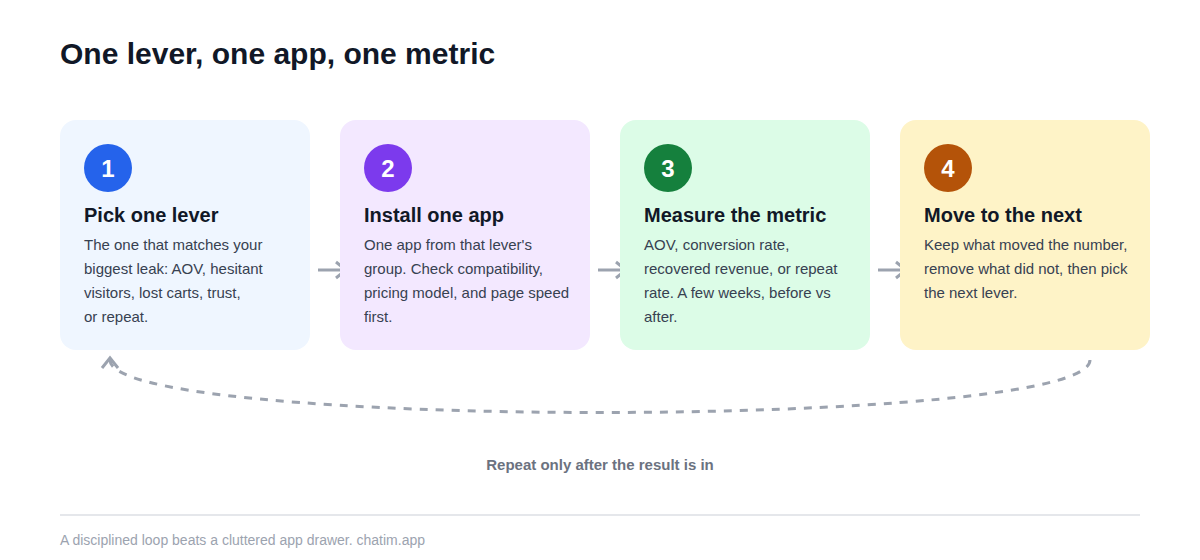
Do not pick by star rating; pick by the leak you need to fix. Start with the single lever that matches your biggest problem, choose one app from that group, install it, and measure the result for a few weeks before adding another. A store losing shoppers on product pages should start with Chatim or a review app; a store with small orders should start with BOGOS or an upsell app; a store with traffic but no repeat buyers should start with email capture and loyalty.
Conclusion
The best Shopify app to increase sales and conversions is the one that fixes your specific bottleneck. That is why the lever framework matters more than any ranking: convert hesitant visitors, raise AOV, recover lost carts, build trust, or drive repeat purchases. Each is a different job with a different tool.
If you run a small or newer store, start lean: one AOV app (BOGOS), one review app (Judge.me's free plan), and a live chat option (Chatim) cover the biggest early wins without much cost. If you are scaling, layer in email/SMS (Klaviyo), a personalization engine (Rebuy), and loyalty (Smile.io) to compound revenue from the traffic you already have. Pick one lever. Install one app. Measure. Then move to the next. That disciplined approach beats a cluttered app drawer every time.
More on this from our team: best Shopify apps for customer service, best live chat for Shopify, how to promote a Shopify store, and all about the sales funnel.
Frequently Asked Questions
What are the best Shopify apps to increase sales and conversions?
The best app depends on the bottleneck you need to fix. Use promotion and upsell apps like BOGOS, Upsell.com, or Frequently Bought Together to raise AOV, live chat and on-page tools like Chatim, Vitals, or Hextom to convert hesitant visitors, email and SMS tools like Klaviyo or Privy to recover lost shoppers, review apps like Judge.me or Loox to build trust, and a loyalty app like Smile.io to drive repeat purchases.
How many Shopify apps should I install at once?
Start with one app for your biggest conversion leak. Measure the result before adding another. Installing several overlapping apps at once can increase cost, add page weight, and make it harder to tell which tool is actually improving performance.
Which Shopify apps can help increase average order value?
Free gift, BOGO, bundle, cross-sell, and upsell apps are designed to increase AOV. The right option depends on where you want to influence the shopper: BOGOS and Frequently Bought Together work on the product page and cart, Upsell.com works on the thank-you and post-purchase pages, and Rebuy covers the whole journey for higher-volume stores.
Do Shopify apps slow down a store?
Some storefront apps add scripts or widgets that can affect page speed. Test important product and cart pages before and after installation, and disable features you are not using. All-in-one apps with many widgets enabled and urgency apps with several timers active are the usual culprits.
Are free Shopify apps enough for a new store?
Free plans can be enough to validate an offer or conversion strategy when your store is still small. BOGOS, Judge.me, Chatim, Smile.io, and Hextom all have usable free plans. As order volume, traffic, or automation needs grow, paid tiers may become more useful. Compare pricing against your actual usage before upgrading.
How should I measure whether a Shopify app is increasing sales?
Track the metric tied to the app's job. Monitor AOV for promotion and upsell apps, conversion rate for live chat and trust tools, recovered revenue for email or cart-recovery tools, and repeat purchase rate for loyalty apps. Compare performance before and after launch over a meaningful test period, usually a few weeks.
What is the best free gift with purchase app for Shopify?
BOGOS Free Gift, Bundle and Upsell by Secomapp is the most established option, with a 5.0-star rating from 3,800+ reviews and 11+ years on the platform. It handles gift-by-threshold and gift-by-product rules, BOGO and Buy X Get Y offers, bundles, and cart-goal progress bars, and it has a free plan.
What is the difference between an upsell and a cross-sell app?
An upsell nudges the shopper toward a bigger or better version of what they are buying, or an add-on after checkout. A cross-sell suggests complementary products, like Amazon's frequently bought together section. Many apps do both; the practical difference is where the offer appears: product page, cart, checkout, or the post-purchase page.
Can live chat actually increase Shopify conversions?
Yes, when it answers questions at the moment of doubt. Most pre-purchase drop-off comes from unanswered questions about sizing, shipping, or returns. A chat widget on product, cart, and checkout pages, backed by a chatbot for off-hours, answers those questions before the shopper leaves. The widget must be answered quickly, though, or it can frustrate rather than convert.
Can I use a sales tool that is not in the Shopify App Store?
Yes. Tools like Chatim install through a theme code snippet or Google Tag Manager, the same way analytics scripts do. The trade-off is that you will not find App Store reviews or a one-click App Store install, so evaluate the vendor through its own site and free plan instead.
Should I use Klaviyo or Privy for abandoned cart recovery?
Privy is simpler and cheaper to start for small Shopify-first stores that mainly want popups, list capture, and a basic abandoned-cart flow. Klaviyo goes deeper on segmentation, multi-channel flows, and revenue attribution, which suits growing stores with bigger lists. Both price by contacts or traffic, so model the cost at your real volume.
Judge.me or Loox: which review app is better for Shopify?
Judge.me is the value pick: unlimited reviews on a forever-free plan, with a paid tier at $15 per month. Loox is the visual pick: polished photo and video review widgets with a discount-for-photo incentive, from $12.99 per month. Visual-first brands in fashion, beauty, or home usually prefer Loox; everyone else can start with Judge.me.
Are all-in-one apps like Vitals better than dedicated apps?
For a small or new store, an all-in-one like Vitals is cheaper and simpler than five separate subscriptions. A dedicated app usually goes deeper in its one category, so if reviews or upsells are your core lever, a specialist may offer more control. Whichever you pick, switch on only the tools you actually use to limit page weight.
Which Shopify sales apps should a small store start with?
Start lean: one AOV app (BOGOS), one review app (Judge.me's free plan), and a live chat option (Chatim's free plan) cover the biggest early wins at little cost. Add email and SMS (Klaviyo or Privy), a personalization engine (Rebuy), and loyalty (Smile.io) as traffic and order volume grow.
Related articles
More in Ecommerce & platforms → Best Shopify Apps for Customer Service in 2026: 9 Compared
9 customer service apps for Shopify stores compared: the free native option, chat widgets, and ecommerce helpdesks, with verified pricing.
 WooCommerce Chatbot: What It Does and How to Add One (2026)
What a WooCommerce chatbot does for a store: product and order questions answered from your own pages, plus how to add one without plugin bloat.
 Wix Chatbot: How to Add One and What It Can Do (2026)
What a Wix chatbot can do for your site: answer service questions, capture leads politely, help with bookings and store orders, and cover after-hours.
 Webflow Live Chat: How to Add It and Hand It Off (2026)
How to add live chat to a Webflow site, keep it on-design, turn it into a lead engine on marketing sites, and ship it as an agency deliverable.