12 Customer Service Email Templates for Every Scenario (2026)

Customer service email templates save time only when they do not sound like templates. The twelve below cover the situations support teams actually face (complaints, refunds, shipping delays, bugs, billing, saying no, closing the loop), each written to be personalized in under a minute by swapping the [bracketed] parts and one sentence of specifics. Before the templates, one structure worth learning, because it is the skeleton inside every good service email and the reason these read human while generic ones read canned.
This guide extends our email cluster: professional email phrases for sentence-level wording, the apology letter guide for formal apologies, and this page for the everyday service scenarios in between.
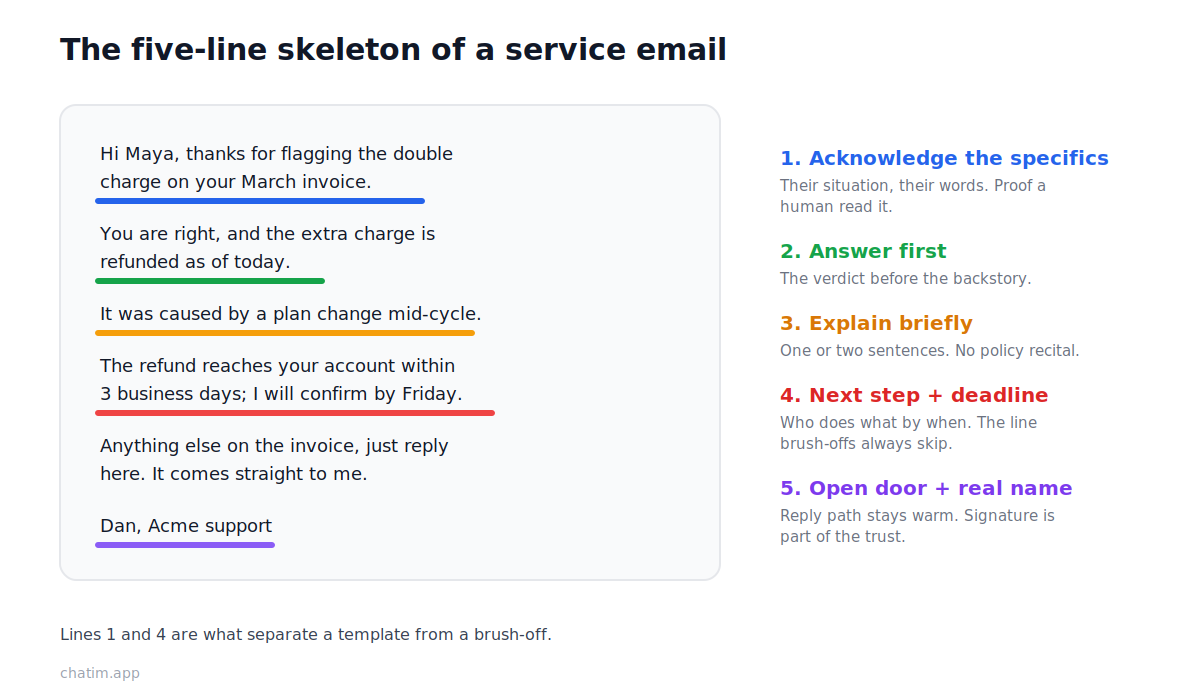
The five-line skeleton of a good service email
Nearly every effective customer service email follows the same shape. Acknowledge the specific situation in the first line, in the customer's own terms, so they know a human read it. Give the answer or status next, not the backstory; the customer wants the verdict before the explanation. Explain briefly if the answer needs context, one or two sentences, no policy recitals. State the next step and its deadline, who does what by when. Close with an open door, a real signature, and a way to reply. Templates go wrong when they skip the first line (reads automated) or the fourth (reads like a brush-off); keep those two and you can improvise the rest.
Responding to complaints
1. First response to a complaint.
Hi [name], thanks for telling us about [specific issue]; you are right that this is not the experience we aim for. Here is what I have done already: [action taken]. Next, [what happens] by [date]. If anything changes before then, I will update you first. Reply to this email any time; it comes straight to me. [Your name]
2. The angry customer, de-escalation first.
Hi [name], I read your message in full and I understand why you are frustrated: [restate the problem in one plain sentence]. I am taking ownership of this personally. Today I will [immediate step], and you will hear from me by [time] with [outcome or update]. Thank you for the direct feedback; it is fair. [Your name]
3. Complaint you cannot resolve today.
Hi [name], quick update so you are not waiting in silence: we are still working on [issue]. So far we have [progress]; the remaining step is [what is left], which we expect done by [date]. I will email you either way on that date. Thanks for bearing with us. [Your name]
Refunds and returns
4. Approving a refund.
Hi [name], your refund of [amount] for [item or order number] is approved and on its way; it typically arrives within [X] business days depending on your bank. The return label is attached if the item still needs to come back. Sorry it did not work out this time, and thank you for giving us the chance to fix it. [Your name]
5. Declining a refund without burning the bridge.
Hi [name], thank you for the details. I looked into this carefully, and because [plain-language reason, e.g. the order falls outside the 30-day window], I cannot issue a refund here. What I can do: [concrete alternative, e.g. a replacement, credit, or discount]. I know it is not the answer you hoped for, so I wanted to be straight about it and still leave you something useful. [Your name]
Shipping and delays
6. Order delayed, proactively.
Hi [name], your order [number] is running behind: it was due [original date] and is now expected [new date] because of [brief reason]. You do not need to do anything; it is moving and we are watching it. If the new date does not work for you, reply and we will sort out an alternative, including cancelling for a full refund. [Your name]
7. Where-is-my-order reply.
Hi [name], good news: your order [number] shipped on [date] and is currently [status/location]. Track it live here: [link]. Expected delivery is [date]. If it has not arrived by [date plus buffer], email me on this thread and I will chase the carrier from our side. [Your name]
Technical issues and bugs
8. Bug confirmed, fix pending.
Hi [name], you found a real bug, and thank you for the clear report; the screenshots helped. Our team has reproduced it and a fix is scheduled for [timeframe]. Until then, this workaround unblocks most people: [workaround]. I have tagged your email to notify you the moment the fix ships. [Your name]
9. Cannot reproduce, keeping it warm.
Hi [name], we tried to reproduce the issue on our side and have not managed to yet, which usually means it is specific to an account or setup. Could you send [two or three specifics: browser, steps, screenshot]? The moment we can see it, we can fix it, and your report stays open with me until then. [Your name]
Account and billing
10. Billing mistake, owned fully.
Hi [name], you were right: you were charged [wrong amount] instead of [correct amount]. That is our error. The difference of [amount] is refunded as of today and should reach your account within [X] business days. I have also checked the rest of your billing history and everything else is correct. Sorry for the extra work this caused you. [Your name]
Saying no to a feature request
11. The honest no.
Hi [name], thank you for the suggestion; I can see exactly why [feature] would help your workflow. I want to be honest rather than vague: it is not on our roadmap right now, because [one-sentence reason]. I have logged your request with your use case attached, and if that changes you will hear from us. Meanwhile, [nearest existing option] covers part of this today. [Your name]
Closing the loop
12. Resolution confirmed plus quiet feedback ask.
Hi [name], confirming this is resolved: [one-line summary of outcome]. If anything about it resurfaces, just reply here and it reopens with full history. And if you have thirty seconds, I would value a line on how we handled this; it goes straight to the team. Thanks for your patience, [your name]
Making templates sound like a person wrote them
Three habits separate teams whose templates work from teams whose templates leak. Always rewrite the first line for the specific situation; it is the line customers use to judge whether anyone read their message. Say the concrete thing (dates, amounts, order numbers) instead of the categorical thing ("your issue", "the inconvenience"); specifics are what sincerity looks like in text. And keep one library, not twelve personal variants: shared templates that everyone edits from the same source stay on-brand and improve with each fix, which is the same logic behind shared saved replies in a customer support inbox. For the sentence-level wording inside these skeletons, our email phrases guide goes deeper, the thank-you messages guide covers the happier occasions, and how to write a professional email covers the fundamentals. A consistent email signature finishes the job; the sign-off is part of the trust.
When the answer should not be an email at all
Some of these templates exist only because the question arrived too late. "Where is my order", "how do I", and "is this compatible" are chat questions that became emails overnight; a live chat widget with a chatbot answers them in the moment, shrinks tomorrow's inbox, and leaves email for what email is good at: decisions, records, and anything with an attachment. The teams with the calmest inboxes did not write better templates; they moved the repetitive half of the conversation somewhere faster and kept templates for the conversations that deserve a human paragraph.
Related reading: B2B cold email templates and canned responses.
Frequently Asked Questions
How do I write a customer service email?
Follow the five-line skeleton: acknowledge the specific situation in the customer's own terms, give the answer or status before the explanation, explain briefly if needed, state the next step with a deadline, and close with an open door and a real signature. The first and fourth lines matter most; skipping them makes an email read automated or dismissive.
What is a good customer service email template?
One that personalizes in under a minute: fixed structure, [bracketed] placeholders for names, dates, amounts, and order numbers, and a first line you rewrite for the specific situation. The twelve templates in this guide cover complaints, refunds, delays, bugs, billing, feature requests, and closing the loop, all built on the same five-line skeleton.
How do you respond to a customer complaint by email?
Acknowledge the specific issue in the first line, state what you have already done, then what happens next and by when, and close with a direct reply path. If you cannot resolve it today, send a progress update anyway with a date you will report back, and keep that date even if the news is 'still working on it.'
How do you write an email to an angry customer?
Restate their problem in one plain sentence so they know they were heard, take personal ownership, commit to an immediate step today, and give a specific time they will hear from you. Skip defensiveness and policy quotes entirely; validation plus a concrete deadline defuses more anger than any apology adjective.
How do you politely decline a refund request?
Give the verdict early with a plain-language reason, then offer a concrete alternative (credit, replacement, or discount) so the no still leaves the customer something. Avoid hiding the refusal in the last paragraph; a clear no with an alternative preserves more goodwill than a vague maybe that becomes no later.
How do you tell a customer their order is delayed?
Proactively, before they ask: state the original date, the new date, and a brief reason, confirm they need to do nothing, and offer an exit (alternative or full refund) if the new date fails them. A delay announced early reads as competence; the same delay discovered by the customer reads as neglect.
How do you say no to a feature request politely?
Honestly and specifically: confirm you understand the use case, say it is not on the roadmap and give a one-sentence reason, log the request with their context, and point to the nearest existing option. Customers handle a clear no well; what erodes trust is the eternal 'we will pass it along' that goes nowhere.
Should customer service emails use templates?
Yes, with discipline: templates guarantee structure and consistency, and the personalization happens in the first line and the specifics (dates, amounts, order numbers). Keep one shared library the whole team edits from the same source, so fixes propagate and the voice stays consistent across agents.
How long should a customer service email be?
As short as the situation allows while covering the skeleton: usually four to seven sentences. Answer first, context second, next step third. Long emails bury the verdict and read like justification; the customer can always reply for more detail, and the open-door closing invites exactly that.
How fast should you respond to customer service emails?
Set a window you consistently beat, and use an auto-reply to state it honestly (with a self-serve alternative for the meantime). Same-business-day responses are a strong standard for small teams. Speed on the first response buys patience for everything after it, including problems that take days to fix.
How do you close a customer service email?
With the next step and its owner ('I will email you by Friday'), an open door ('reply here any time; it reopens with full history'), and a real name. When the issue is resolved, confirm the outcome in one line and optionally ask for quick feedback. Avoid closing with policy boilerplate; the last line is what the customer remembers.
What is the difference between customer service email templates and canned responses?
Length and channel. Canned responses are short saved replies for chat and quick questions; email templates are full five-part messages for situations that need structure: refunds, complaints, escalations. Both benefit from the same rule: shared library, personalized first line, concrete specifics.
Can a chatbot replace customer service emails?
It replaces the emails that never needed to be emails: order status, how-to questions, compatibility checks that arrive overnight. Real-time chat with a chatbot absorbs that repetitive volume, which shrinks the inbox and leaves email for decisions, records, and anything needing an attachment or a careful paragraph.
Related articles
More in Customer service → SaaS Customer Support: The Stage-by-Stage Guide (2026)
How SaaS customer support actually works at each stage: the right stack from founder-led live chat to a full support operation, channels, and metrics.
 How to Reduce Customer Churn: 5 Levers in Payback Order
Reduce customer churn by pulling five levers in payback order: payment recovery, onboarding, support quality, pricing fit, and a 90-day win-back.
 10 FAQ Page Examples That Actually Help Customers (2026)
10 FAQ page examples from Shopify, Airbnb, Slack, Nike and more, with the exact pattern each gets right and a checklist to build your own FAQ page.
 Canned Responses for Customer Service: 20 Examples (2026)
20 canned responses for customer service, organized by situation, plus the one editing habit that keeps saved replies from sounding robotic.