How to Reduce Customer Churn: 5 Levers in Payback Order

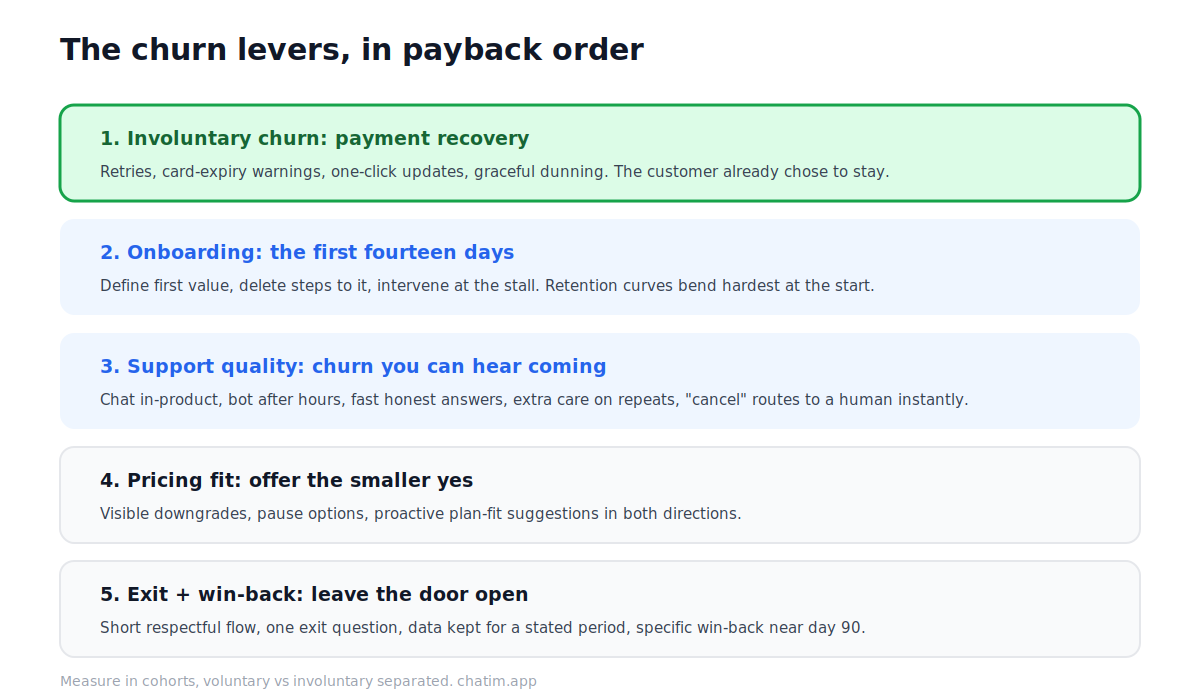
Learning how to reduce customer churn starts with an unglamorous truth: most churn was decided long before the cancellation click, in a failed payment nobody chased, an onboarding that never reached value, or a support question that sat unanswered over a weekend. That is good news in disguise, because it means churn is rarely one problem; it is several small, fixable ones wearing a single scary number. This guide works through the levers in the order of payback: the mechanical churn you can stop this week, the early-lifecycle churn decided in the first days, the support-quality churn that builds silently, and the pricing and win-back work that catches the rest.
Everything here applies to subscription businesses generally, with SaaS as the running example.
The two kinds of churn (and why the rate alone misleads)
Voluntary churn is a decision: the customer chose to leave. Involuntary churn is an accident: a card expired, a payment bounced, a renewal email went to a dead inbox, and a customer who never chose to leave is gone anyway. The two need entirely different fixes, so measure them separately from day one. And read churn in cohorts, not as a single monthly rate: a blended number mixes customers in month one (where churn concentrates) with veterans in year two (where it flattens), so growth phases can mask worsening retention and slow months can fake a crisis. Cohort curves by signup month tell the truth the blended rate hides.
Diagnose before you fix anything
Segment your churned customers three ways and patterns appear fast. By tenure: churn in the first month points at onboarding or mis-sold expectations; churn at month seven points at value fade or a champion leaving. By acquisition source: a channel that brings customers who all leave is a marketing problem dressed as a retention problem. By usage before leaving: customers who churned while active got a better offer or hit a missing feature; customers who faded first stopped getting value weeks before they stopped paying. Add one qualitative source: ask every canceller one question ("what made you decide?") and read every answer yourself. Ten honest exit answers outperform any dashboard at telling you which lever below to pull first.
Fix involuntary churn first (the cheapest win in retention)
Failed payments are the least dramatic and most recoverable churn you have. The fixes are mechanical: retry failed charges on a smart schedule, email before a card expires rather than after, offer a one-click way to update payment details without logging in, and pause access gracefully instead of cutting it the hour a charge fails. None of this requires convincing anyone of your product's value; the customer already chose to stay. For most subscription businesses this is the highest-certainty retention project on the list, which is exactly why it should be finished before the philosophical work begins.
Churn is decided in the first weeks
Retention curves bend hardest at the start: customers who reach real value quickly stay long, and customers who stall early rarely recover. That makes customer onboarding a churn lever wearing a different name. The moves that matter: define the first valuable outcome precisely, remove every step between signup and it, watch where new customers stall (session recordings, funnel steps, chat questions), and intervene at the stall with a human or a well-aimed message rather than a generic day-three email. If you fix only one voluntary-churn lever this quarter, fix the first fourteen days.
The support-quality lever: churn you can hear coming
Support is where churn announces itself in advance, which makes it the most underused retention system a company already owns. An unanswered pre-cancellation question ("does the plan include X?", "why did this break again?") hardens into a decision over a weekend; the same question answered in minutes often dissolves. The practical setup: live chat where customers actually are (inside the product), a chatbot covering nights so no blocking question ages for twelve hours, fast honest answers even when the answer is no, and a habit of treating repeated support themes as product bugs to fix rather than tickets to close. Two support moments are outsized churn events and deserve extra care: the second report of the same problem (trust breaks on repetition, and empathy plus ownership is the only right response) and any message containing the word "cancel", which should route to a person, fast, every time. Support cannot save a product that stopped being useful, but it saves nearly everything else, and it is the cheapest lever on this list after payments; a customer support setup with chat and after-hours coverage is the infrastructure half of the fix.
Keep proving value after the honeymoon
Mid-life churn is usually value amnesia: the product still works, but nobody remembers why it is worth the line item, especially when the person who bought it leaves and a budget review meets a tool no one champions. Counter it by making value visible on a schedule: usage recaps that state outcomes in the customer's terms ("your team answered 300 conversations this month"), periodic check-ins for higher-value accounts, and release notes that connect new features to the problems customers actually raised. The goal is that when the renewal question comes up, the answer is lying around in recent memory. Our guide to customer happiness covers the relationship half of this loop.
Pricing-fit churn: offer the smaller yes
Some customers leave because the plan stopped fitting, not the product: usage dropped, a team shrank, budgets tightened. For them the alternative to churn is a smaller yes, so build the paths: visible downgrades, a pause option for seasonal businesses, and plan-change suggestions when usage and plan drift apart (in both directions; proactive downgrade suggestions buy loyalty that outlasts the discount). A customer on a cheaper plan is a customer you can win back up; a cancelled customer is a cold start. If your cancellation flow offers nothing between full price and goodbye, this lever is unpulled.
The cancellation flow and the win-back window
When someone does cancel, three things matter. Make it respectful and short; hostage-taking flows generate refunds and reviews, not retention. Ask the one exit question and record the answer. And leave the door open explicitly: keep their data for a stated period, say so, and check in once around ninety days later with something specific (a fixed bug they hit, a feature they asked for) rather than a discount blast. Win-backs convert best when the reason they left has actually changed, which is one more argument for reading those exit answers and routing them into the roadmap.
Measure churn like you plan to beat it
Three instruments cover the essentials. Cohort retention curves by signup month, split voluntary versus involuntary: this is the scoreboard. Leading indicators that fire before the cancellation: login gaps, usage decay, support sentiment turning, payment failures; each one is a trigger for a specific play from this guide, not a dashboard decoration. And a simple churn-reasons log fed by exit answers and support transcripts, reviewed monthly, because the ranked list of why people actually leave is the only prioritization document retention work needs. Then pick the top reason, pull the matching lever, and let the next cohort tell you whether it worked.
More on this from our team: SaaS customer support, free trial conversion, and SaaS onboarding best practices.
Frequently Asked Questions
How do I reduce customer churn?
Work the levers in payback order: recover involuntary churn first (payment retries, card-expiry emails, graceful dunning), then fix onboarding so new customers reach value in the first weeks, then use support quality to catch churn early (fast answers, chat in-product, escalating anything containing 'cancel'), then add pricing-fit paths like downgrades and pauses, and finally run a respectful cancellation flow with a 90-day win-back.
What is customer churn?
The rate at which customers stop doing business with you over a period, usually measured monthly or annually for subscriptions. It splits into voluntary churn (the customer decided to leave) and involuntary churn (payments failed and the customer lapsed by accident), and the two require completely different fixes.
What is the difference between voluntary and involuntary churn?
Voluntary churn is a decision: value faded, a competitor won, the plan stopped fitting. Involuntary churn is mechanical: expired cards, failed charges, bounced renewal emails. Involuntary churn is the cheapest to fix (retries, expiry warnings, easy card updates) because the customer never chose to leave, which is why it should be fixed first.
What causes customer churn the most?
By lifecycle stage: early churn usually traces to onboarding that never reached value or mis-set expectations; mid-life churn to value amnesia, champions leaving, or unresolved product friction; and a steady background of involuntary churn from failed payments. Exit answers from your own cancellers rank the causes for your product better than any industry list.
How does customer support reduce churn?
Support is where churn announces itself early: a blocking question answered in minutes dissolves, while the same question aging over a weekend hardens into a decision. Fast honest answers, chat inside the product, after-hours chatbot coverage, special care on repeated issues, and instant human routing for any message containing 'cancel' convert the support queue into an early-warning retention system.
How does onboarding affect churn?
Retention curves bend hardest in the first weeks: customers who reach real value quickly stay long, and customers who stall early rarely recover. Defining the first valuable outcome, deleting steps between signup and it, and intervening where new customers stall is the single strongest voluntary-churn lever most businesses have.
What is a good churn rate?
It varies so much by price point, market, and customer size that blended benchmarks mislead; small-business customers churn faster than enterprises everywhere. The workable standard is internal: cohort curves by signup month, voluntary and involuntary separated, trending better quarter over quarter. Compete with your own last cohort rather than an average of incomparable companies.
How do I identify customers at risk of churning?
Watch leading indicators that fire before cancellation: login gaps, usage decay, the champion's account going quiet, support sentiment turning negative, repeated reports of the same issue, and payment failures. Each signal maps to a specific play (a check-in, an unstalling message, an escalation, a dunning email) rather than a generic save campaign.
Should I offer discounts to stop customers from cancelling?
Sparingly. A discount fixes price-fit churn only, and only temporarily; it does nothing for value or friction churn, and trains customers to threaten cancellation. Better levers in the cancellation moment: a downgrade to a plan that fits, a pause for seasonal use, or fixing the actual reason surfaced by the exit question.
What is a win-back campaign?
A structured attempt to recover cancelled customers after a cool-off, typically around ninety days. It works best when something has genuinely changed: the bug they hit is fixed, the feature they wanted shipped. A specific 'the thing you left over is different now' message outperforms discount blasts, which is one more reason to record exit reasons.
How do downgrade options reduce churn?
They offer a smaller yes to customers whose plan stopped fitting: shrunken teams, dropped usage, tighter budgets. A visible downgrade path, a pause option, and proactive plan-fit suggestions keep the relationship alive at lower revenue instead of ending it, and a customer on a smaller plan can be won back up later; a cancelled one is a cold start.
How should churn be measured?
Cohort retention curves by signup month with voluntary and involuntary churn separated; a blended monthly rate hides more than it shows, especially during growth. Add a monthly-reviewed churn-reasons log built from exit answers and support transcripts; that ranked list of real reasons is the prioritization document for all retention work.
Can churn ever be good?
Some churn is healthy: customers your product was never right for, acquired by channels that promise the wrong thing, cost more to serve than they pay. If a segment churns consistently, the fix may belong in marketing and qualification rather than retention. The goal is not zero churn; it is keeping every customer the product genuinely serves.