Free Trial Conversion: Fix Where Trials Actually Die
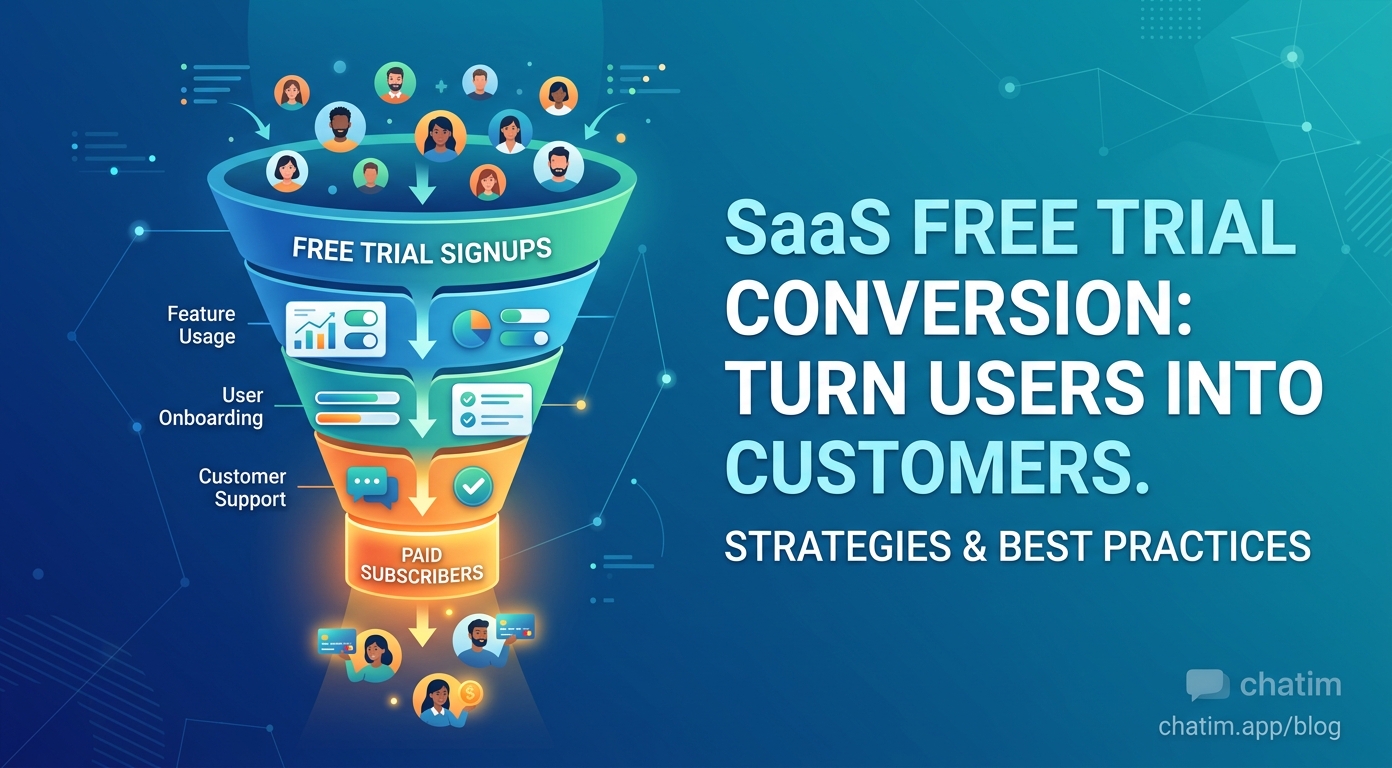
Free trial conversion is where SaaS marketing either becomes revenue or quietly evaporates: everything you spent getting a signup is worth nothing until the trial user hits a moment of value and decides to pay. Most advice on improving it starts with benchmarks, which is the wrong place: published trial conversion numbers range from single digits to well over half depending on whether the trial requires a card, how the product is sold, and who counts as a "trial" at all, so comparing yourself to an average of incomparable companies mostly misleads. This guide takes the useful path instead: decompose your own funnel, find where trials actually die, and apply the fixes that match each death.
It is written for self-serve and lightly sales-assisted SaaS, where the trial itself does most of the selling.
What a "good" trial conversion rate is
The honest answer has a structure, not a number. Opt-out trials (card required upfront) convert a much higher share of a much smaller, more committed group; opt-in trials (no card) convert a smaller share of far more signups. Sales-assisted trials convert differently from pure self-serve. Cheap tools convert differently from platforms that need a team to adopt. So define your own baseline this way: pick one trial model, measure the same cohort shape for a few months, and compete with your own last quarter. The moment your rate is trending up while signup quality holds, you are winning, whatever a benchmark post says.
Decompose the funnel before touching anything
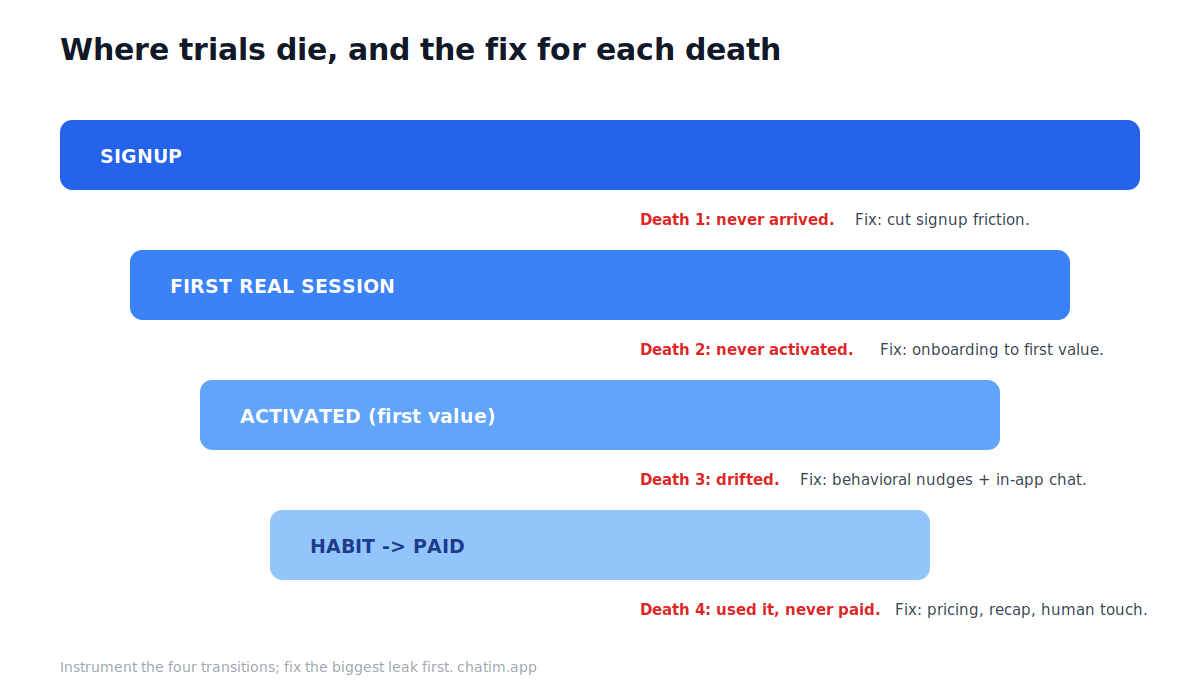
Trials die in four distinct places, and each death has a different fix. Signup to first session: they registered and never really arrived; a friction or intent problem. First session to activation: they arrived and never reached the first valuable outcome; an onboarding problem. Activation to habit: they saw value once and drifted; an integration-into-life problem. Habit to paid: they used it and still did not buy; a pricing, packaging, or permission problem. Instrument these four transitions before optimizing anything, because effort aimed at the wrong stage is invisible in the number you care about.
Shorten the road to first value
Activation is the strongest single lever, because a user who never experienced the product's value has nothing to buy. Define activation as the smallest outcome that proves the promise (the first campaign sent, the first chat answered, the first report generated), then delete everything between signup and that moment that can possibly be deleted: optional fields, premature configuration, empty states with no next step. Use templates and sample data so the product demonstrates itself before the user has invested anything. Our customer onboarding guide covers this stage in depth; everything else in this post works better after it.
Trial design: length, cards, and extensions
On length, the working logic beats the folk numbers: the trial should be a little longer than the time a motivated user needs to reach value in their real workflow. Products that show value in a day rarely benefit from thirty-day trials (urgency dies); products that need a team and data migration punish seven-day ones. Fourteen days suits most tools, and a shorter trial with a generous, human extension policy usually beats a long one, because the extension request is itself a buying signal and a conversation. On cards upfront: requiring one filters for intent and inflates your rate while shrinking your funnel; not requiring one maximizes learning and volume. Early-stage products usually learn more without the card. Whatever you choose, make the trial's rules visible (days left, what happens at the end); surprise is the enemy of conversion.
The chat-during-trial lever
A trial user with a blocking question is a conversion decision in progress, and the clock is running. This is the single strongest argument for live chat during trials: the "does it integrate with X", "how do I import", and "what does the paid plan actually include" questions decide trials, and they get decided in minutes when chat answers them versus days when email does. Three practical moves: put chat inside the product, not just the site, because that is where trial users get stuck; let a chatbot cover the setup questions at night and hand pricing conversations to a human with the transcript; and treat every trial-user chat as revenue work, whoever answers it. Disclosure where due: this is our product category, and this section is why we built one. The pattern holds with any vendor's widget.
Lifecycle emails that follow behavior, not the calendar
The default trial email sequence (day 1 welcome, day 7 check-in, day 13 panic) talks to a calendar. The sequence that converts talks to behavior: activated users get deepening tips, stalled users get the one action that unstalls them ("your widget is installed but not live; here is the last step"), and users approaching the end get a clear summary of what they built and what happens to it. Every behavioral email should have one action, and replies should land with a human. Fewer, sharper messages tied to what the user actually did outperform any cadence of generic ones.
Adding a human without becoming "sales-led"
Self-serve and human touch are not opposites; the trick is aiming the humans. Watch for the signals that predict buying (team invites, integration connected, usage above a threshold, pricing page visits from inside the trial) and route only those accounts to a personal message: a real offer of help, not a demo ambush. High-signal trials get a human; everyone else gets great self-serve. This keeps the cost of touch proportional to the likelihood of revenue, and trial users experience it as service rather than sales, which, done right, it is.
The end-of-trial moment
How a trial ends changes what it converts. Give an honest countdown, state clearly what happens to the user's data and setup (kept, frozen, or deleted, and for how long), and offer a graceful step down: a free plan, a pause, or an extension for the almost-ready. Make the upgrade moment recap what the user actually did ("you handled 214 conversations this month") rather than listing features, because the trial's own evidence is the best sales copy you have. And when a trial expires unconverted, one plain question ("what was missing?") sent by a human recovers more accounts, and more truth, than any discount blast.
Measure in cohorts, improve weekly
Track trial cohorts by week: how many reached each of the four transitions, and where the biggest leak is now. Fix the biggest leak, wait a cohort, measure again; trial optimization is a loop, not a project. Watch two supporting signals alongside the rate itself: time-to-activation (falling is good) and the questions trial users ask in chat, because those transcripts are a ranked list of what is blocking revenue this week. Between your own cohorts trending and your own users' questions answered, you have everything the benchmark posts promised and never deliver: a number that is actually yours, moving in a direction you control. For picking the tooling around all this, our live chat comparison covers the chat half.
Keep going with our guides to SaaS customer support, SaaS onboarding best practices, and reducing customer churn.
Frequently Asked Questions
What is a good free trial conversion rate for SaaS?
There is no single good number, because the rate depends on the trial model: card-required (opt-out) trials convert a much higher share of far fewer signups, no-card (opt-in) trials the reverse, and sales-assisted trials differ from self-serve. Published benchmarks range from single digits to well over half. The useful standard is your own trend: same trial model, cohort over cohort, moving up while signup quality holds.
How do I increase free trial conversion?
Decompose the funnel first: trials die at four points (never arrived, never activated, never built a habit, used it but never paid), and each needs a different fix: friction removal, onboarding to first value, behavioral nudges, or pricing and packaging work. The highest-leverage single fixes are usually shortening time-to-activation and answering blocking questions in real time during the trial.
How long should a SaaS free trial be?
Slightly longer than a motivated user needs to reach real value in their own workflow. Products that show value in a day suit short trials; products needing team setup and data need longer. Fourteen days fits most tools, and a shorter trial with a generous extension policy usually beats a long one, since extension requests are buying signals that start conversations.
Should a free trial require a credit card?
Card-upfront filters for intent: fewer signups, higher conversion rate, less learning. No-card maximizes volume and feedback but converts a smaller share. Early-stage products usually learn more without the card; mature products with strong demand sometimes add it to focus the funnel. Either way, be explicit about what happens when the trial ends.
What is activation in a free trial?
The first moment the user experiences the product's core value: the first campaign sent, first chat answered, first report generated. It is the strongest predictor of conversion, because a user who never reached value has nothing to buy. Define it precisely for your product, measure time-to-activation, and delete every step between signup and that moment that can be deleted.
Why do free trials fail to convert?
Four distinct failure points: signups who never really arrive (friction or low intent), arrivals who never activate (onboarding), activated users who drift before building a habit (integration into their routine), and engaged users who still do not pay (pricing, packaging, or a missing decision-maker). Diagnosing which one dominates your funnel matters more than any generic tactic.
How does live chat improve trial conversion?
A trial user with a blocking question is a conversion decision in progress: integration doubts, import problems, and plan questions decide trials, and they resolve in minutes over chat versus days over email. Chat inside the product catches users where they stall, a chatbot covers setup questions after hours, and pricing conversations hand off to a human with context.
What emails should I send during a free trial?
Behavior-triggered ones: deepening tips for activated users, a single unstalling action for stalled users ('your widget is installed but not live'), and an end-of-trial summary of what the user built and what happens next. One action per email, human-answered replies. Behavioral sequences outperform calendar sequences because they respond to what actually happened.
Should I extend free trials when users ask?
Usually yes, and gladly: an extension request is one of the strongest buying signals a trial produces, and the request itself opens a conversation about what the user still needs to see. A short default trial plus generous human extensions typically outperforms a long trial, which mostly extends procrastination rather than evaluation.
What happens at the end of a free trial matters?
Considerably. A visible countdown, clarity about what happens to the user's data and setup, and a graceful step down (free plan, pause, or extension) all preserve conversions that a hard cutoff loses. The upgrade prompt converts best when it recaps the user's own usage rather than listing features; the trial's evidence is the best sales copy available.
What is a product-qualified lead (PQL)?
A trial account whose behavior signals buying likelihood: team members invited, an integration connected, usage past a threshold, pricing viewed from inside the product. Routing only these accounts to a personal human touch keeps self-serve economics intact while adding sales help exactly where it changes outcomes.
How do I measure trial conversion properly?
In weekly cohorts across four transitions: signup to first session, first session to activation, activation to habit, habit to paid. Fix the biggest leak, wait a cohort, remeasure. Watch time-to-activation as the leading indicator, and read trial users' chat questions weekly; they are a ranked list of what is blocking revenue right now.
Is a free trial or a freemium plan better for SaaS?
They solve different problems: a trial creates urgency and a defined decision moment; a free plan removes the deadline and works as long-term distribution, converting on outgrown limits instead of dates. Products with fast time-to-value can use either; many combine them, with the trial for the paid tiers and the free plan as the landing spot for not-yet buyers.
Related articles
More in Marketing & sales → Best SaaS Affiliate Programs in 2026: 7 Verified Picks
7 SaaS affiliate programs with every rate, duration, cookie, and payout term verified on the official pages, plus the four numbers that decide value.
 SaaS Onboarding Best Practices That Shrink Time to Value
SaaS onboarding best practices organized as a timeline: set expectations at signup, deliver value in session one, build the habit in week one, then measure.
 10 SaaS Marketing Strategies That Compound (2026)
Ten SaaS marketing strategies ranked by cost and time to results, the arithmetic that picks the right two or three for your price point, and what to skip.
 How to Promote on Reddit Without Getting Banned (2026)
How to promote on Reddit the way that works: the four-rung participation ladder, post formats that earn attention, ad notes, and what gets businesses banned.