SaaS Onboarding Best Practices That Shrink Time to Value
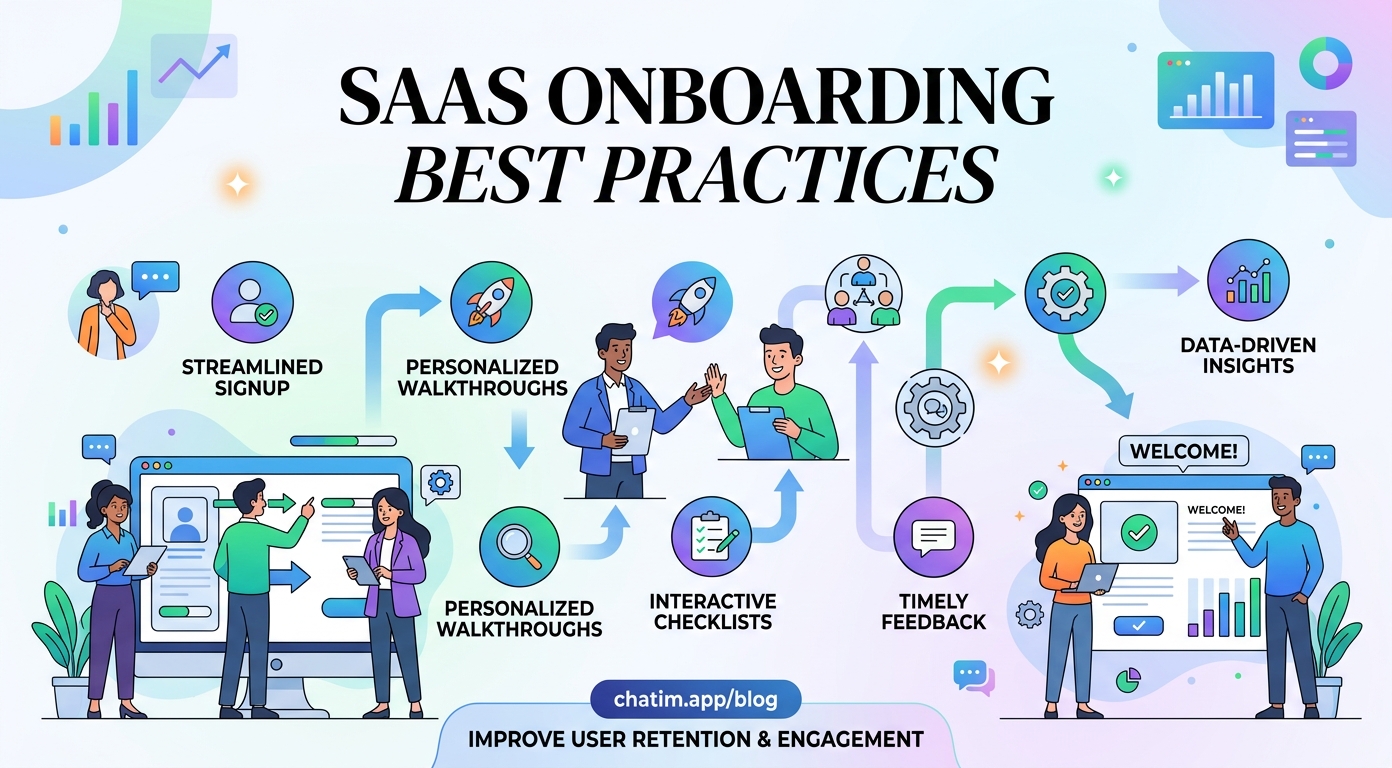
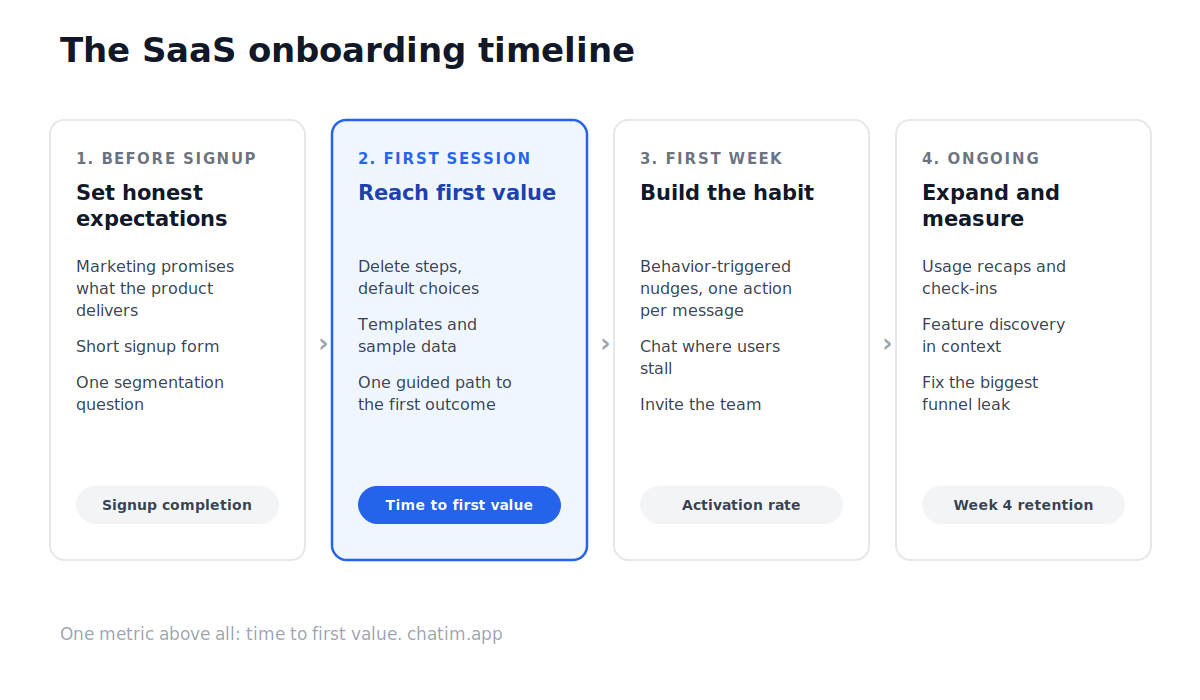
Most lists of SaaS onboarding best practices read like twenty tips in search of a point, so here is the point: onboarding exists to shrink the time between signup and the first moment of real value, because that interval predicts conversion, retention, and expansion better than anything else you can measure this early. Every practice below serves that one number, and they are organized the way a new user actually experiences them: what happens before signup, what happens in the first session, what happens in the first week, and what keeps happening after.
This is the SaaS-specific companion to our broader customer onboarding guide; everything here assumes a self-serve or trial-led product where software does most of the onboarding work.
SaaS onboarding has one job
Shrink time to first value. Not tour completion, not checklist progress, not email opens; those are measures of onboarding activity, and activity is not the goal. A user who skips your tour and reaches value in four minutes is onboarded; a user who completes every step and never experiences the product working on their problem is not. Holding onboarding to this single standard simplifies every design decision that follows: any step, screen, or message that does not move a user toward first value faster is a candidate for deletion, however polished it is.
Define activation before designing anything
Activation is the smallest outcome that proves your product's promise in the user's own context: the first chat answered on their site, the first invoice sent, the first report generated from their data. It is a definition you commit to, not a metric a tool hands you, and it is worth arguing over because everything downstream (the funnel, the nudges, the success metrics) points at it. Two tests for a good definition: the user would agree something valuable just happened, and users who hit it retain visibly better than users who did not. Define it, instrument it, and put time-to-activation on the dashboard your team actually looks at.
Onboarding starts before the signup form
The fastest onboarding in the world cannot rescue a user who arrived expecting a different product, so the first best practice lives in marketing: promise exactly what the product delivers, because accurate expectations are an onboarding feature. Then keep the signup itself short: every field you add costs arrivals, and most of what you want to know can wait or be inferred. The one addition that earns its friction is a single segmentation question (role, use case, or company size) that lets you route the user to the right first path. Everything else belongs after value, not before it.
The first session: delete, default, demonstrate
Three verbs cover most of what works in session one. Delete: remove every optional field, premature configuration screen, and settings decision standing between signup and the core action; each one leaks users who came to see the product work. Default: make choices for the user that they can change later, because a sensible default beats an empty form every time. Demonstrate: use templates and sample data so the product shows itself working before the user has invested anything; an empty dashboard teaches nothing, and a pre-filled one teaches the whole product. If your first session ends with the user having done the real thing once, even in miniature, the rest of onboarding is downhill.
In-product help: the safety net under the flow
Every onboarding flow has holes, and the users who fall through them are silently deciding your product is not worth the effort. The safety net is help that lives where the user is stuck: live chat inside the product, so a blocking setup question gets answered in minutes instead of becoming an abandoned account; a chatbot covering the repetitive setup questions and the hours your team is asleep, handing anything unusual to a human with the transcript attached; and a team habit of reading onboarding-stage chats weekly, because they are a ranked list of where your flow actually loses people. If you run a chatbot, our SaaS onboarding template is a ready starting point for exactly this stage. New users rarely file tickets; they either get an answer where they stand or they leave quietly.
The first week: nudges that follow behavior
The classic onboarding email sequence talks to a calendar; the sequence that works talks to what the user did. Activated users get a deepening tip that builds on their first win. Stalled users get one message naming the single action that unstalls them ("your widget is installed but not live yet; here is the last step"), not a feature newsletter. Users who never came back get one honest question about what was missing. Keep each message to one action, send fewer than feels safe, and let replies land with a human. In-app messages follow the same rule: triggered by behavior, pointed at the next valuable action, easy to dismiss.
Segment the onboarding by job, not by plan
A support lead, a marketer, and a developer can sign up for the same product wanting three different first outcomes, and one generic path will fit none of them. Use the segmentation question from signup to route each to the shortest road to their version of first value, and let the paths differ honestly: different first task, different template, different success moment. Two smaller practices belong here: give experienced users a visible way to skip guidance entirely (forced hand-holding churns exactly the users who would have activated fastest), and let anyone reopen the guidance later, because the second session is often where the real setup happens.
Bring the whole team in early
In team products, a single activated user is a fragile foothold: if the account's value depends on one person, it churns when that person gets busy, changes roles, or leaves. Make inviting colleagues a first-week step rather than an afterthought, and design the invitee's first session separately from the admin's, because a teammate joining an existing workspace needs orientation, not configuration. Sensible default permissions, a visible "what your team already set up" summary, and a first task an invitee can complete in minutes all turn one activated user into an activated account, which is the version that survives renewal season.
Measure onboarding like a funnel
Instrument four transitions: signup to first session, first session to activation, activation to habit (the product in the user's weekly routine), and habit to week-four retention. The biggest leak is your current onboarding priority; fix it, wait a cohort, and measure again, because onboarding is a loop rather than a project you finish. Pair the numbers with two qualitative sources: session recordings of new users at the stall points, and the questions those users ask in chat, which name the confusion in the users' own words. Cohort curves tell you whether it is working; the recordings and transcripts tell you what to change next.
Keep going with our guides to SaaS customer support, free trial conversion, and reducing customer churn.
Frequently Asked Questions
What is SaaS onboarding?
The process of taking a new user from signup to the first moment of real value in the product, and then from that first value to a durable habit. In self-serve SaaS most of it is done by the product itself: the signup flow, the first-session experience, in-product guidance and help, and the messages that follow user behavior in the first weeks.
What are the most important SaaS onboarding best practices?
Define activation precisely, then shrink time to it: delete every step between signup and first value, use templates and sample data so the product demonstrates itself, answer blocking questions in real time with in-product chat, follow behavior (not a calendar) with nudges, route different roles to different first paths, and measure the funnel in cohorts so you always know where the biggest leak is.
What is activation in SaaS?
The smallest outcome that proves the product's promise in the user's own context, such as the first chat answered on their own website or the first report generated from their own data. It is the strongest early predictor of conversion and retention, which is why time-to-activation is the central onboarding metric rather than tour completion or checklist progress.
How long should SaaS onboarding take?
As short as the product allows: the first valuable outcome should land in the first session whenever possible, the habit should form within the first two weeks, and guidance should fade as soon as it stops helping. Products that need team setup and data migration take longer, which is an argument for shortening the road, not for accepting a slow first week.
Should SaaS onboarding use a product tour?
Only if the tour drives the user toward doing the real thing, and only if it can be skipped. Tours that narrate the interface teach less than a single completed task, and forced tours churn exactly the experienced users who would have activated fastest on their own. A short guided path to the first outcome beats a walkthrough of every menu.
What is a good onboarding checklist for SaaS users?
Three to five steps that each move the user measurably closer to first value, ordered so the earliest step delivers the fastest win. A checklist earns its place when completing it means the user has genuinely used the product, not configured it; setup chores that can be deferred or defaulted should not occupy checklist slots.
What onboarding emails should a SaaS product send?
Behavior-triggered ones: a deepening tip for users who activated, a single unstalling action for users who stalled, and one honest question for users who never returned. One action per message, fewer messages than feels safe, and replies answered by a human. Calendar-based drip sequences underperform because they ignore what the user actually did.
How does live chat help SaaS onboarding?
New users rarely file support tickets; they either get an answer where they are stuck or they quietly leave. Chat inside the product catches blocking setup questions in minutes, a chatbot covers repetitive questions and after-hours gaps with a human handoff for anything unusual, and the transcript log doubles as a ranked list of where the onboarding flow actually loses people.
How should onboarding differ for different user roles?
Ask one segmentation question at signup (role, use case, or company size) and route each answer to the shortest path to that segment's version of first value: different first task, different template, different success moment. One generic path fits nobody, and role-specific paths cost little once activation is defined per segment.
How do I onboard teams rather than individual users?
Treat the invite as a first-week onboarding step, not an afterthought, and design the invitee's first session separately from the admin's: a teammate joining an existing workspace needs orientation and a quick first task, not configuration. An account with several activated users survives the champion leaving; an account resting on one user does not.
How do I measure SaaS onboarding success?
Instrument four transitions in weekly cohorts: signup to first session, first session to activation, activation to habit, and habit to week-four retention. Fix the biggest leak, wait a cohort, remeasure. Watch time-to-activation as the leading indicator, and read new-user chat questions and session recordings to learn what to change next.
How does onboarding affect churn?
Retention curves bend hardest in the first weeks: users who reach real value quickly stay long, and users who stall early rarely recover. That makes onboarding the single strongest voluntary-churn lever most SaaS teams have; improving activation for one cohort shows up in retention for every month that cohort lives.
What is the difference between high-touch and low-touch onboarding?
High-touch onboarding assigns humans (kickoff calls, implementation managers) and suits high-price, high-complexity products; low-touch lets the product onboard the user and scales to any volume. Most SaaS lands between: self-serve by default, with humans aimed at the accounts whose behavior signals high value, such as team invites or integration setup.