Best SaaS Affiliate Programs in 2026: 7 Verified Picks
The best SaaS affiliate programs share a quality the affiliate industry rarely advertises: their numbers are public, current, and survive contact with the actual terms page. Every program below was checked against its official program page in August 2026, and the figures quoted are the vendor's own. Chatim is not an affiliate of any program listed here, and this page contains no affiliate links. That matters because affiliate roundups age badly: programs close, rates drop, and third-party listings keep repeating numbers that stopped being true years ago. Terms change, so verify on the program's own page before joining; this guide gives you the accurate starting map and, more usefully, the four numbers that decide whether any program is worth your traffic.
A scope note: these picks are software products a webmaster, freelancer, or agency audience genuinely uses and can credibly recommend (SEO, email, CRM, landing pages, ecommerce). Recommending something you have never used is how affiliate content earns its reputation; every program here passes the could-you-defend-this-in-a-comment-section test.
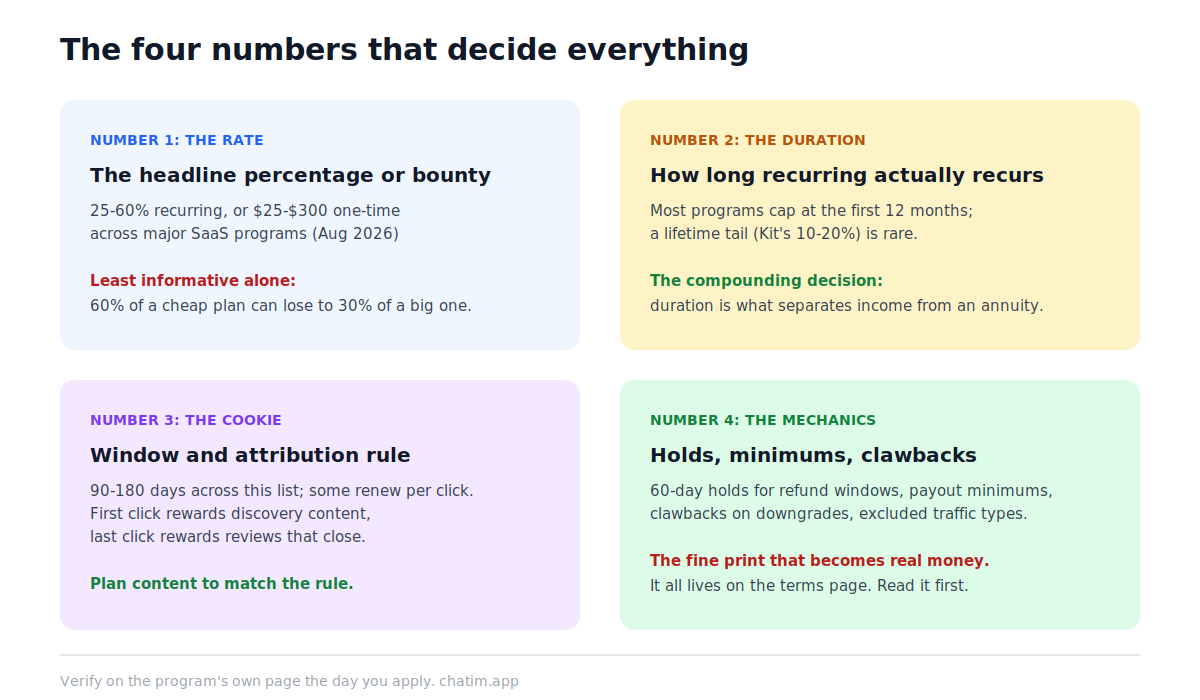
The four numbers that decide everything
Commission rate is the headline, and the least useful alone. Duration is where recurring programs quietly diverge: "30% recurring" for 12 months and "30% recurring" indefinitely are entirely different businesses, and most SaaS programs cap the recurring window at a year. The cookie window sets how long after a click you still get credit, anywhere from 90 to 180 days among the programs below, and the attribution rule beside it (first click or last click) decides who wins when a reader clicks two creators' links. And payout mechanics are the fine print that becomes real money: minimum thresholds, hold periods, clawbacks for refunds and downgrades, and which network (PartnerStack and Impact run most of this list) handles the ledger. Judge every affiliate program on all four, in that order of skepticism.
7 SaaS affiliate programs compared
All terms as listed on each program's official page, August 2026.
| Program | Commission | Duration | Cookie | Network |
|---|---|---|---|---|
| HubSpot | 30% recurring | Up to 1 year | 180 days | Impact |
| GetResponse | 40-60% recurring | 12 months | 90 days | PartnerStack |
| Kit | 50% recurring | 12 months + tier bonuses after | Not stated | Own program |
| ActiveCampaign | 30% recurring | Up to 12 months | 90 days, first click | PartnerStack |
| Unbounce | 25-35% recurring | Up to 12 months | 90 days, renewing | PartnerStack |
| Semrush | $100-$300 per sale + $10 per trial | One-time | 120 days | Impact |
| Shopify | $150 or $25 fixed bounty by region | One-time | Not stated on earnings page | Impact |
The recurring-commission programs
1. HubSpot: the big-ticket recurring standard
HubSpot pays 30% recurring for up to one year with a 180-day cookie, the longest window on this list, and tiers that add bonuses as monthly sign-ups grow. The math case is ticket size: CRM suites bill more than newsletter tools, so 30% of a year compounds into the largest checks here for content that reaches buying teams. Free to join with no customer requirement, paid via Impact with a low withdrawal minimum. The catch is competition: HubSpot content is an ocean, and the program rewards writers with an angle (integrations, comparisons, implementation guides) rather than another "what is a CRM" post.
2. GetResponse: the highest published recurring rate
GetResponse's ladder runs 40% recurring for 12 months at entry, 50% after 50 sales, and 60% after 100, with a 90-day cookie and monthly payouts through PartnerStack, and its page states there is no earning cap. Sixty percent is the highest published recurring rate in mainstream SaaS, and the honest caveat is the base: email marketing entry plans are inexpensive, so the percentage flatters smaller absolute checks until volume builds. Strongest for audiences actually choosing email platforms: creators, small ecommerce, marketing beginners.
3. Kit: the one with a lifetime tail
Kit (formerly ConvertKit) pays 50% for each referral's first 12 months, and then does what almost nobody else does: keeps paying 10 to 20% indefinitely after year one, provided you maintain at least Bronze status (10+ referred paying customers a year). That structure turns a creator-audience newsletter into an annuity, which is exactly the audience Kit serves. One sharp edge from its own terms: referrals driven by paid ads do not count toward status tiers, so this is an organic-content program by design.
4. ActiveCampaign: flat, predictable, first-click
ActiveCampaign pays a flat 30% recurring for up to 12 months, tracked on a 90-day first-click cookie, paid monthly via PartnerStack after a 60-day hold, with refunded accounts excluded. Two details reward reading: first-click attribution means being the discovery source pays here (top-of-funnel comparison content wins credit that last-click programs would hand to the closer), and payouts need at least two active referred accounts. A steady mid-list pick for marketing-automation audiences.
5. Unbounce: renewing cookies for slow deciders
Unbounce pays 25 to 35% of recurring revenue for up to 12 months, with a 90-day cookie that restarts on every click, a small mechanic that fits how agencies and freelancers actually buy landing-page tools: slowly, with repeat visits. Anyone can join, there is no referral cap, and rewards cash out monthly via PayPal or Stripe once verified. The natural fit is conversion-focused content for the same audience that reads about page speed and A/B tests.
The bounty programs
6. Semrush: the famous per-sale check
Semrush pays a one-time $100 to $300 per sale depending on product (rising to $450 at top partner tiers) plus $10 per free trial activation, on a 120-day cookie via Impact. The trial bounty is the underrated half: $10 for a free-trial activation monetizes readers who never buy. Entry has a bar (roughly a thousand monthly visitors or an equivalent organic following, per its page), and the fit is obvious: if you write about SEO, your audience is already searching for this tool by name.
7. Shopify: fixed bounties at platform scale
Shopify's affiliate program pays a fixed bounty per full-price plan referral, $150 for merchants in North America, most of Europe, and several Asia-Pacific markets, and $25 elsewhere, per its help-center earnings page, with Plus and enterprise plans excluded. No percentage math, no duration question: one merchant, one check. The scale is the appeal, since ecommerce content has enormous surface area, and the constraint is the same: one-time bounties build income only as fast as you build traffic, with no compounding tail.
How to actually choose (and disclose)
Pick by audience overlap first, terms second: the best-paying affiliate program you cannot credibly recommend is worth exactly zero, and one honest walkthrough of a tool you use outperforms ten listicles of tools you do not. Prefer recurring over bounty when your audience subscribes and stays (email, CRM), and bounty when the product is a considered one-time switch (a store platform, an SEO suite where the per-sale check beats a year of small percentages). Mind the attribution rule when you plan content: first-click programs reward discovery articles, last-click programs reward comparison and review pages that close. And disclose properly on every page that carries an affiliate link, both because regulators require it and because the audiences these programs monetize can smell an undisclosed pitch from the headline. The same trust math that governs support widgets governs affiliate content: the moment readers feel processed, every recommendation on the site depreciates at once.
More on this from our team: website maintenance packages, the website proposal template, and SaaS marketing strategies.
Frequently Asked Questions
What are SaaS affiliate programs?
Partnerships where a software company pays you for customers you refer, either a percentage of the subscription (often recurring for a defined period) or a fixed bounty per sale. You share a tracked link, a network like PartnerStack or Impact records the referral, and payouts follow the program's schedule.
Which SaaS affiliate program pays the most?
Depends on what your audience buys. As of August 2026, GetResponse publishes the highest recurring rate (40-60% for 12 months), Kit uniquely keeps paying 10-20% after year one, HubSpot's 30% compounds on large tickets, and Semrush pays $100-$300 one-time per sale. Rate alone misleads; multiply rate, ticket size, and duration.
What does recurring commission mean?
You earn a share of the referred customer's subscription every billing cycle, not just once. Most SaaS programs cap it, commonly at the first 12 months. The duration matters as much as the percentage: 30% for one year and 30% forever are entirely different offers.
What is a cookie window in affiliate marketing?
The period after someone clicks your link during which their purchase still credits you. Among major SaaS programs it ranges from about 90 days to 180 days as of August 2026, and some cookies renew on repeat clicks. Longer windows suit considered purchases where readers compare for weeks.
What is the difference between first-click and last-click attribution?
When a buyer clicked several affiliates' links, first-click credits whoever introduced them, last-click credits whoever closed them. It changes what content wins: discovery and comparison articles earn under first-click, while review and best-of pages earn under last-click. Check each program's rule before planning content.
How much can you earn from SaaS affiliate programs?
Honest answer: it scales with qualified traffic, not with the program list. A site with steady buying-intent readers can build meaningful recurring income from a few well-matched programs, while a program list without an audience earns nothing. Model earnings as conversions times commission times duration, using your own traffic numbers.
Do I need a website to join?
Usually some owned audience, not necessarily a website. Several programs accept creators with social or newsletter followings, though some set bars: Semrush, for example, asks for roughly a thousand monthly visitors or an equivalent organic following. Free-to-join programs like HubSpot and Unbounce have no stated minimums.
What are PartnerStack and Impact?
The two networks that run most SaaS affiliate programs: they handle tracking links, attribution, dashboards, and payouts. Joining one program on a network makes the next one easier, and payout methods (PayPal, bank transfer, Stripe) plus minimum thresholds are typically set at the network level.
Do affiliate links need to be disclosed?
Yes. Regulators including the FTC require clear disclosure when you earn from links, on every page carrying them, and vendor terms require compliance too. Beyond the legal side, disclosure is a trust decision: audiences punish discovered stealth marketing far more than they punish an honest disclosure line.
Should I pick recurring or one-time bounty programs?
Match the product's buying pattern. Subscriptions people keep for years (email, CRM) favor recurring programs, where each referral compounds. Considered one-time switches (a store platform, an SEO suite) favor bounties, where the per-sale check beats a year of small percentages on a cheap plan. Most portfolios end up holding both.
Why do affiliate program terms in blog posts so often turn out wrong?
Programs change terms and close quietly, and third-party listings copy each other for years without rechecking. The reliable method: treat any roundup, this one included, as a map, and confirm rate, duration, cookie, and payout terms on the program's own page the day you apply.
Can agencies and freelancers join these programs?
Yes, and they are often the ideal fit: recommending tools clients will actually pay for monthly is normal agency work, and several programs highlight consultants as target partners. Where client billing and referral commissions mix, disclose the relationship to the client; some agencies credit commissions back as a policy.
What are the common payout gotchas?
Hold periods (commissions commonly wait 60 days for refund windows), minimum thresholds before withdrawal, clawbacks when referred customers refund or downgrade early, and exclusions such as self-referrals or paid-ad traffic that some programs disallow entirely. All four live in the terms page, which is always worth reading before the first campaign.
Related articles
More in Marketing & sales →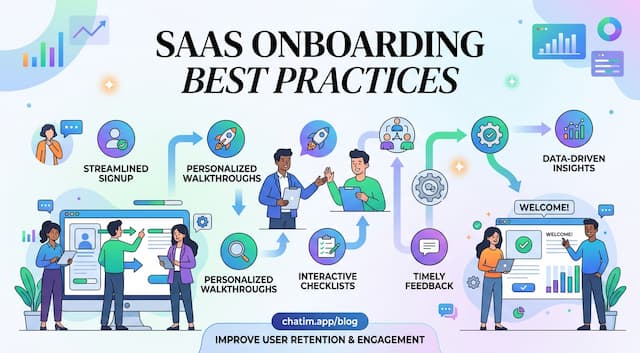 SaaS Onboarding Best Practices That Shrink Time to Value
SaaS onboarding best practices organized as a timeline: set expectations at signup, deliver value in session one, build the habit in week one, then measure.
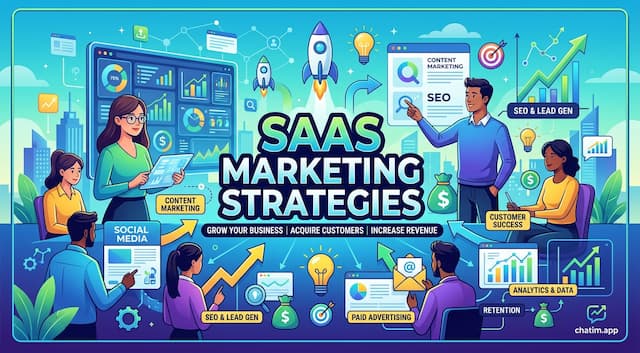 10 SaaS Marketing Strategies That Compound (2026)
Ten SaaS marketing strategies ranked by cost and time to results, the arithmetic that picks the right two or three for your price point, and what to skip.
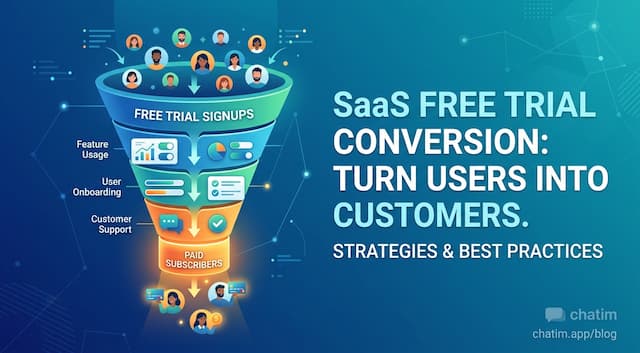 Free Trial Conversion: Fix Where Trials Actually Die
Forget trial conversion benchmarks: decompose the funnel, find which of the four deaths kills your trials, and apply the fix that matches, chat included.
 How to Promote on Reddit Without Getting Banned (2026)
How to promote on Reddit the way that works: the four-rung participation ladder, post formats that earn attention, ad notes, and what gets businesses banned.