10 SaaS Marketing Strategies That Compound (2026)
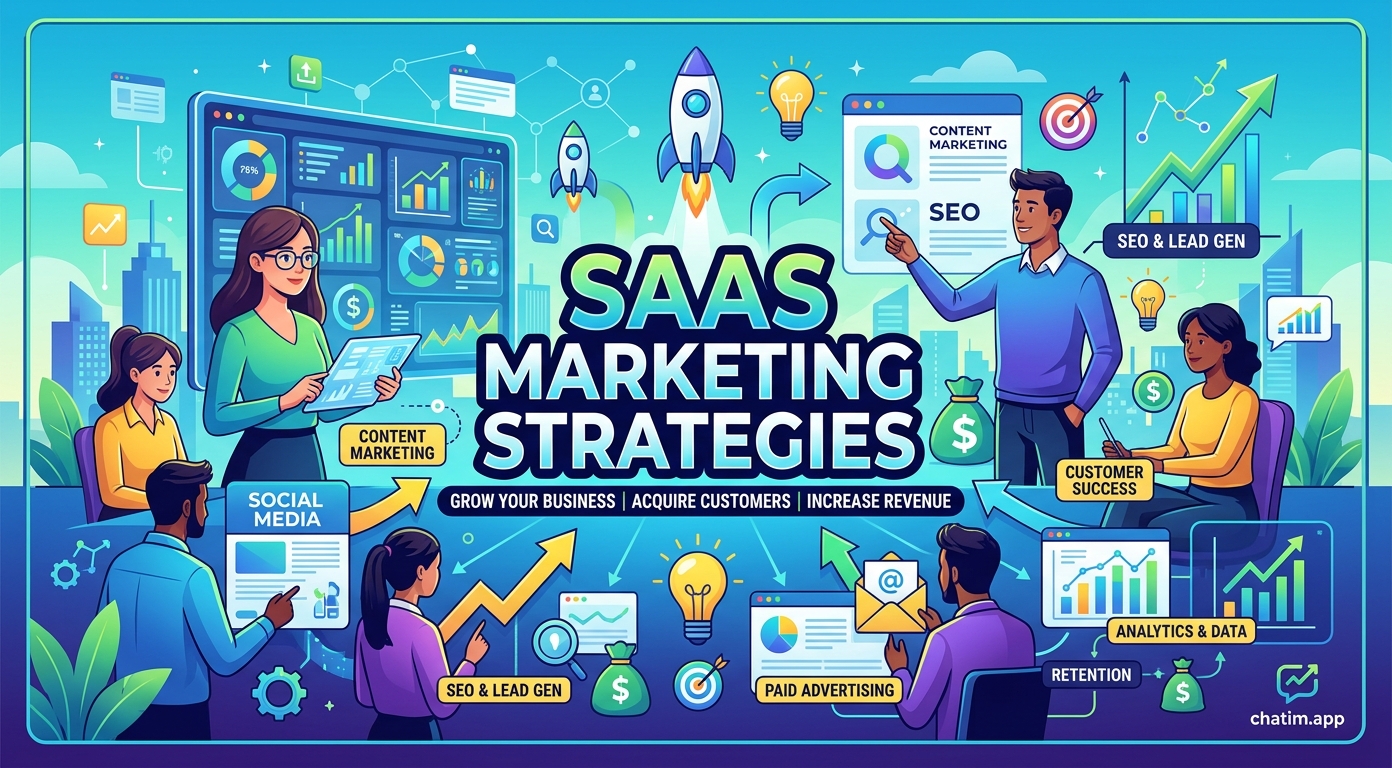
Most lists of SaaS marketing strategies read like a menu with every dish on it: do content, do ads, do social, do everything. Real SaaS companies, especially small ones, win by doing the opposite: picking the two or three strategies that fit their price point and audience, running them long enough to compound, and ignoring the rest without guilt. This guide covers ten SaaS marketing strategies that reliably produce pipeline, what each one costs in time versus money, and how to pick the few worth your next quarter.
One bias to declare up front: we build a live chat product, and exactly one strategy below involves chat. The other nine work whether or not you ever install a widget.
The math that picks your strategies for you
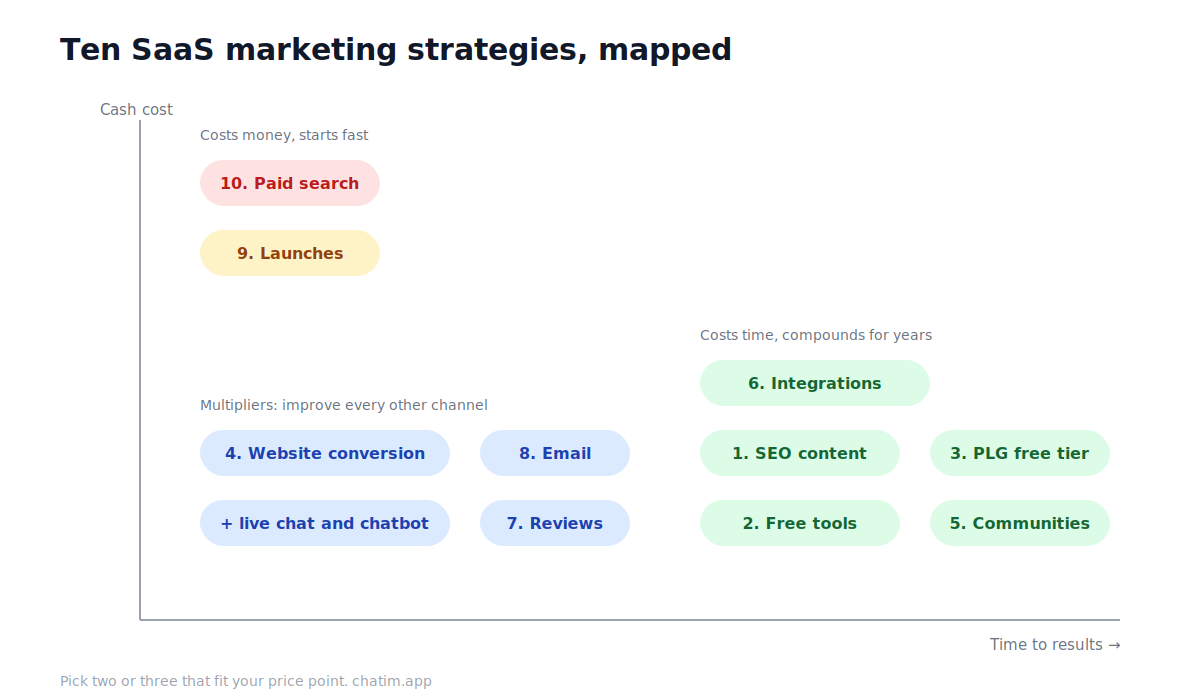
Strategy choice in SaaS is mostly arithmetic. A product priced at twenty dollars a month cannot afford sales calls or expensive paid acquisition; it needs channels with near-zero marginal cost per lead (search, free tools, product-led growth). A product priced at two thousand a month can afford outbound and events, and probably cannot get enough volume from self-serve channels alone. So before the list: know your rough revenue per customer per year, guess honestly what you can spend to acquire one, and read the strategies below through that filter. Time-rich and cash-poor points you at the compounding channels; the reverse points you at the paid ones.
1. Content and SEO aimed at buying intent
The compounding channel most SaaS companies underbuild. The mistake is writing what is easy (company news, generic thought pieces) instead of what buyers search at the moment of choice: comparisons, alternatives, "best X for Y" lists, and pricing explainers. One honest comparison page that ranks earns pipeline monthly for years. Start from queries with obvious purchase intent in your category, cover them better and more honestly than the incumbents, and accept that results arrive in months, not weeks; that delay is exactly why the channel stays underpriced. Our guide to driving traffic to your website covers the broader toolkit.
2. Free tools as lead magnets that never expire
A small free tool that solves one adjacent problem (a calculator, a generator, a checker) earns search traffic no blog post can match, because tool queries carry doing-intent, not reading-intent. The playbook: pick a problem your buyers already search for, build the smallest version that genuinely works, keep it free without a signup wall, and let the tool page introduce your product to people who arrived for the utility. It is slower to build than a post and compounds harder; a good tool is a lead magnet you never have to re-promote.
3. Product-led growth: the free tier is the campaign
In product-led growth the product does the persuading: a free tier or generous trial lets users experience value before a conversation ever happens. It works when your product shows its value quickly and self-serve; it fails when value needs setup, data, or a team to appear. If you go this route, the marketing job shifts from generating demand to removing friction: signup without a card, an onboarding that reaches the first win fast (our customer onboarding guide is the companion here), and upgrade prompts that appear when usage, not a calendar, says the user is ready.
4. Website conversion: the multiplier on every other strategy
Every strategy on this list ends at the same place: your website. Doubling traffic is expensive; doubling the share of visitors who become signups is usually cheaper, and it multiplies every channel at once. The levers are unglamorous: a clear promise above the fold, pricing that answers questions instead of hiding them, proof near every call to action, and a way to ask the blocking question in the moment it forms. That last one is where live chat earns its seat: a trial-blocking question answered in two minutes converts; the same question left for a contact form usually does not. A chatbot covering nights and weekends keeps the answer machine running when you are not. This is the one strategy here that touches our own product category, so weigh our enthusiasm accordingly; the lead generation page shows how we think about it.
5. Communities, honestly participated
Buyers ask peers before they ask vendors: in niche Slack and Discord groups, in subreddits, in professional forums. The strategy that works is patient and boring: be a named human, answer questions in your domain for months, mention your product only when it is genuinely the answer, and let a helpful history do the selling. The strategy that fails is arriving with links. Communities have long memories in both directions, which is precisely why the compounding is real.
6. Integrations and marketplace listings
Every platform your buyers already use (their CMS, their ecommerce platform, their CRM) has an app marketplace, and those marketplaces are search engines with purchase intent built in. Building an integration buys you distribution twice: the listing itself, and the "works with your stack" answer in every sales conversation. Prioritize the one or two platforms where your buyers actually live over a logo wall of shallow integrations nobody maintains.
7. Review platforms and the comparison shopper
Late-stage buyers verify on review platforms and comparison sites before they pay. The strategy is unglamorous hygiene: claim your profiles, keep screenshots and descriptions current, and ask happy customers for reviews steadily (after a support win or a renewal, not in a once-a-year blast). A modest, steady stream of authentic reviews outperforms a suspicious burst, and the profile you neglect is the one a competitor's comparison page will quote.
8. Email that respects the trial clock
Email in SaaS is less about newsletters and more about timing: the trial that expires Thursday, the user who activated but never invited a teammate, the cancelled account worth a win-back note in ninety days. Behavior-triggered messages tied to those moments outperform broadcast sends because they arrive when the decision is live. Keep the list warm with something genuinely useful monthly, and spend your real effort on the five automated emails that map to your funnel's cliff edges.
9. Launches and directories
Launch platforms and startup directories will not build a durable channel, but they do three useful things: a burst of early users who tolerate rough edges, backlinks that help every search strategy above, and forcing-function deadlines that ship the landing page. Treat launches as amplifiers you fire a few times (major releases, not every feature), and harvest the durable assets (links, testimonials, feedback) rather than chasing the leaderboard.
10. Paid channels, last and deliberately
Paid search and social work in SaaS when two numbers cooperate: what a customer is worth per year and what a click costs in your category. Run the arithmetic before the campaign, start with high-intent search terms (your brand, your competitors' alternatives queries, your category plus "software"), and treat paid as a way to buy data and speed while the compounding channels grow, not as the foundation. The classic failure is funding broad awareness ads on a low-priced product; the classic win is defending high-intent queries you already convert well.
Measure like you mean it, then cut
Whatever you pick, instrument it: tag every campaign link with UTMs (our free UTM builder exists for exactly this), watch signups by source rather than traffic by source, and give each strategy a fair window (a quarter for paid and launches, two or three for content and tools) before judging. Then do the part most teams skip: cut the underperformer and reinvest in the winner, even when the underperformer is the fashionable one. Two channels compounding beat five channels dabbled in, and our lead generation strategy guide picks up from here on turning the traffic into pipeline.
Keep going with our guides to SaaS customer support, free trial conversion, and promoting on Reddit.
Frequently Asked Questions
What are the best marketing strategies for SaaS?
The reliable core: intent-focused content and SEO, free tools as lead magnets, product-led growth with a free tier, website conversion optimization (including live chat), community participation, integration marketplaces, review platform hygiene, behavior-triggered email, occasional launches, and deliberate paid search. The best two or three for you depend on your price point: cheap products need near-zero-cost channels, expensive ones can afford outbound and paid.
How do I choose which SaaS marketing strategies to focus on?
Run the arithmetic first: estimate revenue per customer per year and what you can honestly spend to acquire one. Low-priced products point at compounding channels (SEO, free tools, product-led growth); higher-priced products can support paid and outbound. Then pick two or three strategies, run them for at least a quarter (longer for content), and cut what underperforms.
What is product-led growth in SaaS marketing?
A strategy where the product itself does the persuading: a free tier or self-serve trial lets users experience value before any sales conversation. It fits products that show value quickly without setup or a team. The marketing work shifts to removing friction: cardless signup, fast onboarding to the first win, and upgrade prompts triggered by usage.
Does content marketing still work for SaaS?
Yes, when aimed at buying intent rather than volume: comparison pages, alternatives lists, and pricing explainers that meet buyers at the moment of choice. Generic thought-leadership content underperforms because it competes on volume without intent. Content compounds over months, which is why it stays underpriced relative to paid channels.
How does live chat help SaaS marketing?
Live chat converts existing traffic rather than generating new traffic: it answers the blocking question (pricing, fit, integration) in the moment it forms, which is when trials are won or silently lost. A chatbot extends that coverage after hours. It is a multiplier on every traffic-generating strategy, not a substitute for them.
Are free tools a good SaaS marketing strategy?
One of the best for products with search demand in their category. A small free tool (calculator, generator, checker) captures doing-intent queries that blog posts cannot, keeps earning traffic without re-promotion, and introduces your product to users who arrived for the utility. The cost is upfront build time, which is why it stays less crowded than content.
Should a small SaaS spend money on paid ads?
Only after the arithmetic works: annual revenue per customer must comfortably exceed the acquisition cost your category's click prices imply. Start narrow with high-intent search terms, use paid to buy speed and data while compounding channels grow, and avoid broad awareness campaigns on low-priced products, which is the classic money sink.
How long do SaaS marketing strategies take to show results?
Paid ads and launches show results in weeks; email automation shows within a trial cycle; communities, SEO content, and free tools typically need one to three quarters before compounding becomes visible. The practical rule: give fast channels a quarter and compounding channels two or three before judging, and measure signups by source, not traffic.
What is the cheapest way to market a SaaS product?
Channels that cost time instead of money: intent-focused SEO content, honest community participation, marketplace listings for platforms you integrate with, review profile hygiene, and conversion work on the website you already have (clear pricing, proof, live chat for blocking questions). None require ad spend; all reward consistency.
How important are review sites for SaaS?
Important at the decision stage: late-stage buyers verify vendors on review platforms before paying, and comparison pages quote whatever they find there. The work is steady hygiene: claimed profiles, current screenshots, and a regular trickle of authentic reviews requested after genuine wins rather than an annual blast.
What marketing metrics should a SaaS company track?
Signups and revenue by source, not raw traffic: tag campaign links with UTM parameters, track trial-to-paid conversion per channel, and watch acquisition cost against annual revenue per customer. Channel-level truth is what lets you cut underperformers and reinvest, which is where most of the strategy's value actually comes from.
Do integration marketplaces really generate leads?
Yes, because a platform's app marketplace is a search engine whose users already pay for the platform: intent is built in. The listing earns steady discovery, and the integration itself removes a common sales objection. Depth beats breadth: one or two well-maintained integrations where your buyers live outperform a wall of shallow ones.
What is the biggest SaaS marketing mistake?
Dabbling: running five strategies at 20 percent effort so none compounds, then concluding marketing does not work. The pattern that wins is choosing few channels matched to your price point, instrumenting them, giving them an honest window, and reinvesting in the one or two that prove themselves.
Related articles
More in Marketing & sales → Best SaaS Affiliate Programs in 2026: 7 Verified Picks
7 SaaS affiliate programs with every rate, duration, cookie, and payout term verified on the official pages, plus the four numbers that decide value.
 SaaS Onboarding Best Practices That Shrink Time to Value
SaaS onboarding best practices organized as a timeline: set expectations at signup, deliver value in session one, build the habit in week one, then measure.
 Free Trial Conversion: Fix Where Trials Actually Die
Forget trial conversion benchmarks: decompose the funnel, find which of the four deaths kills your trials, and apply the fix that matches, chat included.
 How to Promote on Reddit Without Getting Banned (2026)
How to promote on Reddit the way that works: the four-rung participation ladder, post formats that earn attention, ad notes, and what gets businesses banned.