How to Drive Traffic to Your Website (2026)
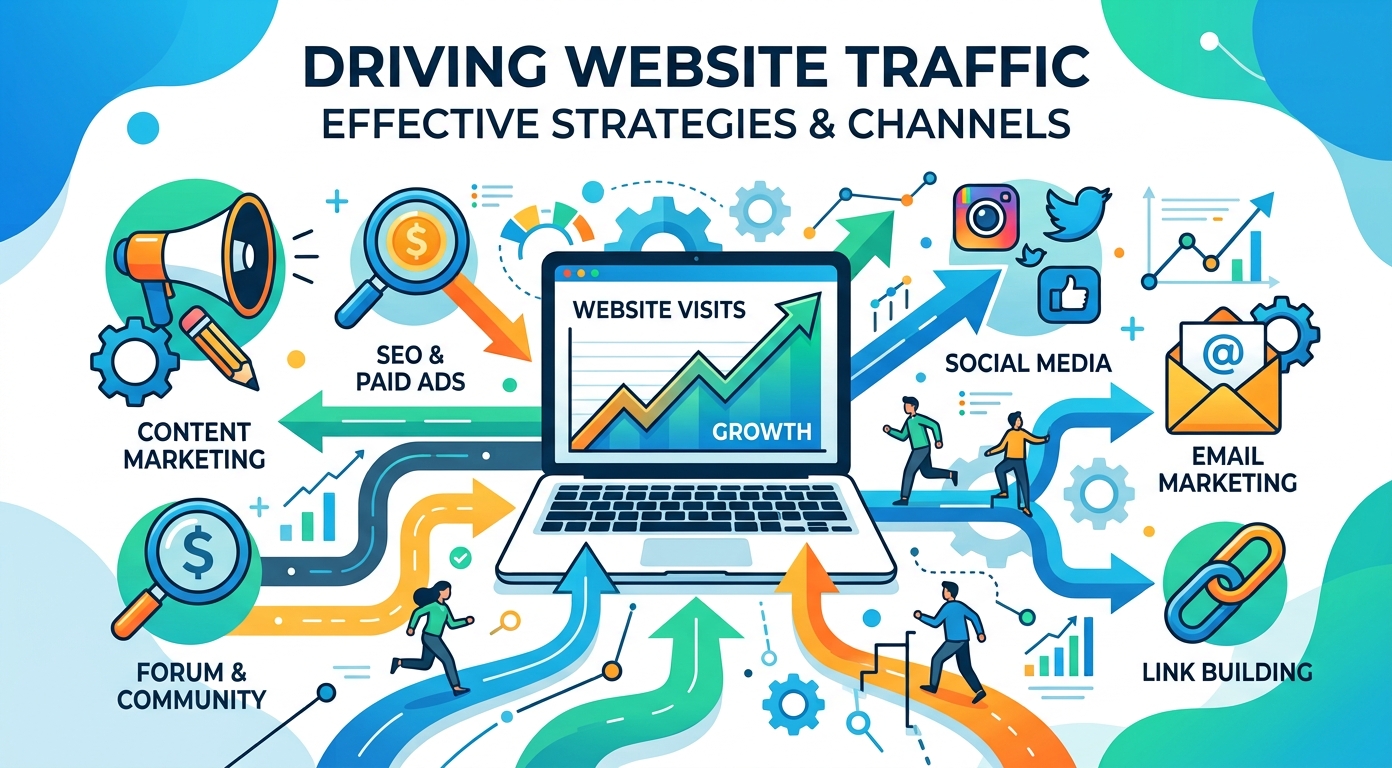
If you want to know how to drive traffic to your website, the honest answer is that there is no single trick. Steady website traffic comes from a handful of channels working together: search, content, social media, email, and paid ads. This guide walks through every one, with the practical steps that make each channel actually send visitors to your website.
Each method below is a real channel, not a vague tip. Some are free and slow, like SEO and content marketing. Some are fast and paid, like Google Ads. The right mix depends on your business, your budget, and how quickly you need results.
Work through the channels in order, pick two or three that fit your business, and commit to them for a quarter. Scattered effort across ten tactics rarely moves a website, but focused effort on three reliably does. Treat this as a working plan rather than a list of ideas.
How to drive traffic to your website: the 9 channels
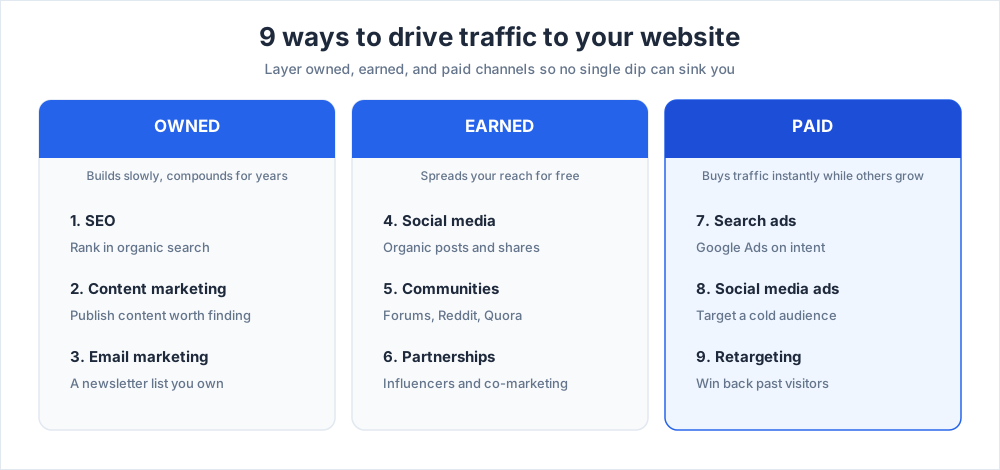
There are nine reliable ways to drive traffic to a website, and they fall into three groups. Owned channels, which are SEO, content, and email, build slowly but compound for years. Earned channels, which are social media, communities, and partnerships, spread your reach. Paid channels buy traffic instantly while the others grow.
No single channel carries a website forever. The strongest traffic strategies layer owned, earned, and paid together, so a dip in one does not sink the whole business. A search algorithm update hurts far less when email and social media are also sending visitors to your website.
As you read, note which channels you already use and which you have ignored. The fastest gains usually come from the channel you have neglected most, not the one you have already optimized to the limit.
Drive organic traffic with SEO
Search engine optimization is the highest-return way to drive traffic over the long run. Organic traffic from Google arrives free, every day, for as long as your pages rank, and it tends to convert well because the visitor was already searching for what your business offers.
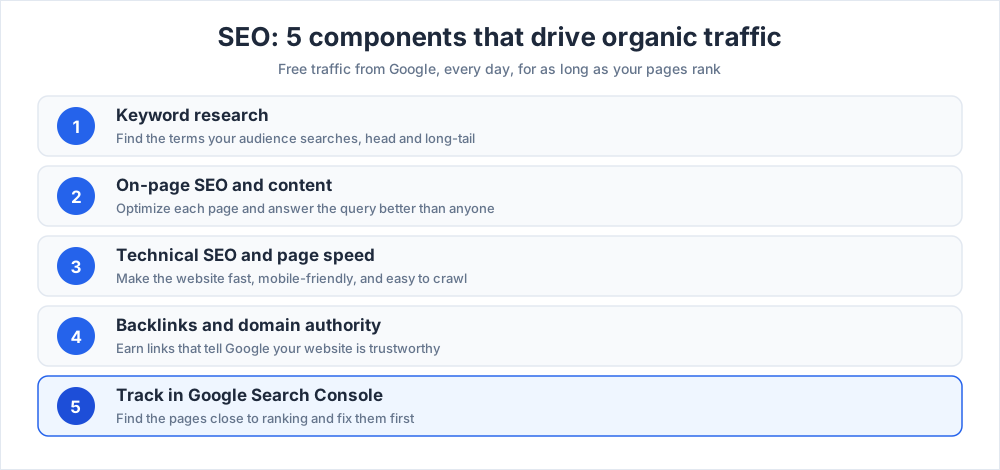
Organic traffic is slow to build and hard for a competitor to take away once you have it. SEO has four parts: finding the right keywords, optimizing your pages, fixing the technical foundation, and earning backlinks. The sections below cover each one in turn.
SEO rewards patience. The strategies in this section take three to six months to show real movement, but the content and rankings you build keep sending free visitors long after the work itself is done.
Start with keyword research
Keyword research is the foundation of organic traffic. Use keyword research tools to find the terms your audience searches, then match each page on your website to one clear topic and the search intent behind it.
Mix head terms with long-tail keywords. Tail keywords have lower search volume but far less competition, so a new website can rank for them quickly and increase visits while the bigger terms are still out of reach. A page that targets a specific question often ranks within weeks.
Group related keywords into topics and give each its own page. Covering a topic fully, with strong target keywords behind every page, tells Google your website is an authority and lifts the whole cluster in search results.
You do not need expensive software to begin. Free keyword tools, including Google's own Keyword Planner and Search Console, surface plenty of keyword ideas for a small business to build content around.
Optimize on-page SEO and content
On-page work is how you make a page rank for its keywords. Put the main keyword in the title, the headers, the URL, and naturally through the content, and write each page for the reader first and the search engine second.
Great content is what actually earns the ranking. Search engines reward pages that answer the query better than anything else, so depth, clarity, and genuinely useful content beat keyword tricks every time. Thin content will not rank no matter how well it is optimized, and it will not earn shares either.
Add internal links between related pages. They help Google understand your website, and they keep visitors moving deeper into your content, which lifts both your rankings and the time each visitor spends on your website.
Fix technical SEO and page speed
The technical layer is the foundation under everything else. If search engines cannot crawl your website, or it loads slowly, even great content will not rank well, and the result is lost traffic.
Focus on the basics: fast loading, mobile-friendly design, a clean site structure, and a valid sitemap. Free tools such as Google's PageSpeed Insights flag what to fix, and speed in particular is both a Google ranking factor and the reason many visitors leave a website before the page has even loaded.
Structured data helps too. Marking up your pages can earn rich results in search, which makes your listing stand out and drives more clicks to your website even at the same ranking position.
Build backlinks and domain authority
Links from other websites are still one of Google's strongest ranking signals. Each quality backlink is a vote that tells Google your website is trustworthy and worth ranking higher.
Earn backlinks by creating content worth citing, writing guest posts for authoritative sites, and building genuine relationships with other publishers in your niche. Avoid buying links, which Google penalizes. Slow, honest link building is the kind that compounds and keeps driving traffic for years.
Track rankings in Google Search Console
Google Search Console is the free tool that shows how your website performs in search. It reports which keywords you already rank for, your click-through rate, and any technical issues Google has found on your website.
Check it every week. The reports point you to the pages that sit just below the top of search results, the queries gaining impressions, and the quick fixes that increase traffic the fastest. It is the cheapest traffic tool a business can use.
Drive traffic with content marketing
This channel is the engine that feeds SEO, social media, and email all at once. Every blog post, guide, or video is an asset that can drive traffic to your website for years after you publish it, which makes it the best long-term use of a marketing budget.
The goal is not more content, it is better content. One genuinely useful, unique article will out-perform ten thin ones, because it earns backlinks, ranks in search, and gets shared by the readers who found it valuable.
Publish unique content on your blog
A consistent blog is the simplest way to publish work that drives traffic. Each blog post targets a keyword, answers a real question, and gives visitors a reason to come back to your website.
Write for people, not algorithms. Useful, well-researched blog posts earn the shares and backlinks that search engines reward, and a strong post keeps sending traffic long after it goes live. This is why original, in-depth work out-performs filler every time.
Mix your formats: how-to guides, lists, original research, and case studies. Variety keeps the blog fresh, gives you more ways to rank, and gives your audience more reasons to share your work with other people.
Plan a content distribution strategy
Publishing is only half the job. A distribution plan decides where each piece goes after it is live: your email list, your social media channels, relevant communities, and partner sites.
A simple rule works here: spend as long promoting a piece as you spent making it. Most websites publish good content and then let it sit unseen, which wastes the hardest part of the work and leaves traffic on the table.
Repurpose every piece. A single guide becomes social posts, an email, a video, and a slide deck, so one effort reaches your audience on several channels and drives traffic from each of them.
Track which channels send the most visitors and share more of your content there. Distribution is a marketing skill in its own right, and getting it right roughly doubles the return on every piece of content you publish.
Drive traffic with social media
Social media will not replace SEO, but it drives fast, immediate traffic and builds the audience that the slower channels rely on. The key is to treat each platform as its own channel with its own style.
Pick the two or three platforms where your customers actually spend time. For most a business that means some mix of Facebook, Instagram, LinkedIn, and X, rather than a thin presence stretched across every network at once.
Consistency matters more than reach at the start. A business that posts useful content on Facebook three times a week will out-perform one that posts everywhere once a month, because social media marketing compounds with frequency.
Organic social posts
Posting organically costs nothing but time. Share every new blog post, answer questions, join conversations, and post consistently so the audience that discovers your website keeps growing.
Match the content to the platform. A professional audience wants insight, an Instagram or Facebook audience wants visuals, and reposting the identical thing everywhere rarely drives much traffic. Tailor the message, share it at the right time, and you earn more clicks for the same effort.
Social media ads
Paid social puts your content in front of a precise audience fast. Facebook and Instagram ads target by interest and behaviour, which makes them strong for driving visitors to a newer website that has no search rankings yet.
Start with a small budget, test a few audiences, and scale only what works. Paid social is the fastest way to learn which message drives traffic and which customers respond before you invest months in organic content.
LinkedIn articles and professional reach
For a B2B business, LinkedIn is the strongest social channel. Publishing long-form articles on LinkedIn puts your expertise in front of a professional audience and links readers back to your website.
Share company updates, employee posts, and useful guides. The platform rewards consistent, genuine activity, and the traffic it sends a business tends to convert into customers well because the audience is already there for work.
Drive traffic with email marketing
Email marketing is the only channel you fully own. Search and social media can change their rules overnight, but an email newsletter list belongs to you, and it drives reliable, repeat website traffic on demand.
Build the list with a clear signup offer, then send a regular newsletter with your best content and links back to new pages on your website. Email consistently drives some of the highest-converting traffic a business gets, because the reader already knows your brand.
Segment the list so each newsletter is relevant, and keep a steady schedule so readers expect you. See our guide to running an email blast for the practical steps to set this up.
Drive traffic with paid ads
Paid advertising is the fastest way to drive traffic to your website. Google Ads put your business at the top of search for high-intent keywords, while social ads build awareness and reach a cold audience that has never heard of you.
Paid traffic stops the moment you stop paying, so treat it as a way to test messages and to bridge the gap while organic traffic grows. Run ads on the keywords and audiences that convert, track the cost per visitor, and reinvest only in what works.
Retargeting is the highest-return paid tactic. Showing ads to people who already visited your website brings back visitors who were close to converting into customers, usually at a much lower cost than a cold click.
Set a clear budget cap before you start, and never let a campaign run unwatched. Paid channels reward quick, frequent adjustments far more than a large, hands-off upfront spend.
Drive traffic with influencers and partnerships
Partnering with influencers and other businesses borrows an audience you have not built yet. When a trusted voice shares your content, their followers become visitors to your website.
Influencer marketing works best when the audience genuinely overlaps with your customers. A small, relevant creator usually drives more useful traffic than a huge, mismatched one, and often costs far less.
Co-marketing also works between businesses: joint events, guest content, shared guides, and affiliate deals all drive visitors both ways, and each partner reaches a fresh audience for free. Pick partners who serve your customers without competing with you.
Drive traffic from online forums and communities
Online communities, including Reddit, Quora, niche forums, and industry groups, are full of people asking the exact questions your content already answers.
Join the communities in your niche and be genuinely helpful. Answer questions, link to the pages on your website only when they truly add value, and never spam. These spaces reward real contributors and quietly punish self-promoters.
Done well, community activity drives steady, high-trust visits, and it often sparks the backlinks and shares that help your SEO at the same time. It is slow, but the visitors arrive primed to trust your business.
Be patient and genuinely human here. A reputation built inside a community takes months to earn, but the trust it creates tends to outlast any single search algorithm change.
Free ways to drive traffic: webinars and podcasts
Not every traffic channel costs money. The best free options to grow include hosting webinars, starting a podcast, and appearing as a guest on other people's shows. None of these need a marketing budget, only time and consistency.
Podcasts and webinars build authority and a loyal audience. Host your own or appear as a guest, and every episode sends interested listeners to your website while building the trust that turns visitors into customers.
These channels compound. A single webinar becomes a blog post, a video, a set of social media clips, and an email, so one effort feeds several traffic channels at once and stretches your time further.
Measure and increase website traffic
You cannot increase website traffic that you do not measure. Google Analytics shows where your visitors come from, which pages they land on, and what they do next on your website.
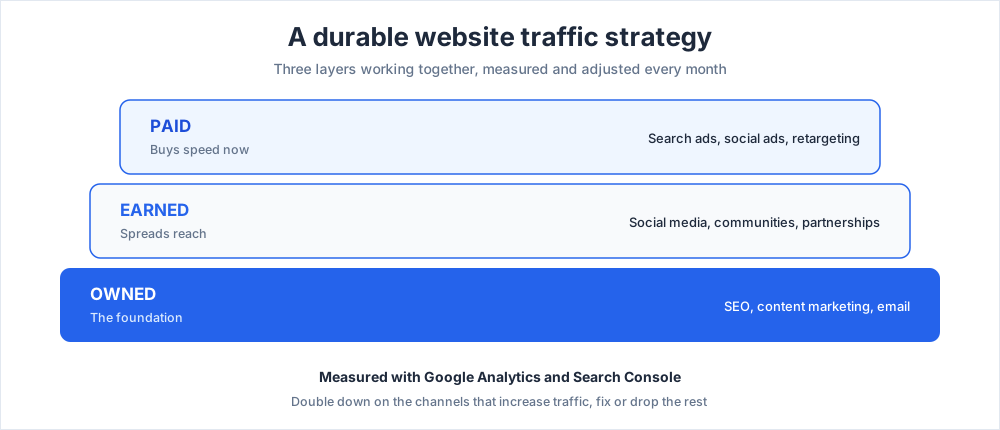
Watch the sources report to see which channels, whether organic search, social media, email, or paid ads, actually drive traffic. Double down on the channels that work, and fix or drop the ones that do not earn their time.
Pair Google Analytics with Search Console for the full picture. Analytics shows what visitors do on your website, search reporting shows how they found it, and together they tell you exactly where to spend your next hour to increase traffic.
Set a simple goal, such as a target to increase website traffic each quarter, and review the numbers every month. Free tools make this easy, and a clear goal keeps your growth strategies honest and focused.
Key takeaways: your traffic strategy
Driving traffic to a website is not one tactic, it is a system. Owned channels like SEO and content compound over time, earned channels like social media and communities spread your reach, and paid ads buy speed while the rest grow.
Pick two or three channels that fit your business and your budget, commit to them for a full quarter, and measure the result with analytics. The marketing strategies that win are simply the ones a business actually sticks with long enough to compound.
Consistency beats intensity. A business that publishes one good piece of content and shares it well every week will out-grow one that does everything once and then stops. Start this week, with a single channel, and add the next one once the first is working.
For more on the strategies behind a high-traffic website, see our guides to social media for business and low-cost digital marketing, learn how to attract advertisers once the traffic arrives, and consider adding Chatim live chat to convert more of your visitors into customers.
Related reading: promoting on Reddit and promoting a Shopify store.
Frequently Asked Questions
How to get 1000 visitors a day to your website?
Reaching 1,000 visitors a day comes from several channels working together rather than one breakthrough. Publish search-optimized content on a steady schedule, build organic traffic with SEO, promote every post on social media, and grow an email newsletter that brings readers back. Most websites reach this level over 6 to 12 months of consistent work. Pick two channels, prove they work, then add the next.
What is the 80/20 rule in SEO?
The 80/20 rule, or Pareto principle, applied to SEO means that roughly 80% of your organic traffic tends to come from about 20% of your pages and keywords. The practical takeaway is to find that high-performing 20%, the pages already ranking or close to ranking, and put most of your effort into improving and expanding them rather than spreading attention evenly across every page.
How much does it cost to drive traffic to your website?
It depends entirely on the channel. Organic traffic from SEO and content marketing has no direct media cost, but it costs time and consistency over months. Email marketing costs little once the list exists. Paid ads have a real, ongoing cost that varies widely with your industry's cost per click. Most businesses combine free channels for long-term traffic with a modest paid budget to bridge the gap while the free channels grow.
What are the 7 C's of a website?
The 7 C's of a website are a design and marketing framework for evaluating an online presence: Context (layout and visual design), Content (the text, images, and video), Community (how visitors interact), Customization (how the site tailors itself to the user), Communication (how the site talks with visitors), Connection (how it links to other sites), and Commerce (its ability to enable transactions). A website that scores well across the 7 C's converts more of the traffic it earns.
How long does it take to drive traffic to a new website?
Paid ads can drive traffic to a brand-new website within hours. Organic traffic is slower: SEO and content marketing usually take three to six months to show real movement, and 6 to 12 months to become a meaningful channel. Social media and community activity sit in between. The realistic plan is to use paid traffic or social media early while SEO and content compound in the background.
What is the best way to drive traffic to your website for free?
The best free ways to drive traffic are SEO, content marketing, organic social media, email marketing, online communities, and being a guest on podcasts or webinars. None of these need a media budget, only time and consistency. SEO and content marketing give the strongest long-term return because a single ranking page can drive traffic for years.
How do I drive traffic to my website without SEO?
SEO is the highest-return channel, but it is not the only one. You can drive traffic without it through social media posts and ads, an email newsletter, paid search and display ads, influencer and partner collaborations, online communities and forums, and podcasts or webinars. These channels also build the audience and links that make SEO work better later, so most websites use them alongside SEO rather than instead of it.
Does social media really drive website traffic?
Yes, though it works differently from search. Social media drives fast, immediate traffic and builds an audience, but the visits tend to come in spikes tied to each post rather than the steady stream SEO provides. It is most effective when you share every new piece of content, post consistently, and treat each platform as its own channel. For many businesses social media also feeds the email list and brand awareness that other channels rely on.
How do I increase organic traffic to my website?
Increase organic traffic by doing four things well: research the keywords your audience searches, publish genuinely useful content that targets them, fix the technical SEO and page speed of your website, and earn backlinks from other sites. Then use Google Search Console to find the pages sitting just below the top of search results and improve those first, since they are the fastest wins.
How do I track where my website traffic comes from?
Google Analytics is the standard free tool. Its sources or acquisition report breaks your website traffic down by channel, showing how much comes from organic search, social media, email, paid ads, and direct visits. Pair it with Google Search Console, which shows the exact search queries and pages bringing in organic traffic. Together they tell you which channels to invest in and which to fix.
Is paid traffic worth it for a small business?
Paid traffic is worth it when used deliberately. It is the fastest way to drive traffic to a new website, to test which messages and audiences convert, and to bridge the gap while organic traffic grows. The risk is that paid traffic stops the moment you stop paying, so a small business should start with a small budget, track the cost per visitor and conversion, and reinvest only in the campaigns that clearly pay back.
How often should I publish content to grow traffic?
Consistency matters more than raw volume. For most small businesses, one well-researched, genuinely useful piece of content per week will out-grow a site that publishes daily for a month and then stops. Pick a schedule you can sustain, hold to it, and spend as much time distributing each piece as you spent creating it.
What is a good amount of traffic for a website?
There is no universal number, because the right amount of traffic depends on your goals. A local service business may thrive on a few hundred well-targeted visitors a month, while an ad-supported site needs tens of thousands. Rather than chasing a benchmark, track your own trend: traffic that grows month over month, and converts into customers, matters far more than a headline figure.
Related articles
More in Marketing & sales → Best SaaS Affiliate Programs in 2026: 7 Verified Picks
7 SaaS affiliate programs with every rate, duration, cookie, and payout term verified on the official pages, plus the four numbers that decide value.
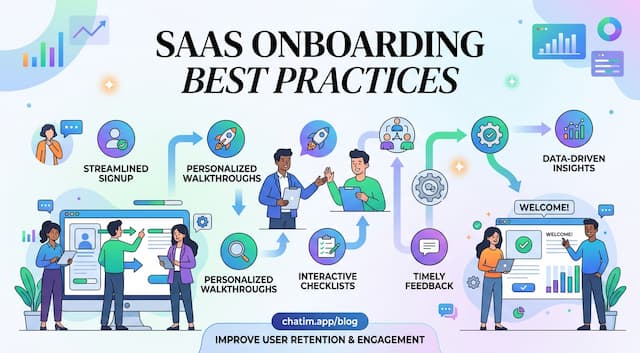 SaaS Onboarding Best Practices That Shrink Time to Value
SaaS onboarding best practices organized as a timeline: set expectations at signup, deliver value in session one, build the habit in week one, then measure.
 10 SaaS Marketing Strategies That Compound (2026)
Ten SaaS marketing strategies ranked by cost and time to results, the arithmetic that picks the right two or three for your price point, and what to skip.
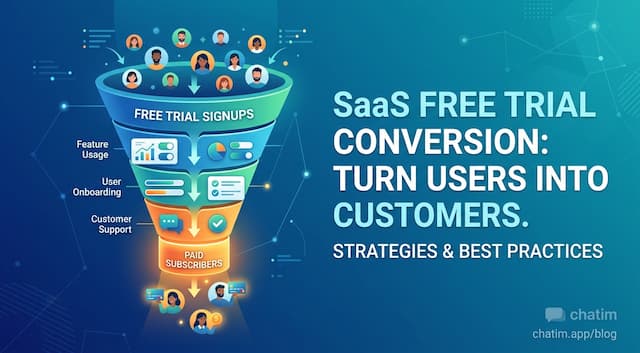 Free Trial Conversion: Fix Where Trials Actually Die
Forget trial conversion benchmarks: decompose the funnel, find which of the four deaths kills your trials, and apply the fix that matches, chat included.