Website Proposal Template: 8 Sections That Win (2026)
A website proposal template earns its keep twice: it wins the project by making the client feel understood, and it protects the project by defining what "done" means before anyone pays anything. Most freelancers and small agencies lose on both counts with proposals that are really just quotes: a price, a list of pages, a signature line. This guide gives you the full template (eight sections, copy-paste ready with [bracketed] placeholders), a walkthrough of what each section is doing psychologically, and the pricing-presentation pattern that stops proposals from being judged on price alone.
It is written for web designers, developers, and small agencies proposing site builds, but the structure carries to any project work.
What a website proposal is (and is not)
A proposal is a persuasion document with a spine of specifics: it restates the client's problem better than they stated it, shows a credible path to solving it, and makes saying yes easy and safe. It is not a quote (a price without a story), not a contract (that comes after the yes, though the proposal's scope section becomes its backbone), and not a portfolio dump (one relevant example beats nine random ones). The test of a good proposal: the client could hand it to a partner who missed every call, and that partner would understand the problem, the plan, the price, and the next step.
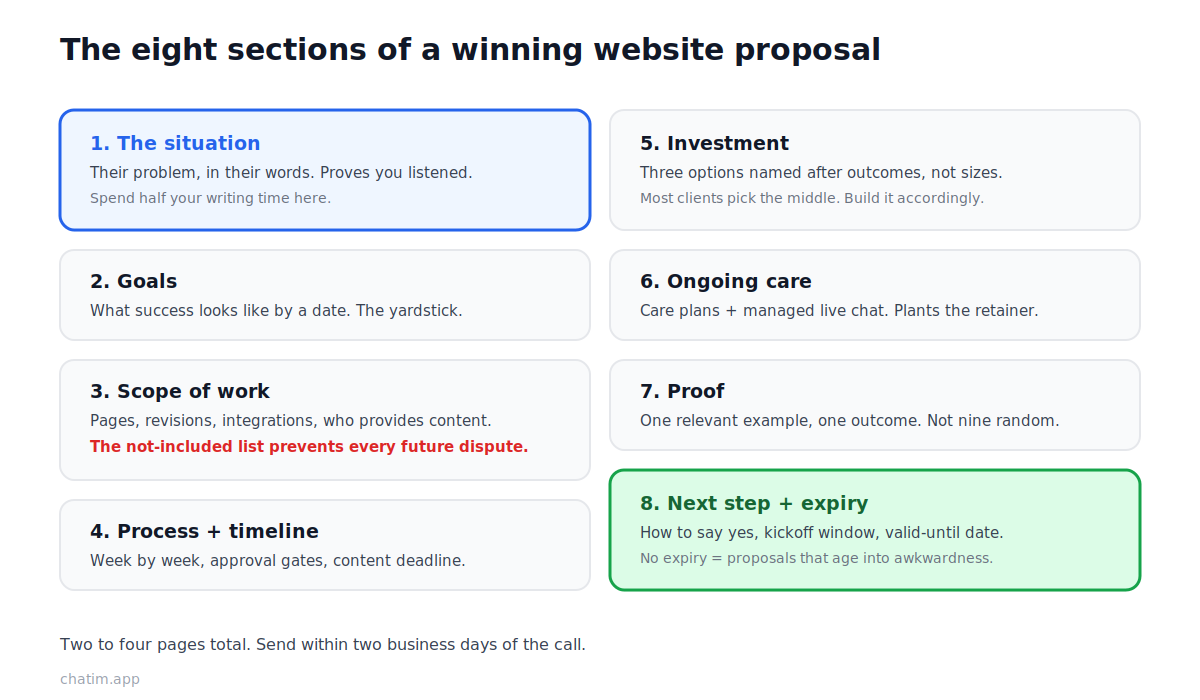
The website proposal template, section by section
1. The situation (their problem, your words).
[Client name] is [one-sentence description of the business]. The current website [honest one-line diagnosis: is not generating inquiries / no longer reflects the brand / is hard to update / loses mobile visitors]. In our conversation on [date], you described [the two or three pains in the client's own phrasing]. The goal of this project is to change that.
This section wins or loses the deal. Written specifically, it proves you listened; written generically, it tells the client this is proposal number forty from a template. Spend half your writing time here.
2. Goals and what success looks like.
By [timeframe after launch], the new site should: [goal 1, e.g. generate a steady stream of quote requests], [goal 2, e.g. let your team update content without a developer], [goal 3, e.g. load fast and look right on phones, where most of your visitors are]. We will treat these as the yardstick for every design and build decision.
3. Scope of work.
Included: [number] pages ([list]), [design rounds] design revisions, mobile-responsive build on [platform], contact form and [live chat / booking / map] integration, basic on-page SEO (titles, descriptions, image optimization), analytics setup, and launch. Not included (available as add-ons): [copywriting, logo design, photography, ongoing maintenance]. Content is provided by [who] by [when].
The "not included" list is the most valuable paragraph in the document; every scope dispute you will ever have lives in its absence.
4. Process and timeline.
Week [1]: kickoff and content collection. Weeks [2-3]: design concept and one revision round. Weeks [4-5]: build and populate. Week [6]: review, second revision round, and launch prep. Launch: [date, contingent on content arriving by the date above]. You will see progress at each stage and nothing goes live without your approval.
5. Investment.
Option A, [name, e.g. "Essentials"]: everything in the scope above, [price]. Option B, [name, e.g. "Growth"]: everything in A plus [copywriting for key pages, extra template, on-site blog setup], [price]. Option C, [name, e.g. "Complete"]: everything in B plus [photography direction, launch campaign assets], [price]. Half is due to begin, half at launch. Each option includes [X] days of post-launch fixes.
6. Ongoing care after launch.
Websites need upkeep: software updates, backups, security monitoring, and small content changes. We offer monthly care plans from [price], including a managed live chat widget so the new site captures inquiries around the clock. Details on request; no obligation either way.
7. Why us (one paragraph, one example).
We recently built [comparable project] for [client type]; [one concrete outcome or client quote]. References available. You will work directly with [name], who answers messages within [timeframe].
8. Next step and validity.
To go ahead, reply to this email or sign below, and we will schedule kickoff within [X] days. This proposal is valid until [date, two to three weeks out]; after that, timeline and pricing may need revisiting.
Presenting the price so it is not the only thing judged
Three patterns consistently help. Offer three options, not one: a single price invites yes-or-no; three options change the question to "which one," and most clients pick the middle. Name the options after outcomes ("Growth"), not sizes ("Medium"), so the upgrade reads as ambition rather than expense. And price the project, not the hours: hourly line items invite auditing and penalize your experience; a project price with clear scope sells the outcome. Keep payment terms simple and stated (half to start, half at launch is the standard shape), and put the post-launch fix window in writing; it costs little and reads as confidence.
Proposal mistakes that lose winnable deals
Sending a price list with no problem statement, so the only comparable number is a competitor's price. Scoping vaguely ("about 5-7 pages") and paying for it in month two. Skipping the not-included list. Ten-page proposals for four-figure projects; length signals insecurity, not thoroughness. No expiry date, which lets proposals age into awkwardness. And the quiet killer: slow delivery of the proposal itself. The freelancer who sends a sharp proposal the next morning routinely beats the better portfolio that sends one in ten days, because responsiveness is the one work sample every client experiences before hiring.
Sending it, and the follow-up that does not grovel
Send the proposal in the body of a short email with the document attached, restating the one-line problem and the next step; our professional email guide covers the wrapper. If you have not heard back in [3-4] days, follow up once with something useful (an idea, an example, an answer to a question from the call), not with "just checking in"; the cold email templates guide has follow-up shapes that add value instead of pressure. And instrument your own front door: freelancers write proposals for people who inquire, and a portfolio site with live chat on it turns "I was looking at your work" into a conversation while the prospect is still warm; it is lead generation for the exact audience that already found you.
After the yes
Convert the proposal's scope section into the agreement, invoice the deposit promptly (a free invoice generator covers it until you have proper billing), and schedule the kickoff inside the acceptance email while momentum is high. Two upsells belong in the first month, both honest: the care plan from section six, because the site genuinely needs maintenance, and a live chat setup, because the new site's job is inquiries and chat is the shortest path from visitor to conversation. Proposals win projects; the care plan and the captured leads are what turn a project into a client.
Related reading: website maintenance packages and form builders.
This guide is for general informational purposes and is not legal advice. A proposal that a client accepts may form a binding contract in your jurisdiction. Have a qualified attorney review your proposal and contract templates before you use them commercially.
Frequently Asked Questions
What is a website proposal?
A persuasion document a freelancer or agency sends a prospective client before a website project: it restates the client's problem, defines goals, scopes the work, lays out process, timeline and pricing, and ends with a clear next step. It is not a contract (that follows the yes) and not a bare quote; its job is to make saying yes easy and safe.
What should a website proposal include?
Eight sections cover it: the client's situation in their own terms, goals and success criteria, scope of work with an explicit not-included list, process and timeline, pricing presented as options, ongoing care after launch, one relevant proof point, and a next step with an expiry date. The situation section does most of the winning; the not-included list does most of the protecting.
How do I write a website proposal that wins?
Spend half the writing time restating the client's problem specifically, in their phrasing from your call; it is the section that proves you listened. Then scope precisely, present three priced options named after outcomes, keep the whole document short, and send it fast. Responsiveness is the one work sample every client experiences before hiring.
How long should a website proposal be?
Short: two to four pages covers all eight sections for most small-business projects. Length signals insecurity rather than thoroughness, and a partner who missed every call should still grasp the problem, plan, price, and next step in five minutes. Put anything longer (full sitemaps, technical specs) in an appendix or after the yes.
How do I price a website proposal?
Price the project, not the hours, and present three options (essentials, growth, complete) named after outcomes so the question becomes which one rather than yes or no. State payment terms plainly; half to begin and half at launch is the common shape. Include a defined post-launch fix window; it costs little and signals confidence.
Should a website proposal include multiple pricing options?
Yes, three is the working standard: a single price invites a yes/no verdict and price comparison, while three options move the decision to which tier fits. Most clients choose the middle option, so build the middle around the scope you actually recommend and let the top tier carry the ambitious extras.
What is the difference between a website proposal and a contract?
The proposal persuades before the decision; the contract formalizes after it. The proposal's scope section typically becomes the contract's backbone, which is why precise scoping and an explicit not-included list matter so much: every future scope dispute traces back to what the proposal left vague.
What should be in the scope of work for a website?
The countable specifics: number and names of pages, design revision rounds, platform, integrations (forms, chat, booking, maps), on-page SEO basics, analytics, and launch, plus who provides content and by when. Equally important is the not-included list (copywriting, logo, photography, maintenance) offered as add-ons.
How do I follow up on a website proposal without being pushy?
Once, after three or four days, with something useful attached: an idea for their project, a relevant example, or an answer to a question from your call. Avoid bare check-ins; they add pressure without value. An expiry date in the proposal (two to three weeks) gives the follow-up a natural, non-desperate reason to exist.
Why do website proposals get rejected?
The usual causes are fixable: no problem statement, so the client compares prices instead of solutions; vague scope that makes the project feel risky; a single take-it-or-leave-it price; a document so long the decision-maker never finishes it; and slow delivery, which loses deals to faster competitors before quality is ever compared.
Should I offer website maintenance in my proposal?
Yes, as a soft mention rather than a hard sell: a short ongoing-care section noting that sites need updates, backups, security, and small changes, with monthly plans available. It plants the retainer conversation early, and extras like a managed live chat widget give the plan visible ongoing value beyond invisible upkeep.
How fast should I send a proposal after the client call?
Within one or two business days while the conversation is fresh, and same-day for small projects if you can. Speed compounds twice: the details from the call are still accurate in your problem statement, and the client reads your responsiveness as a preview of what working together will feel like.
Is there a free template for a website proposal?
Yes; the eight-section template in this guide is free to copy and adapt: situation, goals, scope with exclusions, process and timeline, three-option investment, ongoing care, proof, and next step with expiry. Swap the [bracketed] placeholders, rewrite the situation section for each client, and keep the rest consistent between proposals.