12 Best Shopify Alternatives and Competitors for 2026
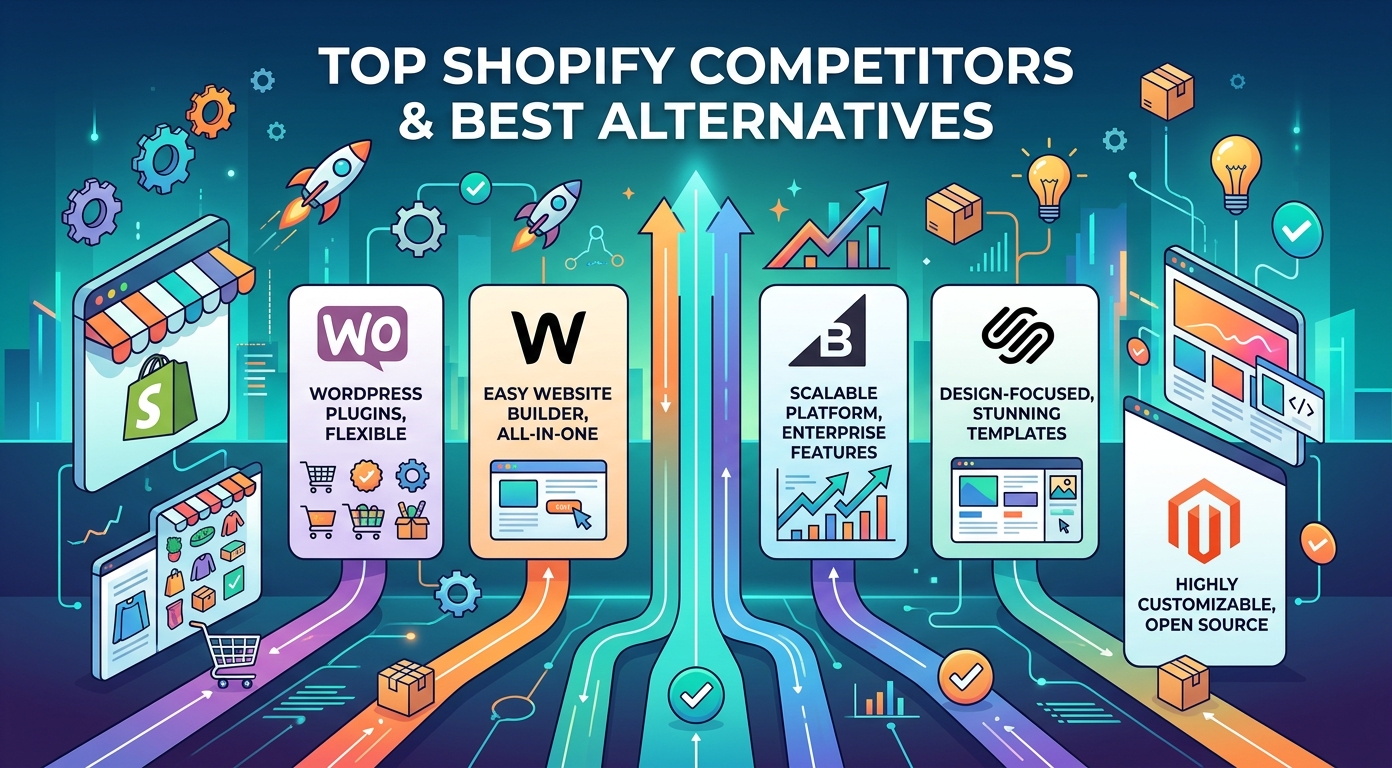
Shopify is a popular choice for building an online store, but it is far from the only one. The best Shopify alternatives can cost less, give you more control, or fit a specific kind of business better than Shopify itself. This guide walks through the strongest competitors to Shopify for 2026, grouped by how they work, so you can match a platform to your goods, your budget, and your goals. Whether you sell physical goods, digital products, or a service, there is a capable option here for almost any ecommerce business. Businesses of every size can find a fitting platform.
Each platform below is a genuine competitor with real strengths and honest trade-offs. We have organized them into three groups: hosted all-in-one builders, open-source ecommerce platforms, and lightweight tools for small shops. By the end you will know which of these Shopify alternatives deserves a closer look for your own store. These competitors serve different businesses, so the pick depends on what you sell.
Why so many sellers look for Shopify alternatives
Shopify earned its reputation by making it easy to launch a shopify store fast. It is polished, reliable, and supported by a huge shopify app store. Even so, it is not the right fit for every seller, and that is exactly why the market for competitors to Shopify keeps growing. Many businesses find a better match elsewhere.
Cost is the most common reason. Shopify charges a monthly fee on every plan, and if you do not use Shopify Payments as your processor, it adds an extra transaction fee on top of your gateway charges. For a new store with thin margins, those costs matter. Many rival platforms either skip transaction fees entirely or run on a free open-source core. Smaller sellers feel this difference most.
Control is the second reason. Shopify is a closed, hosted system, so you work within its rules. Sellers who want to own their code, host anywhere, and customize every detail often prefer an open-source platform. Others simply outgrow the basic ecommerce features of an entry plan and want advanced ecommerce features without paying enterprise rates. And some sellers run a very small catalog where even an entry plan feels like too much. Whatever the reason, the right alternative depends entirely on your business needs.
How to choose the right Shopify alternative for your store
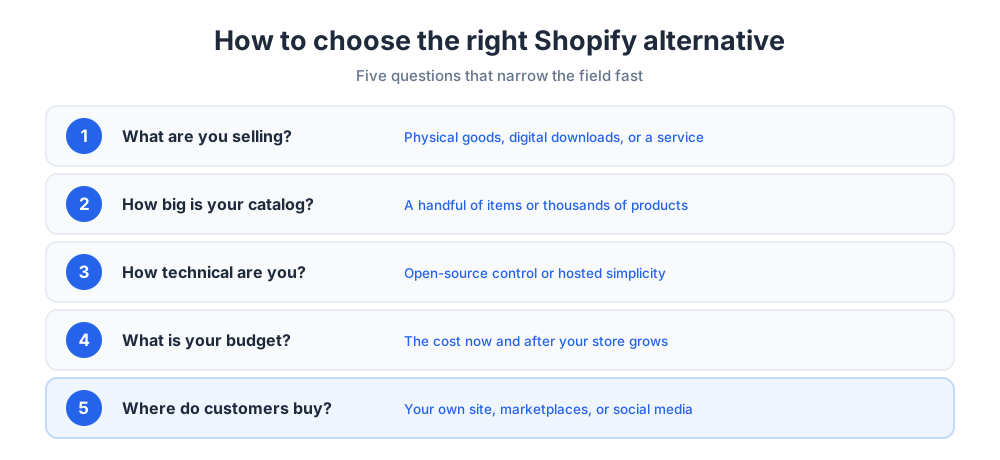
Before you compare names, get clear on what your store actually needs. The right Shopify alternative for a one-person craft shop is rarely the right one for a brand with thousands of products. A few questions narrow the field quickly, and the answers matter at every stage of growth.
First, what are you selling? Physical products, digital downloads, and services each favor different tools. Second, how big is your catalog? A platform built for many products handles a large catalog far better than a lightweight tool. Third, how technical are you? Open-source platforms reward technical skill, while hosted builders trade some control for simplicity. Fourth, what is your budget, both now and after you grow? And fifth, where do your customers buy: your own website, marketplaces, or social media? Most sellers use more than one channel.
Answer those honestly and the list of sensible options shrinks fast. A maker selling a dozen items does not need the same ecommerce platform as a wholesaler serving large enterprises. Match the tool to the job and you avoid paying for power you will never use, or worse, picking something that cannot grow with you. The functionality you need should drive the decision.
The most common Shopify alternatives at a glance
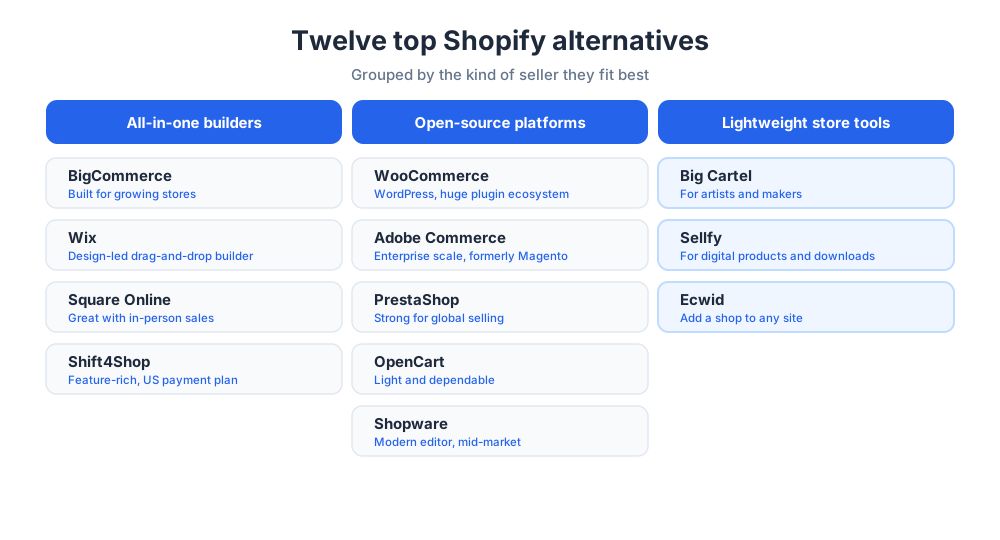
The twelve platforms in this guide cover almost every type of seller. Some are hosted website builder tools that handle everything for you. Some are open-source software you install and control yourself. And a few are lightweight tools designed for tiny shops or for adding a shop to a site you already have. Businesses with different priorities favor different groups.
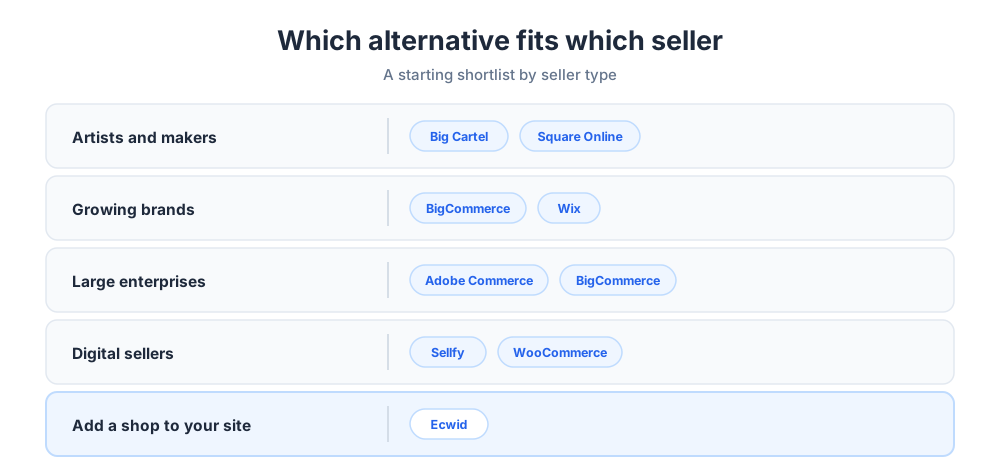
The table below sorts these ecommerce platforms by who they suit best. Use it as a shortlist, then read the detail on any platform that fits. There is no single winner here, only the best match for your goods and your plans. Each ecommerce option pairs its functionality with a price model.
All-in-one website builder platforms
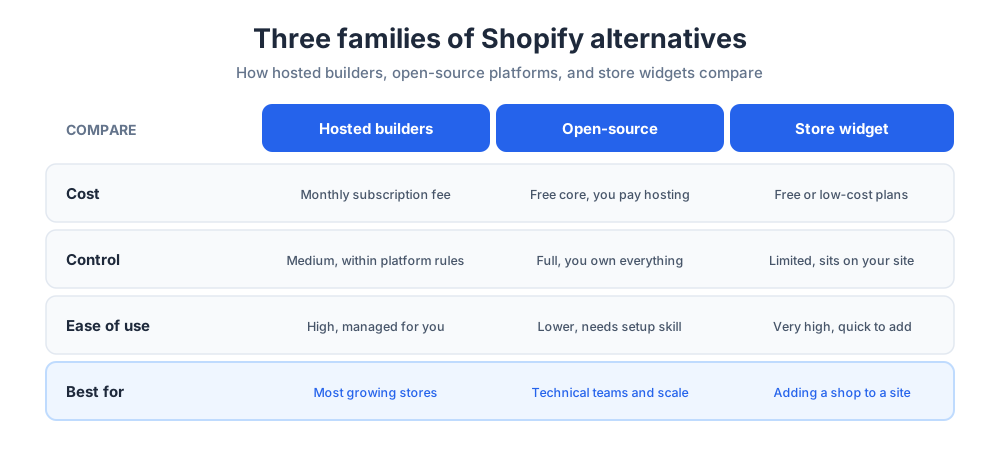
Hosted all-in-one platforms work the way Shopify does: you pay a monthly fee, the company handles hosting and security, and you build your store through a visual website builder. These are the most direct Shopify alternatives, and they suit sellers who want to focus on products and sales rather than servers and code. Each bundles commerce tools into one subscription.
BigCommerce
If you were wondering who Shopify's biggest competitor is, BigCommerce is a strong answer. It is a SaaS-hosted ecommerce platform built for businesses that plan to grow, and it ships with a deep set of features out of the box, which means you lean on third-party apps less than you would elsewhere. Its commerce toolkit is unusually complete.
BigCommerce charges no transaction fees on any plan, supports B2B selling, and handles multi-channel selling across marketplaces and social media. It is one of the few platforms that competes with Shopify on raw ecommerce features rather than ease alone. The trade-offs: BigCommerce pricing moves you to a higher tier once your shop passes set annual sales thresholds, and the theme library is smaller than Shopify's. For a serious ecommerce store with room to scale, it remains a top pick.
Wix
Wix is one of the most widely known Shopify competitors, and it has been around far longer than most. It is a cloud-based website builder with a true drag-and-drop editor, so you can place any element anywhere on the page. For a content-led brand that also wants to sell, a Wix website is hard to beat on design freedom.
Wix ecommerce covers the essentials well: product listings, a cart, payments, and basic shipping. Its AI website builder can generate a starter site from a few prompts, and the Wix App Market adds functionality like reviews, subscriptions, and marketing integrations. The honest limits: once you pick a template you cannot swap it later, and the platform is not built for very large catalogs. In the classic Wix vs Shopify comparison, Wix wins on design and ease, while Shopify wins on pure commerce depth.
Square Online
Square Online, the former Weebly, is a hosted website builder with one standout strength: it integrates tightly with Square's point-of-sale system. If you run a physical shop, cafe, or market stall and want your online sales to share one inventory and one dashboard, this platform is the obvious choice.
It offers a genuine free plan, an easy editor, and quick setup, which makes it great for small businesses taking their first step online. Customization is more limited than a dedicated platform, and Square serves small to medium businesses better than large catalogs. Many local shops start here because the basics work. For a small business owner who wants a simple, reliable storefront tied to in-person sales, Square Online is one of the friendliest Shopify alternatives available.
Shift4Shop
Shift4Shop is an all-in-one ecommerce website builder that bundles order management, email marketing tools, and built-in SEO tools. It offers a large library of free themes and real-time inventory updates, so adding new products to your store is quick and painless. The marketing tools that ship with it cover most everyday campaigns.
The catch is the pricing model: Shift4Shop's lowest-cost route ties you to Shift4 as your payment processor, which only works in some regions. Configuration can feel dated next to newer tools. Still, for a US seller who is comfortable with that payment arrangement, it is a feature-rich Shopify alternative worth a look. Many small businesses appreciate the bundled functionality.
Open-source ecommerce platforms
Open-source platforms flip the model. Instead of renting a hosted store, you download free software, install it on hosting you choose, and own the result outright. These ecommerce platforms reward technical skill with near-total control, and they remove the monthly platform fee, though hosting, plugins, and developer time still cost money. Extra functionality arrives through community plugins, not paid upgrades.
WooCommerce
WooCommerce is the most popular open-source option and one of the most capable Shopify alternatives overall. It is a free plugin that turns any WordPress website into a full online store, which means you get the entire WordPress content engine plus commerce. For a business that lives on content, that pairing is powerful, and many businesses run their online store on WordPress.
The WooCommerce app ecosystem is enormous, with thousands of plugins and integrations covering payments, shipping, subscriptions, and marketing. WooCommerce can scale with your needs and gives you complete ownership of your online store. The trade-offs are real: you manage hosting, security, and updates yourself, it is more technical than a hosted builder, and premium themes and extensions add up. For a content-driven online retailer, though, WooCommerce is tough to beat.
Adobe Commerce (Magento)
Adobe Commerce, still widely known by its original name Magento, is the heavyweight of open-source ecommerce. Magento Open Source is free to download, while Adobe Commerce is the paid enterprise edition with added features and support. Either way, it is built for scale, and few platforms match its commerce depth.
What sets it apart is depth. It handles an enormous product catalog, complex B2B rules, multiple storefronts, and multi-currency selling, which is why so many large brands run on it. The interesting part is how much commerce logic is built in rather than bolted on, including headless commerce options. The trade-offs are equally large: Magento needs developers, demands serious hosting, and has a steep learning curve. It is overkill for a small shop, but for an enterprise with the resources to run it, this Shopify alternative is one of the most powerful platforms in commerce.
PrestaShop
PrestaShop has become one of the most important competitors to Shopify, especially across Europe. It is free, open-source software with a clean, professional admin interface that makes managing items and orders straightforward, even though you host it yourself. Many businesses pick it for cross-border trade.
PrestaShop's strength is international selling: multi-language and multi-currency support are built in, so growing across borders is realistic. A large module marketplace extends the core. The honest limits: many useful modules are paid, the theme selection is modest, and reporting is basic without add-ons. For a seller who wants open-source control with a gentler setup than Magento, PrestaShop is a solid, versatile option.
OpenCart
OpenCart is a lighter open-source platform. Like Magento it is free and updated regularly, but it is far simpler under the hood, which makes it easier to get running on modest hosting. For sellers leaving Shopify, it is a practical pick for a straightforward online store builder experience without heavyweight complexity.
OpenCart has a useful marketplace of extensions and themes, and the core platform is reliable. It does have a learning curve, and integrating some third-party tools can be fiddly. But as a free, dependable way to run an online store with a small or growing catalog, OpenCart earns its place on this list. Smaller businesses on a budget often land here.
Shopware
Shopware is an open-source platform with commercial editions, popular as a Shopify alternative with mid-market and enterprise sellers in Europe. Its standout feature is a drag-and-drop content builder called Shopping Experiences, which lets you design rich product pages and landing pages without code.
Shopware supports multiple sales channels and several shopfronts from one backend, and it offers strong customer service on its paid tiers. The limits: the ecosystem is smaller outside Europe, import speeds can lag, and it is less suited to very small shops. For a growing brand that wants open-source flexibility with a modern editor, Shopware is a capable choice. Mid-sized businesses find it a comfortable fit.
Lightweight tools for small stores and digital downloads
Not every seller needs a full platform. If you have a tiny catalog, sell digital goods, or already have a website you like, a lightweight tool can be a smarter, cheaper Shopify alternative than any full builder. These tools suit small businesses that want to start selling fast.
Big Cartel
Big Cartel is built specifically for artists and makers, and it works as a no-fuss Shopify alternative for them. It is one of the simplest tools here, with a free plan that covers a small number of items and easy-to-customize themes. Setup takes minutes, and Big Cartel handles tax collection and basic store management without fuss. Solo businesses appreciate how little it asks.
The trade-offs match its focus: catalog limits on lower tiers, fewer payment options, and limited configuration compared with larger platforms. But for a creative seller with a handful of items, Big Cartel is one of the friendliest small-shop tools available, and it stays out of your way.
Sellfy
Sellfy is aimed at creators who sell digital goods, print-on-demand merchandise, and subscriptions. You can launch a clean storefront fast, and Sellfy also gives you embeddable buy buttons so you can sell from a site or social post you already run.
Highlights include secure file storage for digital goods, no extra transaction fees, and the ability to sell both digital and physical merchandise side by side. The limits: you cannot offer order-level discounts, and it lacks the deeper merchandising tools of a full platform. For a creator focused on downloadable goods, Sellfy is a quick option that many creator businesses are happy with.
Ecwid
Ecwid, now part of Lightspeed, is not a website builder at all. It is an ecommerce widget you drop into an existing website, blog, or social profile, which makes it a uniquely flexible Shopify alternative. If you love your current site and only need to add a shop, Ecwid solves exactly that.
Ecwid offers a free plan, charges no transaction fees, and lets you sell across multiple sites, marketplaces, and social media from one synced catalog. You can even list on Amazon through it. The honest limits: lower tiers cap item counts, and shipping rates are not always calculated automatically. As an add-on rather than a standalone store, Ecwid fills a niche the other tools cannot. It works well for businesses that already have a site.
A note on payment processing and switching costs
One detail surprises sellers who move away from Shopify: payment processing. The built-in Shopify processor avoids the extra per-sale fee the platform applies when you choose an outside gateway. That charge is part of why some sellers feel locked in.
Most Shopify alternatives handle this differently. Open-source platforms let you connect almost any processor with no platform surcharge. Hosted tools like BigCommerce, Wix, and Square Online also avoid stacking their own transaction fee on top. When you compare the true cost of Shopify and BigCommerce, or any pair of platforms, include processing fees, not just the headline monthly price. Most other ecommerce platforms compete hard here, so the gap can be real for businesses that sell at volume.
Switching does take effort. You will migrate your catalog, recreate pages, redirect old URLs to protect your Shopify SEO equity, and reconnect your add-ons and marketing connectors. None of it is hard, but plan for a weekend of work rather than an afternoon, and test checkout thoroughly before you go live. Most businesses find the move pays off within a season.
Matching products, sales channels, and apps to your plan
With the platforms covered, the final step is matching one to how you actually sell. Think about three things: your products, your sales channels, and the apps you will rely on. These priorities differ between businesses.
For your catalog, a large or fast-changing set of products points toward BigCommerce, WooCommerce, or Adobe Commerce, all of which manage large product catalogs and detailed listing pages well. A small range of products points toward Big Cartel, Square Online, or a hosted website builder. Downloadable goods point cleanly at Sellfy. If you want to add a shop to a site you own, Ecwid is the natural fit for many creator businesses.
For sales channels, decide where customers buy. Selling across marketplaces and social media alongside your own store favors BigCommerce, WooCommerce, or Ecwid. A single branded storefront is well served by any platform here, and social commerce keeps growing as a channel. For apps, check each app marketplace before you commit: WooCommerce's plugin library and the Wix add-on catalog are vast, while open-source platforms lean on community plugins. A quick scan for the functionality you need prevents an expensive surprise later, and your store sales will benefit from getting it right.
One more practical tip applies to every platform: connecting your shop to the other tools you use, from email marketing to analytics, matters as much as the storefront itself. Good marketing automation tools keep orders, customers, and ecommerce data in sync and turn one-time buyers into repeat ones. If you sell on social channels, our guide to social media for business pairs well with any platform on this list, and smart discount code ideas help drive revenue once your store is live. Smooth customer onboarding keeps new shoppers coming back, and listening to customer feedback after launch tells you whether the platform you picked is truly working.
Choosing your Shopify alternative
Every platform in this guide is a genuine Shopify alternative with real strengths. BigCommerce and Adobe Commerce reward scale. WooCommerce and PrestaShop reward control. Wix and Square reward simplicity. Big Cartel, Sellfy, and Ecwid reward sellers who want something small and focused. There is no universal best, only the best match for your product or service and your stage of growth.
Do not commit on day one. Most of these platforms offer a free trial, a demo, or a free plan, so build a test shop on your top two or three picks before deciding. Load a few real products, run a test checkout, and see how the editor feels. Testing beats guessing every time, and a short trial now saves a painful migration later. Pick the platform that fits the store you are building, and the right Shopify alternative will support your online venture for years.
Keep going with our guides to promoting a Shopify store and Shopify chatbots.
Frequently Asked Questions
What is better to use than Shopify?
There is no single platform that is better for everyone; the right choice depends on what you sell and how you sell it. For a large or fast-growing catalog, BigCommerce and Adobe Commerce compete strongly. For full control and content, WooCommerce on WordPress is a top pick. For simple, design-led stores, Wix or Square Online are easier to run. And for tiny or digital catalogs, Big Cartel, Sellfy, and Ecwid can beat Shopify on both price and fit. Match the platform to your store rather than chasing a universal winner.
Why is Shopify falling?
Shopify remains one of the largest ecommerce platforms in the world, so the idea of it falling usually refers to short-term swings in its share price rather than the health of the product. Stock prices move for many reasons, including market conditions and earnings expectations, and they say little about whether the platform suits your store. Most sellers look at alternatives because of cost, control, or fit, not because Shopify is failing. Judge any platform on how well it matches your business, not on headlines about its stock.
Why do 90% of people doing Shopify with FB ads fail?
There is no reliable source for an exact figure like 90 percent, so treat that number as folklore rather than fact. What is true is that running a store on paid social ads is hard for reasons that have little to do with Shopify itself. Ad costs are high, margins on many products are thin, and a store with weak product-market fit will lose money no matter how good the ads are. Success usually comes from a strong product, healthy margins, repeat customers, and channels beyond paid ads, not from the store platform alone.
Does Taylor Swift use Shopify?
Yes, Taylor Swift's official merchandise store has been built on Shopify, and she is one of many major artists and brands that use it to sell merch. That is a useful reminder that Shopify is a capable, trusted platform. It is not, however, a reason to pick it yourself. A global star with a large team has very different needs from a solo maker or a growing small business. Choose your platform based on your own catalog, budget, and goals rather than on which celebrity uses what.
Is there a free alternative to Shopify?
Yes. Open-source platforms such as WooCommerce, Magento Open Source, PrestaShop, and OpenCart are free to download and use, though you still pay for hosting, a domain, and any premium extensions. Hosted tools like Square Online and Ecwid offer genuine free plans with limited features, and Big Cartel has a free tier for a very small catalog. Free never means zero cost overall, but these options remove the monthly platform fee that Shopify charges on every plan.
What is the best Shopify alternative for small businesses?
Small businesses usually want low cost, fast setup, and little maintenance. Square Online is excellent if you also sell in person, since it shares inventory with Square's point-of-sale system. Wix suits a design-led store that needs a straightforward shop, while Big Cartel fits artists and makers with a handful of items. Ecwid is ideal if you already have a website and simply want to add a cart. Each of these keeps things simple while still leaving room to grow.
What is the best Shopify alternative for a large or enterprise store?
For large catalogs and complex requirements, Adobe Commerce, still widely known as Magento, is the most powerful option and is built for large enterprises with developer resources. BigCommerce is a strong hosted choice for mid-market and growing brands that want enterprise features without managing servers themselves. WooCommerce can also scale well when paired with solid hosting. The right pick depends mainly on whether you prefer a fully hosted platform or full open-source control.
Is WooCommerce better than Shopify?
Neither is simply better; they suit different sellers. WooCommerce gives you complete control, no platform fee, and the full WordPress content engine, which is ideal for content-driven stores and anyone who wants to own their setup. Shopify is faster to launch and fully managed, so you never touch hosting or security. If you value control and content, WooCommerce wins; if you value simplicity and built-in support, Shopify is the easier path.
Is BigCommerce a good Shopify alternative?
Yes, BigCommerce is one of the closest direct competitors to Shopify. It is a hosted platform with a deep set of built-in features, charges no transaction fees on any plan, and supports B2B and multi-channel selling. The main trade-offs are a smaller theme library and tier pricing that steps up once your store passes set annual sales thresholds. For a growing store that wants real power without managing servers, BigCommerce is a solid choice.
Can I sell digital products without Shopify?
Absolutely. Sellfy is built specifically for creators selling digital downloads, print-on-demand items, and subscriptions, with secure file storage included. WooCommerce handles digital goods well through free and paid extensions, and both Ecwid and Big Cartel can sell digital items on their plans too. For a creator focused on downloads, a specialized tool often beats a general ecommerce platform on both price and ease.
How do I switch from Shopify to another platform?
Start by exporting your products, customers, and orders from Shopify, since most platforms can import that data. Rebuild your key pages on the new platform, then set up redirects from old URLs to new ones so you protect your search rankings. Reconnect your payment processor, apps, and email marketing, and run a full test checkout before going live. Plan for a weekend of focused work rather than an afternoon, and keep the old store running until the new one is fully verified.
Do Shopify alternatives charge transaction fees?
Many do not. Shopify adds an extra per-sale fee if you do not use Shopify Payments, which is one reason sellers look elsewhere. Open-source platforms let you connect almost any processor with no platform surcharge. Hosted tools like BigCommerce, Wix, Square Online, and Ecwid generally do not stack their own transaction fee on top of your processor's rate. Always compare processing fees, not just the headline monthly price, when you choose a platform.
Is Wix or Shopify better for ecommerce?
It depends on your priorities. Wix wins on design freedom and ease, with a true drag-and-drop editor and an AI website builder, which suits content-led brands and smaller catalogs. Shopify wins on pure ecommerce depth, with stronger tools for large catalogs, inventory, and multi-channel selling. For a simple, attractive store, choose Wix; for a serious, scaling shop, Shopify or a dedicated platform such as BigCommerce is the better fit.