ManyChat vs Chatfuel After the 2026 Chatfuel Relaunch
ManyChat vs Chatfuel, the longest-running rivalry in Meta-channel chat marketing, reads completely differently as of July 2026. Chatfuel just relaunched its lineup around a genuinely free plan: Chatfuel Light covers Instagram, Facebook, and WhatsApp automations with a shared inbox at $0, and a single AI PRO tier at $49 per month (about 29 percent less on annual billing) unlocks the AI sales and support features. ManyChat kept its contact-ladder model: a free plan for 25 active contacts, then tiers at $14, $29, $69, and $139 per month on annual billing as your audience grows, with channel breadth (Instagram, Messenger, WhatsApp, TikTok, Telegram, SMS, email) as its trump card. All plan figures below come from the vendors' July 2026 published pricing.
Short verdict: pick ManyChat if you are a creator or brand running audience automation across many channels and you accept that the bill grows with your contact list. Pick Chatfuel if you want Meta-channel automation with flat, predictable pricing and a real free tier to start on. If the actual job is answering website visitors, neither is the right tool, and there is a third option below.
The quick comparison
| ManyChat | Chatfuel | |
|---|---|---|
| Free plan | 25 active contacts, 2 channels, basic automations | Chatfuel Light: IG, FB, WhatsApp automations, shared inbox, flow builder |
| Paid model | Contact ladder: $14 (250) / $29 (2,500) / $69 (7,500) / $139 (25,000) per month, annual | Single AI PRO tier: $49 per month (about 29% off annually), usage limits apply |
| Overage | Pay per contact above plan | Usage limits per plan; contact vendor beyond |
| Channels | IG, Messenger, WhatsApp, TikTok, Telegram, SMS, email (by tier) | Instagram, Facebook, WhatsApp |
| AI | AI-powered conversations listed from the $29 tier up | AI sales manager, AI knowledge base, AI automations in AI PRO |
| Team seats | 1 to 10 users by tier | Shared inbox included; limits per plan |
| Partner status | Meta ecosystem staple | Official Meta Partner, WhatsApp Business Solution Provider |
| Design center | Creators and audience marketing at scale | SMB automation with AI, flat pricing |
Pricing and features change frequently, verify on each vendor's official pricing page before purchase. Prices shown reflect annual billing where offered.
What ManyChat and Chatfuel do
ManyChat in 2026: the audience-automation ladder
ManyChat is the default name in Instagram and Messenger marketing: comment-to-DM triggers, story-reply automations, broadcasts, and flows that turn engagement into subscribers and sales. The free plan covers 25 active contacts on two channels; paid tiers on annual billing run $14 per month for 250 contacts, $29 for 2,500 (the popular tier, with AI-powered conversations and a third channel), $69 for 7,500 (unlimited channels, 5 users), and $139 for 25,000 (10 users), with per-contact charges above each plan. Channel breadth is the differentiator: beyond Instagram and Messenger, tiers add WhatsApp, TikTok, Telegram, SMS, and email, and the template and creator-community ecosystem is the largest in chat marketing. The trade-off is structural: because every active contact counts, a growing audience walks the bill upward whether or not revenue follows.
Chatfuel in 2026: relaunched around free plus flat AI
Chatfuel, one of the original Messenger-bot platforms, relaunched its lineup in 2026 into a two-tier shape. Chatfuel Light is free: Instagram, Facebook, and WhatsApp automations, a shared inbox, automated replies with a visual flow builder, contact management, and ready-made templates, with no credit card required. AI PRO at $49 per month (about 29 percent less on yearly billing) adds the AI layer: an AI sales manager, AI knowledge base, AI-powered automations, broadcasts and re-engagement, lead-qualification funnels, and advanced contact tools, with usage limits that scale by plan. Chatfuel is an official Meta Partner and WhatsApp Business Solution Provider, and its positioning now centers on letting AI handle sales and support conversations rather than on bot-building mechanics. The trade-off mirrors ManyChat's: channel reach stops at the Meta family, and heavy usage runs into plan limits rather than a transparent per-contact meter.
Pricing: contact ladder vs flat AI tier
Worked examples with July 2026 published prices, annual billing.
Small creator, 2,000 Instagram contacts: ManyChat's $29 tier covers 2,500 contacts with AI conversations and three channels. Chatfuel AI PRO runs $49 (about $35 on yearly billing). At this size the two are close, and the decision is channels (ManyChat) versus flat AI (Chatfuel).
Growing brand, 20,000 contacts: ManyChat needs the $139 tier (25,000 contacts). Chatfuel stays on AI PRO at $49 nominal, subject to plan usage limits that you should confirm against your volume before assuming the gap holds. This is the scenario where ManyChat's meter compounds and Chatfuel's flat tier looks dramatically cheaper on paper at July 2026 prices; the honest caveat is that Chatfuel's limits are less transparent than ManyChat's contact counts, so get them in writing at your scale.
Just starting: Chatfuel Light is the stronger free tier by a wide margin: real automations on three Meta channels versus ManyChat's 25-contact sandbox. If free-until-it-works matters, Chatfuel now wins the on-ramp, which is a reversal of the historical positions and the direct result of its 2026 relaunch.
AI and automation depth
ManyChat's automation is engagement-native: comment-to-DM, story replies, keyword triggers, drip sequences, and broadcasts, with AI-powered conversation features listed from the $29 tier. It is built for marketing motion: capture the follower, qualify, nurture, sell, and its template ecosystem means most creators never build a flow from scratch.
Chatfuel's AI PRO leans toward autonomous handling: an AI sales manager that qualifies leads and drives checkout, an AI knowledge base answering support questions, and AI automations that run conversations end to end, positioned as an AI coworker rather than a flow library. For an SMB that wants conversations handled rather than orchestrated, that framing fits; for a creator running campaign mechanics, ManyChat's granular triggers remain the sharper tool.
Net: campaign mechanics and audience segmentation favor ManyChat; hands-off AI conversation handling at a flat price favors Chatfuel. Both offer free entry points now, so the two-week parallel test costs nothing but setup time.
The third option: Chatim for website conversations
Disclosure: Chatim is our own product. Both of these platforms live inside social channels. If the conversations you actually need to handle happen on your website (pre-sale questions, support, lead capture), Chatim pairs live chat with chatbot automation at predictable per-plan pricing with a free tier and native Shopify and WordPress integrations. Many stores run one social tool and Chatim side by side, one for audience, one for the site.
Try Chatim free at chatim.app →
Channels and reach
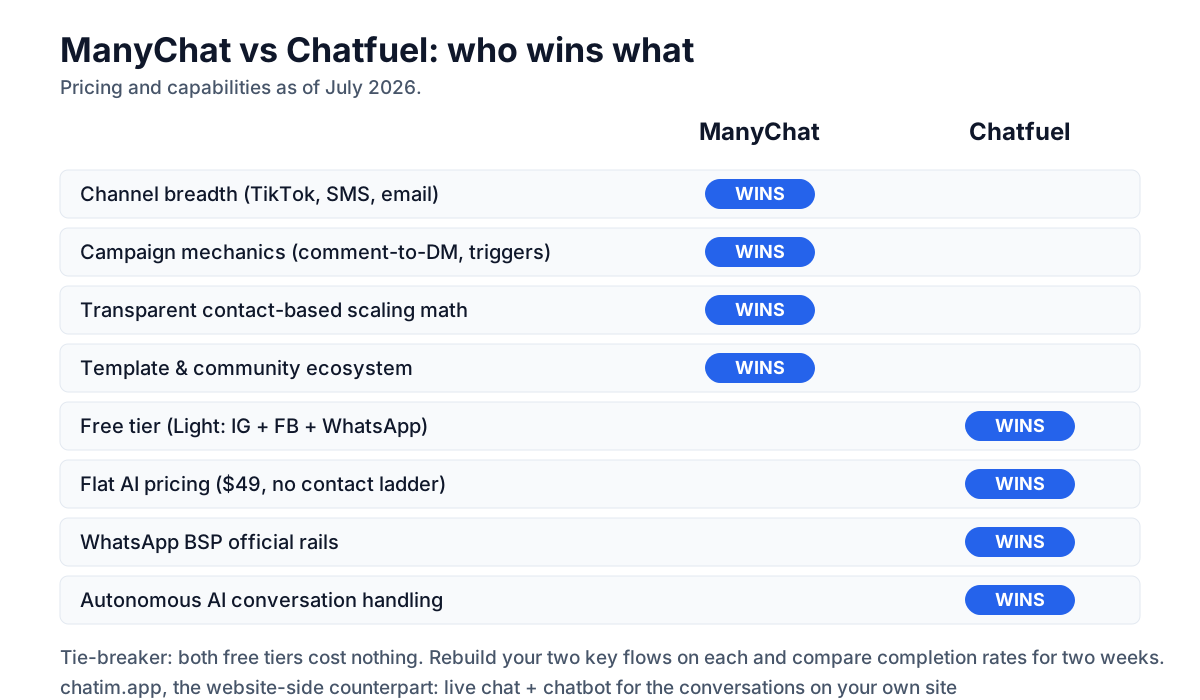
This is ManyChat's clearest win. Instagram and Messenger are table stakes for both, and both connect WhatsApp, but ManyChat's ladder adds TikTok automation, Telegram, SMS, and email, with unlimited channels from the $69 tier. Cross-channel sequences (catch a TikTok comment, continue on Instagram, close over SMS) are a ManyChat-only motion. Chatfuel's WhatsApp Business Solution Provider status makes it a strong pick when WhatsApp is the main channel and you want official-partner rails, but its world is the Meta family plus WhatsApp, full stop. Audience-everywhere brands lean ManyChat; Meta-centric SMBs lose nothing with Chatfuel.
Templates, community, and operations
ManyChat's ecosystem is the largest in chat marketing: official and community template libraries, an agency and creator community that answers most questions before support does, and courses that onboard non-technical marketers. Chatfuel counters with simplicity: two plans, a visual builder, ready-made templates, and an AI layer that reduces how much flow-building you do at all; its 24x7 support and Meta-partner documentation cover the rest. Teams that want to tinker and optimize pick ManyChat; teams that want to switch it on and let AI work pick Chatfuel. Seat needs matter too: ManyChat meters users by tier (1 to 10), while Chatfuel includes its shared inbox on both plans.
Which fits your audience?
ManyChat fits when...
- You run audience marketing across channels: TikTok, Telegram, SMS, and email exist only on this side.
- Campaign mechanics are the job: comment-to-DM, story replies, keyword triggers, and drip sequences with granular control.
- You want transparent scaling math: contact counts are visible, predictable, and comparable tier to tier.
- You lean on templates and community: the largest ecosystem in chat marketing shortens every build.
- Your audience is small today: $14 for 250 contacts is the cheapest paid entry in the category.
Chatfuel fits when...
- You want a real free tier: Chatfuel Light runs IG, FB, and WhatsApp automations at $0.
- Flat pricing beats contact math for you: AI PRO at $49 (about $35 annually) regardless of list size, within plan limits.
- WhatsApp is central: official Business Solution Provider rails matter for reliability and compliance.
- You want AI to run conversations, not just trigger flows: the AI sales manager and knowledge base are the product.
- You value simplicity: two plans, one decision, no ladder to model.
Rebuilding on the other side
Migrations are common in both directions and neither vendor locks you in: contacts export, but flows rebuild natively (ManyChat sequences versus Chatfuel AI automations are different paradigms, not portable files), and channel connections (Instagram, Messenger, WhatsApp numbers) re-point in an afternoon. The practical path is a parallel run: both free tiers cost nothing, so connect a secondary Instagram account or a test page, rebuild your two most important flows on each, and compare completion rates and handle quality for two weeks. Watch one asymmetry: leaving ManyChat mid-ladder is easy, but confirm Chatfuel's usage limits at your real volume before moving a large list onto the flat tier. For the broader field, see our guides to ManyChat alternatives and Chatfuel alternatives, plus Landbot alternatives for website-first bot builders, Collect.chat alternatives for form-style flows, and the full ranking of the best live chat software for the website side.
Frequently Asked Questions
Is ManyChat or Chatfuel better in 2026?
They now sell different shapes. ManyChat is the audience-marketing ladder: channel breadth (Instagram, Messenger, WhatsApp, TikTok, Telegram, SMS, email), granular campaign mechanics, and contact-based tiers from $14 to $139 per month on annual billing. Chatfuel relaunched in 2026 around a free Chatfuel Light plan (Instagram, Facebook, WhatsApp automations) and a single flat AI PRO tier at $49 per month centered on AI-run conversations. Multi-channel creators lean ManyChat; Meta-centric SMBs that want flat pricing and hands-off AI lean Chatfuel.
Did Chatfuel change its pricing in 2026?
Yes, substantially. As of July 2026 the pricing page lists two plans: Chatfuel Light, a free tier covering Instagram, Facebook, and WhatsApp automations with a shared inbox, flow builder, and templates; and AI PRO at $49 per month (about 29 percent less on yearly billing) with the AI sales manager, AI knowledge base, AI-powered automations, broadcasts, and lead-qualification funnels, subject to usage limits. Earlier tier structures you may see cited elsewhere (including contact-scaled Fuely plans) no longer appear on the pricing page.
How much does ManyChat cost in 2026?
As listed on the pricing page in July 2026, annual billing: Free (25 active contacts, 2 channels), $14 per month (250 contacts), $29 (2,500 contacts, AI-powered conversations, 3 channels), $69 (7,500 contacts, unlimited channels, 5 users), $139 (25,000 contacts, 10 users), with per-contact charges above each plan's allowance and prices excluding tax. Monthly billing runs higher (annual saves up to about 30 percent).
How much does Chatfuel cost in 2026?
As listed on the pricing page in July 2026: Chatfuel Light is free (Instagram, Facebook, and WhatsApp automations, shared inbox, automated replies and flow builder, contact management, templates, no credit card required), and AI PRO is $49 per month, about 29 percent less on yearly billing, adding the AI sales manager, AI knowledge base, AI-powered automations, broadcasts and re-engagement, and lead-qualification funnels. Usage limits apply per plan; confirm them against your volume before moving a large audience.
Which has the better free plan, ManyChat or Chatfuel?
Chatfuel, as of its 2026 relaunch, and it is not close: Chatfuel Light runs real automations on Instagram, Facebook, and WhatsApp with a shared inbox at $0, while ManyChat's free plan caps at 25 active contacts on two channels, which is a sandbox rather than a working plan. Historically the positions were reversed, so older comparisons will tell you the opposite. If free-until-it-works is the requirement, start on Chatfuel Light and compare from there.
Which supports more channels, ManyChat or Chatfuel?
ManyChat, decisively. Both cover Instagram, Facebook Messenger, and WhatsApp, but ManyChat's tiers add TikTok automation, Telegram, SMS, and email, with unlimited channels from the $69 tier, enabling cross-channel sequences Chatfuel cannot express. Chatfuel's counterweight is depth on the channels it does cover, including official WhatsApp Business Solution Provider status. Audience-everywhere brands need ManyChat; Meta-plus-WhatsApp businesses lose nothing with Chatfuel.
How does ManyChat's contact-based pricing work?
Every tier includes a monthly allowance of active contacts (people who interacted with your automations): 25 free, 250 at $14, 2,500 at $29, 7,500 at $69, 25,000 at $139, annual billing. Contacts above the allowance bill per contact, so a growing audience raises the bill even between tier jumps. The model is transparent (you can see exactly what a list size costs) but compounding: model your 12-month audience projection, not your current list, before committing.
What is Chatfuel AI PRO and what does the AI actually do?
AI PRO ($49 per month, about 29 percent off annually) is Chatfuel's paid tier centered on AI-run conversations: an AI sales manager that qualifies leads and nurtures them toward checkout, an AI knowledge base that answers support questions from your content, AI-powered automations, broadcasts and re-engagement campaigns, and advanced contact tools. The positioning is an AI coworker that handles conversations end to end, rather than a flow library you orchestrate; usage limits scale by plan.
Which is better for WhatsApp, ManyChat or Chatfuel?
Both connect WhatsApp, with different strengths. Chatfuel is an official WhatsApp Business Solution Provider, which means first-party rails, and its free Light tier includes WhatsApp automations, an unusually low-cost way to start. ManyChat adds WhatsApp from its $29 tier as one channel among many, strongest when WhatsApp is part of a cross-channel sequence rather than the whole strategy. WhatsApp-first businesses should also compare dedicated platforms (Wati, Respond.io) before choosing either.
Which is better for Instagram creators?
ManyChat remains the creator default: comment-to-DM, story-reply automation, keyword triggers, and the largest template and community ecosystem in chat marketing, priced from $14 per month for small lists. Chatfuel covers Instagram automation well and its free tier lowers the entry bar, but the creator-economy tooling, courses, and community answers live on ManyChat's side. Creators with fast-growing audiences should still model ManyChat's contact ladder against Chatfuel's flat tier at their projected list size.
Is it easy to switch between ManyChat and Chatfuel?
Mechanically yes: contacts export, channel connections (Instagram accounts, Facebook pages, WhatsApp numbers) re-point in an afternoon, and both offer free tiers so a parallel test costs nothing but setup time. Flows do not port: ManyChat sequences and Chatfuel AI automations are different paradigms, so rebuild your two most important flows on the destination and compare completion rates for two weeks. Confirm Chatfuel's usage limits at your real volume before moving a large list onto the flat tier.
Do I need ManyChat or Chatfuel at all?
Only if your conversations live in social channels. Both are chat-marketing tools for Instagram, Messenger, WhatsApp, and (on ManyChat) TikTok, SMS, and email audiences. If the conversations you need to handle happen on your website (pre-sale questions, support, lead capture), a website chat platform with a bot is the right shape instead, and many stores run both kinds side by side. Our guides to ManyChat alternatives and Chatfuel alternatives map both the social and website-side options.
Related articles
More in Comparisons → Live Chat vs Chatbot: Which One Does Your Website Need?
Live chat vs chatbot in plain terms: what each does best, where each fails, and the bot-first, human-close handoff pattern that beats running either alone.
 Help Desk vs Service Desk: The Real Difference (2026)
Help desk vs service desk in one line: issue-fixing vs service lifecycle. The five differences that matter, why the terms blur, and which one you need.
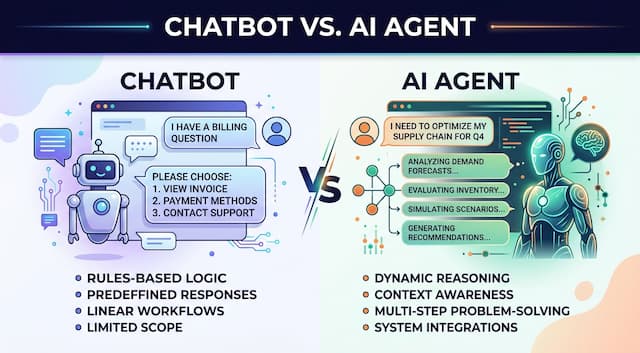 Chatbot vs AI Agent: Where the Line Actually Sits (2026)
Chatbot vs AI agent in plain terms: what each one does, where the line blurs, and how to add autonomy to support and sales without losing control.
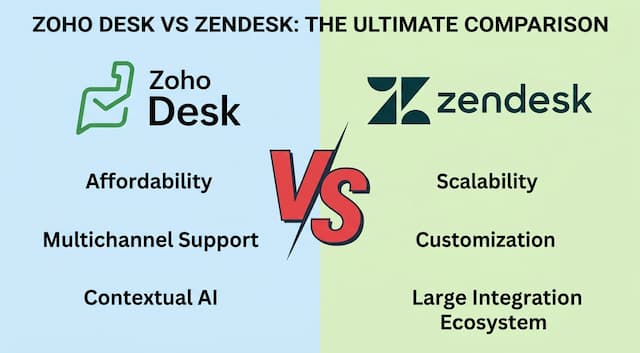 Zoho Desk vs Zendesk in 2026: The Price Gap, Examined
Zoho Desk vs Zendesk in 2026: included AI vs a quiet meter, and where Zendesk earns it