How to Write a Value Proposition (With Examples)

A value proposition is the single clearest answer to one question every customer asks: why should I choose you? It is a short statement that explains the distinct value your product or service delivers and why it beats the alternatives.
This guide explains what a value proposition is, why it matters, the key components of a strong value proposition, a six-step process to write one, the Value Proposition Canvas, real examples, and the mistakes to avoid.
What Is a Value Proposition?
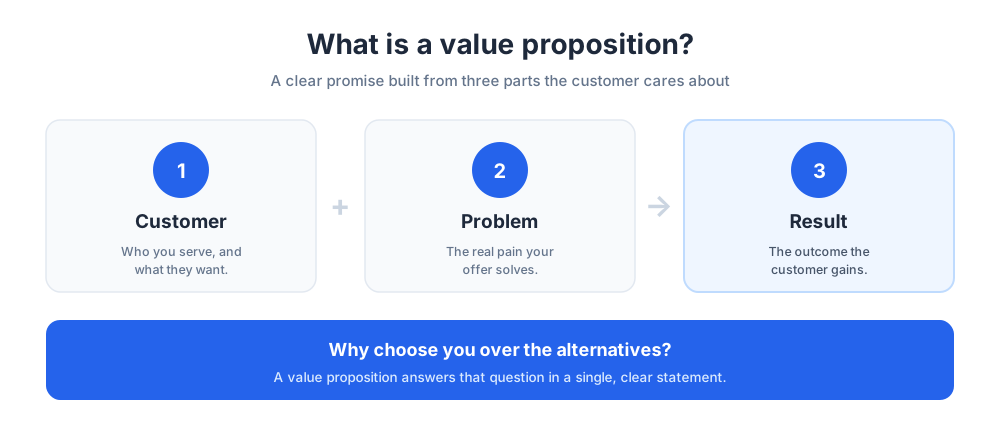
A value proposition is a clear statement of the special value a business promises to deliver to its customers. It answers why a customer should buy from you instead of a competitor, in language the customer actually cares about.
A good value proposition is not a tagline. A catchphrase is built for memory and emotion, while a value proposition is built for clarity. It names the customer, the problem, and the result they can expect.
The idea behind it is simple, but writing one is hard. It forces a company to decide exactly who it serves, what problem it solves, and what makes its offer genuinely different. That decision shapes the whole business model, from pricing to positioning.
Every business needs one. Whether you sell software, coffee, or consulting, a value proposition turns a vague sense of "we are good" into a promise of value a customer can understand in seconds. It also gives your sales team a single, shared message to repeat.
A useful value proposition definition keeps three elements in view at once: the customer, the problem, and the result. Drop any one of them and the message gets blurry.
Why a Value Proposition Matters
A value proposition matters because attention is scarce. Customers decide in moments whether a product is worth a closer look, and a clear value proposition wins that moment.
It also sets the foundation for everything else. Your marketing, your sales conversations, your website, and your advertising all flow from the same core promise. Without it, separate marketing campaigns each send a slightly different message, and the brand starts to feel scattered.
This is why a value proposition should come before your marketing strategies, not after them. The promise decides the channels and the offers. When marketing efforts are built on a clear promise, the whole company speaks with one voice.
A strong value proposition lifts your conversion rate. When people instantly understand the value on offer, more of them take the next step, and that clarity compounds into real business growth over time.
It also protects your revenue. A confused visitor leaves while a convinced visitor buys, so every gain in clarity shows up later in sales numbers and steadier expansion.
Internally, it creates focus. A shared value proposition keeps product, marketing, and sales aligned on the same target customer and the same promise, so the whole company pulls in one direction.
It sharpens hiring and roadmap calls too. When every team can recite the same promise, a new feature is judged against it. That alignment is quiet, but it is a genuine competitive advantage.
Value Proposition vs Slogan vs Mission Statement
These three are easy to confuse, but they do different jobs. Knowing the difference keeps your messaging sharp.
A value proposition explains the practical value a customer gets. It is customer-facing and specific, and it belongs at the top of your homepage and your landing pages, where prospects decide whether to keep reading.
A tagline is a short, memorable phrase built for brand recall. It supports the value proposition but rarely explains it. A mission statement, by contrast, describes why the company exists and looks inward at purpose rather than outward at customer value.
A mission statement often reflects the core values of a business, the beliefs that guide how it treats its team and its market. That is useful for culture, but it does not tell a buyer what they receive.
Use all three, but never let a catchphrase or a mission statement stand in for a real value proposition. Customers want to know what they get, not only what you believe. A memorable line can make a name easier to recall, yet recall alone never closes a sale.
Think of it as a layered system. The tagline grabs attention, the mission explains purpose, and the value proposition does the practical work of convincing a buyer.
Key Components of an Effective Value Proposition
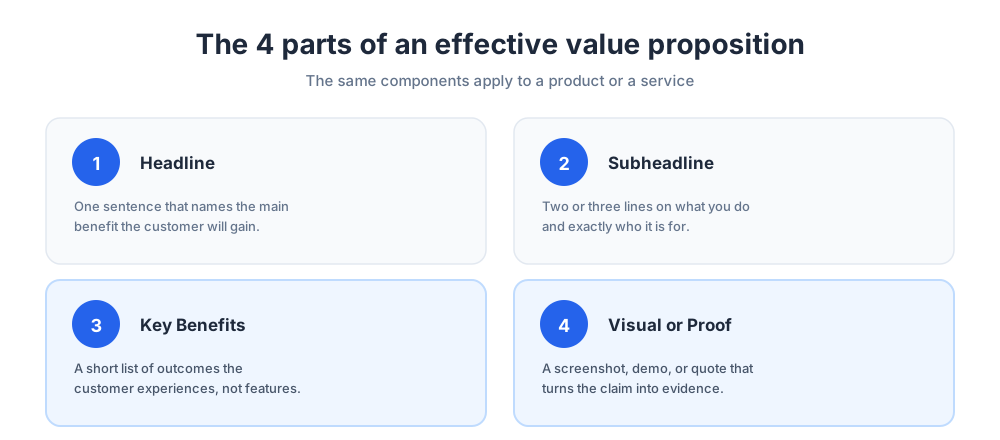
An effective value proposition is built from a few clear parts. Whether it is for a product or a service, the same components apply.
Headline
The headline is a single sentence that names the main benefit. It should be specific and instantly clear, such as "Faster project management for growing teams."
A weak headline lists what you do. A strong headline names the result the customer wants, in their own language.
Subheadline
The subheadline expands the headline in two or three sentences. It explains what the product does, who it is for, and how it helps, without technical jargon.
This is where you connect the promise to the customer's situation, so the value feels concrete rather than abstract.
Key Benefits
A short list of key benefits makes the value scannable. Each point should focus on an outcome, not a feature, so the customer sees what changes for them.
Three or four points work best. A long list dilutes the message and buries the benefits that matter most.
Visual or Proof
A supporting visual or a piece of proof makes the value proposition believable. A product screenshot, a short demo, or a customer quote turns a claim into evidence.
Proof closes the gap between what you say and what the customer is willing to believe.
How to Write a Value Proposition in 6 Steps
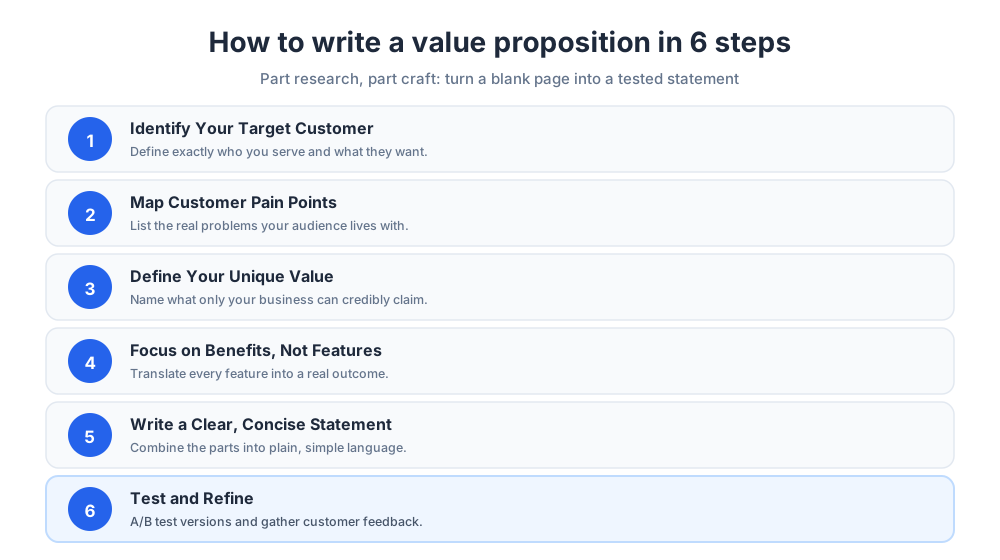
Writing a value proposition is part research and part craft. These six steps turn a blank page into a clear, tested statement.
Identify Your Target Customer
Start with the people you serve. A value proposition that speaks to everyone speaks to no one, so define your ideal customers in detail.
Describe their role, their goals, and their context. The sharper the picture of your target audience, the easier every later step becomes. Vague targeting produces vague messaging every time.
Useful detail comes from real sources: sales calls, support chats, surveys, and interviews with current customers. The goal is to picture one specific buyer, not a faceless market.
Map Customer Pain Points
Next, map the real pain points your product solves. List the problems, frustrations, and unmet needs your audience lives with every day.
Use market research, support tickets, and direct conversations to gather these pain points. The strongest value proposition speaks straight to a real, felt problem.
Rank those problems by how often they appear and how much they hurt. A value proposition cannot solve everything, so it should target the pain points that matter most to the people you want as customers. Solving a small annoyance rarely moves a buyer; a costly, repeated problem almost always does.
Good problem mapping also improves your customer service later. When the company already understands what frustrates buyers, support teams answer faster and new customers trust the brand.
Define Your Unique Value
Now name what makes your offer special. What can you provide that competitors cannot, or cannot provide as well? It might be speed, design, price, innovation, or service.
This is the heart of a unique value proposition. If you cannot name a genuine point of difference, the work is in the product, not the phrasing. A unique value proposition has to rest on something true.
Test your candidate difference against rivals directly. Could a competitor copy your headline word for word? If yes, it is not yet a unique value proposition. The aim is a claim that only your business can credibly make.
Difference can come from many places: faster delivery, a simpler design, deeper innovation, or a level of support rivals will not match. Whatever the source, write it down plainly, because that idea is what your unique value proposition will defend.
Focus on Benefits, Not Features
Customers buy outcomes, not specifications. Translate every feature into a benefit: "500GB of storage" becomes "keep every file safe and reach it from anywhere."
Walk down your feature list and ask "so what?" until each line describes a result the customer genuinely wants.
Write a Clear, Concise Statement
Now write the statement itself. Combine the headline, the subheadline, and the key benefits into a clear, concise statement a stranger can understand in seconds.
Cut jargon and cut clever phrasing. Plain language wins, because a value proposition has to be understood before it can be believed. Aim for a clear message a busy reader can absorb without slowing down.
Read the draft aloud. If you stumble, the buyer will too. Then trim again, because most first drafts carry twice the words they need.
Test and Refine
A value proposition is never finished. Test different versions with real customers through message testing, A/B testing on a landing page, and direct feedback from sales calls.
Watch which version lifts the conversion rate, then keep refining. Testing turns an educated guess into a value proposition proven by evidence rather than opinion.
Set up the testing as a habit, not a one-time event. Run a fresh round whenever you launch a product or notice that sales have slowed. Each round of testing teaches the team something concrete about how buyers read the promise.
Keep the testing simple enough to repeat. Over months, this steady testing compounds into a value proposition that genuinely fits the market.
The Value Proposition Canvas
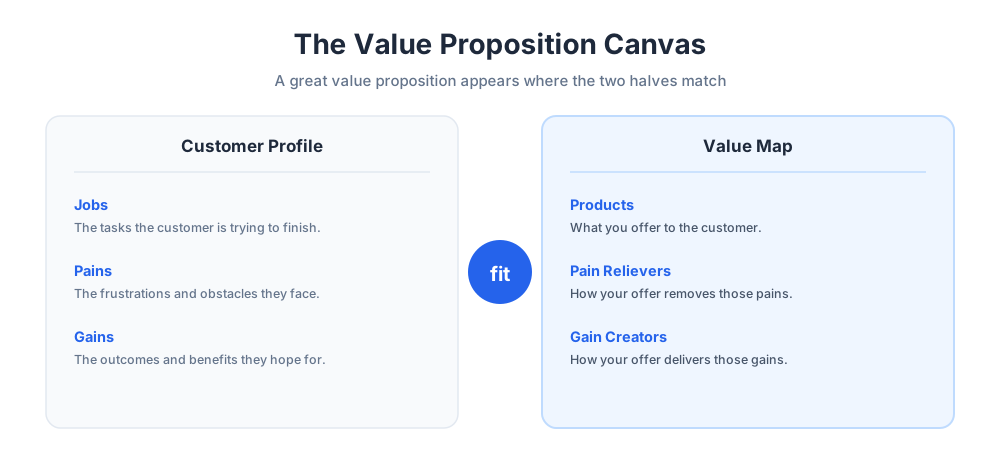
The Value Proposition Canvas is a popular framework for designing a value proposition that truly fits the customer. It is a simple visual tool with two halves.
One half is the customer profile: their jobs to be done, their pains, and their gains. The other half is your value map: your products, your pain relievers, and your gain creators.
A great value proposition appears when the two halves match. Your pain relievers should answer real customer problems, and your gain creators should deliver the outcomes the customer actually wants.
The Value Proposition Canvas is most useful before you write a word. It forces you to ground the message in customer insights rather than internal opinion, so the final statement fits the market.
Work through the customer profile first, and resist the urge to start with your product. List the jobs the people you serve are trying to finish and the outcomes they hope for.
Then build the value map and look for tight matches. A good business model lines up your offer with the customer profile point by point, so the value proposition reflects what buyers actually want.
Used well, the canvas also improves the customer experience long after launch. When the team can see which pains the product relieves, support, onboarding, and product decisions all point the same way, and the people who buy notice.
Value Proposition Examples
Good value proposition examples make the theory concrete. The samples below show the same principles applied to a product, a B2B service, and three well-known brands.
Product Value Proposition Example
Imagine a solar company with this statement: "Power your home with clean energy and cut your electricity bill, with affordable panels built for everyday efficiency."
It works because it pairs two clear benefits, a lower bill and a cleaner home, and names the target market plainly. The value is obvious in one read.
Notice how the statement leans on competitive pricing without sounding cheap. The word "affordable" signals exceptional value, while "everyday efficiency" promises quality the customer can feel.
B2B Value Proposition Example
For a B2B service, consider: "We deliver tailored IT support that helps small businesses grow securely, with round-the-clock help and a plan built for your needs."
This example suits B2B marketing because it speaks to a specific buyer, names a real worry, and promises a personal approach rather than a generic service.
A B2B value proposition usually has to clear a higher bar. The buyer is often a target committee, not a single person, so the promise has to satisfy several roles at once: the user who wants ease, the manager who wants quality, and the finance lead.
Strong B2B messaging also names the target outcome in business terms. Phrases like saved hours or lower risk land harder than soft adjectives, because a target buyer has to justify the purchase to someone else.
Value Propositions From Well-Known Brands
Studying well-known brands shows how a value proposition scales. Nike's value proposition is widely understood as inspiration and innovation for every athlete; the company sells motivation and performance, not just footwear.
McDonald's value proposition centers on fast, consistent, affordable food served conveniently almost anywhere. The promise is reliability: customers know exactly what they will get, and that predictability has carried the company across many markets.
Stripe built its value proposition around developer-friendly payments. It promises to remove the technical friction of accepting money online, so a business can start selling quickly. It turned a dull task into a smooth experience, and that focus is part of why it found strong market fit.
These unique value proposition examples share a pattern worth copying. Each company names a clear customer, a clear problem, and a clear result, then repeats that promise everywhere buyers meet the brand. None of them try to be everything to everyone.
Notice too that each company built a compelling value proposition by leaning on one true strength. Nike leans on innovation, McDonald's on consistency, and the payments company on a frictionless developer experience. A value proposition gets its power from focus.
Common Value Proposition Mistakes
A few mistakes weaken otherwise good messaging. The first is being vague: words like "quality," "innovative," and "world-class" sound good but say nothing a customer can picture.
The second is listing features instead of value. A spec sheet is not a value proposition, because customers care about outcomes, not parts.
The third is talking about the company instead of the customer. A value proposition that opens with "we are" usually misses the point; it should open with what the customer gains.
The last mistake is writing it once and forgetting it. Markets shift, so a value proposition needs regular review against fresh customer insights.
Value Proposition Best Practices
The strongest value propositions share a few habits. They are specific, they are customer-centric, and they can be understood in a single read.
They are also tested, not assumed. The best teams treat their value proposition as a living asset, refining the wording as they learn more about their customers.
Another habit is consistency. A strong value proposition shows up the same way across the website, the pitch deck, and every marketing channel, so buyers hear one promise no matter where they meet you.
Above all, a great value proposition tells the truth. When the promise matches the real experience customers receive, trust builds, word of mouth spreads, and the value proposition becomes a genuine engine for lasting success.
Frequently Asked Questions
What is a value proposition and example?
A value proposition is a clear statement of the unique value a business promises its customers. It answers why someone should buy from you instead of a competitor, naming the customer, the problem, and the result. An example for a solar company: "Power your home with clean energy and cut your electricity bill, with affordable panels built for everyday efficiency." It works because it pairs two concrete benefits and speaks directly to a specific buyer.
What is Nike's value proposition?
Nike's value proposition is widely understood as inspiration and innovation for every athlete. Rather than selling footwear on specifications, the brand sells motivation, performance, and identity, positioning its products as tools that help people push their limits. This is an interpretation of Nike's well-known brand positioning, not an official company statement, but it shows how a value proposition can rest on emotion and aspiration as much as on product features.
What is McDonald's value proposition?
McDonald's value proposition centers on fast, consistent, affordable food served conveniently almost anywhere. The core promise is reliability: customers know more or less exactly what they will get, at a predictable price, in a short time. This is a description of McDonald's well-known positioning rather than an official statement, and it illustrates how consistency and convenience can themselves be a powerful value proposition.
What are the 5 key values of a value proposition?
There is no single official list, but a strong value proposition usually rests on five essentials: relevance (it addresses a real customer problem), clear value (it names a concrete benefit or outcome), differentiation (it shows why you beat alternatives), clarity (it can be understood in seconds), and credibility (it is backed by proof the customer believes). Frameworks vary, but a value proposition that covers these five points will be far stronger than one that misses any of them.
What is a value proposition?
A value proposition is a short, clear statement of the unique value a product or service delivers to a specific customer. It explains the problem solved, the benefit gained, and why the offer is better than the alternatives. A value proposition is not a slogan or a mission statement: it is customer-facing and practical, and it usually sits at the top of a homepage or landing page.
Why is a value proposition important?
A value proposition is important because customers decide in moments whether a product is worth their attention. A clear value proposition wins that moment, lifts conversion rates, and sets the foundation for marketing, sales, and advertising. Internally, it keeps product, marketing, and sales aligned on the same customer and the same promise, so the whole company speaks with one voice.
How do you write a value proposition?
Write a value proposition in six steps. Identify your target customer, map the customer pain points your product solves, define your unique value, translate features into benefits, write a clear and concise statement, then test and refine it with real customers. The result should name the customer, the problem, and the outcome in plain language a stranger can understand in seconds.
What is the difference between a value proposition and a slogan?
A value proposition explains the practical value a customer receives: the problem solved and the benefit gained. A slogan is a short, memorable phrase built mainly for brand recall and emotion. A slogan supports a value proposition but rarely explains it, so a business needs both. The value proposition does the convincing, while the slogan helps people remember the brand.
What are the key components of a value proposition?
An effective value proposition usually has four components: a headline that names the main benefit, a subheadline that expands on what the product does and who it is for, a short list of key benefits focused on outcomes, and a supporting visual or piece of proof. Together these give a customer a clear and believable reason to engage.
What is the Value Proposition Canvas?
The Value Proposition Canvas is a framework for designing a value proposition that fits the customer. It has two halves: a customer profile (their jobs, pains, and gains) and a value map (your products, pain relievers, and gain creators). A great value proposition appears when the two halves match, so the canvas is most useful before you write the statement itself.
What is a unique value proposition?
A unique value proposition is a value proposition built on a point of difference only your business can credibly claim. If a competitor could copy your statement word for word, it is not yet unique. The difference might be speed, design, price, innovation, or service, but it has to rest on something true about the product, not just clever wording.
How long should a value proposition be?
A value proposition should be as short as possible while still being clear. In practice that usually means a headline of one sentence, a subheadline of two or three sentences, and three or four benefit points. The goal is for a busy stranger to understand the offer in a few seconds, so cut jargon and trim every sentence that does not add meaning.
How often should you update your value proposition?
Treat a value proposition as a living asset rather than a one-time task. Review it whenever you launch a new product, enter a new market, or notice that conversion rates have slipped. Even without a big change, a regular check against fresh customer insights, perhaps once or twice a year, keeps the promise accurate and relevant.
Related articles
More in Marketing & sales → Best SaaS Affiliate Programs in 2026: 7 Verified Picks
7 SaaS affiliate programs with every rate, duration, cookie, and payout term verified on the official pages, plus the four numbers that decide value.
 SaaS Onboarding Best Practices That Shrink Time to Value
SaaS onboarding best practices organized as a timeline: set expectations at signup, deliver value in session one, build the habit in week one, then measure.
 10 SaaS Marketing Strategies That Compound (2026)
Ten SaaS marketing strategies ranked by cost and time to results, the arithmetic that picks the right two or three for your price point, and what to skip.
 Free Trial Conversion: Fix Where Trials Actually Die
Forget trial conversion benchmarks: decompose the funnel, find which of the four deaths kills your trials, and apply the fix that matches, chat included.