Types of Customers: How to Engage and Retain Each One
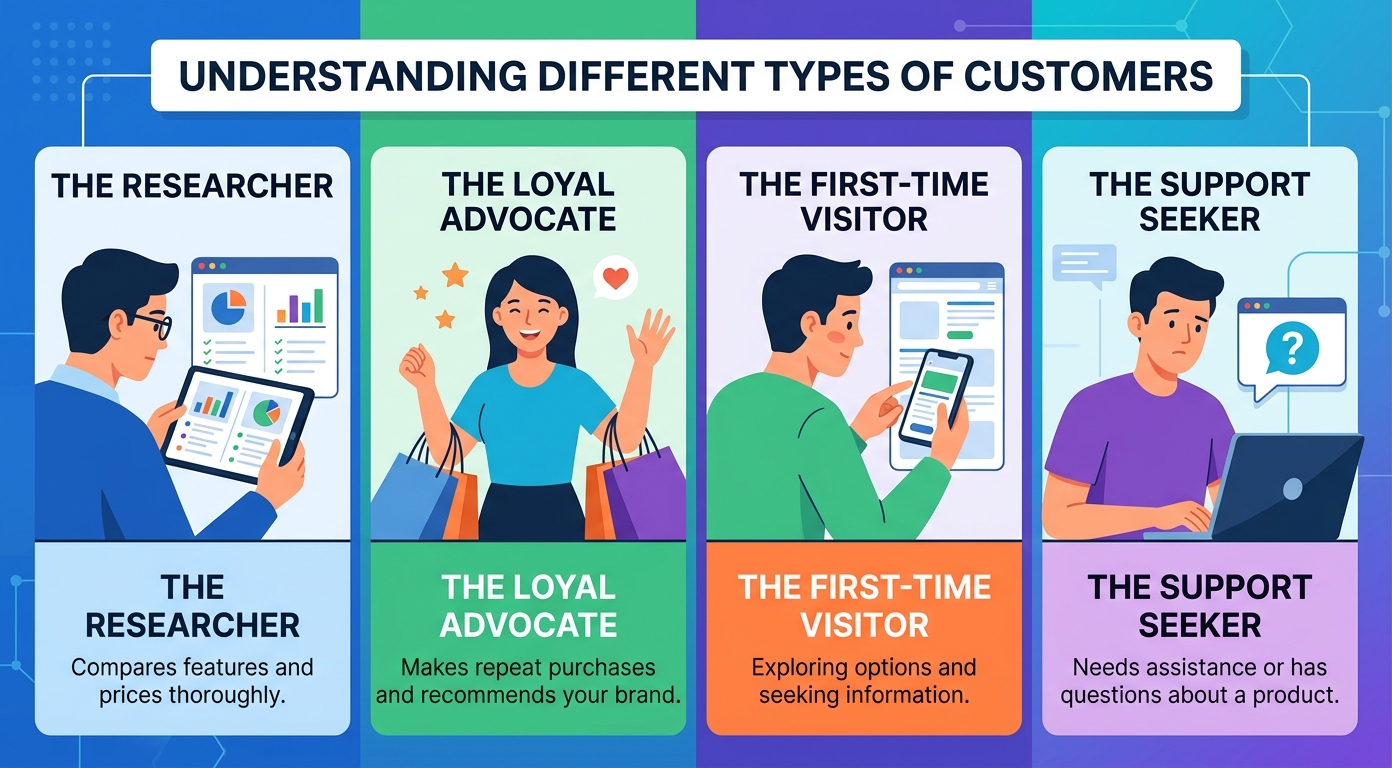
Not every customer is the same. Some arrive ready to buy, some need convincing, and some only show up for a discount. The different types of customers each behave in their own way, and the businesses that grow fastest learn to recognize and serve every one of them.
This guide breaks down the main types of customers, what drives each group, and the practical strategies to engage and retain them with the right support and service. Once you can spot a type, you can give that person the experience they actually want.
What are customer types?
Customer types are the recognizable groups your customers fall into based on their behavior, intent, and motivations. Two people can buy the same product for completely different reasons, and those reasons change how your service should treat them.
Grouping consumers this way is not about sticking labels on people. It is a practical shortcut: once you know a person's type, you know roughly what they need, what worries them, and how your support should respond.
Marketers often sort consumers by age or location, but behavior is the more useful split. A first-time visitor and a loyal regular can share a postcode yet behave in completely different ways.
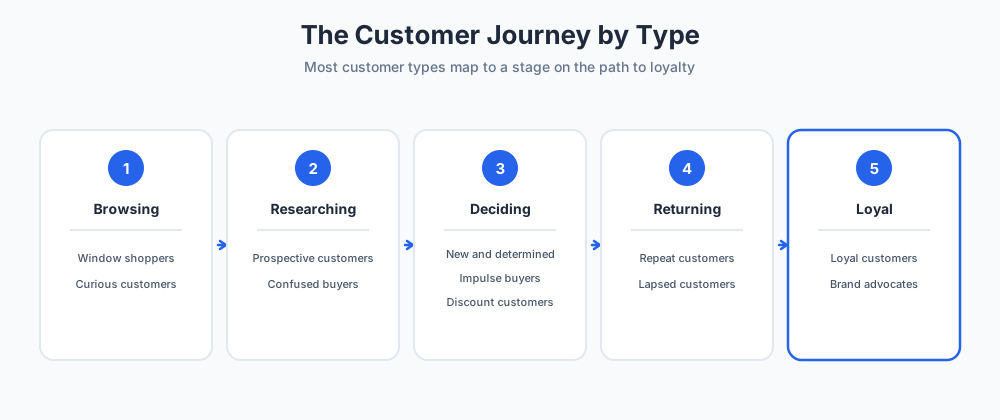
Some customer types are defined by where a person sits in the buying journey, from a first visit to a daily habit. Others are defined by personality, budget, or the simple way someone likes to shop.
None of these groups are fixed. A curious browser today can be a loyal buyer next month, and a careful buyer can become an impulse one given the right product or service at the right moment.
Think of customer types as a practical map. You will never predict every person perfectly, but knowing the common patterns lets a business prepare the right response in advance instead of improvising every time.
Why understanding customer types matters
When you treat every customer the same, you serve none of them well. A deal hunter and a loyal repeat customer want very different things, and a single generic experience disappoints both.
Understanding customer types sharpens your marketing, your sales, and your customer service. You spend effort where it pays off, you write messages that land, and you stop guessing what people want.
It also lifts customer retention. People stay with a business that clearly understands them and delivers service that fits, and they drift away from one that treats them as a number.
There is a clear retention payoff in the numbers, too. Steady attention to the right groups lifts retention and turns a single sale into many.
There is a sales angle as well. Knowing your types tells you which groups move smoothly through the sales funnel, which stall, and whether your product has truly found its market fit.
Done well, this focus improves customer satisfaction across the board, because the help each person receives matches their real situation rather than a one-size script.
There is one more reason this matters: your team. When everyone shares the same language for customer types, training is faster and customer service stays consistent from one agent to the next.
The main types of customers
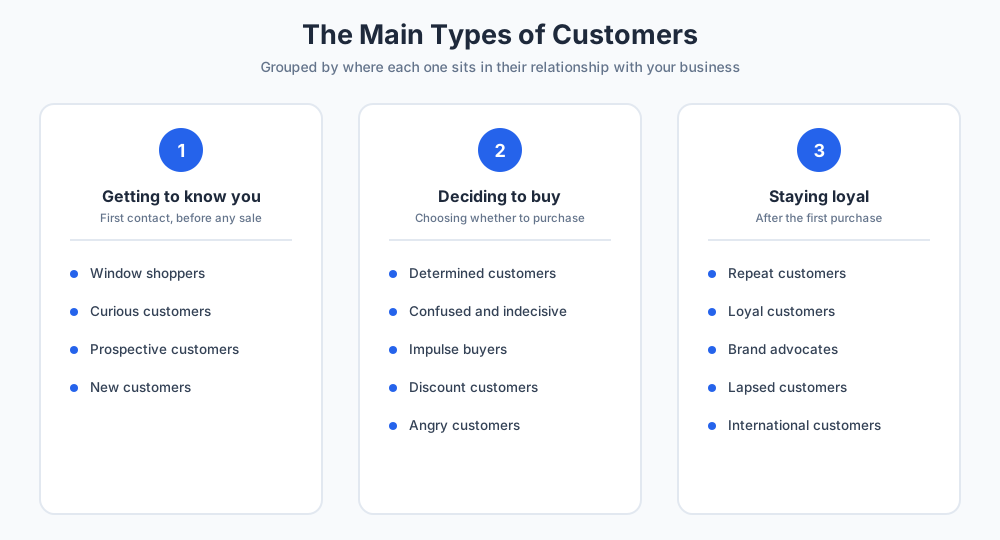
Below are the common types of customers you will meet, with a short description of each and clear advice on how to win them with the right approach. Most businesses serve a mix of all of them at once.
New customers
New customers are buying from you for the very first time. They studied the market, compared the options, chose you, and now expect the value they were promised.
They need guidance more than anything else. A clear customer onboarding flow, with welcome emails, short tutorials, and quick answers, turns a nervous first purchase into real confidence.
Make support easy to reach in these first days, because a fast, friendly customer service reply sets the tone for the whole relationship.
Strong onboarding also builds early brand trust and sets up long-term loyalty. Get that first experience right and a new customer becomes a repeat one; get it wrong and they quietly disappear.
Prospective customers
Prospective customers, often called leads, are looking at your product with a real intention to buy, but they have not made the final call yet.
Highlight the benefits clearly, remove friction from the buying experience, and offer an obvious line of support for any questions they raise.
A personalized demo works well, because prospective customers want proof that your product or service fits their needs before they spend money.
Helpful, low-pressure support at this stage is often what tips a slow buying decision into a confident yes, and it shortens your sales cycle along the way.
Window shoppers
These shoppers browse without a firm plan to buy. They are comparing options, gathering ideas, and they are easy to lose to the next tab.
Do not pressure them. Friendly, low-key support and clear product information keep them engaged until simple curiosity hardens into intent.
Many of these shoppers will never buy, and that is fine. The ones who do will remember a brand that helped without pushing.
If a window shopper does return, treat the visit as a fresh start and give them friendly, patient service rather than a hard sell.
Determined customers
These customers know exactly what they want. They have a clear need, they found the product that solves it, and they want to buy without fuss.
These determined customers value speed above all. A quick checkout, accurate stock information, and fast delivery keep them satisfied and likely to return.
Do not slow them down with upsells or long forms. The best help for this group is an experience that simply gets out of their way.
Curious customers
Curious customers have visited your site several times. They already know the product but still carry a few open questions before they will buy.
Give them detailed content, honest proof such as reviews, and clear policies that remove any lingering risk from the purchase.
Curious customers are close to converting, so this is where strong support strategies pay off most. A quick, knowledgeable answer from your support team is often the final nudge they need.
A short FAQ page and an honest comparison with rivals also build the confidence this group is looking for, and they quietly raise your brand in their eyes.
Confused and indecisive customers
Confused and hesitant customers want to buy but do not fully understand what you offer or which option is right, so they stall.
They need clear, simple explanations delivered fast. A chatbot or a short chat with a support agent removes the doubt and turns hesitation into a confident purchase decision.
Patience matters with this group. Rushing uncertain customers usually pushes them away, while calm, guided support earns the sale and their trust.
Good product descriptions and a tidy site also do quiet work here, answering questions before they are even asked.
Impulse buyers
Impulse customers act in the moment. They were not planning to buy anything, but the right offer at the right time wins them over instantly.
A gentle sense of urgency, a frictionless checkout, and smart product recommendations turn impulse buyers into fast, happy sales.
Impulse sales add up fast for a business, and a strong, scannable product range keeps this brand top of mind. Keep the experience short, and make support instant if a question comes up.
Discount and bargain customers
Discount customers only buy when there is a deal. They know your catalog well and simply wait for the price to drop before they act.
To convert a discount hunter, lead with coupon codes, a seasonal promotion, and clear added value rather than full-price messaging.
These shopping customers want to feel they got a smart deal. Bundle a small extra with the purchase, and the perceived value, not just the price, is what closes them.
Support still matters: a cheap product backed by poor service will not earn a second order, even from bargain shoppers.
Angry and dissatisfied customers
Angry customers have hit a problem and they are not happy about it. How your business responds decides whether they stay or leave for good.
Lead with empathy. Angry customers want to be heard first and offered a real solution second, whether that is a replacement, a refund, or a genuine goodwill gesture.
Handled well, angry customers often become loyal ones, because a problem solved quickly builds more trust than no problem at all. Unhappy customers who feel ignored, by contrast, rarely come back.
Train your customer service team so every agent knows how to calm tension and turn dissatisfaction into a fixed issue and a saved relationship.
Loyal customers
Loyal customers come back again and again. They are your most valuable group, the cheapest to serve, and the easiest to sell to.
Keep them close with personal service, early access to new products, and a clear place in your loyalty programs.
Loyal customers also become your strongest brand advocates, so feature them in testimonials and reward them for spreading the word about your brand.
Never take this group for granted. These customers deserve your best care and your clearest loyalty rewards, because loyalty fades fast if the experience slips.
Repeat customers
These customers buy from you regularly but are not yet emotionally loyal. They like you, yet a competitor and a single good promotion could still tempt them away.
Consistency is what converts repeat buyers into loyal ones. Deliver the same quality every time, keep improving the experience, and make sure your support feels personal.
A light loyalty perk, such as points or a members-only price, gives this group a concrete reason to keep choosing your business.
Referring customers and brand advocates
Referring customers loved their purchase enough to recommend you to friends and family. They act as unpaid marketing for your business.
Brand advocates are worth real effort to protect. Stay consistent, build a community around your brand, and give brand advocates small incentives to keep referring.
A simple referral program turns happy buyers into advocates who bring in new customers at almost no cost and with built-in trust.
Word of mouth from advocates is the cheapest growth a brand can earn. Great support is what creates this group in the first place, because people only recommend a brand they believe in.
Lapsed customers
Lapsed customers bought from you once but then stopped. Often something went wrong, and they quietly left without complaining.
Reconnect with a personal message, fix whatever the original issue was, and give them a clear reason to return, such as a fresh offer or promotion.
Lapsed customers rarely give a third chance, so make the second one count with attentive service and a smooth, easy experience.
International customers
International customers buy from a different country, currency, or language. They are a large growth opportunity and an easy group to underserve by accident.
Support international customers with local payment options, honest shipping information, and customer service in their own language wherever you can.
A little localization goes a long way. When the product experience feels built for them, these customers become just as loyal as any local buyer.
How to identify your customer types
You cannot serve a customer type you have never spotted. Identifying types is mostly a matter of paying attention to behavior and to your own data.
Watch the signals: how often someone buys, what they ask, how price-sensitive they are, and which channel they arrived through. Each signal hints at a type and its mindset.
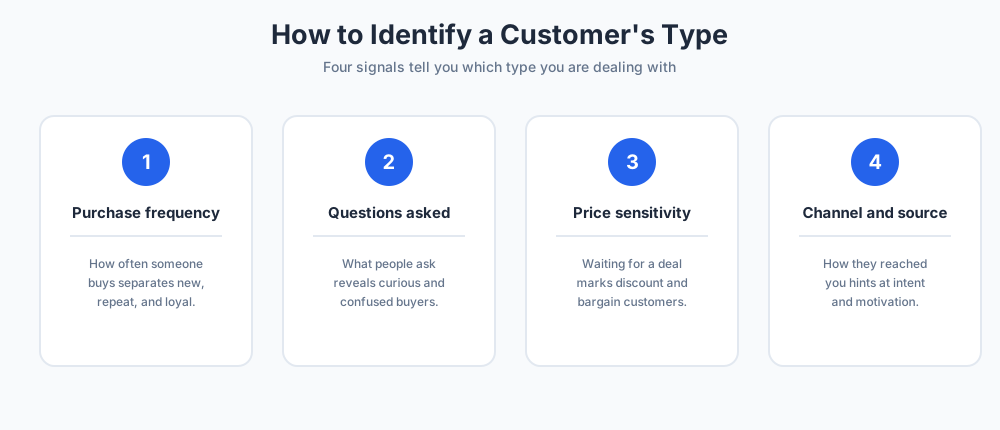
Customer feedback and support conversations are gold here. The questions people ask, and the way they ask them, reveal intent faster than any formal survey.
Your customer service agents see these patterns first, so ask the agents which customer types come up most and what those people struggle with.
A CRM helps you tag and track customers over time, so a one-time buyer who comes back is recognized as a returning customer rather than a stranger starting over.
Review the patterns regularly. The mix of types you serve will shift as your product, pricing, marketing, and support change.
None of this needs a big analytics team. A simple habit of reading conversations each week will tell a small business almost everything it needs about the customer types it serves.
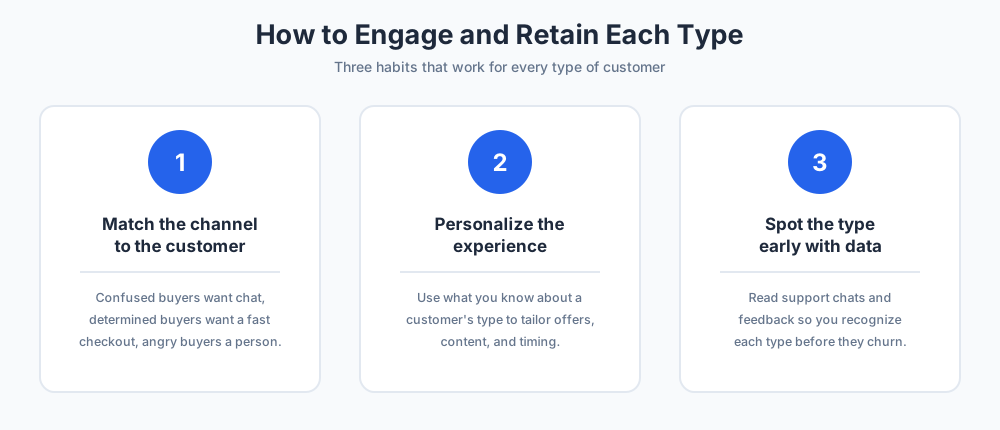
How to engage and retain each customer type
Recognizing a type is only half the job. The real payoff comes from adjusting how you engage and retain each group day to day.
Match the channel to the customer
Different customers prefer different channels. A confused buyer wants live chat, a determined buyer wants a fast self-checkout, and an angry buyer wants a quick human reply from your support team.
Offer several support options and let each type of shopper pick the one that suits them. Forcing everyone down one path frustrates most of them.
Whatever the channel, fast and friendly customer service is the constant that every type rewards.
Personalize the experience
Personalization is what makes a customer feel understood rather than processed. Use what you know about a person's type to tailor offers, content, and timing.
The types of customer service each group needs will differ, so map your help to the type instead of running one script for everyone.
Tie it together with clear strategies for each type, and overall satisfaction climbs. Personalized care is also the surest route to customer loyalty.
Common mistakes to avoid
The first mistake is treating every customer as the same buyer. That wastes effort and quietly frustrates people who have very different needs.
The second is over-focusing on new customers while ignoring loyal ones. Existing customers are cheaper to keep and worth far more over their lifetime, so balance your marketing and support between the two.
The third is ignoring angry and unhappy buyers. A complaint handled well is one of your best chances to build trust and rescue the customer relationship.
The fourth is guessing instead of measuring. Let real data and honest feedback, not assumptions, tell you which types you serve and where your product or service falls short.
The fifth is forgetting that types change. Keep watching, because today's window shopper is tomorrow's loyal advocate if your support treats them well.
Final thoughts
The different types of customers are not a rigid system. They are a lens that helps you see your customers clearly and respond to what each one genuinely needs.
Start simple. Pick the three or four types you see most often, sharpen the help and support you give them, and build out from there as you learn.
Strong support, honest marketing, and a real focus on the customer will carry any business a long way. Unlike other customers who are quickly forgotten, the ones you understand tend to stay.
Whatever your product or service, the principle holds: know the type, then serve it well. Do that consistently and more of your customers, whatever their type, turn into loyal shoppers who come back and bring others with them.
Winning is rarely about having the most customers. It is about understanding the customers you have and giving each type real, attentive service, which is exactly what builds a lasting brand.
Frequently Asked Questions
What are customer types?
Customer types are the recognizable groups your buyers fall into based on their behavior, intent, and motivations. Two people can buy the same product for very different reasons, and knowing a person's type tells you roughly what they need, what worries them, and how your service should respond. It is a practical shortcut, not a rigid label.
What are the 4 types of customers?
A common four-type model splits customers into new customers, prospective customers (leads), impulse buyers, and loyal customers. Other versions swap in discount or need-based customers. There is no single official list, so treat any four-type model as a starting point and adapt it to the groups you actually serve.
What are the five types of customers?
The classic five-type model is loyal customers, impulse buyers, discount customers, need-based or determined customers, and window shoppers. Loyal customers drive the most revenue, while window shoppers browse without buying. Most businesses see all five, plus newer groups such as prospective and lapsed customers.
What are the 8 types of customers?
An eight-type list usually covers new customers, prospective customers, window shoppers, determined or need-based customers, impulse buyers, discount customers, angry or dissatisfied customers, and loyal customers. This guide also adds curious, confused, repeat, referring, lapsed, and international customers, since most businesses meet all of them.
What are some types of customers?
Common types of customers include new, prospective, window shoppers, curious, confused or indecisive, determined, impulse buyers, discount or bargain customers, angry or dissatisfied, repeat, loyal, referring brand advocates, lapsed, and international customers. Each behaves differently and needs a slightly different approach to engage and retain them.
Why do customer types matter?
When you treat every customer the same, you serve none of them well. Understanding customer types sharpens your marketing, sales, and customer service, lifts customer retention, and improves satisfaction, because the help each person receives matches their real situation. It also shows which groups are most valuable and which are at risk of leaving.
How do I identify my customer types?
Watch behavior and data. Note how often someone buys, what they ask, how price-sensitive they are, and which channel they arrived through. Customer feedback and support conversations reveal intent fast, and a CRM lets you tag and track customers over time. Review the patterns regularly, since your mix of types shifts as your business changes.
How do you handle angry customers?
Lead with empathy. Angry customers want to be heard first and offered a real solution second, whether that is a replacement, a refund, or a goodwill gesture. Handled quickly and well, an angry customer often becomes a loyal one, because a problem solved fast builds more trust than no problem at all. Train your team so every agent can calm tension.
What is a loyal customer?
A loyal customer buys from you again and again and feels a genuine preference for your brand. They are your most valuable group: the cheapest to serve, the easiest to sell to, and the most likely to become brand advocates. Keep them with personal service, early access to new products, and a clear place in your loyalty program.
What is the difference between a new and a repeat customer?
A new customer is buying from you for the first time and needs guidance and reassurance through onboarding. A repeat customer buys regularly but is not yet emotionally loyal, so a competitor could still tempt them away. The goal is to move people along: turn new customers into repeat ones, and repeat customers into loyal advocates.
How do you turn a new customer into a loyal one?
Get the first experience right. Use a clear onboarding flow, make support easy to reach, and deliver the value you promised. Then stay consistent on every order, personalize the experience, and reward repeat purchases. Loyalty is earned through reliable service over time, not won with a single sale.
How do you deal with indecisive customers?
Confused and indecisive customers want to buy but do not understand which option is right, so they stall. Give them clear, simple explanations delivered fast, through a chatbot or a quick chat with an agent. Good product descriptions and a tidy site help too. Stay patient, because rushing an uncertain customer usually pushes them away.
How do you retain customers?
Retention comes from matching your service to each customer type rather than running one script for everyone. Personalize the experience, reply fast on the channel each group prefers, fix problems generously, and reward loyalty. Watch customer feedback so you spot issues early, and remember that an existing customer is far cheaper to keep than a new one to win.
What do prospective customers need?
Prospective customers, or leads, are interested but have not decided. They need clear benefits, a smooth buying experience, honest proof such as a demo or reviews, and an easy line of support for their questions. Helpful, low-pressure service at this stage is often what tips a slow decision into a confident purchase.
Related articles
More in Customer service → SaaS Customer Support: The Stage-by-Stage Guide (2026)
How SaaS customer support actually works at each stage: the right stack from founder-led live chat to a full support operation, channels, and metrics.
 How to Reduce Customer Churn: 5 Levers in Payback Order
Reduce customer churn by pulling five levers in payback order: payment recovery, onboarding, support quality, pricing fit, and a 90-day win-back.
 10 FAQ Page Examples That Actually Help Customers (2026)
10 FAQ page examples from Shopify, Airbnb, Slack, Nike and more, with the exact pattern each gets right and a checklist to build your own FAQ page.
 12 Customer Service Email Templates for Every Scenario (2026)
12 customer service email templates for complaints, refunds, delays, bugs and saying no, plus the five-line skeleton that keeps them sounding human.