Crisp vs Intercom in 2026: One Bill or Two Meters
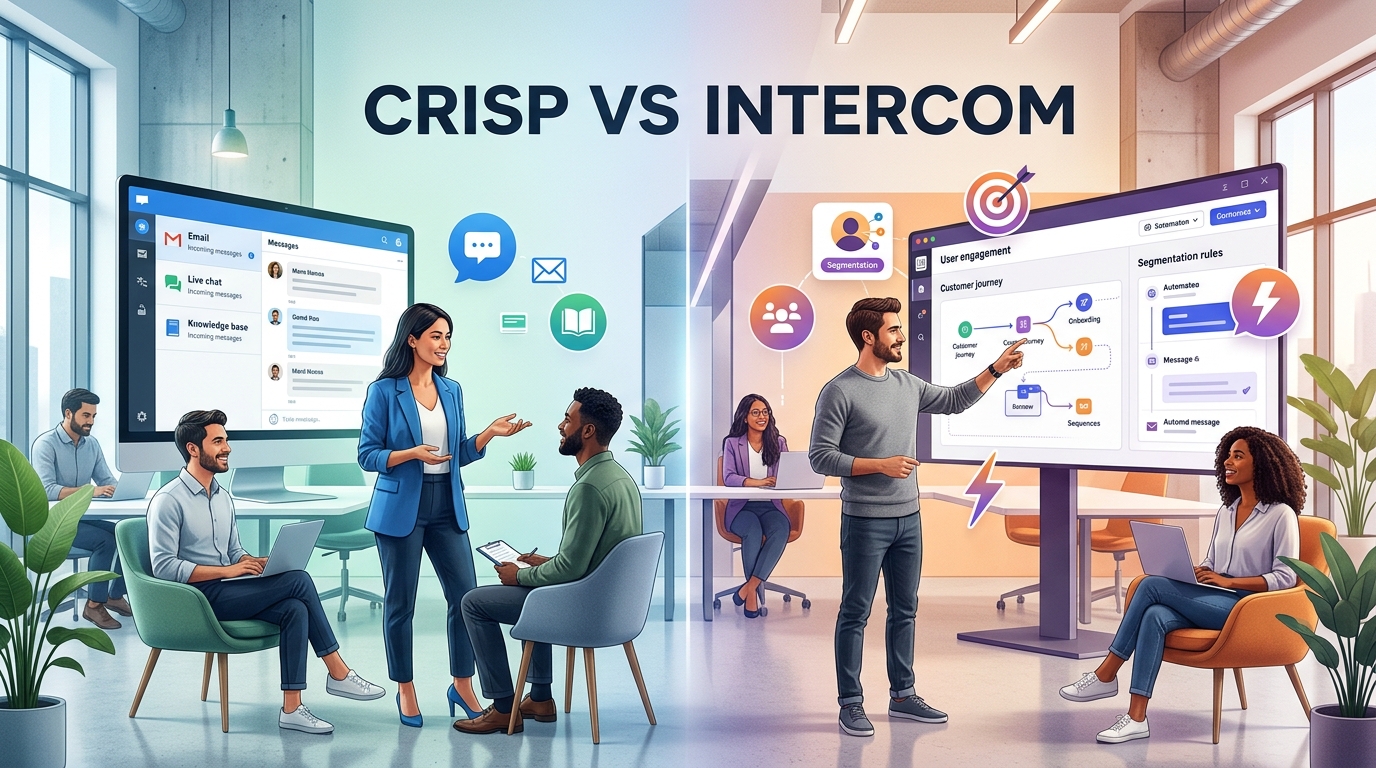
Crisp vs Intercom is the widest pricing-philosophy gap you can find between two products that do broadly the same job. Crisp charges one flat fee per workspace, $45, $95 or $295 a month, seats included by tier, conversations explicitly unlimited, AI credits bundled in. Intercom charges two meters at once: seats at $29 to $132 per person billed annually, and Fin, its AI agent, at a printed $0.99 per outcome on top. (A naming note: Intercom rebranded as Fin in May 2026, and Salesforce signed a definitive agreement to acquire the company in June 2026, though the deal has not yet closed; this post keeps the Intercom name most buyers still search for.) An 8-person support team can genuinely pay $95 a month on one side and $680 plus AI usage on the other, which looks like a mispricing until you itemize what the Intercom dollars buy: the category's most-benchmarked AI agent, product-led messaging tooling, and platform depth Crisp does not pretend to match. This comparison prices both honestly at July 2026 published rates, finds each product's real meter, and sorts out which teams should stop overpaying and which are underbuying.
The one-minute read on Crisp vs Intercom
| Crisp | Intercom | |
|---|---|---|
| Pricing model | Flat per workspace: Mini $45, Essentials $95, Plus $295 | Per seat: Essential $29, Advanced $85, Expert $132 (annual) |
| Conversations | Unlimited, stated on the pricing page | Not the meter; AI outcomes are |
| AI agent | Hugo, billed through bundled AI credits | Fin, $0.99 per outcome, included on every plan |
| Free plan | Yes: 2 seats, unlimited conversations, 100 profiles | None; Early Stage startups get 93 percent off |
| The quiet meter | Customer profiles: 5,000 to 200,000 by tier | Seats plus outcomes, both climbing with success |
| Extra seats | $10 per agent per month past the included count | Full price per seat; 20 to 50 free Lite seats up-tier |
| Suite pieces | KB, mini-CRM, campaigns, status page in the fee | Help center included; analytics and outbound as add-ons |
| Origin story | Made in Europe (Crisp IM SAS, France) | The SaaS-industry default, AI-first since Fin |
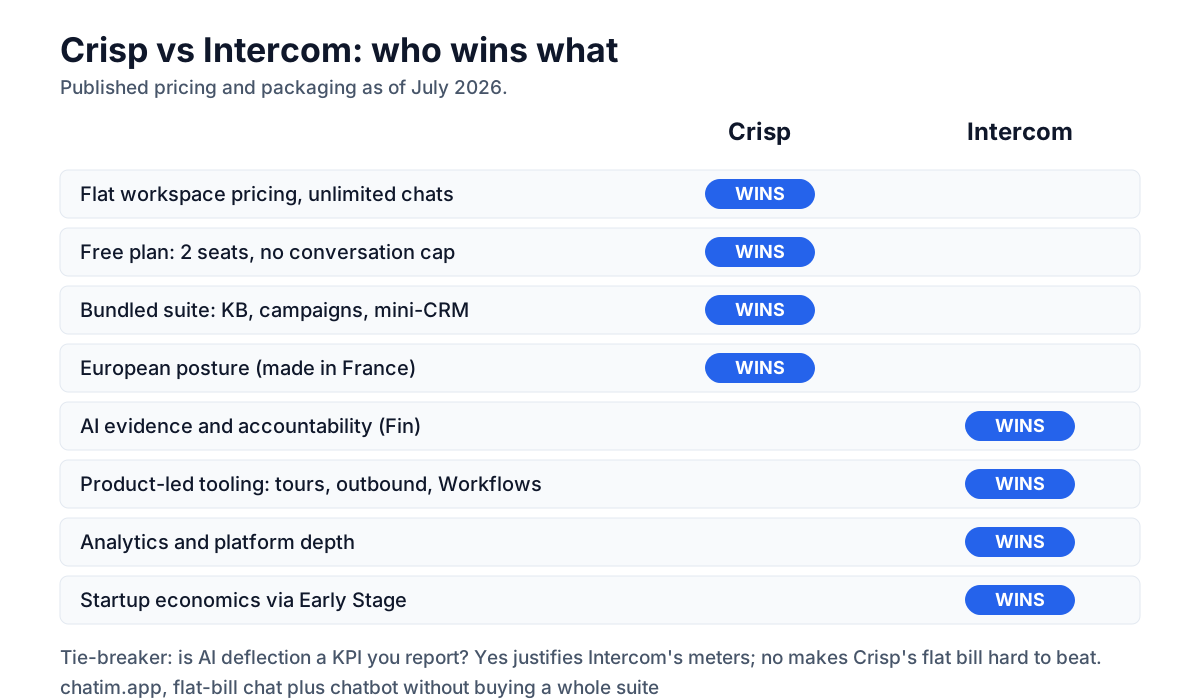
The pattern: Crisp sells certainty, one number covering almost everything, while Intercom sells capability and bills it precisely. Neither is being greedy; they are pricing different promises.
Published prices as of July 2026: Crisp's are flat monthly workspace rates, Intercom's are annual per-seat rates. Both vendors adjust pricing; read the live pages before committing.
The flat-fee suite and the AI flagship
Crisp: one workspace fee, the whole toolkit
Crisp bundles what its rivals itemize. The free plan carries 2 seats with unlimited conversations and 100 customer profiles; Mini at $45 per workspace adds 4 seats, a shared email inbox, 5,000 profiles and $5 of AI credits; Essentials at $95 is the sweet spot, 10 seats, an omnichannel inbox, workflow builder, knowledge base, AI chatbot, analytics, 50,000 profiles and $25 in credits; Plus at $295 brings 20-plus seats, ticketing, white labelling, 100-plus integrations, 200,000 profiles and $75 in credits. Extra agents cost a flat $10, every plan gets a 14-day trial, and the pricing page states outright that conversation volume is never limited. Hugo, Crisp's named AI agent, draws from the bundled credits. The company is French and markets its made-in-Europe posture, which matters to GDPR-minded buyers, and its true ceiling is the profile count, the one number on the page that behaves like a meter.
Intercom: seats, outcomes, and Fin out front
Intercom's packaging centers on Fin the way a car ad centers on the engine. Every plan, Essential $29, Advanced $85 with the Workflows builder and 20 free Lite seats, Expert $132 with 50, includes the messenger, inbox, help center and Fin itself, billing a printed $0.99 per outcome. Copilot for human agents is listed at $29 per agent on intercom.com (fin.ai shows $35, so check the live page), Pro analytics and Proactive Support Plus are $99 each, and qualifying startups get 93 percent off year one through Early Stage. Intercom publishes customer results claiming 50 to 70 percent resolution rates and wraps Fin in money-back performance marketing; the numbers are the vendor's own, but no competitor matches the volume of public evidence behind them. It is the expensive default for a reason, and the bill grows in two directions at once as your team and your AI usage do.
Pricing: one bill against two meters
Run the sizes and watch the gap open, at July 2026 rates. Two founders: Crisp is free with unlimited conversations, Intercom is $58 a month plus outcomes, unless Early Stage applies, in which case Intercom becomes nearly free and wins the year. Five agents: Crisp Essentials at $95 flat against Advanced at $425 plus Fin usage, a 4-to-5x spread. Eight agents: still $95 on Crisp, since Essentials includes ten seats, against $680 plus usage, and the spread passes 7x before a single AI outcome is billed. What stops this from being a rout is what the spread buys and where Crisp's own meters hide: profile caps (50,000 on Essentials) that busy stores eventually hit, AI credits that deplete with Hugo's workload, $10 per seat past the included count, and the simple fact that Intercom's Lite seats, analytics and outbound tooling have no Crisp equivalent at any price. Teams that need what Intercom uniquely does will pay the two meters without regret; everyone else is the reason Crisp prints the unlimited-conversations line.
AI: Hugo's credits against Fin's track record
Fin is the measurable one: $0.99 per outcome, printed, with Intercom-published customer results in the 50-to-70-percent range, standalone deployments on rival helpdesks, and more public benchmarking than any support AI. Hugo is the economical one: billed through the credits bundled into each plan, and at Crisp's earlier published rates $5 of credits covered roughly 90 AI conversations, pennies per conversation against Fin's dollar per outcome. The catch sits in the units and the evidence. A Hugo conversation is not a Fin outcome, credits deplete whether or not the answer landed, and Crisp publishes far less about resolution performance, so the honest read is that Fin's price is high and proven while Hugo's is low and lightly documented. The test writes itself: both products offer 14-day trials, so run the same hundred real questions through each, count actual resolutions, and divide. A Hugo that resolves half of what Fin does at a twentieth of the cost is still the bargain; a Hugo that resolves a tenth is not.
The third option: Chatim between the two models
Disclosure: Chatim is our own product. If Crisp's bundle is more suite than you need and Intercom's meters are more bill than you want, the middle exists: Chatim pairs live chat with chatbot automation at predictable per-plan pricing, keeps a free tier, and ships native Shopify and WordPress integrations. Small teams get the flat-bill certainty without buying a status page they will never open.
Try Chatim free at chatim.app →
Product depth: where the price gap goes
Intercom's premium concentrates in the layers around the conversation. Workflows automates routing and follow-ups with real sophistication, product tours and outbound messages serve product-led onboarding, Pro analytics answers management questions Crisp's dashboards do not ask, Lite seats let half the company observe support without paid seats, and the app ecosystem runs deeper than Crisp's hundred-plus integrations. Crisp's depth is horizontal instead: a knowledge base, mini-CRM, email campaigns and a status page all inside the flat fee, each competent, none best-in-class, collectively replacing two or three other subscriptions for a small company. The buying question is which shape of depth your team will actually use: one excellent conversation platform with precision billing, or a serviceable everything-suite at a price that ignores your growth.
Channels, GDPR, and the Europe question
Both cover the modern channel set, website chat, email, and the social messengers, with Crisp folding them into its omnichannel inbox at Essentials and Intercom treating SMS, WhatsApp and phone as usage-priced add-ons on top of its core messenger, email and in-app channels. The differentiation is postural. Crisp leads with its French incorporation and made-in-Europe identity, which shortens GDPR conversations with EU privacy officers, while Intercom, long the default for American SaaS, answers the same compliance questionnaires with more paperwork but no less capability. For EU-first companies the soft factors, data posture, euro billing sensibilities, vendor jurisdiction, tilt Crisp; for global product companies the ecosystem tilt runs the other way. Neither tilt outweighs the pricing models; both can tip a close call.
Whose customer are you?
Crisp pays off when...
- Volume is high and headcount fluid: unlimited conversations on one flat bill.
- You want the side-suite: knowledge base, campaigns and mini-CRM without more vendors.
- Two-seat teams can start free without a conversation cap ticking.
- European posture matters to your customers or your counsel.
Intercom pays off when...
- AI deflection is a KPI: Fin's evidence and per-outcome billing make it accountable.
- Product-led motion needs tours, outbound and Workflows, not just an inbox.
- Lite seats and analytics serve an organization, not just a support desk.
- You qualify for Early Stage, which erases the price gap for a year.
Changing sides without losing history
The swap is mechanically easy in both directions, widget out, widget in, canned responses and operating hours ported, channels reconnected, with conversation history the main thing that stays behind in exports rather than moving natively. The real migration is conceptual: leaving Intercom means rebuilding Workflows logic in Crisp's simpler builder and accepting lighter analytics; leaving Crisp means re-scattering the side-suite (knowledge base, campaigns, status page) or paying Intercom add-ons to replace it. Pilot the AI first on both, as above, and only then move the widget. For the wider field, see our guides to Crisp Chat alternatives, Intercom alternatives, Tidio alternatives, HelpCrunch alternatives, and the full ranking of the best live chat software.
For more head-to-head comparisons, see Crisp vs Tidio, Intercom vs Zendesk, Intercom vs Drift, and Intercom vs HubSpot.
Frequently Asked Questions
Is Crisp or Intercom better in 2026?
They price different promises, so match the promise to your team. Crisp sells certainty: flat workspace fees of $45 to $295 a month with seats included, conversations explicitly unlimited, and a knowledge base, campaigns and mini-CRM bundled in. Intercom sells capability with precise billing: $29 to $132 per seat annually plus Fin at $0.99 per outcome, backed by the category's strongest public AI evidence and product-led tooling. High-volume small teams lean Crisp; AI-accountable, product-led organizations lean Intercom.
How much does Crisp cost in 2026?
Crisp publishes flat per-workspace prices: Free (2 seats, unlimited conversations, 100 customer profiles), Mini at $45 per month (4 seats, 5,000 profiles, $5 AI credits), Essentials at $95 (10 seats, omnichannel inbox, knowledge base, workflow builder, 50,000 profiles, $25 credits), and Plus at $295 (20-plus seats, ticketing, white labelling, 200,000 profiles, $75 credits), with Enterprise custom. Extra agents cost $10 per month, and every plan has a 14-day trial. As of July 2026.
How much does Intercom cost in 2026?
Intercom's published annual per-seat rates are Essential $29, Advanced $85 (Workflows plus 20 free Lite seats), and Expert $132 (50 Lite seats). Fin is included on every plan and bills $0.99 per outcome. Add-ons: Copilot listed at $29 per agent on intercom.com (fin.ai shows $35; check the live page), Pro analytics $99 per month, Proactive Support Plus $99. There is no free plan, but Early Stage gives qualifying startups 93 percent off the first year. As of July 2026; confirm on intercom.com. Note that Intercom rebranded as Fin in May 2026, and Salesforce agreed to acquire the company in June 2026 (the deal has not yet closed).
Does Crisp really offer unlimited conversations?
Yes, and unusually, it says so in plain text: Crisp's pricing page states there are no limits on conversation volume on any plan, free included. The meters that do exist are elsewhere: customer profiles (100 free, then 5,000, 50,000 and 200,000 by tier), bundled AI credits that Hugo consumes, and included seat counts with extra agents at $10. For high-volume, human-heavy support, the unlimited-conversations line is the whole reason Crisp makes shortlists.
How do Hugo and Fin compare?
Fin is proven and precisely billed: $0.99 per outcome, printed, with Intercom-published customer results claiming 50 to 70 percent resolution and standalone deployments on other helpdesks. Hugo is economical and lightly documented: it draws from the AI credits bundled into each Crisp plan, and at Crisp's earlier published rates $5 covered roughly 90 AI conversations. A Hugo conversation is not a Fin outcome, so run both 14-day trials on the same hundred real questions, count actual resolutions, and divide cost by success before believing either sticker.
Why is Intercom so much more expensive than Crisp?
Because the meters point at different things. An 8-agent team pays Crisp Essentials $95 flat (ten seats included) while eight Intercom Advanced seats cost $680 before Fin usage, at July 2026 prices. The Intercom premium buys Fin's accountability, Workflows automation, product tours and outbound, Pro-grade analytics, Lite seats and a deeper ecosystem, none of which Crisp sells at any price. Teams that use those layers get their money's worth; teams that only need chat, inbox and a bot are the ones the gap is warning.
What are Crisp's customer profile caps and do they matter?
Profiles are Crisp's real growth meter: 100 on Free, 5,000 on Mini, 50,000 on Essentials, 200,000 on Plus. Every visitor or contact Crisp stores counts toward the cap, so busy stores and big lists climb tiers on data rather than conversations. Before assuming the $95 flat fee lasts forever, estimate contacts you will accumulate in a year; crossing 50,000 moves you from $95 to $295, which is still flat, just a bigger flat.
Which is better for a startup?
Check Intercom's Early Stage program first: qualifying startups get 93 percent off year one, which turns Advanced seats into single digits and usually beats every alternative on price while it lasts, with the full Fin stack included. If you do not qualify, Crisp's free plan (2 seats, unlimited conversations) is the strongest genuinely free start in this matchup, and $45 Mini is a gentle first paid step. Plan for year two prices on both before you commit either way.
Is Crisp GDPR-friendly because it is European?
Crisp is a French company (Crisp IM SAS) and markets its made-in-Europe posture, which genuinely simplifies vendor-jurisdiction conversations for EU privacy teams. That is a posture advantage, not a compliance verdict: GDPR compliance depends on configuration and data-processing agreements on either platform, and Intercom serves EU customers with the standard paperwork. If your counsel or customers strongly prefer EU-based vendors, Crisp starts the conversation ahead; treat the rest as due diligence, not decided.
What does Crisp include that Intercom charges extra for?
The side-suite. Crisp's flat fee bundles a knowledge base, email campaigns, a mini-CRM and a status page (tiers vary), where Intercom's comparable coverage means the help center plus paid add-ons like Proactive Support Plus and Pro analytics at $99 each. In the other direction, Intercom includes things Crisp cannot match: Fin's caliber, Lite seats, product tours and Workflows depth. Neither bundle is padding; they reveal which customer each product is built around.
How hard is it to switch between Crisp and Intercom?
Mechanically easy, conceptually medium. The widget swap, canned responses, operating hours and channel reconnections take an afternoon; conversation history mostly stays behind in exports. Leaving Intercom means rebuilding Workflows in Crisp's simpler builder and accepting lighter analytics; leaving Crisp means replacing its bundled knowledge base and campaigns with add-ons or separate tools. Trial the destination's AI on real questions first, then move the widget last.
Do I need Crisp or Intercom at all for a small website?
Maybe neither yet. If the job is answering visitors, capturing leads and automating repeated questions, a focused tool does it without a suite or a meter: our own Chatim bundles live chat and chatbot automation at predictable per-plan pricing with a free tier and native Shopify and WordPress integrations (disclosure: Chatim is our product). Graduate to Crisp when you want the side-suite, or to Intercom when Fin-grade AI becomes a line item you can justify.
Related articles
More in Comparisons → Live Chat vs Chatbot: Which One Does Your Website Need?
Live chat vs chatbot in plain terms: what each does best, where each fails, and the bot-first, human-close handoff pattern that beats running either alone.
 Help Desk vs Service Desk: The Real Difference (2026)
Help desk vs service desk in one line: issue-fixing vs service lifecycle. The five differences that matter, why the terms blur, and which one you need.
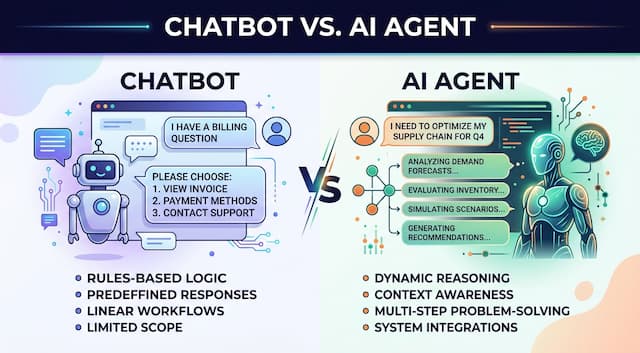 Chatbot vs AI Agent: Where the Line Actually Sits (2026)
Chatbot vs AI agent in plain terms: what each one does, where the line blurs, and how to add autonomy to support and sales without losing control.
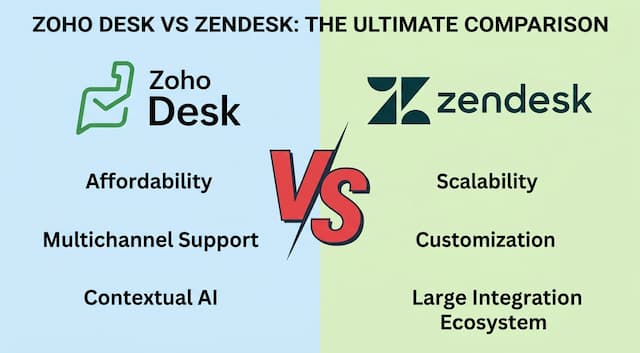 Zoho Desk vs Zendesk in 2026: The Price Gap, Examined
Zoho Desk vs Zendesk in 2026: included AI vs a quiet meter, and where Zendesk earns it