Crisp vs Tidio in 2026: Two Meters, Very Different Bills
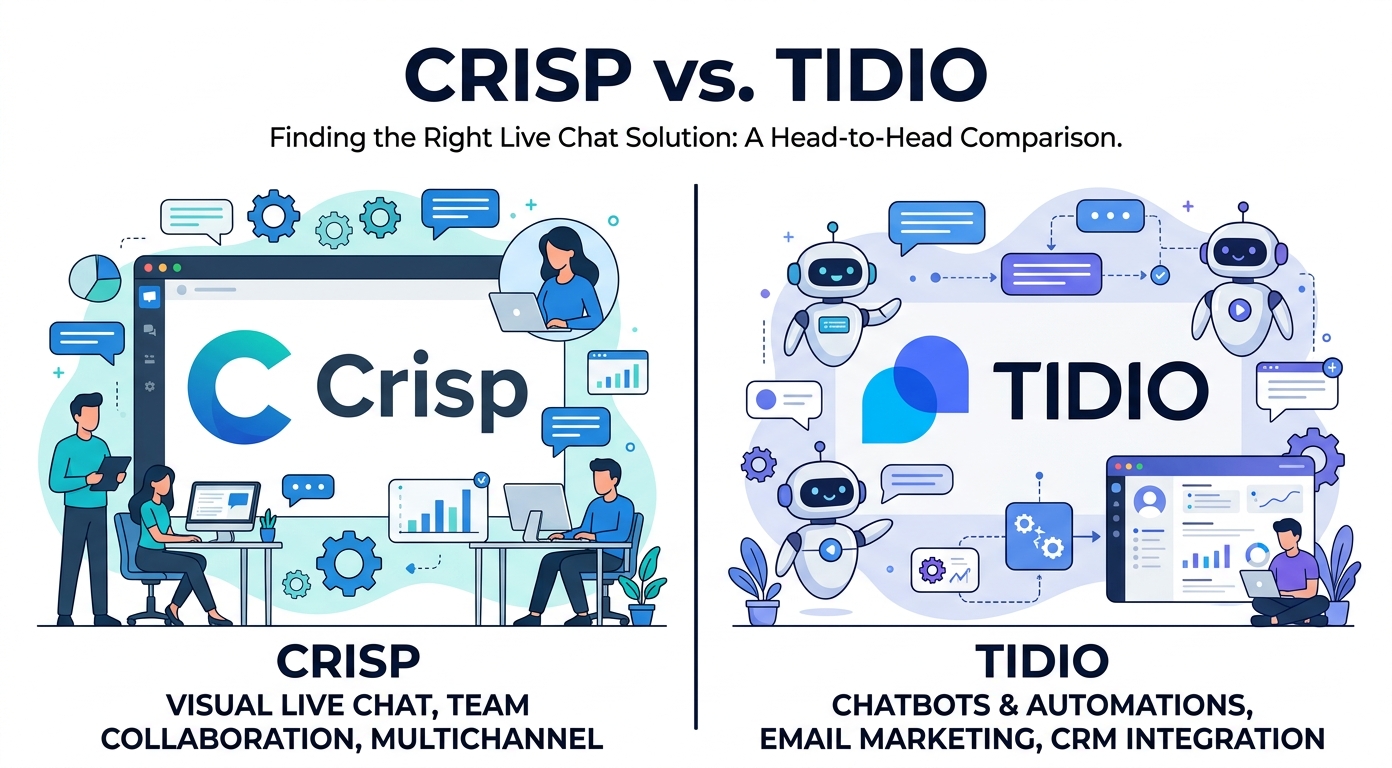
Crisp vs Tidio may be the hardest call in SMB customer service software, because on paper they rhyme: workspace-priced chat suites with free plans, bundled channels, and an AI agent. The real difference hides in what each one meters. Crisp charges a flat rate per workspace with unlimited conversations (Free, then Mini at $45, Essentials at $95, Plus at $295 per month), and scales on seats and AI credits. Tidio includes 10 seats on every plan and meters billable conversations instead (Free, then Starter at $24.17 per month billed annually, Growth from $49.17), with Lyro AI priced per AI conversation from $32.50. Every number below is a published July 2026 tier.
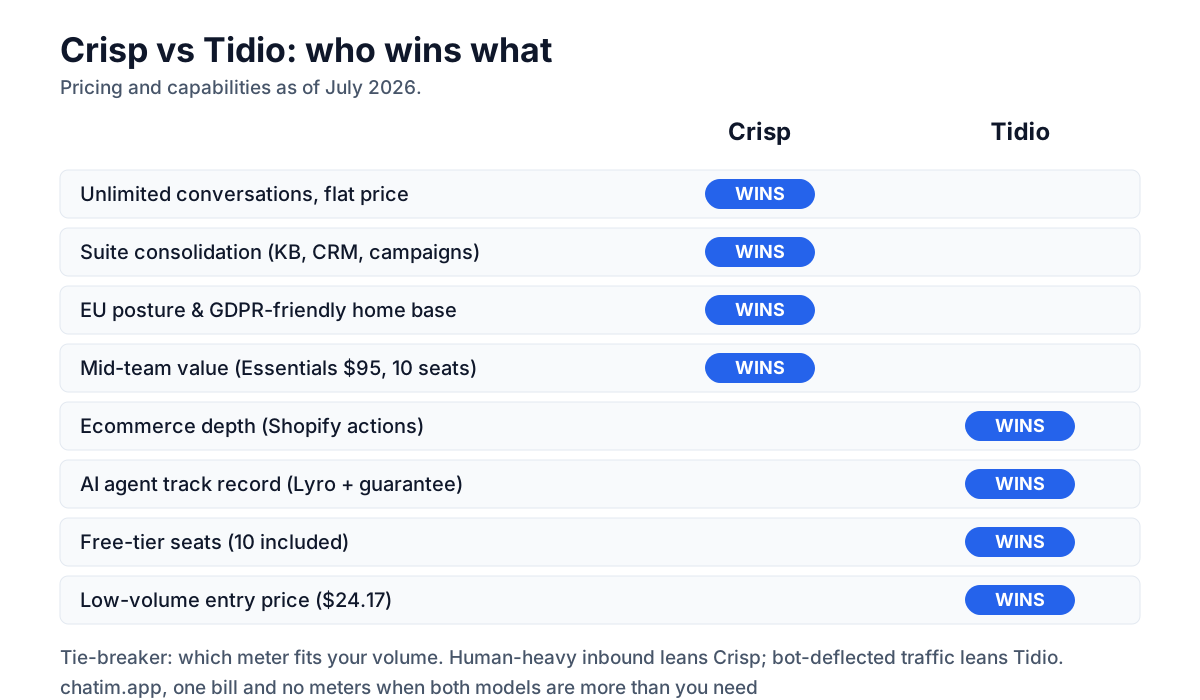
Short verdict: pick Crisp if conversation volume is high or unpredictable and you want a full suite (knowledge base, mini-CRM, campaigns) at one flat price. Pick Tidio if you are ecommerce-first, want the stronger AI agent story, or need more seats at the free and entry tiers. The volume-vs-seats meter decides most cases.
The short version first
| Crisp | Tidio | |
|---|---|---|
| Pricing model | Flat per workspace, unlimited conversations; seats + AI credits scale | Per workspace, metered billable conversations; 10 seats included |
| Free plan | Yes: 2 seats, unlimited conversations | Yes: 10 seats, 50 billable conversations/month |
| Entry paid (annual) | Mini $45/month: 4 seats, $5 AI credits | Starter $24.17/month: 100 conversations |
| Mid tier | Essentials $95/month: 10 seats, omnichannel, knowledge base | Growth from $49.17/month: 250-2,000 conversations |
| AI agent | Hugo + AI features on bundled credits ($5-$75 by tier) | Lyro, add-on from $32.50/month for 50 AI conversations |
| Extra seats | $10 per agent/month beyond plan seats | Custom seats at Plus tier and above |
| Suite extras | Knowledge base, mini-CRM, campaigns, status page, white label (Plus) | Flows automation, ticketing, native Shopify actions |
| Home base | France, made in Europe | Poland/US, strong ecommerce focus |
Pricing as listed on the vendors' pricing pages in July 2026. Crisp bills per workspace per month; Tidio annual billing shown. Pricing moves; confirm on both vendors' pages before you buy.
What Crisp and Tidio each are
Crisp in 2026: the flat-rate suite with unlimited conversations
Crisp bundles a shared inbox, website chat, email, social channels, a knowledge base, a lightweight CRM, campaigns, and a status page into one workspace-priced product, with Hugo, its new AI support agent, running on bundled AI credits. The Free plan covers 2 seats with unlimited conversations; Mini ($45 per month) adds a shared email inbox, 4 seats, and $5 in AI credits; Essentials ($95) is the flagship: 10 seats, omnichannel inbox, workflow automation builder, AI chatbot, knowledge base, analytics, and $25 in credits; Plus ($295) brings 20-plus seats, ticketing, white labelling, 100-plus integrations, and $75 in credits, with Enterprise custom above. Extra agents are $10 per month, customer-profile caps scale by tier (100 to 200,000), and Crisp is explicit that no plan meters conversation volume. Every plan trials free for 14 days, and the company builds in Europe, which GDPR-sensitive teams count as a feature.
Tidio in 2026: ecommerce-first, priced by conversations
Tidio pairs its chat widget, ticketing, and native channel integrations (Messenger, Instagram, WhatsApp, email) with two automation products: Flows (no-code triggers) and Lyro, its AI agent. Every self-serve plan includes up to 10 seats; the meter is billable conversations, counted only when a human agent replies (bot-handled and unanswered conversations are free). The Free plan covers 50 conversations per month; Starter is $24.17 per month billed annually for 100; Growth scales 250 to 2,000 from $49.17; Plus (from $749) and Premium (custom, with pay-per-resolution billing and the guaranteed 50 percent Lyro resolution rate Tidio lists as a published plan feature) serve bigger teams. Lyro prices from $32.50 per month for 50 AI conversations, sells standalone for Zendesk and Salesforce, and Tidio claims it resolves up to 67 percent of questions. Native Shopify actions and first-class WooCommerce plugins anchor its ecommerce position; branding removal is $16.67.
Pricing: volume meter vs seat meter
Two workspace models, opposite meters. Three worked examples with July 2026 published prices.
Solo founder: Crisp Free gives 2 seats with unlimited conversations; Tidio Free gives 10 seats but caps at 50 human-answered conversations per month. A one-person shop answering everything personally hits Tidio's cap first, which makes Crisp's free tier the stronger genuinely-free option at volume, and Tidio's the stronger one if a bot deflects most traffic (Lyro and Flows conversations do not count).
Growing store, 800 conversations per month, 4 agents: on Tidio that volume sits in Growth (roughly $57-$82 by quota step). On Crisp, Mini at $45 covers it with conversations unmetered, but with only $5 of AI credits; matching Lyro-level automation means Essentials at $95. Comparable totals, different shapes: Tidio's bill tracks volume, Crisp's tracks features and seats.
High-volume team, 3,000 conversations, 8 agents: Tidio's self-serve ladder ends at 2,000 conversations; past it you are quoted Plus from $749. Crisp Essentials holds at $95 flat with volume unlimited, plus whatever AI credits you consume. This is the scenario where, at July 2026 prices, the two products diverge by an order of magnitude, and the reason high-volume, human-heavy teams keep landing on Crisp.
The AI meters differ too: Lyro bills per AI conversation (from $32.50 for 50); Crisp bundles dollar-denominated AI credits ($5, $25, $75 by tier) that Hugo and AI features draw down, roughly 90 AI conversations for $5 by Crisp's earlier published rates. Estimate your bot share before assuming either is cheaper.
AI: Lyro vs Hugo and Crisp's credit model
Lyro is the more established AI agent story: trained on your FAQ and site content, executing actions, handing off cleanly, sold standalone for other helpdesks, and backed by the 50 percent resolution guarantee Tidio publishes for its Premium tier. Its meter is simple (per AI conversation) and generous in one key way: Lyro traffic never consumes Tidio's human-conversation quota.
Crisp's Hugo is newer, positioned as an AI support teammate across the omnichannel inbox, drawing on the knowledge base and CRM context, and billed through the bundled credit pool rather than per conversation. The credit model makes small-scale AI effectively included (every paid tier carries credits), and heavy AI use a variable line you top up. Crisp publishes less public evidence on resolution rates than Tidio or the AI-first platforms, so run the 14-day trial against your real questions.
Net: for measurable, guaranteed deflection today, Tidio's Lyro carries the stronger record; for AI woven through a suite you already pay one flat price for, Crisp's credit model is simpler to budget at low volume. Test both on identical questions; both trials are free.
The third option: Chatim when you want the simple version
Disclosure: Chatim is our own product. If the quota ladders and credit pools feel like more model than your support workload needs, Chatim bundles live chat and chatbot automation at predictable per-plan pricing with a free tier and native Shopify and WordPress integrations. One bill, no meters to model.
Try Chatim free at chatim.app →
Suite breadth vs ecommerce depth
Crisp's pitch is consolidation: knowledge base, mini-CRM, campaigns, status page, and (at Plus) white labelling and a ticketing system, replacing three or four point tools with one $95-$295 workspace. Tidio's pitch is depth where stores live: native Shopify actions (carts, orders), WooCommerce and WordPress plugins, cart-aware Flows, and an AI agent tuned on retail questions. A SaaS or services company consolidating its stack leans Crisp; a store optimizing conversion and support leans Tidio. Both ship solid mobile and desktop apps, and both remove branding only on higher tiers or add-ons (Crisp white-label at Plus, Tidio at $16.67 per month).
Channels, Europe, and operational details
Both cover website chat, email, Messenger, Instagram, and WhatsApp, with Crisp adding its knowledge-base-backed help center and status page and Tidio adding a stronger ticketing-from-chat flow on its paid tiers. Crisp's French home base and made-in-Europe posture simplify GDPR conversations for EU businesses; Tidio serves EU customers fine but anchors its go-to-market in ecommerce. Seat economics differ at the margin: extra Crisp agents are a flat $10, while Tidio custom seats live at the Plus tier, so teams growing past 10 humans should model both. Crisp's customer-profile caps (5,000 on Mini, 50,000 on Essentials) matter to high-traffic sites the way Tidio's conversation quotas do; check which ceiling you hit first.
Picking a side
Crisp makes sense if...
- Conversation volume is high or spiky: flat workspace pricing with unlimited conversations is the whole point.
- You want to consolidate tools: knowledge base, mini-CRM, campaigns, and status page ride along at no extra vendor count.
- EU posture matters: built in Europe, with GDPR-friendly defaults that shorten compliance reviews.
- Your team sits between 4 and 10 agents: Essentials at $95 flat is the segment's price-performance standout.
- You want white labelling without enterprise sales: it ships at Plus ($295).
Tidio makes sense if...
- You run on Shopify or WooCommerce: native actions and cart-aware automation are Tidio's home game.
- AI deflection is the goal today: Lyro's track record, standalone option, and Premium-tier guarantee lead this matchup.
- Many teammates share light chat duty: 10 seats on every plan, including Free.
- Your volume is modest: at 100-250 human conversations, Starter and low Growth undercut Crisp's $45-$95.
- A bot will answer most traffic: bot-handled conversations are free, stretching the quota you pay for.
How hard is the swap?
Easiest migration in this series: both are widget-first, both ship WordPress and Shopify plugins, and both import little beyond canned responses and operating hours, so a switch is an afternoon plus retraining the bot. Export conversation history for the archive, rebuild Flows as Crisp workflow automations (or the reverse), re-point the knowledge base, and run the two free trials in parallel (14 days each) on live traffic. Compare missed conversations, response times, and AI answers on identical questions, then keep the one whose meter fits how your volume actually behaves. For the broader field, see our guides to Crisp Chat alternatives and Tidio alternatives, the full ranking of the best live chat software, and the platform guides for Shopify and WordPress.
For more head-to-head comparisons, see Crisp vs Intercom, Tidio vs Intercom, Tidio vs LiveChat, and tawk.to vs Tidio.
Frequently Asked Questions
Is Crisp or Tidio better in 2026?
They are the two closest SMB chat suites, split by what each meters. Crisp charges flat per workspace with unlimited conversations (Mini $45, Essentials $95, Plus $295 per month) and scales on seats and AI credits, bundling a knowledge base, mini-CRM, and campaigns. Tidio includes 10 seats on every plan and meters billable conversations (Starter $24.17 per month billed annually, Growth from $49.17), with the stronger AI agent story in Lyro. High or unpredictable volume favors Crisp; ecommerce depth and AI deflection favor Tidio.
Which is cheaper, Crisp or Tidio?
At low volume, Tidio: Starter at $24.17 per month (100 human conversations) undercuts Crisp Mini at $45, and Tidio's free plan carries 10 seats. At high volume, Crisp, dramatically: Tidio's self-serve ladder ends at 2,000 conversations before the $749 Plus tier, while Crisp Essentials stays $95 flat with conversations unlimited. Both as of July 2026. The crossover sits somewhere in the hundreds of monthly human-answered conversations; model your real month on both meters.
How much does Crisp cost in 2026?
As listed on the vendor’s pricing page in July 2026, billed per workspace per month: Free (2 seats, unlimited conversations), Mini $45 (4 seats, $5 AI credits, 5,000 customer profiles), Essentials $95 (10 seats, $25 credits, 50,000 profiles, omnichannel inbox, workflow builder, knowledge base, analytics), Plus $295 (20+ seats, $75 credits, 200,000 profiles, ticketing, white labelling), Enterprise custom. Extra agents are $10 per month. No plan meters conversation volume, and every plan has a 14-day free trial.
How much does Tidio cost in 2026?
As listed on the vendor’s pricing page in July 2026, billed annually: Free $0 (50 billable conversations per month, 10 seats), Starter $24.17 per month (100 conversations), Growth from $49.17 (250 to 2,000), Plus from $749, Premium by quote with a guaranteed 50 percent Lyro resolution rate on pay-per-resolution billing (a feature Tidio publishes on the plan). Lyro AI is an add-on from $32.50 per month (50 AI conversations), Flows from $24.17, branding removal $16.67. Only human-agent replies count toward the conversation quota.
Does Crisp really have unlimited conversations?
Yes; it is explicit on the pricing page, including a dedicated FAQ (why are there no limits on the number of conversations). Crisp's meters are seats (2 to 20+ by tier, $10 per extra agent), customer profiles (100 to 200,000 by tier), sub-inboxes, and AI credits. That structure is the core difference from Tidio, whose plans meter human-answered conversations. Teams with heavy inbound volume and human-first replies are exactly who the Crisp model favors.
How do Hugo and Lyro compare?
Lyro (Tidio) has the longer track record: trained on your content, action execution, standalone deployment on Zendesk or Salesforce, a published up-to-67-percent resolution claim, and the 50 percent guarantee Tidio publishes for its Premium tier, billed per AI conversation from $32.50 per month. Hugo (Crisp) is the newer AI support agent woven through Crisp's omnichannel inbox and knowledge base, billed through bundled AI credits ($5 to $75 by tier). Lyro leads on public evidence; Hugo leads on budgeting simplicity at small scale. Trial both on identical questions.
What are Crisp AI credits and how far do they go?
Each paid tier bundles a dollar-denominated credit pool ($5 on Mini, $25 on Essentials, $75 on Plus) that Hugo and AI features draw down, with top-ups available. By Crisp's earlier published rates, $5 covered roughly 90 AI conversations, though consumption depends on the features used. The practical read: light AI use is effectively included in the plan price, and heavy automation becomes a variable line item, the mirror image of Tidio's fixed per-AI-conversation quotas.
Which is better for Shopify and WooCommerce, Crisp or Tidio?
Tidio. Native Shopify actions (cart contents, order lookups inside chat), first-class WooCommerce and WordPress plugins, cart-aware Flows automation, and an AI agent tuned on retail questions make it the ecommerce pick of this pair. Crisp integrates with the major ecommerce platforms and works well on stores, but its center of gravity is the consolidated support suite rather than storefront mechanics. The full rankings live in our Shopify and WordPress live chat guides.
Which is better for a growing support team of 5-10 people?
Usually Crisp. Essentials at $95 flat covers 10 seats, unlimited conversations, the omnichannel inbox, workflow automation, knowledge base, and analytics, a package that would cost multiples elsewhere. Tidio covers the same headcount (10 seats on every plan) but volume growth walks you up conversation quotas toward the $749 Plus tier. The exception: if a bot deflects most traffic, Tidio's meter barely moves (bot conversations are free), and its total can stay lower.
Is Crisp GDPR-friendly for EU businesses?
Crisp is built by a French company (Crisp IM SAS) with an explicit made-in-Europe posture, which shortens GDPR conversations for EU teams: EU home jurisdiction and privacy-conscious defaults. Tidio serves EU customers with standard GDPR compliance tooling as well; the difference is posture and jurisdiction rather than a binary. For strict data-residency requirements, confirm current hosting and data-processing terms with either vendor before relying on them.
Is it easy to switch between Crisp and Tidio?
Yes, the easiest swap in this category: both are widget-first with WordPress and Shopify plugins, so the mechanical switch is an afternoon. Port canned responses and operating hours, rebuild automations (Flows versus Crisp workflows do not transfer), re-point knowledge content, retrain the AI on the same sources, and archive conversation exports. Run both 14-day trials in parallel on live traffic and compare missed conversations and AI answers before committing either way.
Do I need Crisp or Tidio at all?
Under roughly 50 human conversations per month, free tiers cover you: Crisp Free (2 seats, unlimited conversations), Tidio Free (10 seats, 50 conversations), or free-forever tools like Chatim's free tier and Tawk.to. The paid tiers earn their price when volume, channels, a knowledge base, or AI deflection become real needs. Our guides to Crisp Chat alternatives and Tidio alternatives map the adjacent options if neither meter fits how your support actually behaves.
Related articles
More in Comparisons → Live Chat vs Chatbot: Which One Does Your Website Need?
Live chat vs chatbot in plain terms: what each does best, where each fails, and the bot-first, human-close handoff pattern that beats running either alone.
 Help Desk vs Service Desk: The Real Difference (2026)
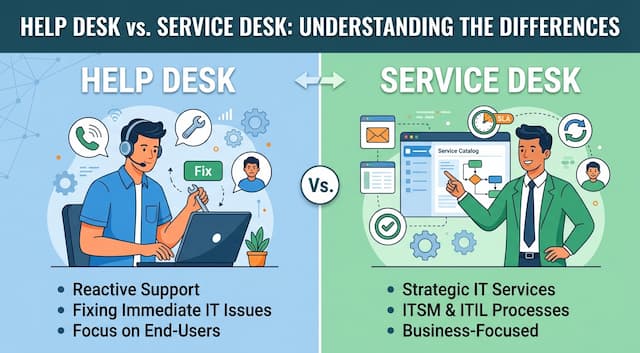
Help desk vs service desk in one line: issue-fixing vs service lifecycle. The five differences that matter, why the terms blur, and which one you need.
 Chatbot vs AI Agent: Where the Line Actually Sits (2026)
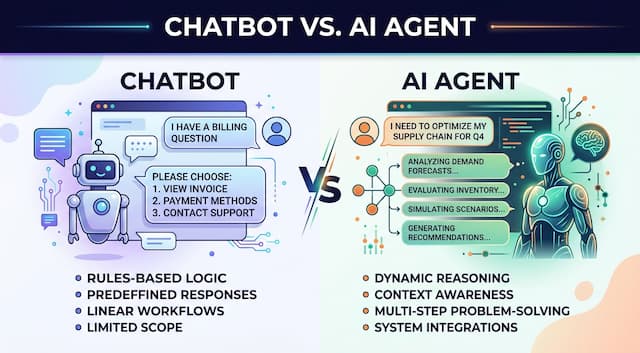
Chatbot vs AI agent in plain terms: what each one does, where the line blurs, and how to add autonomy to support and sales without losing control.
 Zoho Desk vs Zendesk in 2026: The Price Gap, Examined
Zoho Desk vs Zendesk in 2026: included AI vs a quiet meter, and where Zendesk earns it