Tidio vs LiveChat in 2026: One Bills Seats, One Doesn't
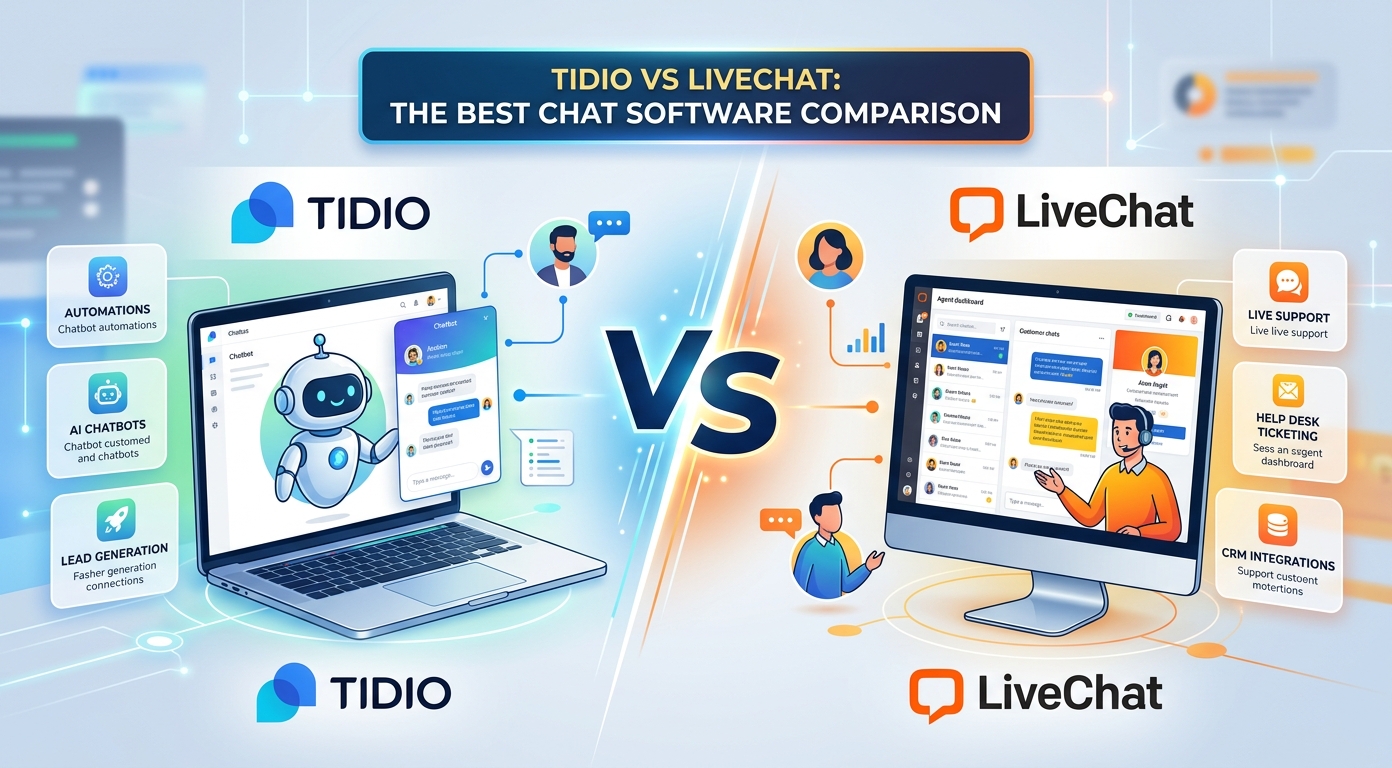
Tidio vs LiveChat used to be a feature debate; in 2026 it is mostly a question of how you want to be billed. Tidio sells a workspace: every plan includes up to 10 seats, and you pay for billable conversations (Free plan, then Starter at $24.17 per month billed annually), with Lyro, its AI agent, as an add-on from $32.50. LiveChat sells seats: $19 per person at Starter, $49 at Team, $79 at Business, billed annually, with its AI chatbot sold as a separate product (ChatBot, from $52 per month). Prices below come straight from the July 2026 published plans.
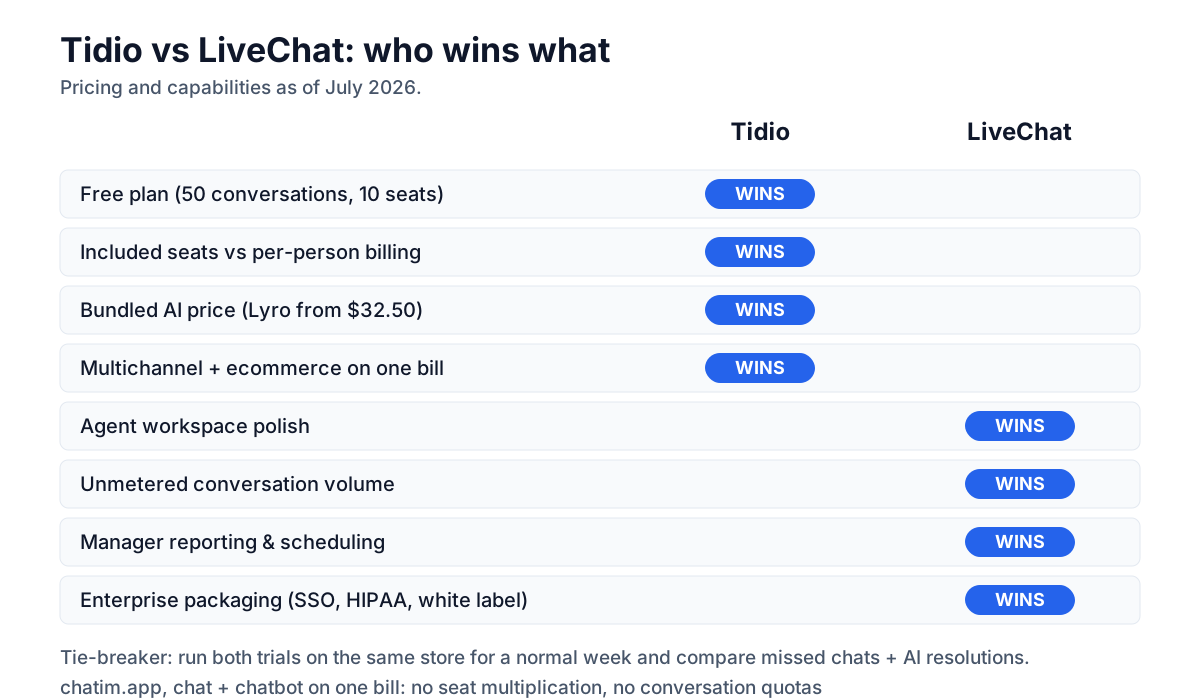
Short verdict: Tidio wins for small teams and ecommerce stores that want a free start, bundled channels, and AI at SMB prices. LiveChat wins for staffed support teams that live in the agent workspace and want the most polished per-seat chat product on the market. The pricing models decide most cases before features do.
Tidio vs LiveChat: the quick table
| Tidio | LiveChat | |
|---|---|---|
| Pricing model | Per workspace: 10 seats included, billed by conversation volume | Per person: every agent seat is billed |
| Free plan | Yes: 50 billable conversations/month, 10 seats | No: 14-day trial only |
| Entry paid (annual) | Starter $24.17/month, 100 conversations | Starter $19/month, 1 user, 100 tracked visitors |
| Mid tier (annual) | Growth from $49.17/month, 250-2,000 conversations | Team $49/person/month, unlimited users |
| AI agent | Lyro add-on from $32.50/month (50 AI conversations) | ChatBot, separate product from $52/month |
| Channels included | Messenger, Instagram, WhatsApp, email native | Website, Messenger; SMS, WhatsApp, email via marketplace or higher tiers |
| Branding removal | Add-on $16.67/month | Full widget customization from Team; white label at Enterprise |
| Design center | Ecommerce SMBs, automation-first | Staffed support teams, agent-workspace-first |
Pricing as listed on the vendors' pricing pages in July 2026, annual billing shown (monthly billing runs higher: LiveChat Starter $25, Team $59, Business $89). Numbers change; confirm on the vendor pages before buying.
What Tidio and LiveChat actually sell
Tidio in 2026: a workspace priced by conversations
Tidio bundles live chat, ticketing, and channel integrations (Messenger, Instagram, WhatsApp, email) into one workspace with up to 10 seats on every self-serve plan. The Free plan covers 50 billable conversations per month; Starter ($24.17 per month billed annually) covers 100; Growth (from $49.17) scales from 250 to 2,000; Plus (from $300 plus usage) and Premium (custom, with pay-per-resolution billing and a guaranteed 50 percent Lyro resolution rate, per Tidio's published plan) serve larger operations. A billable conversation is counted only when a human agent replies, so spam and unanswered messages are free, and bot-handled conversations do not consume the quota. Lyro, Tidio's AI agent, answers from your support content and sells as an add-on from $32.50 per month for 50 AI conversations (Tidio claims it solves up to 67 percent of questions); Flows, the no-code automation builder, starts free for 100 reached visitors. Branding removal is a $16.67 per month add-on.
LiveChat in 2026: the per-seat agent workspace standard
LiveChat (from Text, which also builds ChatBot, HelpDesk, and KnowledgeBase) is the most polished per-agent chat product in the category, now shipping LiveChat 2.0 with a revenue counter in the inbox. Starter is $19 per person per month billed annually but is effectively a solo plan: 1 user, 100 tracked visitors, 60-day history, and basic widget customization. Team at $49 per person is the real starting point for teams: unlimited users and chat history, full customization, campaigns, and basic reporting. Business at $79 adds staffing prediction, a work scheduler, advanced reporting, and SMS plus Apple Messages; Enterprise (by quote) adds white label, SSO, HIPAA, and SLAs. Text Intelligence (reply suggestions, summaries, sentiment) is built into every plan, but autonomous bot conversations belong to ChatBot, a separate product from $52 per month billed annually. As of July 2026, LiveChat's published plans include no free plan; trials run 14 days.
Pricing: seat math vs conversation math
The models are opposites, so the same team gets very different bills.
A 5-agent team: on LiveChat Team, 5 seats at $49 is $245 per month at July 2026 prices. On Tidio, all 5 agents fit inside any plan's 10 included seats; the cost driver is volume, so a store handling 250 human conversations pays Growth at roughly $49.17-$82 depending on quota, plus Lyro if you add AI. Tidio is dramatically cheaper for small teams with moderate volume.
A high-volume operation: the math flips. Tidio's Growth tops out at 2,000 billable conversations; past that you are in Plus territory from $300 per month plus usage. LiveChat never meters conversations: 5 agents handling any volume still pay $245 at Team. Busy teams with few agents are LiveChat's best case; quiet teams with many part-time agents are Tidio's.
The AI line item: Tidio's Lyro from $32.50 (50 AI conversations) undercuts LiveChat's ChatBot from $52, and Lyro conversations do not consume the human quota. At enterprise scale, Tidio's Premium tier offers pay-per-resolution billing with a 50 percent resolution-rate guarantee on its published plan, a model LiveChat's published plans do not match as of July 2026; its answer is Text Intelligence assist features inside the inbox plus ChatBot for automation.
Watch the caps, not just the prices: LiveChat Starter's 1-user and 100-visitor limits make it a solo plan despite the attractive $19; Tidio's billable-conversation definition (only human replies count) is generous, but growing volume walks you up the quota ladder. Model a realistic month on both before deciding.
AI and automation: Lyro vs ChatBot plus Text Intelligence
Tidio's Lyro is an AI agent in the modern sense: it learns from your support content (FAQ upload, website scraper, Zendesk article import), answers open-ended questions, executes Actions, and hands off to humans. It prices per AI conversation (from $32.50 for 50), can run standalone on other helpdesks including Zendesk and Salesforce, and Tidio publishes an up-to-67-percent resolution claim with a guaranteed 50 percent rate on the Premium tier. Flows covers the scripted side: no-code triggers for lead capture, cart nudges, and FAQ paths, free for the first 100 reached visitors.
LiveChat's automation splits in two. Text Intelligence, included in every plan, assists agents: reply suggestions, chat summaries, tag suggestions, text enhancement, and sentiment analysis (early access), with source limits by tier. Autonomous conversations belong to ChatBot, a sibling Text product from $52 per month that builds scripted and AI-assisted flows and integrates natively with the LiveChat inbox. The combination is powerful but is two products with two bills, and the marketing claim (solve up to 80 percent of cases) belongs to ChatBot, not LiveChat itself.
Net: for out-of-the-box AI deflection at SMB prices, Tidio's Lyro is the simpler, cheaper path. For agent-assist inside a premium workspace with automation added deliberately, the LiveChat plus ChatBot stack is deeper but costs more and adds vendor surface.
The third option: Chatim for stores that want one bill
Disclosure: Chatim is our own product. If the Tidio vs LiveChat decision comes down to juggling conversation quotas against per-seat fees, Chatim's answer is simpler: live chat plus a chatbot bundled at predictable per-plan pricing with a free tier, native Shopify and WordPress integrations, and no per-conversation metering or per-agent multiplication.
Try Chatim free at chatim.app →
Agent workspace and features
LiveChat's agent experience is its moat: the inbox is fast, keyboard-friendly, and now revenue-aware in 2.0; Business adds staffing prediction, a work scheduler, agent performance reports, and on-demand reporting that support managers actually use. Tidio's panel is clean and modern with a live visitors list, macros, viewed-pages history, automatic assignment, and analytics that grow by tier, but it is built for lean teams rather than managed departments; permissions and advanced analytics arrive on Growth, and departments only at Plus. If you employ a support manager who schedules shifts, LiveChat earns its per-seat premium; if the founder answers chats between other jobs, Tidio's defaults are enough.
Channels and ecommerce fit
Tidio includes Messenger, Instagram, WhatsApp, and email integrations natively on its plans, and its Shopify app ships native actions (cart data, order lookups) that make it a default pick in ecommerce; WordPress and WooCommerce integrations are first-class. LiveChat covers website and Messenger cleanly, gates SMS and Apple Messages to Business, and routes WhatsApp, email, and X through marketplace integrations; its Shopify app is solid and product cards in chat are polished, but the deep ecommerce automation lives in the wider Text ecosystem. For multichannel SMB support on one bill, Tidio is ahead; for website-first chat excellence, LiveChat is.
Reporting, ecosystem, and enterprise
LiveChat's reporting depth (agent performance, staffing prediction, on-demand reports) plus the Text product family (HelpDesk ticketing, KnowledgeBase self-service, ChatBot automation) gives it a real upgrade path into a full support stack, and Enterprise brings SSO, HIPAA, white label, and SLAs. Tidio counters with unified analytics across chat, Lyro, and Flows, OpenAPI and custom analytics at Plus, and Premium-tier compliance features (SSO, dedicated services). Enterprises with procurement checklists usually find LiveChat's package more familiar; Tidio's top tiers exist but its center of gravity remains SMB.
Which one fits your team?
Pick Tidio if...
- You want a free start with a real plan (50 conversations per month, 10 seats), not just a trial.
- Your team is small but several people share chat duty: 10 included seats beat per-person billing.
- Ecommerce is the job: native Shopify actions, WooCommerce support, and cart-aware automation.
- You want AI answering customers this week: Lyro from $32.50 without a second product to configure.
- Multichannel on one bill matters: Messenger, Instagram, WhatsApp, and email included.
Pick LiveChat if...
- Agents work chat full-time: the workspace, shortcuts, and 2.0 revenue tracking repay the per-seat price.
- Volume is high and headcount is low: unmetered conversations at $49 per person beat quota ladders.
- A support manager runs the team: staffing prediction, work scheduler, and agent reports are the real product.
- You want an upgrade path into a full stack: HelpDesk, KnowledgeBase, and ChatBot integrate natively.
- Enterprise requirements loom: white label, SSO, HIPAA, and SLAs are packaged and familiar.
If you decide to switch later
Both directions are easy by helpdesk standards: install the other widget, port canned responses and operating hours, reconnect channels, and re-point the Shopify or WordPress plugin. Chat history exports archive rather than migrate cleanly, so plan on a fresh start with an archived record. Run both trials in parallel (Tidio's 7 days, LiveChat's 14) on the same store, and compare a normal week's workload: time-to-first-response, missed chats, and, if you test AI, real resolution rates from Lyro vs a ChatBot flow. For the broader field, see our guides to Tidio alternatives and LiveChat alternatives, the full ranking of the best live chat software, and the platform guides for Shopify and WordPress and WooCommerce.
For more head-to-head comparisons, see Tidio vs Intercom, LiveChat vs Zendesk, Crisp vs Tidio, and tawk.to vs Tidio.
Frequently Asked Questions
Is Tidio or LiveChat better in 2026?
They price for different teams. Tidio wins for small teams and ecommerce stores: a real free plan (50 conversations per month, 10 seats included), bundled Messenger, Instagram, WhatsApp, and email channels, and Lyro AI from $32.50 per month. LiveChat wins for staffed support teams: the most polished per-agent workspace in the category, unmetered conversation volume, manager-grade reporting, and an enterprise package (SSO, HIPAA, white label). The pricing models usually decide it before features do.
Which is cheaper, Tidio or LiveChat?
For small teams, Tidio: all plans include up to 10 seats, so 5 agents on Growth (from $49.17 per month billed annually) cost a fraction of 5 LiveChat Team seats ($245 at $49 per person). For high-volume teams with few agents, LiveChat: it never meters conversations, while Tidio's quota ladder tops out at 2,000 billable conversations before the Plus tier (from $300 plus usage). Both as of July 2026. Model one realistic month on each before choosing.
How much does Tidio cost in 2026?
As listed on the vendor’s pricing page in July 2026, billed annually: Free $0 (50 billable conversations/month, 10 seats), Starter $24.17 per month (100 conversations), Growth from $49.17 (250 to 2,000 conversations), Plus from $300 plus monthly usage (custom limits, dedicated CSM), Premium by quote (3,000+ Lyro conversations, pay-per-resolution billing, and the 50 percent resolution guarantee Tidio publishes). Add-ons: Lyro AI from $32.50 per month (50 AI conversations), Flows from $24.17 (2,000 reached visitors), branding removal $16.67.
How much does LiveChat cost in 2026?
As listed on the vendor’s pricing page in July 2026, billed annually: Starter $19 per person per month (1 user, 100 tracked visitors, 60-day history), Team $49 per person (unlimited users and history, full customization), Business $79 (staffing prediction, scheduler, advanced reports, SMS), Enterprise by quote (white label, SSO, HIPAA, SLAs). Monthly billing runs $25/$59/$89. ChatBot, the AI automation product, is separate from $52 per month. No free plan; 14-day trial.
What counts as a billable conversation on Tidio?
Only conversations where a human agent replies (or that an agent proactively starts). Spam, unanswered visitor messages, and conversations handled entirely by Lyro AI or Flows automation do not consume the quota, and a thread counts once regardless of message count. This definition is generous for automation-heavy stores: the more your bot resolves, the fewer billable conversations you use. It also means adding Lyro effectively stretches your human quota rather than competing with it.
Does LiveChat have a free plan?
As of July 2026, LiveChat's published plans do not include one; it offers a 14-day free trial (no credit card), after which every plan bills per person, starting at $19 per month billed annually for the single-user Starter. Tidio keeps a free forever plan with 50 billable conversations per month and 10 seats. If free matters long-term, that structural difference, trial versus free tier, usually settles the comparison for very small teams.
How do Lyro and ChatBot compare for AI?
Lyro is Tidio's AI agent: it learns from your support content, answers open questions, executes actions, and hands off to humans, from $32.50 per month for 50 AI conversations, with Tidio claiming up to 67 percent resolution and guaranteeing 50 percent on the Premium tier. ChatBot is a separate Text product (from $52 per month billed annually) that builds scripted and AI-assisted flows integrating natively with LiveChat, marketed at solving up to 80 percent of routine cases. Lyro is cheaper and simpler; the LiveChat plus ChatBot stack is deeper but two products and two bills.
Can Lyro work with helpdesks other than Tidio?
Yes. Tidio sells Lyro as a standalone AI agent that plugs into Zendesk, Salesforce, and other helpdesk software, priced by AI conversation with no requirement to use Tidio's own inbox. That mirrors Intercom's Fin-standalone strategy and gives teams a low-commitment way to add AI deflection to an existing stack. LiveChat's Text Intelligence assist features, by contrast, live inside LiveChat itself, with ChatBot as the automation layer.
Which is better for Shopify and WooCommerce, Tidio or LiveChat?
Tidio, for most stores. Its Shopify app includes native actions (cart data, order lookups), its WooCommerce and WordPress plugins are first-class, and its pricing suits small-store economics. LiveChat's Shopify app is polished, with product cards in chat, and suits larger stores staffed by full-time agents. See our platform guides to live chat for Shopify and WordPress live chat plugins for the full rankings including both.
Which has better reporting and team management?
LiveChat, clearly, from Business tier up: staffing prediction, a work scheduler, agent performance reports, and on-demand reporting are tools an actual support manager uses weekly. Tidio's analytics are solid for SMBs (basic on Starter, advanced from Growth, custom at Plus) and unify chat, Lyro, and Flows in one view, but departments and granular permissions arrive only at the top tiers. If someone's job title includes managing the support team, LiveChat's per-seat premium buys real tooling.
Do Tidio and LiveChat limit tracked visitors?
LiveChat does: Starter tracks up to 100 concurrent visitors, Team 400, Business 1,000, with custom limits at Enterprise; high-traffic sites should size this cap first. Tidio does not meter visitor tracking the same way; its levers are billable conversations, Lyro AI conversations, and Flows reached visitors (100 free, up to 100,000 on paid quotas). Both models are workable; just make sure the cap you hit first is one you can afford to raise.
Is it easy to switch between Tidio and LiveChat?
Yes, in either direction, by helpdesk standards: install the other widget (both ship WordPress and Shopify plugins), port canned responses, operating hours, and channel connections, and archive chat history exports since history does not migrate cleanly. Run the trials in parallel (7 days on Tidio, 14 on LiveChat) over the same store traffic and compare missed chats, time-to-first-response, and AI resolution on identical questions before committing.
Do I need either Tidio or LiveChat at all?
Count your monthly conversations first. Under roughly 50 human conversations per month, free tiers cover you (Tidio Free, or free-forever tools like Tawk.to and Chatim's free plan). Both platforms earn their money when volume, channels, or team coordination grow past that. Our guides to Tidio alternatives and LiveChat alternatives map the cheaper and adjacent options, including the free tier of the market, if the honest answer is that a lighter tool fits today.
Related articles
More in Comparisons → Live Chat vs Chatbot: Which One Does Your Website Need?
Live chat vs chatbot in plain terms: what each does best, where each fails, and the bot-first, human-close handoff pattern that beats running either alone.
 Help Desk vs Service Desk: The Real Difference (2026)
Help desk vs service desk in one line: issue-fixing vs service lifecycle. The five differences that matter, why the terms blur, and which one you need.
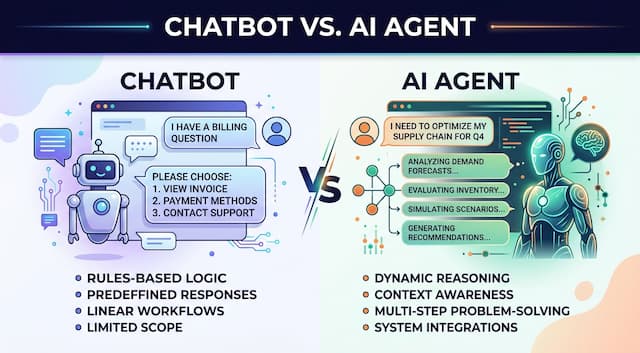 Chatbot vs AI Agent: Where the Line Actually Sits (2026)
Chatbot vs AI agent in plain terms: what each one does, where the line blurs, and how to add autonomy to support and sales without losing control.
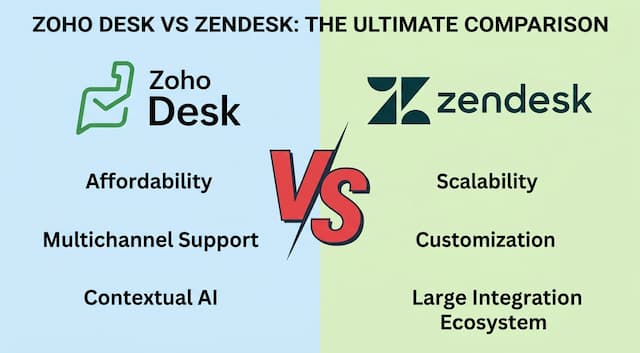 Zoho Desk vs Zendesk in 2026: The Price Gap, Examined
Zoho Desk vs Zendesk in 2026: included AI vs a quiet meter, and where Zendesk earns it