Zendesk vs Salesforce in 2026: Support Desk or CRM Suite
Nobody shortlists Zendesk vs Salesforce casually. One is the default answer to "we need a support tool"; the other is the CRM your revenue team may already live in, with customer service sold as an edition of the platform. That difference in gravity decides more of this comparison than any feature list: Zendesk is bought by support leaders and running in weeks, Salesforce Service Cloud is bought by companies and rolled out as a project. It also produces two very different bills. Zendesk prices support seats from $19 to $115 per agent per month billed annually and meters its AI per automated resolution at a rate it does not display. Salesforce prices Service Cloud editions from $25 to $550 per user per month and publishes two AI meters for Agentforce: $2 per conversation, or Flex Credits at $500 per 100,000 drawn down per action. This comparison prices both stacks at July 2026 published rates and calls out where each one genuinely wins.
The short answer on Zendesk vs Salesforce
| Zendesk | Salesforce Service Cloud | |
|---|---|---|
| What it is | A support suite, sold to support teams | A CRM platform with service editions |
| Entry point | Support Team $19 per agent (ticketing only) | Starter Suite $25 per user (CRM suite, transaction fees apply) |
| Mid tier | Suite Team $55, omnichannel included | Enterprise $175 (AI, help center, workflow automation) |
| Top tier | Suite Professional $115, Enterprise by quote | Unlimited $350; Agentforce 1 Service $550 with 2.5M Flex Credits |
| AI agent billing | Per automated resolution, rate not displayed | $2 per conversation, or $500 per 100k Flex Credits, published |
| Copilot for agents | $50 per agent add-on | Bundled into higher editions and Agentforce 1 |
| Time to value | Days to weeks, minimal admin | Weeks to months, admin or partner expected |
| Best when | Support is the job to solve now | The company already runs on Salesforce |
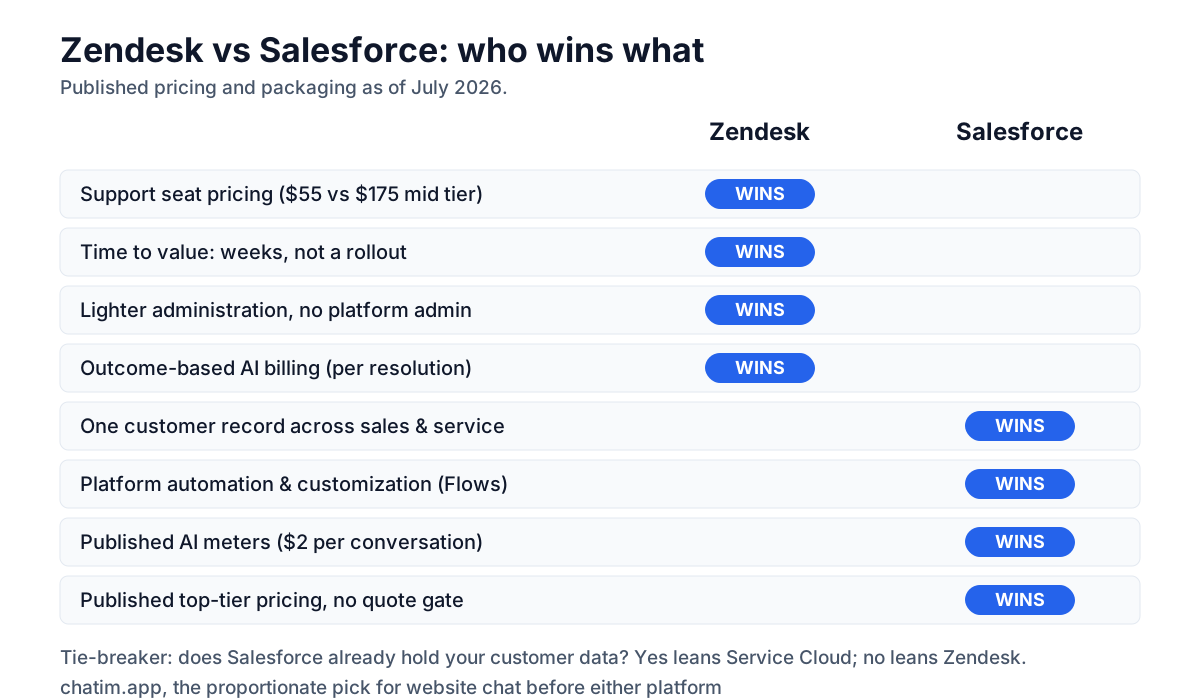
If your company does not already use Salesforce, Zendesk is almost always the shorter, cheaper path to good support. If Salesforce already holds your customer data, Service Cloud starts with an advantage no support tool can buy: the service agent sees the same record as sales, marketing, and commerce.
Both vendors label these as published or starting prices and reserve the right to change them; Salesforce's page notes transaction fees on lower suites and that pricing is subject to change. Confirm on the vendors' pages before you commit.
A support suite against a CRM platform
Zendesk: support software, priced as such
Zendesk sells exactly one job: customer support at scale. Ticketing, messaging, email, help center and voice ship in the Suite from $55 per agent per month billed annually (Suite Team), rising to $115 at Suite Professional and quote-only at Enterprise, with a $19 ticketing-only Support Team plan underneath. The extras are itemized where Salesforce bundles: agent Copilot at $50 per agent, Workforce Engagement at $50, advanced Contact Center at $83, and AI agents billed per automated resolution at a rate the pricing page does not display, commonly published around $1.50. A support leader with a corporate card can have it answering customers this week.
Salesforce Service Cloud: service as a CRM edition
Service Cloud is Salesforce with a headset. Starter Suite at $25 per user per month is a small-business CRM covering sales, service, marketing and commerce with transaction fees on top; Pro Suite at $100 adds real-time chat and requires an annual contract; Enterprise at $175 brings AI for customer service, a self-service help center and workflow automation; Unlimited at $350 adds chat, bots, Knowledge and a full sandbox with the Premier Success plan. At the top sits Agentforce 1 Service at $550 per user, the everything edition Salesforce markets as its best for service, bundling the full AI suite, unmetered employee-facing Agentforce use, Tableau Next analytics, and 2.5 million Flex Credits per org per year. All of it presumes the Salesforce platform underneath: objects, Flows, permission sets, and someone who administers them.
Pricing: seat ladders on very different slopes
Take a 10-agent support team that needs omnichannel support and self-service. On Zendesk that is Suite Team at $550 per month, or $1,050 with Copilot on every agent. The comparable Salesforce rung is Enterprise at $1,750 per month, more than triple the base Zendesk bill, before implementation. The gap is not padding: the Salesforce number buys platform customization, Flow automation and a shared customer record that Zendesk cannot replicate, but a team that just needs tickets answered will never use enough of it to break even.
The slopes also behave differently at the ends. At the bottom, Salesforce's $25 Starter Suite looks cheaper than Zendesk Suite Team, but it is a lightweight CRM suite with service basics and transaction fees, not a support desk; pricing it against Suite Team flatters it into the wrong category. At the top, the positions flip: Salesforce publishes its ceiling ($350 Unlimited, $550 Agentforce 1) while Zendesk sends enterprise buyers to sales for a quote. Enterprises that want list prices on the table before procurement lean Salesforce here; everyone below about 20 agents leans Zendesk on raw arithmetic, at July 2026 prices.
AI: Agentforce's two meters vs Zendesk's one
Salesforce publishes both of its AI meters. Agentforce customer-facing agents cost a flat $2 per conversation on the pre-purchase model, or you buy Flex Credits at $500 per 100,000 and let each agent action draw them down at rates set by Salesforce's rate card (the per-action cost is on the rate card, not the pricing page, so get it in writing). A free Foundations tier lets teams build agents before paying for usage, and Agentforce 1 Service includes 2.5 million credits per org per year in its $550 seat. Zendesk publishes its meter's logic but not its price: AI agents bill per automated resolution, counted only when the AI resolves without human escalation, at a rate commonly published around $1.50.
The meters bill different events, so unit prices mislead. A conversation is not a resolution: at 1,000 AI-handled conversations a month with a 60 percent resolution rate, Agentforce's conversation meter bills all 1,000 ($2,000) while Zendesk bills the 600 resolutions, roughly $900 at the commonly cited rate. On those numbers Zendesk's outcome meter wins the math even without a printed price, and the Flex Credit path can land anywhere depending on how many actions your flows burn. The honest move with both vendors is the same: run a month of real traffic through a trial and price the meter on your own transcript, not the vendor's example.
The third option: Chatim for the website front line
Disclosure: Chatim is our own product. Plenty of teams comparing these two are really buying a way to answer website visitors, and neither a $550 platform seat nor a metered enterprise suite is the proportionate tool for that. Chatim covers live chat plus chatbot automation at predictable per-plan pricing with a free tier and native Shopify and WordPress integrations; keep the CRM decision separate and let the website front line pay for itself first.
Try Chatim free at chatim.app →
Platform gravity: data, admin, and AppExchange
Salesforce's real product is the shared object model. When service, sales and commerce read one customer record, deflection bots can check order status, agents can see lifetime value, and executives get one report; that is what the premium buys, and it compounds with every Salesforce cloud you already own. The cost is administration: Service Cloud assumes a Salesforce admin or implementation partner, and changes travel through a platform, not a settings page. Zendesk's center of gravity is the support team itself: admin work an ops-minded lead can own, a marketplace built specifically around support tooling, and integrations into whatever CRM you run, including Salesforce. Buy Salesforce for the data gravity; buy Zendesk to avoid inheriting a platform.
Voice, channels, and implementation reality
Zendesk treats channels as products you switch on: messaging, email, help center and social in every Suite plan, voice built in and expandable to the $83 per agent Contact Center. Salesforce covers the same channels but assembles them: chat arrives at Pro Suite, bots and Knowledge mature through Enterprise and Unlimited, voice lands via Service Cloud Voice with telephony partners, and each piece is configured on the platform. That assembly is the recurring theme of this matchup: Salesforce can match or exceed every Zendesk capability, and will ask for configuration, an admin, or a partner invoice at each step. Budget time-to-value like a line item; on that line, Zendesk wins by weeks.
Which one earns your seats
Zendesk is the right buy when...
- Support is the problem you are solving this quarter: live in weeks, not a rollout plan.
- Nobody on staff administers Salesforce, and you would rather not hire for it.
- 10 agents at $550 per month beats $1,750 for depth you will not configure.
- You want AI billed on outcomes: pay per resolution rather than per conversation.
Salesforce is the right buy when...
- Your company already runs Salesforce: the shared customer record is the whole argument.
- Service must plug into sales, commerce and marketing processes, not sit beside them.
- You want published AI meters and can pre-buy usage ($2 per conversation, or credit packs).
- The top of your plan is platform consolidation, and Agentforce 1's bundled credits price it.
Switching, and what it really costs
Moving between these two is less a data migration than a re-implementation. Tickets, contacts and knowledge articles transfer with standard tools and partners in either direction; what does not transfer is the automation layer, which gets rebuilt as Zendesk triggers and macros or as Salesforce Flows, and on the Salesforce side that usually means partner hours in the budget. Both offer working trials (Zendesk's 14 days default to Suite Professional with Copilot; Salesforce trials run on the suites, with the free Foundations tier for testing Agentforce builds), so pilot the AI on real tickets before signing either meter. For the wider field, see our guides to Zendesk alternatives, HubSpot alternatives, Intercom alternatives, Zoho alternatives, and the full ranking of the best live chat software.
For more head-to-head comparisons, see Zendesk vs Freshdesk, Intercom vs Zendesk, Help Scout vs Zendesk, and HubSpot vs Zendesk.
Frequently Asked Questions
Is Zendesk or Salesforce better for customer service in 2026?
It depends on what your company already runs. If Salesforce holds your customer data, Service Cloud starts with an advantage no support tool can buy: agents work the same record as sales and commerce. If not, Zendesk is almost always the shorter and cheaper path: omnichannel support from $55 per agent per month billed annually, live in weeks, no platform admin required. Salesforce editions for comparable support depth start at $175 per user and assume configuration work.
How much does Salesforce Service Cloud cost in 2026?
Salesforce's published starting prices are Starter Suite at $25 per user per month (a small-business CRM suite; transaction fees apply), Pro Suite at $100 (annual contract; real-time chat arrives here), Enterprise at $175, Unlimited at $350, and Agentforce 1 Service at $550 per user per month billed annually, which bundles the full AI suite and 2.5 million Flex Credits per org per year. Salesforce notes its pricing page is informational and subject to change, so confirm with sales.
How much does Zendesk cost in 2026?
Zendesk's published annual-billing prices are Support Team at $19 per agent per month (ticketing only), Suite Team at $55, Suite Professional at $115, and Suite Enterprise by quote. Add-ons are itemized: Copilot at $50 per agent, Workforce Engagement at $50, Contact Center at $83. AI agents are metered per automated resolution; Zendesk does not print that rate. As of July 2026; verify on zendesk.com.
How is Agentforce priced?
Salesforce publishes two consumption meters for Agentforce. The Conversations model bills a flat $2 per customer-facing conversation on a pre-purchase basis. The Flex Credits model sells credits at $500 per 100,000, and each agent action draws credits at rates set on Salesforce's rate card, so ask for the per-action costs in writing. There is a $0 Foundations tier for building agents before you pay for usage, and the $550 Agentforce 1 Service edition includes 2.5 million Flex Credits per org per year.
Is Agentforce's $2 per conversation cheaper than Zendesk's AI?
Usually not per outcome, at the commonly cited rates. Agentforce's conversation meter bills every AI conversation whether or not it resolves; Zendesk bills only automated resolutions, at an undisplayed rate commonly published around $1.50. At 1,000 AI conversations with a 60 percent resolution rate, Agentforce bills about $2,000 while Zendesk bills roughly $900. The comparison flips only if your resolution rate is very high or your Flex Credit costs per action work out lower; test both on real traffic.
What is Agentforce 1 Service Edition?
It is Salesforce's top service bundle, marketed on its pricing page as the best of Salesforce for Service: $550 per user per month billed annually for everything in Unlimited plus the full AI suite, unmetered employee-facing Agentforce usage, Tableau Next analytics, and 2.5 million Flex Credits per org per year for customer-facing agents. It is the consolidation play: one SKU instead of a suite plus add-ons plus usage packs. Price it against your real usage before assuming the bundle wins.
Is Salesforce overkill for a small support team?
For most teams under about 20 agents, yes. The $25 Starter Suite is a lightweight CRM with service basics and transaction fees, not a full support desk, and the editions that match Zendesk's depth start at $175 per user per month plus implementation. A 10-agent team pays Zendesk Suite Team $550 per month against $1,750 for Service Cloud Enterprise, at July 2026 prices. Salesforce earns the premium when the CRM platform is the point, not the ticket queue.
We already use Salesforce CRM. Should we still consider Zendesk?
Yes, but the bar is higher. Zendesk integrates with Salesforce and many companies run exactly that pairing to get support-first UX at support-tool prices. The trade is a synced copy of the customer record instead of the native one, and one more vendor. If your service processes need to trigger Salesforce Flows, update shared objects, or feed platform analytics natively, Service Cloud's integration advantage usually wins; if support just needs CRM context visible, the connector is enough.
How long does each take to implement?
Zendesk is typically live in days to weeks: connect channels, import articles, set triggers, go. Service Cloud is a project measured in weeks to months, usually with a Salesforce admin or implementation partner configuring objects, Flows, permissions and console layouts. Neither number is a criticism; they reflect what is being installed. Budget time-to-value as a real cost line when comparing bills, because it is the biggest hidden difference between the two.
How do voice and phone support compare?
Zendesk includes voice in the Suite and scales to a full contact center add-on at $83 per agent per month, all one vendor. Salesforce handles voice through Service Cloud Voice, which pairs the console with telephony from Amazon Connect or partner providers, configured on the platform. Zendesk is the simpler single-vendor buy; Salesforce offers more flexibility in telephony choice at the cost of assembly work.
Can I migrate from Salesforce Service Cloud to Zendesk, or the other way?
Yes. Tickets, contacts and knowledge content move with standard importers and migration partners in both directions. The real cost is the automation layer: business rules rebuild as Zendesk triggers and macros or as Salesforce Flows, and the Salesforce side of that usually involves partner hours. Run the destination's trial against a copy of real workload first; both vendors' trials are functional enough for a genuine pilot.
Do we need a platform like either of these at all?
If the actual job is answering website visitors and converting them, no. Suites earn their bills when routing, governance and cross-team process are the problem. A small team can cover website chat, common-question automation and lead capture with a chat-plus-chatbot tool instead: our own Chatim does exactly that with a free tier and native Shopify and WordPress integrations, and the disclosure is that it is our product. Solve the front line first; buy a platform when process demands one.
Related articles
More in Comparisons → Live Chat vs Chatbot: Which One Does Your Website Need?
Live chat vs chatbot in plain terms: what each does best, where each fails, and the bot-first, human-close handoff pattern that beats running either alone.
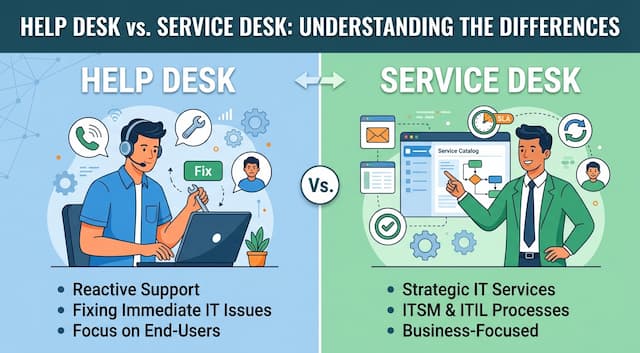 Help Desk vs Service Desk: The Real Difference (2026)
Help desk vs service desk in one line: issue-fixing vs service lifecycle. The five differences that matter, why the terms blur, and which one you need.
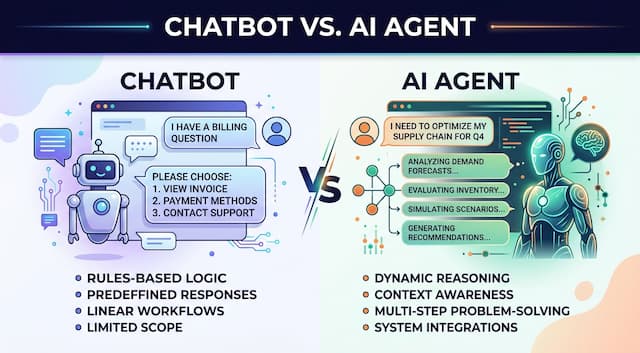 Chatbot vs AI Agent: Where the Line Actually Sits (2026)
Chatbot vs AI agent in plain terms: what each one does, where the line blurs, and how to add autonomy to support and sales without losing control.
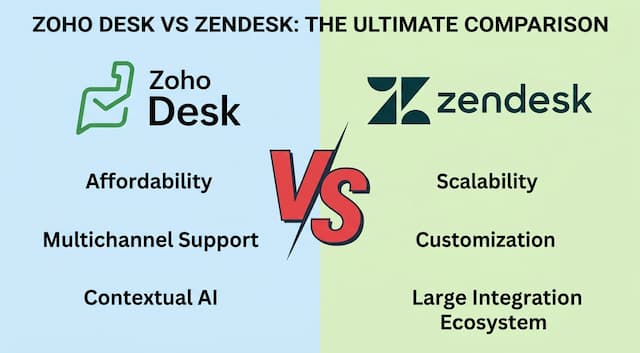 Zoho Desk vs Zendesk in 2026: The Price Gap, Examined
Zoho Desk vs Zendesk in 2026: included AI vs a quiet meter, and where Zendesk earns it