LiveAgent vs Zendesk (2026): Budget Bundle or Big Suite?
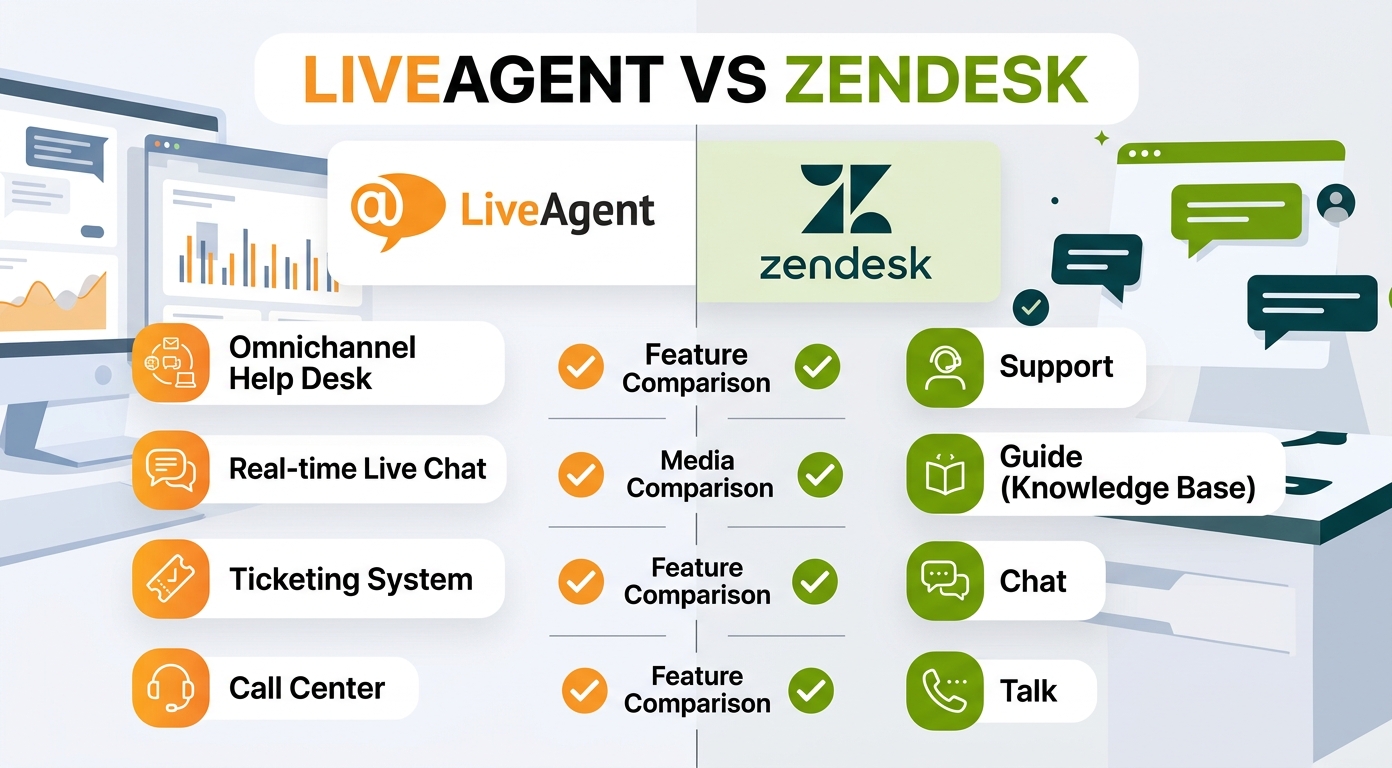
LiveAgent vs Zendesk asks the oldest question in helpdesk software: how much of the enterprise standard do you actually need, and what does the budget all-in-one give up to undercut it? LiveAgent's pitch is Zendesk-like breadth (email ticketing, live chat, knowledge base, social channels, and a real built-in call center) at per-agent prices that top out where Zendesk's begin: $15 to $69 per agent per month billed annually, with an AI chatbot and AI Answer Assistant included on every plan. Zendesk answers with the deepest ecosystem in customer service: Suite Team at $55 per agent, Suite Professional at $115, AI agents billed per automated resolution, and a marketplace and admin talent pool no rival matches. Prices are the vendors' published July 2026 tiers.
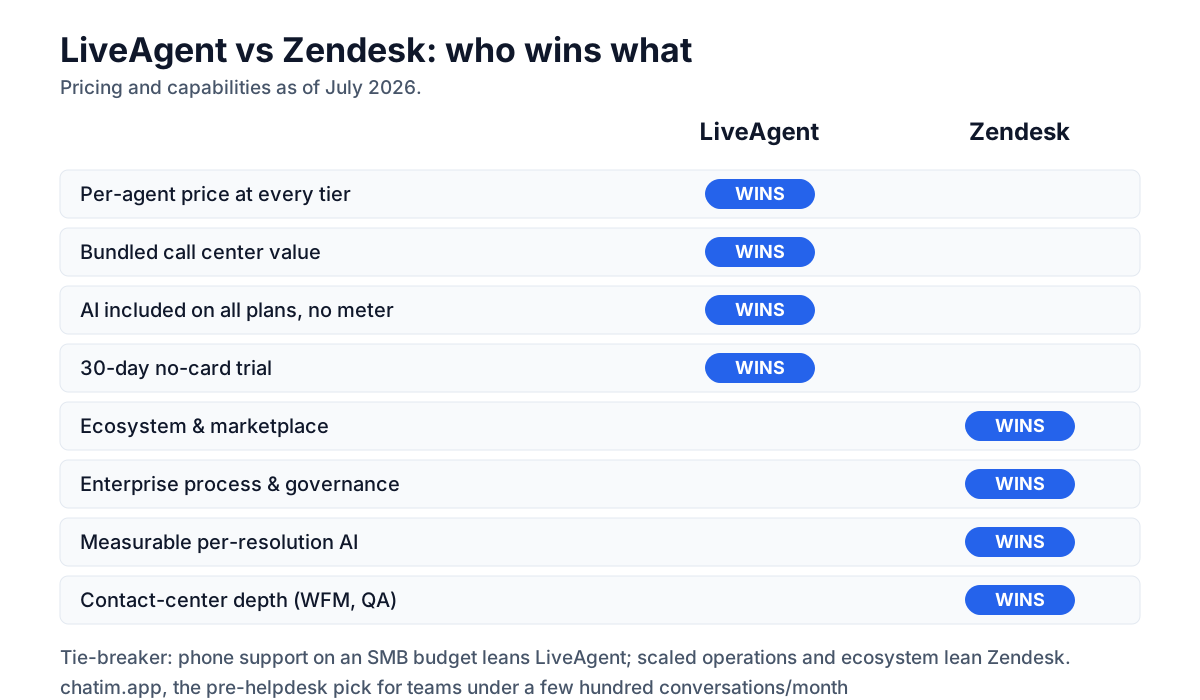
Short verdict: if phone support matters and the budget is SMB-sized, LiveAgent delivers the bundle at a fraction of the stacked Zendesk cost. If you are building a scaled support operation on process, governance, and integrations, Zendesk earns its premium. The honest math depends on which add-ons you would actually buy, so the worked examples below stack them explicitly.
LiveAgent vs Zendesk, condensed
| LiveAgent | Zendesk | |
|---|---|---|
| Entry (annual) | Small Business $15/agent/month | Support Team $19/agent (ticketing only); Suite Team $55 |
| Top published tier | Enterprise $69/agent/month | Suite Professional $115/agent (Enterprise by quote) |
| Call center | Built in on every plan: IVR, routing, recordings | Telephony in Suite; full Contact Center add-on $83/agent |
| AI | AI chatbot + AI Answer Assistant included on every plan | AI agents per automated resolution (rate not displayed); Copilot $50/agent add-on |
| Social channels | WhatsApp, IG, FB, X, Viber: $39/month add-ons on lower tiers, bundled on Large/Enterprise | Messaging channels bundled in Suite |
| Free plan / trial | No free plan; 30-day trial, no card | No free plan; 14-day trial (defaults to Suite Professional) |
| Ecosystem | Solid integrations, smaller catalog | Largest marketplace in customer service |
| Design center | SMB all-in-one value | Support operations at scale |
Pricing and features change frequently, verify on each vendor's official pricing page before purchase. Annual billing shown (LiveAgent monthly runs $19-$85). Always re-check the vendor pages before purchase; prices move.
The budget bundle and the big suite
LiveAgent in 2026: the bundled value play
LiveAgent, built by Quality Unit, packs an unusual amount into SMB per-agent pricing: email ticketing, live chat, a knowledge base, social channels, and, rarest of all at this price, a genuine call center with IVR, call routing, call recordings, callbacks, and voicemail. Tiers run Small Business $15, Medium $29, Large $49, and Enterprise $69 per agent per month billed annually, with a 30-day no-card trial and an AI chatbot plus AI Answer Assistant included on every plan. The catches are structural: there is no free forever plan, WhatsApp, Instagram, Facebook, X, and Viber cost $39 per month each as add-ons on the Small and Medium tiers (they bundle into Large and Enterprise), and the admin surface is utilitarian and configuration-dense compared with newer tools. For teams that use the whole bundle, especially voice, the price-to-capability ratio is the category's best.
Zendesk in 2026: the operations standard
Zendesk remains the reference implementation of support at scale: ticketing with skills-based routing and SLA machinery, messaging and help center, voice, workforce tools, and the largest integration marketplace in the industry, staffed by the deepest pool of experienced admins. Support Team at $19 per agent per month covers email ticketing alone; Suite Team at $55 adds AI agents, knowledge base, omnichannel routing, messaging, and telephony; Suite Professional at $115 adds admin Copilot, App Builder, skills routing, and IVR, with Enterprise by quote. AI agents bill per automated resolution (counted only without human escalation; the rate is not displayed on the pricing page), agent Copilot is a $50 per agent add-on, and a full Contact Center runs $83 per agent. Where LiveAgent bundles, Zendesk itemizes, and where LiveAgent saves money, Zendesk buys process depth, ecosystem, and hiring optionality.
Pricing: bundled vs itemized
The list prices are only the opening bid; the add-on stacking decides the real gap. The scenarios below use published July 2026 prices on annual billing.
5-agent team, chat and email only: LiveAgent Medium runs $145 per month; Zendesk Suite Team runs $275. Both cover the workload; the gap is $1,560 per year for capability this team may never notice. If two social channels matter on LiveAgent's Medium tier, add $78 in add-ons and the gap narrows to about $52 per month.
8-agent team with real phone support: this is LiveAgent's showcase. Its call center is included: 8 agents on Large cost $392. The equivalent Zendesk stack (Suite Team $440 plus Contact Center at $83 per agent, $664) lands at $1,104, nearly three times the price at July 2026 rates. Even granting that Zendesk's telephony and workforce tooling run deeper, the delta funds a lot of imperfection.
AI-heavy operation: the models differ in kind. LiveAgent includes its AI chatbot and Answer Assistant in every plan with no per-resolution meter on the pricing page. Zendesk meters AI agents per automated resolution (rate undisplayed; commonly cited around $1.50) plus $50 per agent for Copilot. If deflection volume is high, get Zendesk's rate in writing and model it; if you want AI included in a flat seat price, LiveAgent's bundle is the simpler bet, with the caveat that its AI is younger and less proven than Zendesk's.
AI: included vs metered
LiveAgent's AI ships on every plan: a chatbot for deflection and an AI Answer Assistant that drafts replies from your knowledge base. It is the value story (no meter, no add-on), but the public evidence base (resolution benchmarks, case studies at scale) is thinner than what the AI-first vendors publish, so trial it against your real tickets during the 30 days.
Zendesk's AI is the operations story: AI agents resolving against your help center with billing that counts only clean, non-escalated resolutions, intelligent triage and auto-assist on higher tiers, a $50 Copilot for agents, and the Forethought partnership inside its ecosystem. It is more mature, more measurable, and more expensive, and the undisplayed per-resolution rate means the true cost lives in a sales conversation.
Net: LiveAgent for AI-included simplicity at SMB scale; Zendesk for measured, per-outcome automation inside an enterprise workflow. Neither should be chosen on the vendor's AI claims alone; both trials are long enough to measure deflection on your own traffic.
The third option: Chatim under the helpdesk threshold
Disclosure: Chatim is our own product. A small team fielding website questions does not need a call center or a ticketing suite. Chatim pairs live chat with chatbot automation at predictable per-plan pricing with a free tier and native Shopify and WordPress integrations. Start there; graduate to LiveAgent or Zendesk when tickets, routing, or phone volume actually bind.
Try Chatim free at chatim.app →
Voice: the axis that decides most cases
If phone support is core, this comparison usually ends here. LiveAgent's call center (IVR trees, routing, recordings, callbacks, voicemail) is part of every plan, which makes it one of the only SMB-priced helpdesks where voice is not an afterthought or an add-on. Zendesk's voice stack is deeper at the top end: bundled telephony in Suite, IVR at Professional, and the $83 Contact Center add-on bringing workforce management, quality assurance, and the tooling a 50-seat phone operation actually needs. SMB phone volume belongs on LiveAgent's economics; contact-center operations belong on Zendesk's architecture. The middle (10 to 20 agents with meaningful call volume) should price both stacks precisely, because this is where the three-times gap either justifies itself or does not.
Process, ecosystem, and scale
Zendesk's moat is everything around the ticket: skills-based routing, SLA policies, approval workflows and sandboxes at Enterprise, custom roles, audit-grade governance, warehouse-friendly data, and a marketplace where nearly every support-adjacent tool ships a first-class integration. Hiring is part of the moat too: experienced Zendesk admins are a job market, not a search. LiveAgent covers SMB process well (rules, SLAs, departments, tags, reporting) and integrates with the mainstream stack, but its catalog is smaller and complex orgs will hit edges. Teams planning to double headcount or add compliance requirements should weigh Zendesk's headroom against paying for it years early.
The decision, case by case
LiveAgent wins if...
- Phone support matters and the budget is SMB-sized: the bundled call center at $15-$69 per agent is the category's best voice value.
- You want one bill with AI included: chatbot and Answer Assistant ship on every plan with no per-resolution meter.
- Your team is under roughly 20 agents and uses the whole bundle: ticketing, chat, knowledge base, and voice together.
- A 30-day no-card trial fits how you evaluate: twice Zendesk's window, on the tiers you would actually buy.
- Every dollar counts: at 5 to 10 agents the stack costs a third to half of the equivalent Zendesk build.
Zendesk wins if...
- You are building a scaled operation: skills routing, SLA machinery, governance, and sandboxes are the product.
- The ecosystem matters: the largest marketplace and admin talent pool in support reduce every future project's cost.
- AI must be measurable: per-resolution billing and mature AI agents beat included-but-younger AI for volume deflection.
- Contact-center depth is required: workforce management and QA tooling live on this side.
- You expect to grow into enterprise requirements: buying headroom now beats migrating later.
The cost of switching later
Both directions are well supported: native importers and third-party migration services move tickets, contacts, and knowledge-base content, and both trials (LiveAgent 30 days, Zendesk 14 on Suite Professional) are long enough for a parallel run. Rebuild automation natively: LiveAgent rules and Zendesk triggers do not port, and IVR trees need redrawing on either side. Port the knowledge base first (both AI layers train on it), benchmark first-response time and, if voice matters, call-handling metrics on live traffic, and time the cutover to your renewal. For the broader field, see our guides to Zendesk alternatives, HelpScout alternatives for the shared-inbox direction, JivoChat alternatives and ClickDesk alternatives for other chat-plus-voice bundles, and the full ranking of the best live chat software.
Comparing other tools in this space? See our breakdowns of Zendesk vs Freshdesk, Intercom vs Zendesk, Help Scout vs Zendesk, and HubSpot vs Zendesk. Or zoom out to the full LiveAgent alternatives roundup.
Frequently Asked Questions
Is LiveAgent or Zendesk better in 2026?
LiveAgent is the value pick: ticketing, live chat, knowledge base, and a built-in call center at $15 to $69 per agent per month billed annually, with AI included on every plan. Zendesk is the operations pick: the deepest process machinery (skills routing, SLAs, governance), the largest integration marketplace, and mature per-resolution AI, from $55 per agent for the full Suite. Under roughly 20 agents with phone support in the mix, LiveAgent's economics usually win; scaled operations justify Zendesk's premium.
Which is cheaper, LiveAgent or Zendesk?
LiveAgent, at every published tier: its top Enterprise tier ($69 per agent per month billed annually) sits between Zendesk's Suite Team ($55) and Suite Professional ($115), and its entry tiers undercut everything Zendesk sells. The gap widens with add-ons: 8 agents with full phone support cost about $392 on LiveAgent Large versus roughly $1,104 on Zendesk (Suite Team plus the $83 per agent Contact Center). Zendesk's counterweights are ecosystem, process depth, and AI maturity, not price. As of July 2026.
How much does LiveAgent cost in 2026?
As listed on the pricing page: Small Business $15 per agent per month billed annually ($19 monthly), Medium Business $29 ($35), Large Business $49 ($59), Enterprise $69 ($85). Every plan includes the built-in call center (IVR, routing, recordings), an AI chatbot, and an AI Answer Assistant. WhatsApp, Instagram, Facebook, X, and Viber connections are $39 per month add-ons on Small and Medium and bundle into Large and Enterprise. There is no free plan as of July 2026; the trial runs 30 days with no card. Promotions appear periodically, so check the live page.
How much does Zendesk cost in 2026?
As listed on the pricing page, billed annually: Support Team $19 per agent per month (email ticketing only), Suite Team $55 (AI agents, knowledge base, omnichannel, messaging, telephony), Suite Professional $115 (admin Copilot, App Builder, skills routing, IVR), Suite Enterprise by quote. Expect add-on pricing of $50 per agent for Copilot, $50 for Workforce Engagement, and $83 for Contact Center. AI agents bill per automated resolution at a rate not displayed on the pricing page, so confirm it with sales before budgeting.
Which has better phone and call center support?
Different answers at different scales. LiveAgent includes a real call center (IVR trees, call routing, recordings, callbacks, voicemail) in every plan, unmatched value for SMB phone volume. Zendesk bundles telephony in Suite, adds IVR at Professional, and its $83 per agent Contact Center add-on brings workforce management and QA tooling for genuine contact-center operations. Under roughly 20 agents, LiveAgent's included voice usually wins; at contact-center scale, Zendesk's architecture does.
How does the AI compare, LiveAgent vs Zendesk?
They differ in model and maturity. LiveAgent includes an AI chatbot and AI Answer Assistant on every plan with no per-resolution meter shown on its pricing page: AI as a bundled feature. Zendesk meters AI agents per automated resolution (counted only when the AI resolves without human escalation; the rate is not displayed), sells agent Copilot at $50 per agent, and adds intelligent triage and voice AI on higher tiers: AI as a measured operation. Zendesk's AI carries the stronger public track record; LiveAgent's carries the simpler bill. Trial both on your own tickets.
Does LiveAgent have a free plan?
No. LiveAgent offers a 30-day free trial with no credit card, then paid per-agent tiers from $15 per month billed annually; there is no free forever plan as of July 2026. Zendesk likewise has no free plan (14-day trial, defaulting to Suite Professional). If a permanent free tier matters, that is a different category: Tawk.to, Chatim's free tier, Freshdesk's 6-month program for 1-2 agents, or Zoho Desk's 3-user free plan.
What do social channels cost on each platform?
On LiveAgent, WhatsApp, Instagram, Facebook, X, and Viber are $39 per month add-ons each on the Small and Medium tiers, and bundle into Large ($49) and Enterprise ($69), so channel-heavy SMBs should price the Large tier against their add-on stack. On Zendesk, social messaging channels are part of the Suite from Team ($55) up. A two-channel team on LiveAgent Medium ($29 plus $78 in add-ons) lands near Suite Team pricing, which is the one scenario where the LiveAgent price advantage mostly evaporates.
Which is better for a small business?
LiveAgent, in most cases: the $15-$29 tiers cover ticketing, chat, knowledge base, and phone at prices no Zendesk configuration matches, the AI is included, and the 30-day trial is the category's most generous. Choose Zendesk small only if you know you are growing into enterprise requirements and want to avoid a later migration. And below a few hundred conversations a month, neither helpdesk is the right first tool; a chat widget with a bot covers the workload for far less.
Which is better for enterprise support operations?
Zendesk, clearly. Skills-based routing, SLA machinery, approval workflows, sandboxes, custom roles, audit-grade governance, warehouse-friendly data, the largest integration marketplace, and a hiring market of experienced admins are what enterprise operations actually run on. LiveAgent's Enterprise tier ($69) serves midsize teams well but its ecosystem and process depth are not built for complex, compliance-heavy orgs. The honest enterprise comparison for Zendesk is Freshworks, Salesforce, or Intercom, not LiveAgent.
Is it easy to migrate between LiveAgent and Zendesk?
Yes, in both directions: native importers and third-party migration services move tickets, contacts, and knowledge-base content, and both trials (30 days on LiveAgent, 14 on Zendesk) support a parallel run. The rebuild work is automation and voice: rules versus triggers do not port, and IVR trees need redrawing on either platform. Port the knowledge base first since both AI layers train on it, benchmark first-response and call-handling metrics on live traffic, and cut over at your renewal to avoid double-paying.
Do I need LiveAgent or Zendesk at all?
Count conversations and channels first. Under a few hundred conversations a month with no phone queue, a chat-first tool with a bot (Chatim's free tier, Tidio, Tawk.to) covers the workload at a fraction of either bill. LiveAgent earns its seats when tickets, multiple channels, and phone support arrive together on an SMB budget; Zendesk earns its Suite when process, governance, and scale become the job. Our guide to Zendesk alternatives maps the field in both directions.
Related articles
More in Comparisons → Live Chat vs Chatbot: Which One Does Your Website Need?
Live chat vs chatbot in plain terms: what each does best, where each fails, and the bot-first, human-close handoff pattern that beats running either alone.
 Help Desk vs Service Desk: The Real Difference (2026)
Help desk vs service desk in one line: issue-fixing vs service lifecycle. The five differences that matter, why the terms blur, and which one you need.
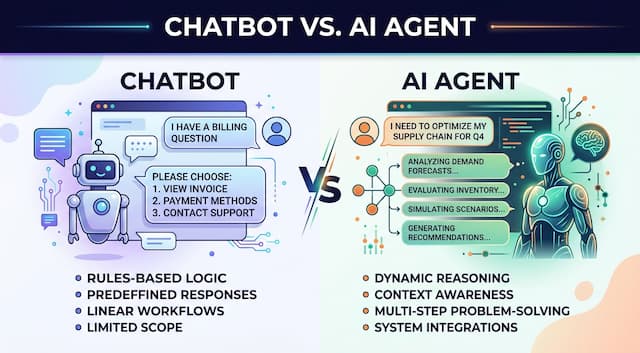 Chatbot vs AI Agent: Where the Line Actually Sits (2026)
Chatbot vs AI agent in plain terms: what each one does, where the line blurs, and how to add autonomy to support and sales without losing control.
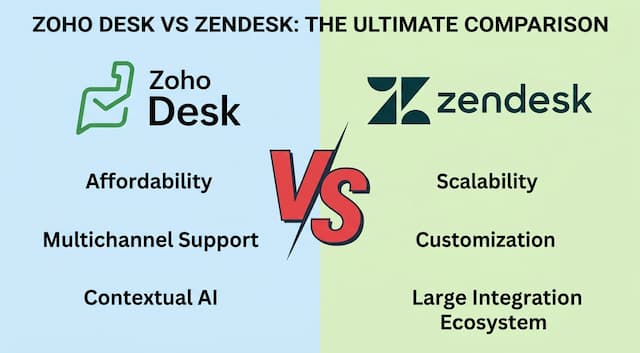 Zoho Desk vs Zendesk in 2026: The Price Gap, Examined
Zoho Desk vs Zendesk in 2026: included AI vs a quiet meter, and where Zendesk earns it