Gorgias vs Zendesk After the 2026 Pricing Overhaul
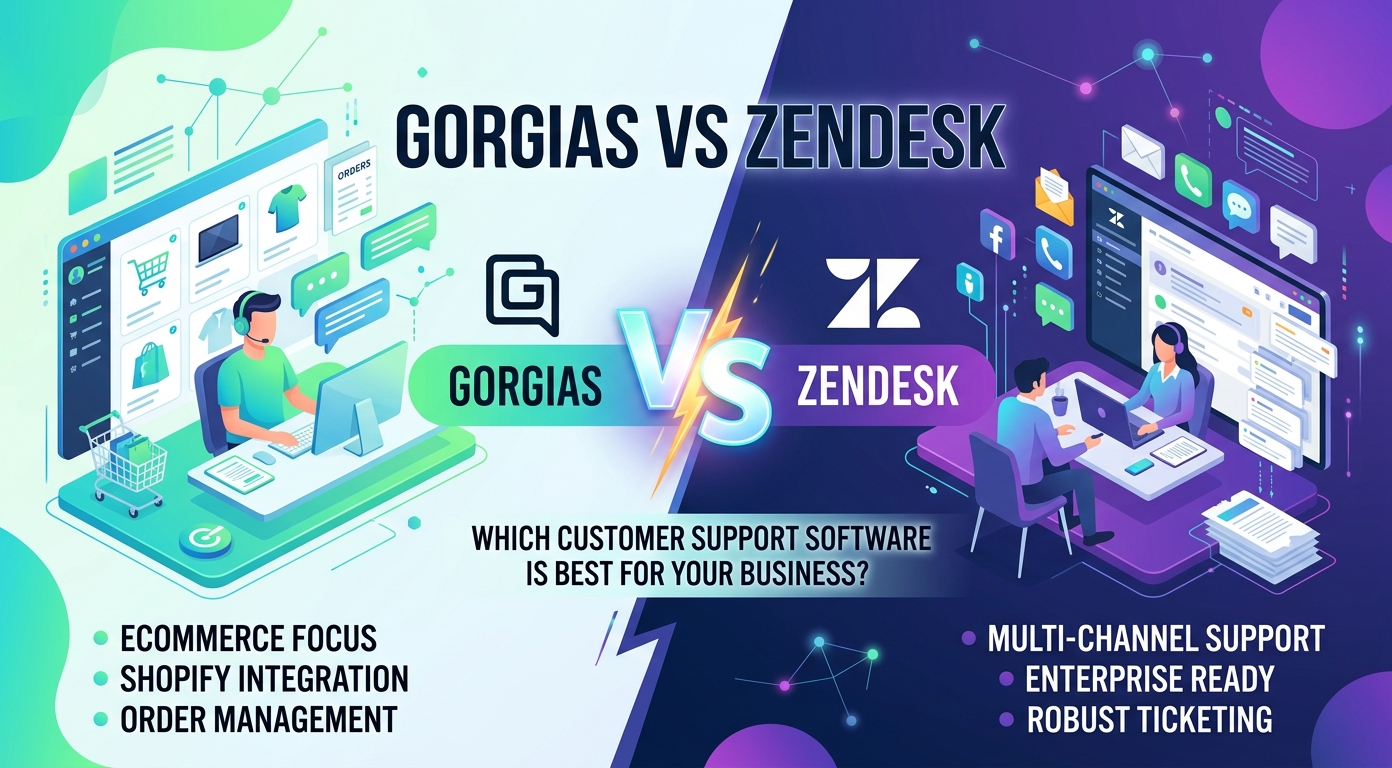
Gorgias vs Zendesk pits the Shopify-native helpdesk against the industry-standard suite, and for an online store this choice shapes the whole support stack. In 2026 the two share one number and differ on every other. Both meter AI at roughly $1.50 per automated unit (Gorgias per automated interaction beyond plan allowances, Zendesk per automated resolution at its commonly published rate). Everything else is opposite: Gorgias prices its helpdesk by ticket volume, never per agent (Basic at $50 per month billed annually for 300 tickets, or $77 with the optional AI Agent switched on), while Zendesk prices by seat (Suite Team at $55 per agent per month) with volume unmetered. Figures below are the July 2026 price lists, post-overhaul.
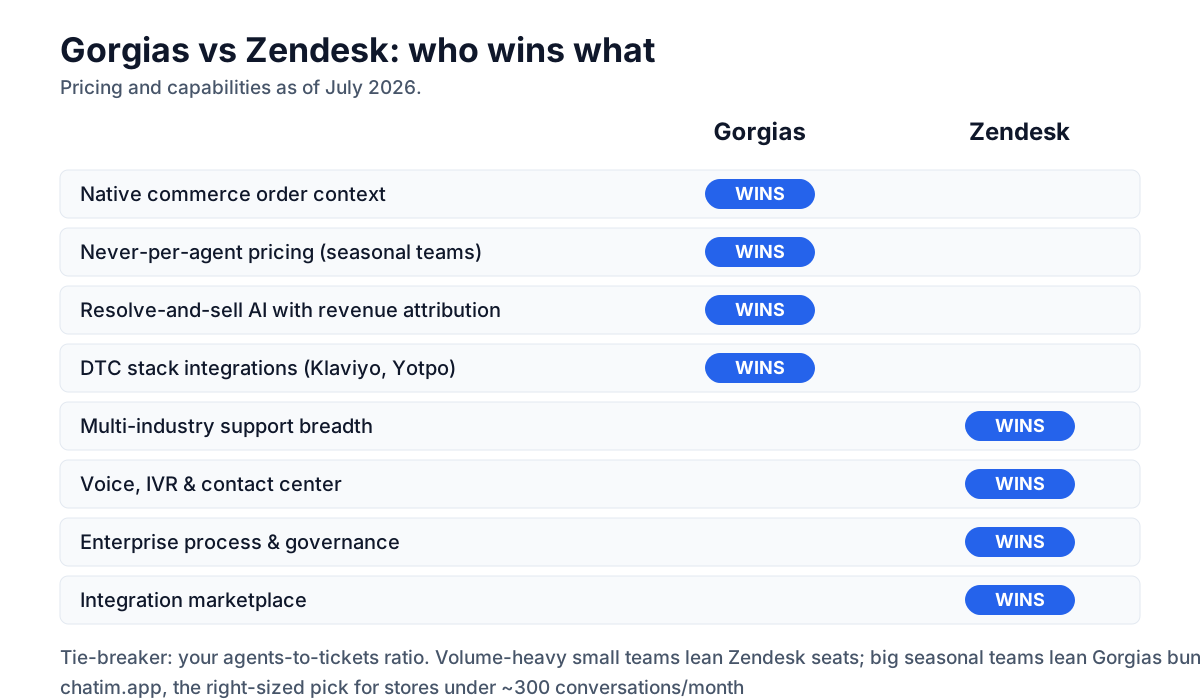
Short verdict: pick Gorgias if you run a Shopify, BigCommerce, or WooCommerce store and want order-aware support with AI that resolves and sells, billed by volume. Pick Zendesk if support spans more than ecommerce, voice is core, or enterprise process and ecosystem matter more than storefront context. Your agents-to-tickets ratio decides the price winner before features do.
Gorgias vs Zendesk in one table
| Gorgias | Zendesk | |
|---|---|---|
| Pricing model | Ticket-volume bundles, never per agent | Per agent seat, volume unmetered |
| Entry (annual) | Basic $50/month helpdesk (300 tickets); $77 with optional AI Agent | Support Team $19/agent (ticketing only); Suite Team $55/agent |
| Scale tier (annual) | Pro $300/month helpdesk (2,000 tickets); $471 with AI Agent | Suite Professional $115/agent |
| AI pricing | Optional add-on per tier ($27-$477/month with allowances); overage $1.50 per automated interaction | Per automated resolution (commonly published around $1.50) |
| Agent AI assistant | Bundled in AI Agent component | Copilot add-on $50/agent/month |
| Voice | Volume-priced add-on | Telephony in Suite; Contact Center add-on $83/agent |
| Commerce integration | Native Shopify, BigCommerce, WooCommerce order context | Via marketplace apps |
| Design center | DTC and ecommerce brands | Multi-industry support at scale |
Pricing as listed on the vendors' pricing pages in July 2026, annual billing shown (Gorgias monthly runs $90 Basic, $550 Pro; a Starter tier exists on monthly billing ($10 helpdesk-only, $40 with AI) only). Zendesk does not display its per-resolution AI rate; confirm before budgeting. All prices change, verify on the vendor pages before purchase.
What Gorgias and Zendesk are built for
Gorgias in 2026: the ecommerce helpdesk, sold by volume
Gorgias is built around the order: native Shopify, BigCommerce, and WooCommerce integrations surface cart contents, order status, and customer history next to every conversation, with one-click actions like refunds and automation for where-is-my-order flows. Its 2026 pricing page carries an Add AI Agent toggle. Helpdesk-only, annual billing: Basic $50 per month ($60 monthly, 300 tickets, then $0.40 per ticket over), Pro $300 (2,000 tickets), Advanced $750 (5,000 tickets), with a $10 Starter on monthly billing. Switching the AI Agent on lifts those to $77, $471, and $1,227, adding allowances of 30, 190, and 530 automated interactions with overage at $1.50 each, and a custom tier sits above with SSO and a dedicated CSM. No plan bills per agent, which makes seasonal scaling free at the headcount level, and voice and SMS attach as volume-priced add-ons. Gorgias claims it powers customer conversations for 40 percent of Shopify brands, and its AI Agent is positioned to resolve and sell: product questions, upsells, and revenue attribution, not just deflection.
Zendesk in 2026: the multi-industry suite
Zendesk is the reference support suite across industries: ticketing, messaging, help center, voice, workforce tools, and the largest integration marketplace in the category. Support Team at $19 per agent per month covers email ticketing; Suite Team at $55 adds AI agents, knowledge base, omnichannel routing, messaging, and telephony; Suite Professional at $115 adds admin Copilot, App Builder, skills-based routing, and IVR, with Enterprise by quote. AI agents bill per automated resolution, counted only when the AI resolves without human escalation (the rate is not displayed on the pricing page), agent Copilot is a $50 per agent add-on, and a full Contact Center runs $83 per agent. Ecommerce context (Shopify order data and the like) arrives through marketplace apps rather than native product design, which works, but the order is a sidebar in Zendesk where it is the center of gravity in Gorgias.
Pricing: volume math vs seat math
The models are mirror images, so your agents-to-tickets ratio decides the winner.
Few agents, high volume favors Zendesk seats. A 3-agent team handling 1,500 tickets per month pays Zendesk Suite Team $165 in seats with volume unmetered (AI resolutions extra), versus Gorgias Pro at $300 helpdesk-only ($471 with the AI Agent on, July 2026 prices) because volume, not headcount, drives the bill. If your small team grinds through big queues without automation, per-seat pricing is objectively cheaper.
Many agents, seasonal peaks favor Gorgias volume. A 12-agent operation (holiday temps included) pays Zendesk $660 per month at Suite Team before add-ons; on Gorgias, headcount is free and the same 2,000-ticket volume stays $300 helpdesk-only ($471 with AI). Gorgias also sells a seasonal-friendly story structurally: hire ten temps for Black Friday and your bill does not move unless volume does.
AI changes both bills. Gorgias includes an automation allowance per tier and meters $1.50 per automated interaction beyond it; Zendesk meters per automated resolution on top of seats at a rate its pricing page does not display. If AI handles a big share of volume, model it explicitly: on Gorgias, automated interactions replace tickets you would otherwise pay for; on Zendesk, resolutions stack on top of seats you already pay for. Run last quarter's numbers through both formulas, and through Copilot ($50 per agent at Zendesk, bundled in Gorgias's AI component) if agents use assist features.
AI: resolve-and-sell vs resolve-at-scale
Gorgias AI Agent is ecommerce-shaped: it answers order questions with live order data, handles returns and where-is-my-order flows, recommends products, and attributes revenue to conversations. It attaches to any plan as an optional component ($27 to $477 per month by tier, bringing allowances of 30, 190, and 530 automated interactions), overage at $1.50, and the pitch is explicitly that support becomes a revenue channel, not just a cost line.
Zendesk AI agents are industry-general: trained on your help center, resolving across messaging and email, with intelligent triage, auto-assist, and generative voice AI arriving on higher tiers, and the Forethought partnership adding a second autonomous option inside the ecosystem. Billing counts only clean resolutions (no human escalation), which is a stricter meter than most rivals and easier to defend internally.
Net: for a storefront, Gorgias's AI knows the order and can sell, which generic agents cannot match without integration work. For support that spans products, policies, and industries beyond commerce, Zendesk's AI stack is broader and its resolution-only billing cleaner. Both trials will settle it on your own tickets within two weeks.
The third option: Chatim for stores below helpdesk volume
Disclosure: Chatim is our own product. If your store handles a few hundred conversations a month, both of these platforms are ahead of your problem. Chatim covers live chat plus a chatbot with native Shopify and WordPress integrations at predictable per-plan pricing with a free tier; graduate to a helpdesk when ticket volume, not tooling ambition, forces it.
Try Chatim free at chatim.app →
Commerce depth: native vs marketplace
This is Gorgias's home game. Order data, refunds, cancellations, loyalty actions, and cart context are product primitives, and integrations with Klaviyo, Yotpo, and the DTC stack are first-class; onboarding a Shopify store takes an afternoon. Zendesk reaches the same data through marketplace apps and APIs, which enterprises with dev resources wire up well, but the out-of-box experience treats the order as an attachment rather than the organizing object. If agents spend their day inside order lookups, the native difference compounds into real handle-time savings; if commerce is one queue among many, the marketplace approach is fine.
Process, voice, and ecosystem
Zendesk's counterattack is everything around the ticket: skills-based routing, SLA policies, IVR (Suite Professional), workforce engagement, sandboxes and governance at Enterprise, plus the largest marketplace and admin talent pool in the industry. Gorgias covers SMB-to-midmarket process (rules, macros, intents, statistics) and adds voice and SMS as volume add-ons, with SSO and dedicated CSMs arriving on its custom tier, but it does not pretend to be a contact-center platform. Operations with heavy phone volume, compliance requirements, or non-commerce queues will feel Gorgias's edges; DTC brands rarely do.
So which one wins for your store?
Go with Gorgias if...
- You sell on Shopify, BigCommerce, or WooCommerce and want order context native, not wired up.
- Headcount fluctuates: seasonal temps are free when pricing follows tickets, not seats.
- You want AI that resolves and sells: product recommendations and revenue attribution, not just deflection.
- Your automation share is high: AI interactions replace paid tickets rather than stacking on seat fees.
- You want the DTC stack (Klaviyo, Yotpo, subscriptions) integrated out of the box.
Go with Zendesk if...
- Support spans more than the store: multiple products, B2B queues, internal service desks.
- A small team handles high volume without much automation: unmetered tickets on $55 seats win that math.
- Voice is core: bundled telephony, IVR, and the $83 Contact Center add-on for real call operations.
- Enterprise process matters: skills routing, SLAs, sandboxes, governance, and the deepest admin ecosystem.
- You want maximal integration choice: the marketplace covers tools Gorgias will never natively support.
Migration: what it actually takes
Both directions are well-trodden: importers and migration partners cover tickets, contacts, macros, and help-center content, and both offer trials (Gorgias free trial, no card; Zendesk 14 days defaulting to Suite Professional). Reconnect commerce integrations first, since order-context automations are where the value moves, then rebuild rules and intents natively; they do not port. Run a two-week parallel on live traffic, compare handle time on order questions specifically (that is where the platforms differ most), and time the cutover to your renewal. For the broader field, see our guides to Gorgias alternatives and Zendesk alternatives, plus Re:amaze alternatives for the multi-brand angle, live chat for Shopify, and the full ranking of the best live chat software.
For more head-to-head comparisons, see Gorgias vs Re:amaze, Zendesk vs Freshdesk, Intercom vs Zendesk, and Help Scout vs Zendesk.
Frequently Asked Questions
Is Gorgias or Zendesk better for ecommerce in 2026?
Gorgias, for most stores. Native Shopify, BigCommerce, and WooCommerce integrations put order data, refunds, and cart context at the center of every conversation, its AI Agent resolves and sells with revenue attribution, and pricing follows ticket volume rather than seats. Zendesk wins ecommerce cases where support spans more than the store, voice is core, or enterprise process (skills routing, SLAs, governance) matters; its commerce context comes through marketplace apps rather than native design.
Which is cheaper, Gorgias or Zendesk?
It depends on your agents-to-tickets ratio, as of July 2026. Few agents with high volume favors Zendesk: 3 agents on Suite Team cost $165 per month with unmetered tickets, versus Gorgias Pro at $300 helpdesk-only ($471 with the AI Agent) for 2,000 tickets. Many agents with moderate volume favors Gorgias: 12 agents cost $660 on Zendesk Suite Team but nothing extra on Gorgias, where only volume bills. AI shifts both: Gorgias meters $1.50 per automated interaction over allowance, Zendesk meters per automated resolution on top of seats.
How much does Gorgias cost in 2026?
As listed on the vendor’s pricing page in July 2026. Gorgias prices by ticket volume, never per agent, with an Add AI Agent toggle on the pricing page. Helpdesk-only, annual: Basic $50 per month ($60 monthly, 300 tickets), Pro $300 ($360, 2,000 tickets), Advanced $750 ($900, 5,000 tickets), Starter $10 on monthly billing. With the AI Agent on: Basic $77, Pro $471, Advanced $1,227, adding 30, 190, and 530 automated interactions respectively, plus a custom tier above 5,000 conversations with SSO and a dedicated CSM. Overages: about $0.36-$0.40 per ticket and $1.50 per automated interaction. Voice and SMS are volume-priced add-ons.
How much does Zendesk cost in 2026?
As listed on the vendor’s pricing page in July 2026, billed annually: Support Team $19 per agent per month (email ticketing only), Suite Team $55 (AI agents, knowledge base, omnichannel, messaging, telephony), Suite Professional $115 (admin Copilot, App Builder, skills routing, IVR), Suite Enterprise by quote. Zendesk's add-ons stack on top: Copilot at $50 per agent, Workforce Engagement at $50, and Contact Center at $83. AI agents bill per automated resolution; the rate is not displayed on the pricing page, so confirm it with sales before budgeting.
Did Gorgias change its pricing model?
Yes. As of July 2026, the Gorgias pricing page carries an Add AI Agent toggle: helpdesk-only tiers run $10 (Starter, monthly billing), $50 Basic, $300 Pro, and $750 Advanced per month billed annually ($60, $360, $900 monthly), and enabling the optional AI Agent lifts them to $40, $77, $471, and $1,227 with bundled automated-interaction allowances (30/190/530) at $1.50 per interaction over. If you see the helpdesk-only numbers cited elsewhere as the whole price, that source is describing the toggle-off view; both configurations are current.
How does Gorgias AI pricing compare with Zendesk AI pricing?
They converge on the number and differ on the meter. Gorgias includes an automated-interaction allowance in every bundle (30 to 530 by tier) and charges $1.50 per interaction beyond it. Zendesk includes AI agents in every Suite plan and bills per automated resolution, counted only when the AI fully resolves without human escalation, at a rate its pricing page does not display (commonly published around $1.50). Zendesk's meter is stricter (abandonments do not bill); Gorgias's allowances mean small automation volume may cost nothing extra. Model last quarter's volume under both definitions.
Does Gorgias really power 40 percent of Shopify brands?
That figure is Gorgias's own marketing claim, displayed on its pricing page as of July 2026 (we power customer conversations for 40 percent of Shopify brands). It is their marketing figure, not an independently confirmed one, and definitions matter (brands versus stores versus GMV). What is verifiable: Gorgias is consistently the most-cited Shopify-native helpdesk in the category, and its Shopify integration depth is the product's core differentiator.
Which handles voice and phone support better?
Zendesk. Suite plans include telephony, Suite Professional adds IVR, and the $83 per agent Contact Center add-on covers real call-center operations; workforce engagement tools add scheduling and QA on top. Gorgias offers voice and SMS as volume-priced add-ons suited to DTC phone volume (order questions, returns), not contact-center scale. If phone is your primary channel, Zendesk is the safer platform; if it is an occasional channel next to chat and email, Gorgias's add-on model is cheaper.
Which is better for seasonal or fast-growing teams?
Gorgias, structurally: pricing is never per agent, so hiring ten holiday temps changes nothing unless ticket volume grows too, and its AI allowances absorb part of peak volume. On Zendesk, every temp is a $55-$115 seat for the season. The reverse also holds: if you automate volume down over time, a Gorgias bill shrinks with tickets while a Zendesk bill only shrinks if you cut seats. Match the pricing model to which number (heads or tickets) you expect to move.
Can Gorgias handle non-ecommerce support?
It can (email, chat, social, voice add-ons, rules, and macros all work generically), but it is not the design center: the data model, integrations, and AI training all orbit orders and storefronts. Multi-product companies, B2B queues, and internal service desks fit Zendesk (or a general helpdesk like Freshdesk or HelpScout) better. The practical test: if under half your tickets reference an order, Gorgias's premium over a general helpdesk stops paying for itself.
Is it hard to migrate between Gorgias and Zendesk?
No, both directions are routine: importers and migration partners move tickets, contacts, macros, and help-center content, and both offer trials to run in parallel (Gorgias with no card required; Zendesk 14 days, defaulting to Suite Professional with Copilot). The work is in the automations: Gorgias intents and rules versus Zendesk triggers and AI agent configuration rebuild natively rather than porting. Reconnect commerce integrations first and benchmark handle time on order questions during the parallel run; that metric decides this comparison more than any feature list.
Do I need Gorgias or Zendesk at all?
Count monthly conversations. Below roughly 300, a chat-first tool with a bot covers the workload at a fraction of either bill: Chatim's free tier, Tidio, or Re:amaze at the light end (see our Shopify live chat guide for that tier). Gorgias earns its bundles when order-context automation starts saving real agent hours; Zendesk earns its seats when process, channels, and team size demand a suite. Starting light and graduating with a clean export is a legitimate strategy both vendors support.
Related articles
More in Comparisons → Live Chat vs Chatbot: Which One Does Your Website Need?
Live chat vs chatbot in plain terms: what each does best, where each fails, and the bot-first, human-close handoff pattern that beats running either alone.
 Help Desk vs Service Desk: The Real Difference (2026)
Help desk vs service desk in one line: issue-fixing vs service lifecycle. The five differences that matter, why the terms blur, and which one you need.
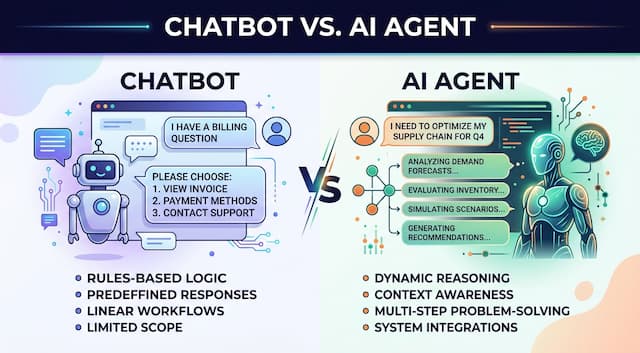 Chatbot vs AI Agent: Where the Line Actually Sits (2026)
Chatbot vs AI agent in plain terms: what each one does, where the line blurs, and how to add autonomy to support and sales without losing control.
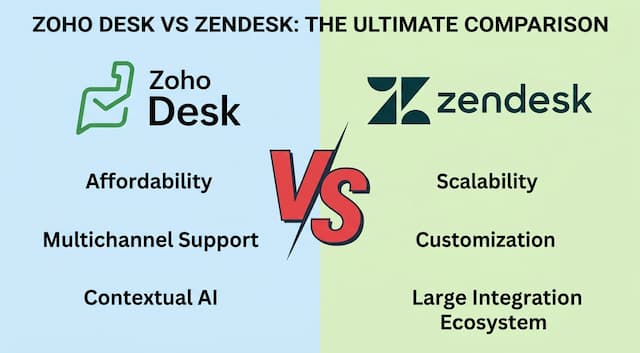 Zoho Desk vs Zendesk in 2026: The Price Gap, Examined
Zoho Desk vs Zendesk in 2026: included AI vs a quiet meter, and where Zendesk earns it