Gorgias vs Re:amaze (2026): Ecommerce Helpdesk Face-Off
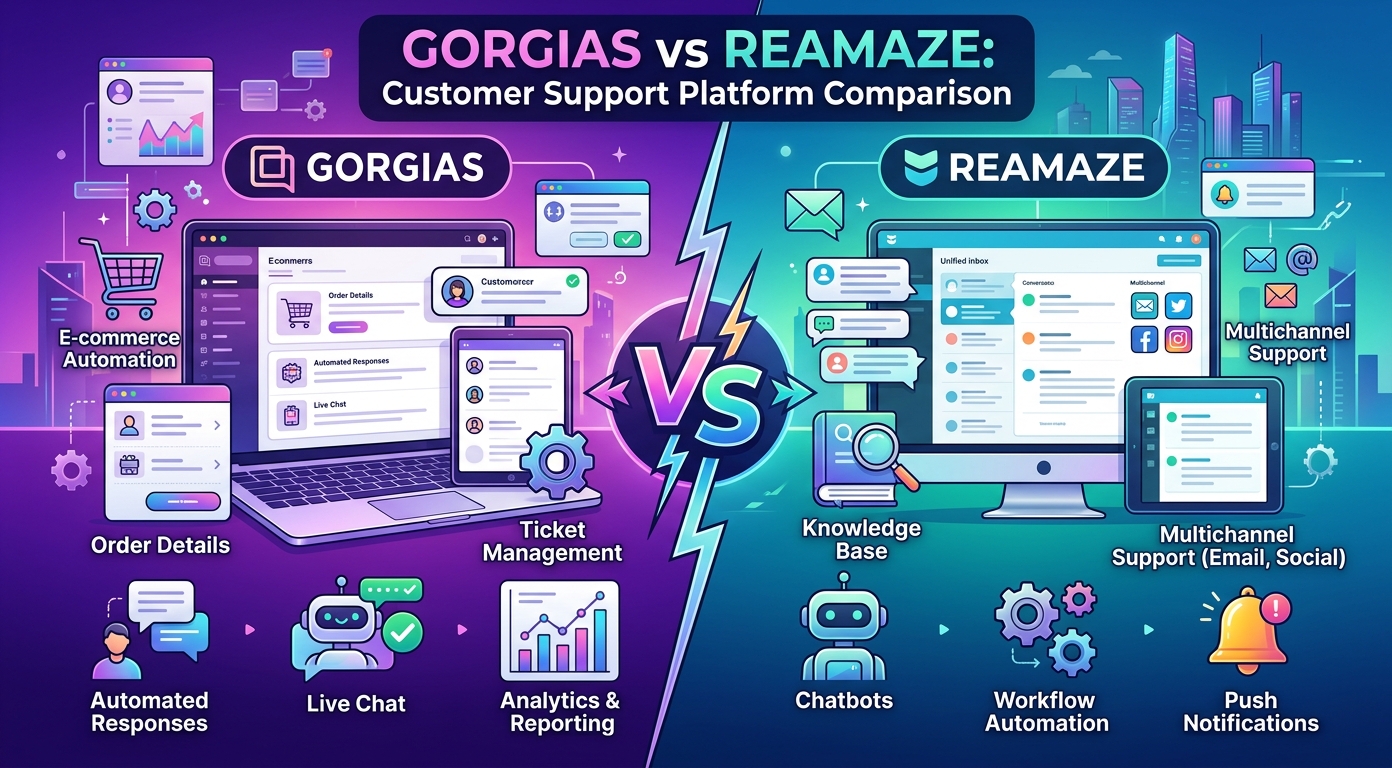
Gorgias vs Re:amaze compares two helpdesks built for online stores, both fluent in Shopify, BigCommerce, and WooCommerce, and priced on opposite meters. Gorgias prices by ticket volume, never per agent: helpdesk-only Basic runs $50 per month billed annually (300 tickets) and Pro $300 (2,000), with an optional AI Agent lifting those to $77 and $471 and adding automated-interaction allowances. Re:amaze bills per team member at SMB-friendly rates (Basic $26.10 per member per month billed annually, Pro $44.10, Plus $62.10), with a $59 flat Starter covering 500 responded conversations for unlimited members, and its AI Agent and chatbots included from the Basic tier. Both vendors' published July 2026 tiers, annual billing unless noted.
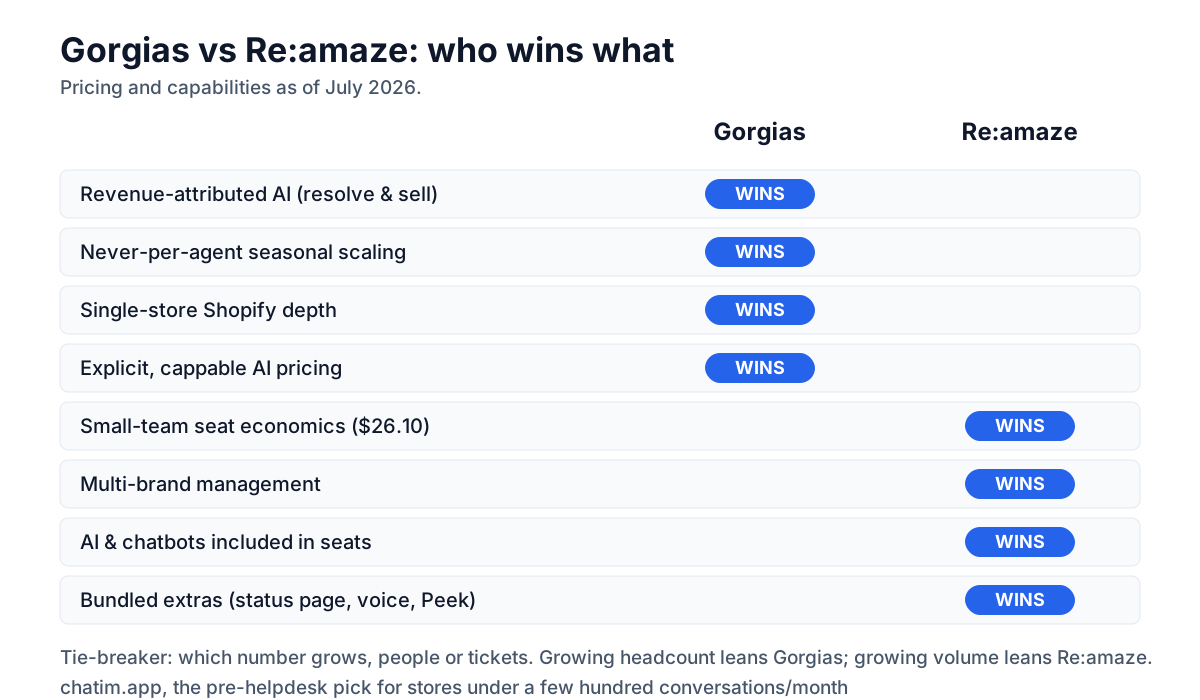
Short verdict: small teams with real ticket volume get dramatically better math from Re:amaze's cheap seats; brands leaning into automation, Shopify-native order actions, and revenue-attributed AI justify Gorgias's bundles. Multi-storefront operators should look at Re:amaze first regardless: multi-brand management is its signature feature.
Scoreboard first: the quick comparison
| Gorgias | Re:amaze | |
|---|---|---|
| Pricing model | Ticket-volume bundles, never per agent | Per team member; flat $59 Starter (500 conversations, unlimited members) |
| Entry (annual) | Basic $50/month helpdesk (300 tickets); $77 with optional AI Agent | Basic $26.10 per member/month ($29 monthly) |
| Scale tier | Pro $300/month helpdesk (2,000 tickets); $471 with AI Agent | Pro $44.10, Plus $62.10 per member/month |
| AI pricing | Optional add-on with allowances per tier; $1.50 per automated interaction over | AI Agent and chatbots included from Basic |
| Conversation limits | Metered by tier (300 to 5,000+) | Unmetered on Basic and up (Starter capped at 500) |
| Multi-brand | Supported | Signature feature: multiple brands in one account (Pro) |
| Voice/SMS | Volume-priced add-ons | SMS and voice channels on Pro |
| Ownership | Independent | GoDaddy brand |
Pricing as listed on the vendors' pricing pages in July 2026, annual billing shown (Re:amaze monthly runs $29/$49/$69; annual saves 10 percent). Vendors reprice often, so verify on their pages before purchase.
The contenders: Gorgias and Re:amaze
Gorgias in 2026: volume bundles with revenue-focused AI
Gorgias organizes support around the order: native Shopify, BigCommerce, and WooCommerce integrations put cart contents, order status, and one-click actions (refunds, cancellations) next to every conversation, and its AI Agent resolves and sells, answering product questions, recommending items, and attributing revenue to conversations. The 2026 pricing page carries an Add AI Agent toggle: helpdesk-only runs Basic $50 per month billed annually (300 tickets), Pro $300 (2,000), Advanced $750 (5,000), Starter $10 on monthly billing; the optional AI Agent lifts those to $77, $471, and $1,227 with allowances of 30, 190, and 530 automated interactions, and a custom tier sits above, with overage at roughly $0.36-$0.40 per ticket and $1.50 per automated interaction. No plan bills per agent, so seasonal temps are free at the headcount level. Voice and SMS attach as volume-priced add-ons, and Gorgias claims it powers conversations for 40 percent of Shopify brands.
Re:amaze in 2026: cheap seats, brands unlimited, AI included
Re:amaze (a GoDaddy brand) is the per-seat value play of ecommerce support: Basic at $26.10 per team member per month billed annually includes unlimited email inboxes, live chat, social channels, FAQ, workflow automation, chatbots, proactive Cues, customer intents, and the Re:amaze AI Agent; Pro at $44.10 adds multi-brand management, live visitor view, SMS and voice channels, advanced reporting, and a status page; Plus at $62.10 adds departments, staff performance reporting, satisfaction ratings, Peek live screensharing, and in-chat video calls. The $59 flat Starter covers 500 responded conversations with unlimited team members, and conversations are unmetered from Basic up. The trial requires no credit card and plans carry no contracts. Its signature strength is running multiple storefronts and brands from one account without per-brand pricing.
Pricing: cheap seats vs volume bundles
The meters point in opposite directions, so team shape decides the bill. Worked examples with July 2026 published prices, annual billing.
Small team, real volume: 3 agents handling 1,200 tickets per month pay Re:amaze Basic $78.30 (3 seats, conversations unmetered). The same volume on Gorgias sits in Pro at $300 helpdesk-only ($471 with the AI Agent) because tickets, not people, drive the bill. That gap is not subtle, and it is the reason lean stores default to Re:amaze seats.
Tiny team, tiny volume: under 500 conversations, Re:amaze's $59 flat Starter with unlimited members competes with Gorgias's monthly-billing Starter ($10 helpdesk-only, $40 with the AI Agent); both are fine, and the free trials settle it on workflow preference.
Seasonal army: 15 holiday temps cost Re:amaze $391.50 per month at Basic; on Gorgias they cost nothing, only the ticket volume they process does. High-headcount, high-season operations are Gorgias's structural best case, the mirror image of the small-team scenario.
Automation-heavy: if AI handles a large share, Gorgias's model converts tickets into bundled automated interactions (then $1.50 each over allowance) with revenue attribution to justify the line; Re:amaze includes its AI Agent and chatbots from Basic with no per-interaction meter on the pricing page, which makes light-to-moderate automation effectively free. Heavy automation at scale needs a quote-level conversation with both.
AI: resolve-and-sell vs included-in-the-seat
Gorgias AI Agent is the more productized automation: trained on store policies and catalog, executing order actions, recommending products, and reporting revenue per conversation, with allowances by tier and a clean $1.50 overage. It is the stronger choice when automation rate is a KPI someone owns and support is expected to sell.
Re:amaze AI Agent ships inside the Basic seat alongside scripted chatbots, intents, and Cues (proactive messages), covering FAQ deflection, drafting, and routing without a separate meter. It is less prominent in Re:amaze's marketing and publishes fewer performance claims, which in practice means: good default automation included in a cheap seat, not a headline deflection engine.
Net: stores that want automation to carry revenue targets benchmark Gorgias; stores that want competent automation included with human-first support get it cheaper at Re:amaze. As always, both trials on identical questions beat both marketing pages.
The third option: Chatim below helpdesk volume
Disclosure: Chatim is our own product. Under a few hundred conversations a month, neither bundle nor seats is the real question; a chat widget with a bot is. Chatim pairs live chat and chatbot automation with native Shopify and WordPress integrations at predictable per-plan pricing with a free tier. Graduate to Gorgias or Re:amaze when order-context automation starts saving real agent hours.
Try Chatim free at chatim.app →
Commerce depth and multi-brand
On single-store Shopify depth, Gorgias leads: one-click order actions, the widest DTC integration ecosystem (Klaviyo, Yotpo, subscriptions), macros templated on order variables, and automation flows built around commerce events. Re:amaze covers the same platforms capably (order data in conversations, store-aware chatbots) and pulls ahead on a different axis: multi-brand management on Pro runs several storefronts, help sites, and inboxes under one roof with unlimited email inboxes even at Basic, without multiplying subscriptions. Portfolio operators, agencies, and holding companies feel that difference monthly; single-brand DTC teams feel Gorgias's depth daily.
Operations, channels, and extras
Re:amaze packs surprising extras into its seats: a status page, Peek live screensharing and in-chat video (Plus), satisfaction ratings, staff shifts, and SMS and voice as channels on Pro rather than add-ons. Gorgias counters with operational focus: ticket fields and views tuned to DTC workflows, revenue dashboards, voice and SMS add-ons that scale by usage, and an app store dense with ecommerce tooling. Neither is an enterprise suite (no Zendesk-grade routing or governance), and both onboard in days, not months. Support ops maturity is a wash; pick on pricing shape and brand count.
How to choose between them
Choose Gorgias when...
- Automation carries a number: resolve-and-sell AI with revenue attribution is the product's spine.
- Headcount surges seasonally: never-per-agent pricing makes temps free.
- You live in single-store Shopify depth: one-click order actions and the densest DTC integration ecosystem.
- You want AI usage priced explicitly: allowances plus $1.50 per interaction is easy to model and cap.
- Support is a revenue channel in your P&L, not just a cost line.
Choose Re:amaze when...
- Your team is small and volume is real: 3 seats at $78.30 versus a $300-$471 Pro tier, at July 2026 prices, is the whole argument.
- You run multiple brands or storefronts: multi-brand management in one account is the signature feature.
- You want AI and chatbots included in the seat price with no interaction meter.
- SMS, voice, a status page, and screensharing matter without add-on stacking.
- You prefer no contracts and a flat $59 Starter while you are small.
What a migration involves
Both migrate easily by helpdesk standards: reconnect the store integrations first (that is where the value lives), import contacts and conversation history via each vendor's importers, and rebuild macros and automations natively, since intents, flows, and cues do not port. Both offer no-card trials (Re:amaze explicitly contract-free), so run a two-week parallel on live traffic and benchmark two numbers: handle time on order questions, and automation's share of resolutions at each platform's real price. Time the cutover to a quiet season, not Q4. For the broader field, see our guides to Gorgias alternatives and Re:amaze alternatives, plus Zendesk alternatives for the enterprise direction, live chat for Shopify, and the full ranking of the best live chat software.
For more head-to-head comparisons, see Gorgias vs Zendesk.
Frequently Asked Questions
Is Gorgias or Re:amaze better for ecommerce in 2026?
Both are ecommerce-native; the split is pricing shape and brand count. Re:amaze wins for small teams with real volume (Basic $26.10 per member per month billed annually, conversations unmetered, AI included) and for multi-brand operators (multiple storefronts in one account). Gorgias wins for automation-led brands (resolve-and-sell AI with revenue attribution, optional per-tier add-on with allowances plus $1.50 per interaction) and seasonal teams (never priced per agent). Single-store Shopify depth also leans Gorgias.
Which is cheaper, Gorgias or Re:amaze?
For small teams, Re:amaze, dramatically: 3 agents on Basic cost $78.30 per month with unmetered conversations, versus Gorgias Pro at $300 helpdesk-only ($471 with the AI Agent) for that volume, since Gorgias bills volume. For big seasonal headcounts, Gorgias: 15 temps cost Re:amaze $391.50 monthly at Basic but nothing on Gorgias unless volume rises. As of July 2026. Match the meter to which number grows: people favors Gorgias, tickets favors Re:amaze.
How much does Re:amaze cost in 2026?
As listed on the vendor’s pricing page in July 2026: Basic $26.10 per team member per month billed annually ($29 monthly) with unlimited email inboxes, live chat, social channels, chatbots, Cues, and the Re:amaze AI Agent; Pro $44.10 ($49) adds multi-brand management, live visitor view, SMS and voice channels, and a status page; Plus $62.10 ($69) adds departments, staff reporting, satisfaction ratings, Peek screensharing, and video calls. A $59 flat Starter covers 500 responded conversations with unlimited members. No contracts; annual billing saves 10 percent.
How much does Gorgias cost in 2026?
As listed on the vendor’s pricing page in July 2026. Gorgias prices by ticket volume, never per agent, with an Add AI Agent toggle. Helpdesk-only annual: Basic $50 per month ($60 monthly, 300 tickets), Pro $300 ($360, 2,000), Advanced $750 ($900, 5,000), Starter $10 monthly-billing. With the AI Agent: $77, $471, and $1,227, adding 30/190/530 automated interactions, plus a Starter at $40 ($10 helpdesk-only, $40 with AI), and a custom tier above 5,000 conversations. Overage runs about $0.36-$0.40 per ticket and $1.50 per automated AI interaction. Voice and SMS are volume-priced add-ons.
Does Re:amaze really include AI for free?
The Re:amaze AI Agent and chatbots are listed as included features from the Basic tier on the live pricing page (July 2026), with no per-interaction meter shown, alongside intents and proactive Cues. That makes light-to-moderate automation effectively part of the $26.10 seat. Re:amaze publishes fewer performance claims than Gorgias does for its AI, so treat it as competent included automation rather than a headline deflection engine, and confirm any usage terms with the vendor at high volumes.
What is Re:amaze's multi-brand feature and why does it matter?
On the Pro tier, one Re:amaze account manages multiple brands: separate storefronts, help sites, chat widgets, and inboxes under one login and one bill, with unlimited email inboxes available even at Basic. For portfolio operators, agencies, and sellers running several shops, this avoids multiplying helpdesk subscriptions per brand. Gorgias supports multiple stores too, but Re:amaze's account structure and per-seat pricing make the multi-brand case its signature economic advantage.
Which has deeper Shopify integration, Gorgias or Re:amaze?
Gorgias, on a single store: one-click order actions (refunds, cancellations), macros templated on order variables, automation triggered by commerce events, revenue dashboards, and the densest DTC app ecosystem (Klaviyo, Yotpo, subscriptions). Re:amaze surfaces order data in conversations and store-aware chatbots across Shopify, BigCommerce, and WooCommerce, which covers most workflows, but Gorgias treats the order as the product's organizing object. Single-brand DTC teams notice daily; multi-brand operators often trade that depth for Re:amaze's structure.
How do the AI models compare, Gorgias AI Agent vs Re:amaze AI Agent?
Gorgias positions its AI as a revenue worker: trained on catalog and policies, executing order actions, recommending products, attributing revenue, with explicit pricing (bundled allowances, then $1.50 per automated interaction). Re:amaze bundles its AI Agent into every seat from Basic with chatbots, intents, and Cues, no meter on the pricing page, and quieter marketing. If automation owns a KPI, benchmark Gorgias; if you want included automation with human-first support, Re:amaze delivers it cheaper. Trial both on identical questions.
Is Re:amaze still owned by GoDaddy?
Yes; the site brands it a GoDaddy company (July 2026), consistent with our standing records. In practice that means stable ownership and infrastructure rather than startup risk, and development cadence that has favored steady iteration over splashy releases. Gorgias remains independent and ships aggressively around its AI Agent. Neither ownership situation should decide the choice; pricing shape and brand count matter far more.
Which handles voice and SMS better?
Differently. Re:amaze includes SMS and voice as channels on the Pro tier ($44.10 per member), making them part of the seat. Gorgias sells voice and SMS as separate add-ons priced by call and text volume, which scales cleanly for heavy usage but adds line items. Occasional phone volume favors Re:amaze's bundling; a real calling operation should price Gorgias's add-ons at actual volume, and beyond that, look at helpdesks with full contact-center features.
Is it easy to migrate between Gorgias and Re:amaze?
Yes: both provide importers for contacts and conversation history, both connect the same storefronts, and both offer no-card trials (Re:amaze is explicitly contract-free). The real work is rebuilding automations: Gorgias flows and macros versus Re:amaze intents, cues, and workflow rules do not port. Reconnect store integrations first, run a two-week parallel on live traffic, benchmark handle time on order questions and automation share at real prices, and avoid cutting over during peak season.
Do I need Gorgias or Re:amaze at all?
Count monthly conversations. Under a few hundred, a chat widget with a bot covers the workload: Chatim's free tier, Tidio, or Re:amaze's own $59 Starter at the light end. The helpdesks earn their price when order-context automation and team workflows start saving real hours. Our guides to Gorgias alternatives and Re:amaze alternatives map the full field, including the enterprise direction (Zendesk) and the SMB chat tier below both.
Related articles
More in Comparisons → Live Chat vs Chatbot: Which One Does Your Website Need?
Live chat vs chatbot in plain terms: what each does best, where each fails, and the bot-first, human-close handoff pattern that beats running either alone.
 Help Desk vs Service Desk: The Real Difference (2026)
Help desk vs service desk in one line: issue-fixing vs service lifecycle. The five differences that matter, why the terms blur, and which one you need.
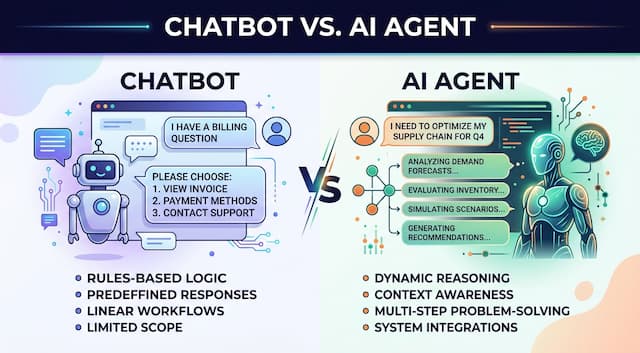 Chatbot vs AI Agent: Where the Line Actually Sits (2026)
Chatbot vs AI agent in plain terms: what each one does, where the line blurs, and how to add autonomy to support and sales without losing control.
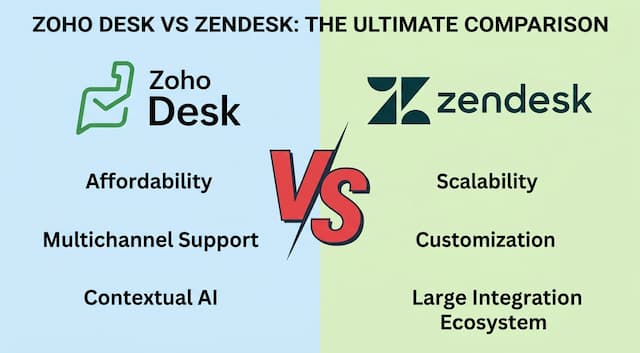 Zoho Desk vs Zendesk in 2026: The Price Gap, Examined
Zoho Desk vs Zendesk in 2026: included AI vs a quiet meter, and where Zendesk earns it