12 Bad Customer Service Examples (and How to Fix Them)
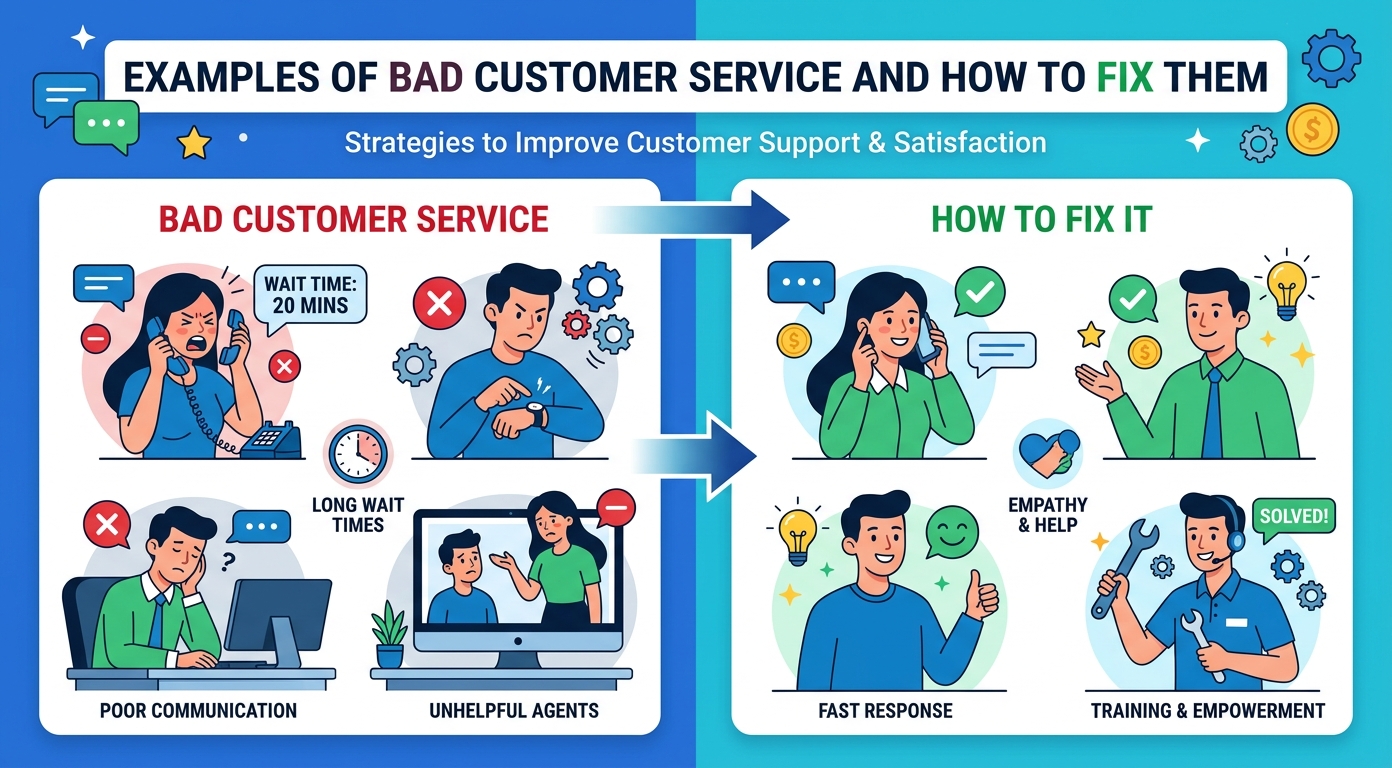
Bad customer service examples are everywhere, and most of us can name one from memory: the call that bounced between five departments, the chat reply that arrived three days late, the agent who clearly did not care. This guide collects the most common poor-service cases and pairs each one with a practical fix, so you can spot the same patterns in your own company before customers do.
Poor customer service is rarely the fault of one bad employee. It usually traces back to weak processes, outdated policies, or a team that was never given the right tools. The good news is that every example below has a clear cause and a clear solution. Improve customer service in these specific areas and you protect revenue, your brand, and the customers you already worked hard to win.
What counts as bad customer service?
Bad customer service is any interaction that leaves a customer feeling ignored, frustrated, or worse off than before they reached out about a product or service. It is not always an angry tone. A polite agent who never solves the problem still delivers a bad customer experience, because the customer's real goal was a resolution, not a friendly chat.
Customers judge customer service by effort. Every extra step, every repeated explanation, every transfer raises the effort and lowers customer satisfaction. A single slow reply might be forgiven. A pattern of slow replies tells customers your business does not value their time, and that is when a one-off complaint becomes lost loyalty.
It helps to split poor customer service into two parts: how an interaction feels and what it achieves. A warm agent who cannot fix anything fails on outcome. A fast fix delivered with no warmth still fails as a customer service experience. Strong customer service needs both, and the cases below show what happens when one or the other breaks down.
12 bad customer service examples and how to fix each
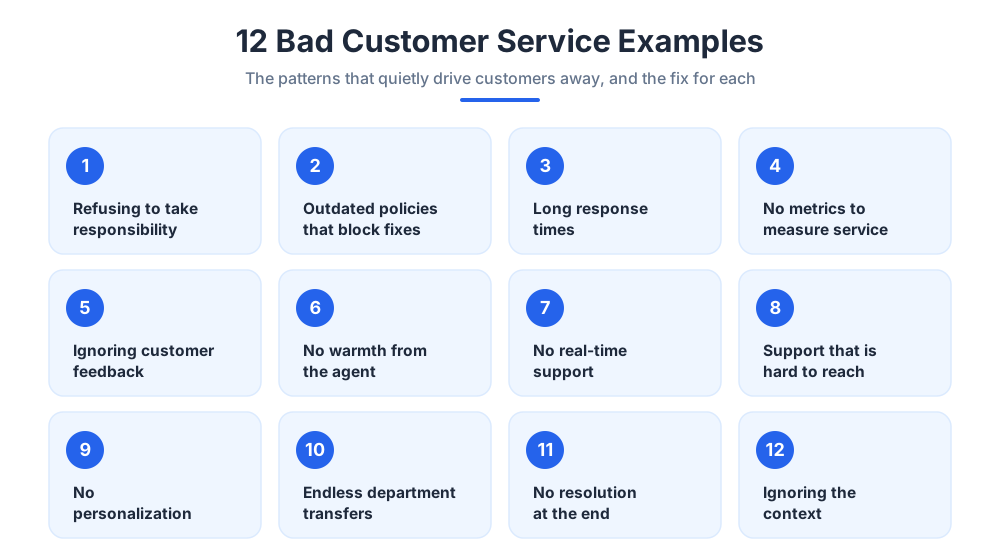
Here are 12 cases drawn from the complaints customers raise most often. Each one pairs the issue with a fix you can apply this quarter. Read them as a checklist: if even one sounds familiar, you have found a quick win.
1. Refusing to take responsibility
One of the most common bad customer service examples involves a company that will not take responsibility. The agent blames the customer, blames another team, or blames a vague policy, and the customer is left holding an issue nobody will own.
The fix is a culture of ownership. Train every customer service representative to say "I will sort this out" and mean it. Give agents the authority to resolve common issues without escalating, and reward the people who close cases instead of passing them along.
2. Outdated policies that block fast fixes
Customers want their issues solved quickly. Outdated policies get in the way. When the rulebook was written for a business that no longer exists, support agents are forced to apply rules that make no sense, and customers pay for it with wasted time.
Review your policies on a schedule, not just after a crisis. Ask your customer support staff which rules cause the most friction and the most complaints, then change them. A policy that creates more friction points than it prevents is not protecting the business; it is quietly costing it customers.
3. Long response times
A slow reply is one of the clearest bad-service patterns, and one of the most damaging. Every hour a customer waits, frustration grows, and a simple question can harden into a poor customer experience or a public review.
Speed up the first response with automation and live chat. A chatbot can handle routine questions instantly, while a contact center routes complex issues to a human fast. The goal is not to replace people; it is to make sure no customer sits waiting when a quick answer was available all along.
4. No metrics to measure customer service
If you do not measure customer service, you cannot improve it. Plenty of teams run on gut feeling, with no data on reply times or resolution rates. That is a quiet failure, because weak spots stay invisible until customers leave.
Track a small set of metrics that matter: first response time, resolution time, customer effort, and a customer satisfaction score. Use the numbers to spot which customer issues recur and which agents need help. Metrics turn vague worries into specific, fixable failures.
5. Ignoring customer feedback
Customers often hand you the solution for free. They tell you what went wrong and how to fix it. Ignoring customer feedback is one of the most wasteful bad-service patterns, because the research is already done and the company simply throws it away.
Build a habit of reading, tagging, and acting on customer feedback. Close the loop by telling customers what changed because of what they said. Our guide to collecting and acting on customer feedback covers the methods that turn raw comments into real improvements.
6. No warmth from the agent
Missing compassion is one of the bad-service patterns customers remember longest. When an agent recites a script and never acknowledges how the customer feels, the customer feels like they are talking to a wall. The issue might get solved, but the relationship does not.
Acknowledgment is a teachable skill. Coach agents to name the customer's feeling ("I can see why that is frustrating"), then move to the fix. Apology matters too; our guide to apologizing without sounding scripted shows how to acknowledge an issue with genuine care.
7. No real-time support
Some companies offer no real-time support at all. They reply to emails on business days only, and a customer with an urgent problem waits days for a fix that could have taken minutes. That delay turns a quick question into a frustrating experience, and from the customer's side the silence reads as indifference.
You do not need a 24/7 contact center to fix this. One or two agents on live chat, backed by a chatbot for off-hours, covers most needs. A real-time support experience is not a large investment, and it signals respect for the customer's time.
8. A customer service team that is hard to reach
When the support desk is buried behind menus, hidden contact pages, and chatbots with no exit, customers feel trapped. Making support difficult for customers to reach saves money on paper, but it pushes problems into public reviews where they cost far more.
Make the path to a human obvious. Put a clear contact option on every page, and let a customer support team member take over from the bot at any point. Easy access is itself a form of good service.
9. No personalization
Modern consumers expect personalization. When every reply is an obvious copy-and-paste, customers can tell, and a generic answer to a specific issue feels dismissive. Treating people as ticket numbers is a subtle but real form of bad service.
Personalize with context. Pull up the customer's history before you reply, reference their actual situation, and tailor the solution to their need. Personalization does not mean writing every message from scratch; it means making each customer feel seen.
10. Endless transfers between departments
Few things frustrate customers more than being passed from one department to the next. Each transfer means repeating the whole story again, and passing customers from agent to agent signals that no single person is willing to own the outcome.
Limit transfers to one, and only when it is truly necessary. Before any handoff, pass the full context so customers never have to repeat themselves. If a customer service department finds itself transferring constantly, that is a process problem to fix.
11. No resolution at the end
Customers will forgive a wait. They will not forgive a non-answer. When an interaction ends with no resolution, all that patience converts straight into frustration, and the customer walks away with a problem and a grudge.
Define what "resolved" means for each common issue, and do not close a case until the customer agrees it is done. If a fix takes time, set a clear expectation and follow up. A resolution delivered late still beats a case quietly dropped.
12. Ignoring the context
Some agents give the same canned solution regardless of context. A first-time buyer and a ten-year customer get the identical scripted reply. Ignoring context is one of those bad-service patterns that feels small but tells customers the company is not really listening.
Read the situation before you respond. A frustrated, long-time customer may need acknowledgment first and a fix second. Context turns a correct answer into the right answer, and that difference is what customers actually remember.
Bad customer service examples from big brands
Bad customer service is not only a small-business issue. Some of the most cited cases come from household brands, and they show how even a large company with deep resources can damage its own brand through weak service.
Airlines, banks, and big retailers generate these stories constantly: a viral video, a thread of frustrated customers, a screenshot shared thousands of times. Subpar customer service from a household name spreads fast, because consumers forward a pattern of negative experiences exactly like that. The bigger the brand, the louder the failure travels.
The lesson is not that any single company is uniquely bad. It is that scale never excuses a broken customer experience, and a highly visible brand pays for every weak interaction in public. A household name has more reach, so the same mistake is simply seen by far more people.
The 7 qualities of bad customer service
If you want a quick diagnostic, the 7 qualities of bad customer service appear again and again across complaints. Slow response times. A lack of empathy. Untrained or unhelpful staff. Poor communication and broken promises. No ownership of the problem. Rude behavior or a dismissive tone. And no resolution at the end.
Each quality maps to a fix already covered above. Slow replies need faster channels. Low understanding needs coaching. Unhelpful agents need training and tools. Weak communication needs clear, honest updates. The point of naming the qualities is simple: once you can label what bad service looks like, you can train your team to do the opposite.
Run this list against your own support transcripts and customer complaints. If two or three of these qualities show up regularly, you have found your priorities. Most teams do not need to fix everything at once; they need to fix the one or two qualities that drive the most damage.
What bad customer service costs your business
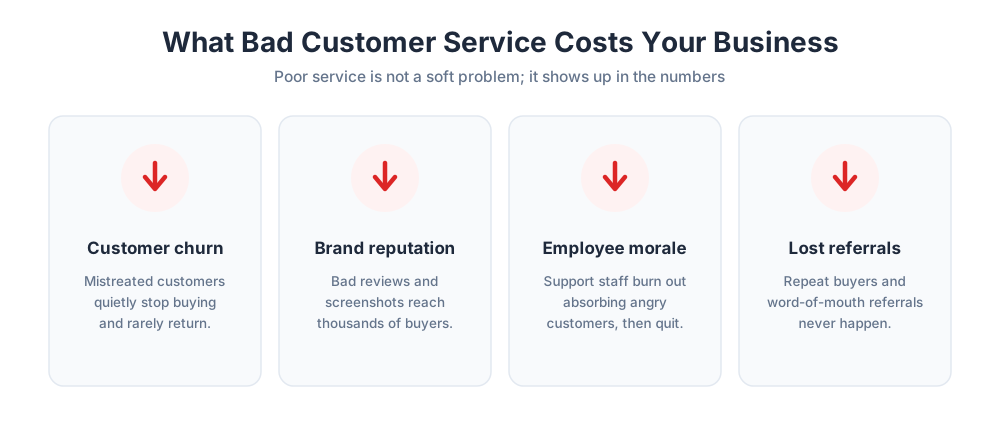
It is tempting to treat poor customer service as a soft problem. It is not. Bad customer service shows up directly in the numbers, and the cost lands on the business in several concrete ways.
Customer churn and lost revenue
The first cost is lost accounts. Customers who feel mistreated leave, and they rarely announce it; they simply stop buying. Because winning a new customer costs far more than keeping an existing one, the slow loss of customers to weak service is one of the most expensive issues a business can have.
Churn also compounds. Dissatisfied customers who leave take their future purchases with them, and a large percent of customers never say why. Replacing that revenue means spending again on marketing and sales, so every account you keep protects recurring revenue and builds customer loyalty.
Damage to brand reputation
The second cost is a battered public image. Unhappy customers talk. They leave reviews, post screenshots, and warn friends, and a single viral complaint can reach more people than a year of advertising.
Reputation is slow to build and fast to lose. The reputational harm from one bad story can outlast the incident by years. A business with a trusted brand earns the benefit of the doubt; a brand known for weak service has to overcome doubt on every sale.
Lower employee morale
The third cost is internal. Bad customer service drags down how your team feels about the job. Support staff who spend every shift absorbing angry customers, with no tools and no authority to fix anything, burn out and quit. High turnover then makes customer service worse, and the cycle feeds itself.
Give your team the tools, training, and authority to actually help customers, and morale rises with it. A support role that lets people solve real issues is a far better job than one that only absorbs blame, and happier agents deliver visibly better customer service.
Fewer referrals and repeat buyers
The fourth cost is the quiet one. Weak customer service erodes customer relationships, and the customers who would have referred friends or come back next month simply do not. You never see those lost sales, which makes this the easiest cost to ignore and the most expensive to keep ignoring.
Strong customer service does the opposite. A customer who walks away from a smooth experience becomes a free marketing channel, telling friends and writing the reviews that bring the next buyer in. Customer service is not only a cost center; it is one of the cheapest ways to grow a business.
Good customer service vs bad customer service
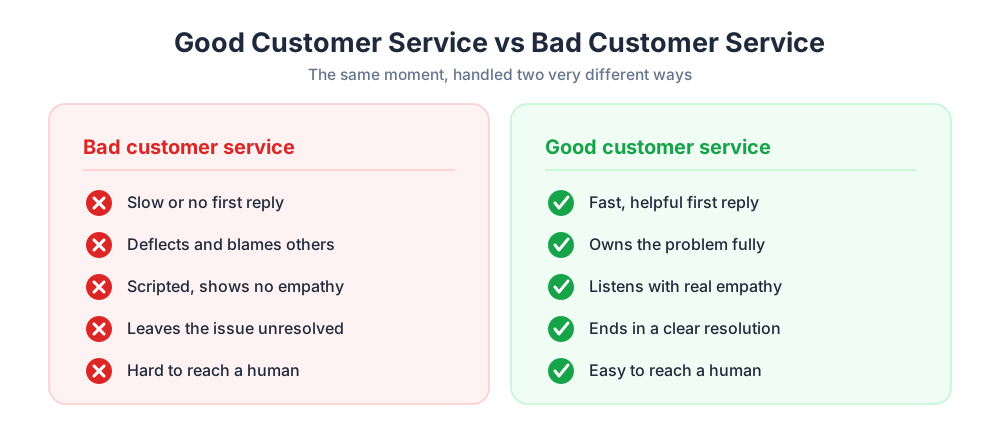
The line between strong customer service and bad customer service is thinner than it looks. The same issue, a delayed order, can become either a loyal customer or a lost one depending entirely on how the interaction is handled.
Good customer service is fast, owns the problem, shows real understanding, and ends in a true resolution. Bad customer service is slow, deflects, recites a script, and leaves the issue open. Customers are not comparing you to perfection; they are comparing you to the last company that handled them well.
Exceptional customer service goes one step further: it anticipates the problem and solves it before the customer has to ask. You do not need to be exceptional everywhere. You need to be reliably good, because a consistent service experience is what turns first-time buyers into loyal customers and protects you from the examples above.
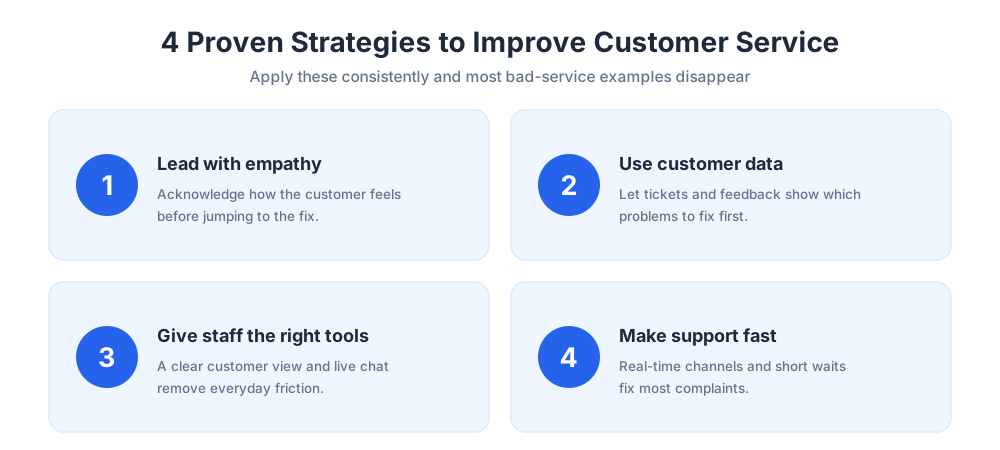
Proven strategies to improve customer service
Fixing poor customer service is not mysterious. A handful of proven strategies, applied consistently, address almost every example in this guide. Here are the ones with the biggest payoff.
Lead with empathy in every customer experience
Genuine care is the cheapest upgrade available to any team. Train agents to acknowledge how a customer feels before jumping to the fix. A service experience that starts with "I understand why this is frustrating" lands very differently from one that opens with a policy quote.
Make empathy a standard, not a personality trait. Add it to onboarding, model it in coaching, and review it in transcripts. A consistent culture of genuine care turns ordinary support into the kind of great customer experience people mention to friends.
Use customer data to fix root problems
Treat every complaint as a useful signal. The patterns in your tickets and feedback show which problems recur, which policies cause friction, and which issues to fix first. Without that signal, teams fix symptoms; with it, they fix causes.
Set a simple rhythm: review the data monthly, group customer requests into themes, and act on the biggest one. A business that removes its top one or two recurring friction points each quarter steadily eliminates the examples in this guide.
Give your support staff the right tools
No agent can deliver good service with bad tools. Give your customer support staff a clear view of customer history and the authority to resolve common issues on the spot. A modern ticketing system and live chat remove the friction that makes customer support agents look unhelpful.
Tools also protect consistency. When every agent works from the same record and the same playbook, service quality stops depending on who happens to pick up the case. Good tools make great customer service repeatable.
Make support fast and easy to reach
Speed and access fix more complaints than almost anything else. Offer real-time channels, keep response times short, and make it easy to reach a human. Customers rarely expect instant perfection; they expect a fast, honest reply and a clear path forward.
Meet customers where they already are. Email, live chat, and messaging apps each suit a different moment, and offering a sensible mix of service options means no customer is forced into a channel that does not work for them. Our roundup of what strong customer support looks like goes deeper on building this habit.
How live chat helps ecommerce teams deliver better service
Many of the examples in this guide, slow replies, hard-to-reach support, no real-time help, share one fix: live chat. For an online store especially, a chat widget on the site catches questions at the exact moment a customer is deciding whether to buy or whether to walk away.
Live chat shortens the first response to seconds, keeps the whole conversation in one place, and lets one agent help several customers at once without the cold feel of a phone queue. Paired with a chatbot for routine questions, it covers both speed and depth, and it keeps customer engagement and the shopping experience strong right through checkout and support.
If you want to see how this works in practice, our roundup of ways to improve the ecommerce customer experience puts live chat alongside the other quick wins. The pattern is consistent: meet customers fast, in the channel they prefer, and most bad-service examples never get the chance to happen.
Turn bad customer service examples into better experiences
Every example in this guide is also an opportunity. These cases are not just warnings; they are a map of exactly where most companies lose customers, which means they are a map of where you can win them. Most of these qualities combine into a single bad customer service experience, and so does every fix.
Pick the one or two examples that sounded most like your own business and the customers it serves, and fix those first. Faster responses, real understanding, clear ownership, and easy access to support are not expensive, and together they are the difference between service that quietly drains customers and service that drives business success.
More on this from our team: empathy in customer service.
Frequently Asked Questions
What are some examples of bad customer service?
Common examples of bad customer service include long response times, agents who refuse to take responsibility, no real-time support, endless transfers between departments, a lack of empathy, ignored customer feedback, no personalization, and interactions that end with no resolution. This guide covers twelve of them in detail, each paired with a practical fix. The pattern behind most examples is the same: the customer feels their time and their problem were not taken seriously.
What are the 7 qualities of bad customer service?
The seven qualities that show up most often in bad customer service are slow response times, a lack of empathy, untrained or unhelpful staff, poor communication and broken promises, no ownership of the problem, rude or dismissive behavior, and no resolution at the end. Each one has a clear fix, from faster channels to better coaching. Naming the quality is the first step, because once you can label what bad service looks like you can train your team to do the opposite.
What is the 10/5/3 rule in customer service?
The 10/5/3 rule is a retail and hospitality guideline for greeting customers on the floor. The common version says that within ten feet a staff member should acknowledge the customer with eye contact or a nod, within five feet they should offer a warm greeting, and the third step is usually framed as offering direct help once you are close enough to speak. Exact wording varies between companies, and some use a simpler 10 and 5 rule, so treat it as a principle about noticing customers early rather than a fixed script.
What is unprofessional behavior in customer service?
Unprofessional behavior in customer service includes a rude or dismissive tone, arguing with the customer, blaming them for the problem, ignoring what they actually said, making promises the company does not keep, and discussing other customers or internal issues in front of someone. It also covers slow, careless replies that signal the customer does not matter. Professional service stays calm, takes ownership, listens first, and focuses on a fair resolution even when the customer is upset.
What is the most common example of bad customer service?
Long response times are probably the most common example of bad customer service. Customers expect a fast first reply, and every hour of silence turns a simple question into frustration and, often, a public complaint. The fix is to speed up that first response with live chat and a chatbot for routine questions, so no customer is left waiting when a quick answer was available all along.
How does bad customer service affect a business?
Bad customer service hits a business in several concrete ways. It drives customer churn, because mistreated customers quietly stop buying. It damages brand reputation, since unhappy customers leave reviews and warn friends. It lowers employee morale, as support staff burn out absorbing angry customers with no tools to help. And it costs future referrals and repeat purchases you never get to see, which makes it one of the most expensive problems a company can ignore.
What causes bad customer service?
Bad customer service is rarely the fault of one bad employee. It usually traces back to weak processes: outdated policies, no metrics to measure service, understaffed support, agents with no authority to resolve issues, and no system for acting on customer feedback. Because the causes are structural, the fixes are too. Update the policies, give staff the right tools and training, and measure the results so problems become visible early.
How do you fix bad customer service?
Fixing bad customer service starts with the specific problem. Slow replies need faster channels like live chat. Low empathy needs coaching. Unhelpful staff need training, tools, and the authority to resolve issues on the spot. Then build the habits that prevent relapse: lead with understanding, use customer data to fix recurring problems, and make support fast and easy to reach. Pick the one or two weak spots that cause the most complaints and fix those first.
What is the difference between good and bad customer service?
Good customer service is fast, takes ownership of the problem, shows genuine understanding, and ends in a real resolution. Bad customer service is slow, deflects responsibility, recites a script, and leaves the issue open. The same situation, such as a delayed order, can produce a loyal customer or a lost one depending entirely on how the interaction is handled. Customers compare you not to perfection but to the last company that treated them well.
How should you handle an angry or frustrated customer?
Start by acknowledging how the customer feels before jumping to a fix, since a frustrated customer needs to feel heard first. Stay calm, do not argue, and take ownership of the problem even if it was not your fault. Then focus on a clear, fair resolution and tell the customer exactly what happens next. A genuine apology, paired with a real fix, turns many angry customers back into loyal ones.
Can live chat improve customer service?
Yes. Live chat fixes several of the most common bad customer service examples at once. It shortens the first response to seconds, keeps the whole conversation in one place, and lets one agent help several customers without the cold feel of a phone queue. Paired with a chatbot for routine questions, it covers both speed and depth, which is why it is one of the most effective service upgrades for an online store.
How do you measure customer service quality?
Track a small set of metrics rather than relying on gut feeling. First response time and resolution time measure speed. A customer satisfaction score measures how customers felt about an interaction. A customer effort score measures how hard it was to get help, which strongly predicts whether customers stay. Reviewing these numbers together shows which issues recur and which agents need extra support.
What should a company do after a bad customer service experience?
After a bad customer service experience, reach out quickly, acknowledge what went wrong without excuses, and offer a concrete fix or a fair gesture. Then close the loop internally: log what happened, find the process gap that caused it, and fix that gap so the same issue does not repeat. A customer who sees a company own a mistake and correct it often ends up more loyal than one who never had a problem at all.
Related articles
More in Customer service → SaaS Customer Support: The Stage-by-Stage Guide (2026)
How SaaS customer support actually works at each stage: the right stack from founder-led live chat to a full support operation, channels, and metrics.
 How to Reduce Customer Churn: 5 Levers in Payback Order
Reduce customer churn by pulling five levers in payback order: payment recovery, onboarding, support quality, pricing fit, and a 90-day win-back.
 10 FAQ Page Examples That Actually Help Customers (2026)
10 FAQ page examples from Shopify, Airbnb, Slack, Nike and more, with the exact pattern each gets right and a checklist to build your own FAQ page.
 12 Customer Service Email Templates for Every Scenario (2026)
12 customer service email templates for complaints, refunds, delays, bugs and saying no, plus the five-line skeleton that keeps them sounding human.