Ecommerce Customer Experience: 10 Ways to Improve (2026)
Your ecommerce customer experience is the sum of every interaction a shopper has with your store, from the first ad they see to the support reply they get weeks after delivery. When that experience feels easy, consistent, and personal, customers buy more, return sooner, and tell other people. When it feels slow or confusing, they abandon the cart and rarely come back.
This guide breaks the ecommerce customer experience into 10 practical strategies any business can apply this quarter, plus the metrics that separate success from guesswork. None of the 10 require a platform migration or a big budget.
They are the same moves the strongest stores use to turn a one-time buyer into a loyal customer: faster support that beats a bigger marketing budget, a smoother path to purchase, honest product information, and a checkout that gets out of the way. Treat this as a working checklist rather than a theory piece.
What is ecommerce customer experience?
Ecommerce customer experience, often shortened to ecommerce CX, is how a shopper perceives your brand across every digital touchpoint: your storefront, product pages, checkout, emails, support channels, and post-purchase communication. Every business that sells online manages a customer experience whether it means to or not.
It is wider than customer service. Customer service is the help a shopper gets when they ask for it. The customer experience is everything they feel whether they ask for help or not.
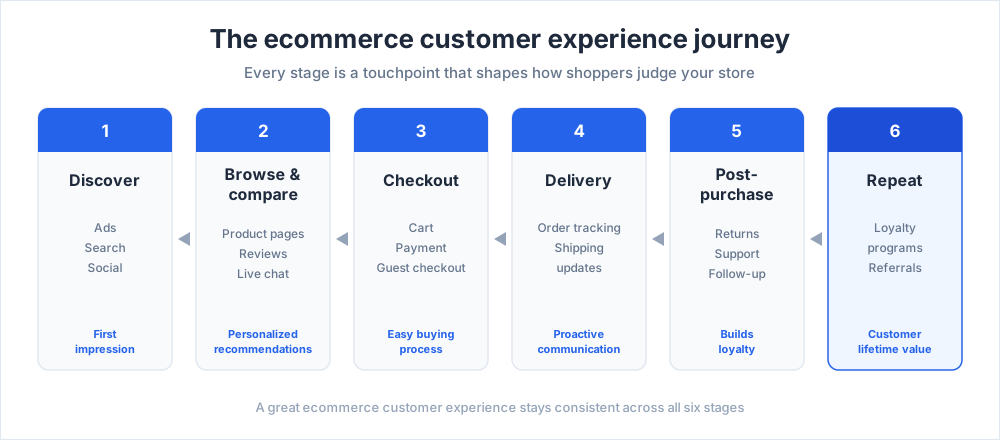
A useful way to picture it is the buying journey. A shopper discovers your store, browses products and services, reads reviews, adds an item to the cart, completes the purchase, waits for delivery, and at some point needs support.
Every one of those purchase touchpoints shapes the experience. A consistent customer experience keeps the quality even across the whole purchase journey, so the brand experience never depends on which page a shopper happens to land on.
Because the whole interaction happens in a digital world, the first impression usually comes from a page rather than a person. Website design, page speed, and clarity are part of the customer experience, not separate from it. Treating the storefront, the emails, and the support channels as one digital experience is what keeps it coherent.
Why customer experience matters for online stores
The importance of customer experience is easiest to see in the numbers that follow it. Winning a new customer costs far more in marketing than keeping an existing one, so customer retention is where margin is won or lost for most businesses. Consumers have more options than ever, which makes the experience the real point of difference.
A positive customer experience is the main reason shoppers buy again instead of comparing prices somewhere else. Every positive experience also lifts how much a customer spends over their lifetime with the store.
Loyalty compounds. Loyal customers spend more per order, forgive the occasional mistake, and refer friends, while unhappy customers do the opposite and often leave a public review on the way out. Customer loyalty, in other words, is the cheapest growth a store has.
For ecommerce brands, a few points of improvement in the customer experience move revenue more reliably than another round of paid marketing. Brands that invest here build trust at the same time.
A consistent, seamless ecommerce customer experience signals that a store is legitimate and will be there if something goes wrong. That reassurance matters most for direct customers buying from a brand they have not used before. It is what turns cautious potential customers into happy customers and, eventually, into the loyal buyers brands compete hardest to keep.
10 strategies to improve your ecommerce customer experience
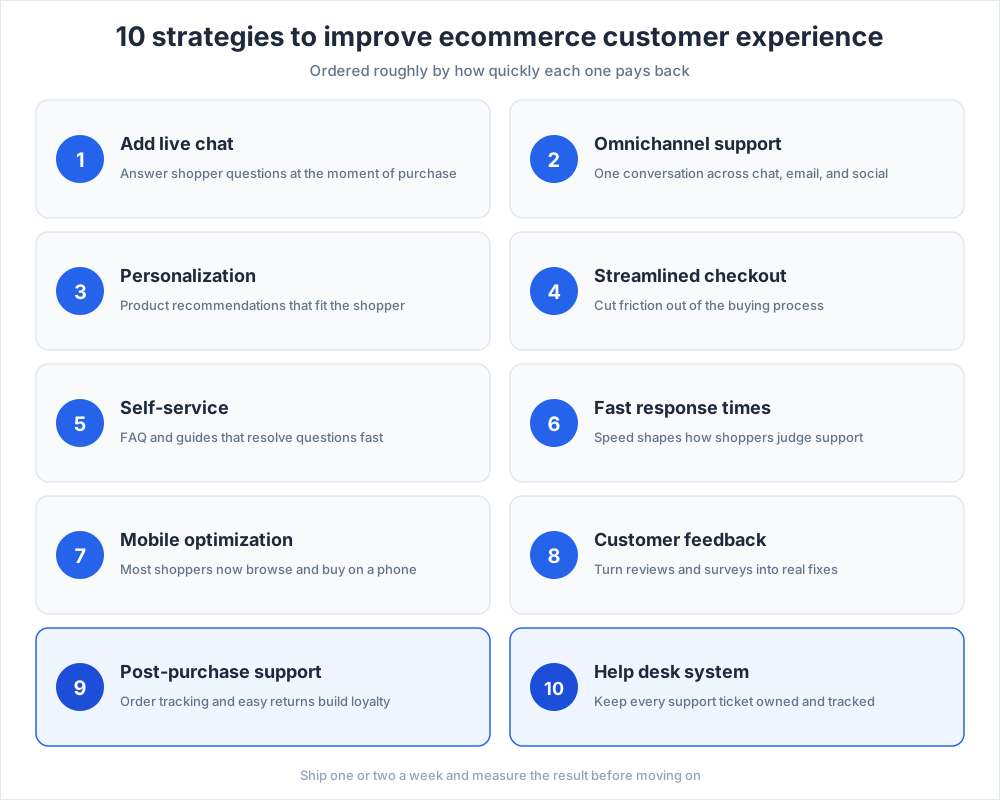
The strategies below are ordered roughly by how quickly they pay back. Start at the top, ship one or two a week, and measure the result before moving on.
Each one is a concrete change, not a vague principle. Together these experience strategies form a plan any business can run without a dedicated CX department.
1. Add live chat at key customer journey moments
Live chat answers a customer's question at the exact moment it would otherwise cost you the sale. A visitor stuck on shipping cost, sizing, or return policy can ask and get an answer in seconds instead of leaving to search elsewhere.
Placed on product and checkout pages, live chat is one of the highest-return changes you can make to the buying experience. It removes the single biggest reason a ready-to-buy visitor hesitates: an unanswered question.
Proactive chat goes a step further. A short, well-timed message on a high-intent page invites the question a shopper was hesitant to ask. The goal is not to interrupt, it is to make help easy for customers who want it without forcing it on those who do not.
2. Offer omnichannel customer support
Customers do not all want the same channel. Some want live chat, some email, some prefer social media or a phone line. Omnichannel customer support means a customer can reach you where they prefer and pick up the conversation elsewhere without repeating themselves.
The win is continuity. When your customer support team can see the full history regardless of where a conversation started, the customer never has to explain an order twice.
Brands that remember context this way turn a connected experience into a quiet loyalty signal: a customer who is never asked to repeat themselves assumes the store has its act together.
3. Personalize the experience with product recommendations
Personalization turns a generic catalog into a store that seems to understand the customer. Using browsing history and customer data, you can surface personalized product recommendations, recently viewed items, targeted marketing, and pairs-well-with suggestions.
Done well, these picks lift average order value and make the customer feel known rather than tracked. These recommendations also do real work on discovery, showing online shoppers items they would not have searched for.
The line to respect: use customer information to be helpful, be transparent about it, and never let personalization feel intrusive. The brands that personalize well treat that information as a trust to keep.
4. Streamline the checkout and buying process
A clumsy checkout is where good intentions go to die. Long forms, forced account creation, surprise shipping costs, and a narrow set of payment options all push customers out at the last step.
Offer guest checkout, trim form fields to the essentials, show total cost early, and support the payment methods your customers actually use.
A checkout that gets out of the way is one of the simplest ways to make purchasing painless, and it has the most direct line to revenue. A confusing checkout is the most expensive page in any digital marketplace.
5. Build self-service into the online shopping experience
Many consumers would rather solve a small problem themselves than wait for a reply. A clear FAQ, sizing guides, shipping and returns pages, and short how-to videos let them do exactly that.
Good self-service improves that experience and lightens the load on your team at the same time. Every answered question is a ticket that never gets opened.
Self-service content also doubles as pre-sale reassurance. The same returns page that deflects a support ticket answers a question a hesitant buyer had before purchasing, which is one more way to empower customers.
6. Speed up response times
Speed shapes how customers judge support more than almost anything else. Consumers reward a fast, partial answer delivered on time over a slow, perfect one.
Set a clear response time target for each channel and staff against it, especially during launches and peak season when a small delay turns into a long queue.
AI chatbots and saved replies help here. Let automation handle repetitive questions instantly, and route the genuinely complex ones to a person. The customer gets a quick answer either way, and your team focuses where it counts.
7. Optimize the mobile digital storefront
Most shoppers now browse and buy on a phone. If your mobile storefront loads slowly or is awkward to tap through, you lose those sales no matter how good the desktop site experience is.
Test the full mobile path: page speed, image sizing, tap targets, and a checkout that works with one thumb. Mobile is not a smaller version of the store, it is where most buying now happens.
For stores built on Shopify, our guide to live chat for Shopify covers mobile-friendly support widgets that do not slow the page down.
8. Turn customer feedback and reviews into improvements
Customer feedback is the cheapest research you will ever get. Post-purchase surveys, review requests, and support-ticket tags all show you where the experience breaks.
The mistake is collecting customer feedback and never closing the loop. Pick one theme each month, fix it, and tell customers you did.
Reviews deserve the same treatment. Reply to critical reviews in public, and treat recurring complaints as a roadmap rather than noise. Our guide to collecting customer feedback has survey templates to start from.
9. Build loyalty with standout post-purchase support
The customer journey does not end at the order confirmation. Order tracking, proactive shipping updates, easy returns, and a friendly follow-up email turn a single purchase into a relationship.
Post-purchase is the cheapest place to earn loyalty. A customer who has a smooth return is often more likely to buy again than one who never had a problem at all, because they have now seen that the store keeps its word.
It is also where loyalty programs do their best work, rewarding the second and third order while the goodwill from a clean delivery is still fresh. Strong customer relationships are built after the sale, not only during it.
10. Run a help desk to keep customer support organized
Once a business grows past a few support people, a shared inbox stops scaling. A help desk gives every ticket an owner, a status, and a history, so nothing slips and your team is not duplicating work.
Help desk reporting also feeds the rest of this list. Response times, common questions, and satisfaction by channel become visible once ticket management lives in one place.
Our help desk software guide compares the main options for ecommerce teams of different sizes.
How to measure ecommerce CX success
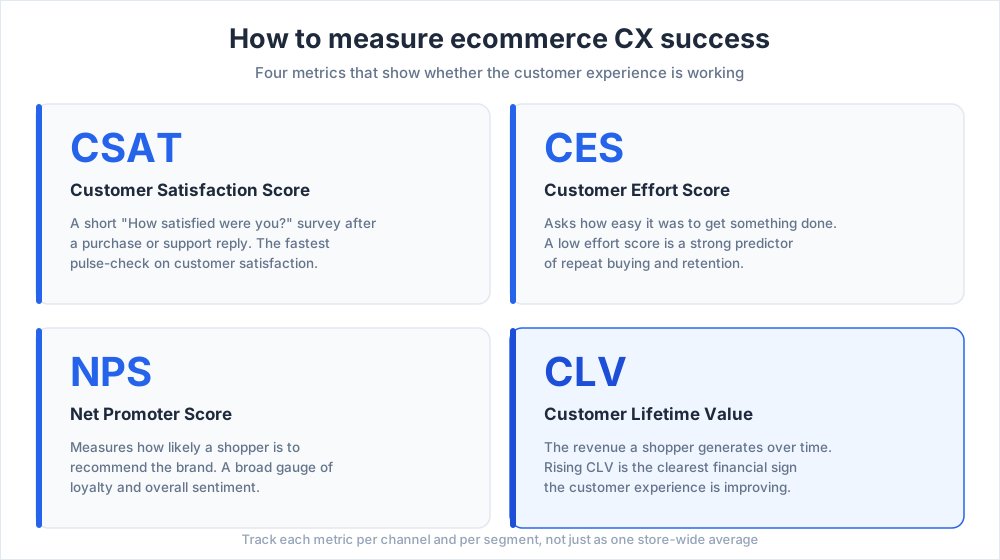
You cannot improve what you do not measure. Four metrics together give a reliable read on CX results without drowning your team in dashboards.
- Customer satisfaction score (CSAT). A short "How satisfied were you?" survey after a support interaction or a purchase. The fastest pulse-check on customer satisfaction.
- Customer effort score (CES). Asks how easy it was to get something done. A low score here is a strong predictor of repeat buying.
- Net Promoter Score (NPS). Measures how likely a customer is to recommend the brand, a broad gauge of loyalty and overall sentiment.
- Customer lifetime value (CLV). The revenue a customer generates over time, and the clearest financial sign that the experience is improving when it rises.
Track these per channel and per segment, not just as one store-wide number. Strong brands watch for a weak mobile checkout or a slow email queue, not only the average.
The point of measurement is to find the one fixable thing. Watch the trend rather than any single reading, and connect it back to revenue so the work has a clear business case beyond marketing reports.
Ecommerce customer experience mistakes that cost you loyal customers
Most stores lose customers to a short list of avoidable mistakes rather than one big failure. Watch for these patterns:
- Hiding shipping cost and delivery time until the final checkout step.
- Treating support as a cost center, with slow replies and no clear owner for tickets.
- Asking for feedback, then never acting on it or replying to reviews.
- A mobile site that is an afterthought next to the desktop store.
- Personalization that feels like surveillance because it is never explained.
Each of these quietly erodes trust. Fixing even two of them protects the loyal customers you already have, which is cheaper than replacing them.
Many businesses chase new traffic while brands leak existing customers through exactly these gaps. An effective customer experience plugs the leaks first.
Building your ecommerce customer experience strategy
Building one is just putting these pieces in priority order. Pick the two or three changes that map to your weakest metric, ship them, measure, and repeat.
You do not need every strategy live at once. You need steady progress on the ones that matter for your business and your customers.
Most teams find the fastest wins are live support and a cleaner checkout, because both remove friction at the moment a customer decides to buy. Those wins cost less than a marketing campaign and show up faster.
From there, personalization, self-service, and post-purchase work compound the result over the next few quarters. A great ecommerce customer experience is not a project with an end date.
It is the habit of removing small frictions before they cost a sale, applied consistently across the whole online store. The brands that treat customer experience as that habit are the ones that build a reputation for a great customer experience and the lasting loyalty and success that follow it.
For more on the support side of the experience, see our guides to customer service fundamentals, choosing live chat software, and how chatbots handle routine questions. Pair them with Chatim live chat to put real help on the pages where it changes the buying decision.
Frequently Asked Questions
What is ecommerce customer experience?
Ecommerce customer experience is how a shopper perceives your online store across every digital touchpoint, from the first ad and the product page to checkout, support, and post-purchase emails. It is broader than customer service: customer service is the help a shopper gets when they ask, while the customer experience is everything they feel across the whole buying journey whether they ask for help or not.
Why is customer experience important in ecommerce?
A positive customer experience is the main reason a shopper buys again instead of comparing prices elsewhere, so it drives customer retention and customer lifetime value. Winning a new customer costs far more in marketing than keeping an existing one, which means a few points of improvement in the experience usually move revenue more reliably than another round of paid ads.
How do you measure ecommerce customer experience?
Four metrics give a reliable read: customer satisfaction score (CSAT) for post-interaction sentiment, customer effort score (CES) for how easy it was to get something done, Net Promoter Score (NPS) for how likely shoppers are to recommend the brand, and customer lifetime value (CLV) for the financial trend. Track them per channel and per segment rather than as one store-wide average.
What is C2B and C2C?
C2B (consumer-to-business) is a model where individuals sell products, services, or influence to companies, such as a freelancer or an influencer being paid by a brand. C2C (consumer-to-consumer) is where individuals sell directly to each other through a marketplace like eBay or Etsy. They sit alongside the more common B2C (business-to-consumer) model, and each one shapes a different set of customer experience expectations: C2C shoppers, for example, weigh seller reviews and buyer protection more heavily than they would on a single-brand store.
What is the difference between customer service and customer experience?
Customer service is one part of the customer experience. Customer service is the direct help a shopper receives when they contact you. The customer experience is the full impression formed across the storefront, product pages, checkout, delivery, and support combined. You can have fast customer service and still deliver a poor customer experience if the checkout is confusing or the mobile site is slow.
How can a small ecommerce store improve its customer experience quickly?
Start with the changes that remove friction at the moment of purchase: add live chat to product and checkout pages, simplify the checkout, and publish clear shipping and returns pages. These three cost little, need no platform migration, and have the most direct line to revenue. From there, layer in personalization, faster response times, and post-purchase follow-up.
Does live chat improve the ecommerce customer experience?
Yes. Live chat answers a shopper's question at the exact moment an unanswered question would otherwise cost the sale, such as uncertainty about sizing, shipping, or returns. Placed on product and checkout pages, it removes the biggest reason a ready-to-buy visitor hesitates, and proactive chat can invite the question a shopper was reluctant to ask.
How does personalization improve ecommerce CX?
Personalization uses browsing history and customer data to surface product recommendations, recently viewed items, and relevant suggestions, which shortens the path to a product the shopper actually wants. Done transparently, it makes the shopper feel understood and lifts average order value. The rule is to use customer information to be helpful and never let personalization feel like surveillance.
What are the most common ecommerce customer experience mistakes?
The most common mistakes are hiding shipping cost and delivery time until the final checkout step, treating support as a cost center with slow replies, asking for customer feedback and never acting on it, neglecting the mobile site, and running personalization that is never explained. Each one quietly erodes trust and costs loyal customers over time.
How fast should ecommerce customer support respond?
Faster is better, and a fast partial answer usually beats a slow perfect one. Set a clear response time target for each channel, staff against it, and tighten it during launches and peak season. AI chatbots and saved replies can handle repetitive questions instantly so your team can focus on the complex ones.
What metrics show ecommerce CX success?
Rising customer lifetime value and customer retention are the clearest signs that ecommerce CX is working, because they show shoppers choosing to buy again. CSAT and CES give a faster pulse-check after individual interactions, and NPS gauges overall sentiment. Watch the trend over time rather than any single reading.
How do loyalty programs affect ecommerce customer experience?
Loyalty programs do their best work right after the sale, rewarding the second and third order while the goodwill from a clean delivery is still fresh. They reinforce a positive experience rather than replace it: a loyalty program layered on top of slow support or a clumsy checkout will not retain shoppers on its own.
What role does mobile play in the ecommerce customer experience?
Most shoppers now browse and buy on a phone, so the mobile experience is the experience for a large share of your customers. A slow or awkward mobile storefront loses sales no matter how polished the desktop site is. Test page speed, image sizing, tap targets, and a checkout that works with one thumb.
What is a good ecommerce customer experience strategy?
A good customer experience strategy is a short, prioritized list of changes rather than a grand plan. Identify your weakest metric, pick two or three fixes that address it, ship them, measure the result, and repeat. Most stores find the fastest wins are real-time support and a cleaner checkout, then build on personalization, self-service, and post-purchase work over the following quarters.